A candy billed as a luxury item helped a welterweight state export $5.8 billion last year.
Also: 
 This Lalique decanter holds 1.5 liters of Macallan whisky. This rare combination recently sold at auction for about $460,000:
The Macallan, founded in 1824, is produced at a distillery near Easter Elchies House in north east Scotland’s Speyside whisky region.
The Lalique decanter was created using the “cire perdue” or “lost wax” method.
Before the auction, the whisky was taken on a 12-city “tour du monde” to build up interest and raise funds for charity: water, an organization that provides access to clean, safe drinking water for people in developing nations.
 A Whole Bunch of Scientists walk into a bar...
 Johann Salomo, Christoph Schweigger, and Jacques Arsene d'Arsonval were galvanized into instant action.

Shock the Junkie: A hallucinogen called ibogaine has helped addicts kick heroin, meth and everything in between. Is it the trip that does the trick?Ron Price needs his milkshake. It's 10 o'clock on a Monday morning and the bald, barrel-chested former bodybuilder is shuffling around the kitchen of a posh rehab clinic in Tijuana, wearing slippers and a blue Gold's Gym T-shirt. Price had been employed as stockbroker in New Mexico, until his training regimen left him with debilitating injuries that forced him to undergo 33 surgeries in less than a decade. His doctor prescribed OxyContin, and Price quickly became dependent on the potent painkiller. More recently he started snorting cocaine and chugging booze to numb the pain. Now, 53 years old and three weeks into rehab, all he wants is a milkshake and to crawl back into bed. Clare Wilkins, the vivacious 40-year-old director of Pangea Biomedics, pops the lid of the blender to check the consistency of the concoction Price craves: peanut butter, soymilk, agave syrup, hemp protein powder and a few scoops of chocolate-flavored Green SuperFood.
Oh, and a half-teaspoon of root bark from the tabernanthe iboga plant.
 Researchers at the Stanford School of Medicine attempted to measure the computational power of the combined synapses in the typical human brain. Lead researcher Stephen Smith wrote:
One synapse, by itself, is more like a microprocessor–with both memory-storage and information-processing elements–than a mere on/off switch. In fact, one synapse may contain on the order of 1,000 molecular-scale switches. A single human brain has more switches than all the computers and routers and Internet connections on Earth.


The most important gold item in the [Hoxne] hoard is the body chain, which consists of four finely looped gold chains, made using the "loop-in-loop" method called "fox tail" in modern jewellery, and attached at front and back to plaques. At the front, the chains have terminals in the shape of lions' heads and the plaque has jewels mounted in gold cells, with a large amethyst surrounded by four smaller garnets alternating with four empty cells, which probably held pearls that have decayed. At the back, the chains meet at a mount centred on a gold solidus of Gratian (r. 375–383), which has been converted from an earlier use, probably as a pendant, and which may have been a family heirloom. Body chains of this type appear in Roman art, sometimes on the goddess Venus or nymphs; some examples have erotic contexts, but they are also worn by respectable high-ranking ladies. They may have been regarded as a suitable gift for a bride. The Hoxne body chain, worn tightly, would fit a woman with a bust-size of 76–81 cm (30–32 inches).
"The iconography (of ancient Chavin drawings) shows people mixed with animal features in altered states of being," said Kolar, who is presenting her recent work at a conference in Cancun, Mexico this week. "There is peyote and mucus trails out of the nose indicative of people using psychoactive plant substances. They were taking drugs and having a hallucinogenic experience." If that wasn't enough, the mazes at Chavin de Huantar also include air ducts that use sunlight to produce distorted shadows of the maze's human participants. And sound waves from giant marine shells found in the maze in 2001 may have produced a frequency that actually rattled the eyeballs of those peyote-using ancients, Kolar said...
The Chavin de Huantar site in Peru isn't the only place where sound played an important role. The Mayan rulers at Chichen Itza in the Yucatan also figured out how to use sound for crowd control. David Lubman, an acoustic engineer who has spent the past 12 years studying the Mayan site, says a strange bird-like echo from the Kukulkan temple was actually constructed on purpose.
"It's sort of spooky," Lubman said from Irvine, Calif. "It's not an ordinary echo."
Lubman's analysis compared the acoustic soundprint of the quetzal bird, which was revered by Mayans, to the sound of the echo at Chichen Itza. The two sounds matched. Lublin said the secret is in the acoustic properties of the steep staircase on the temple's front.
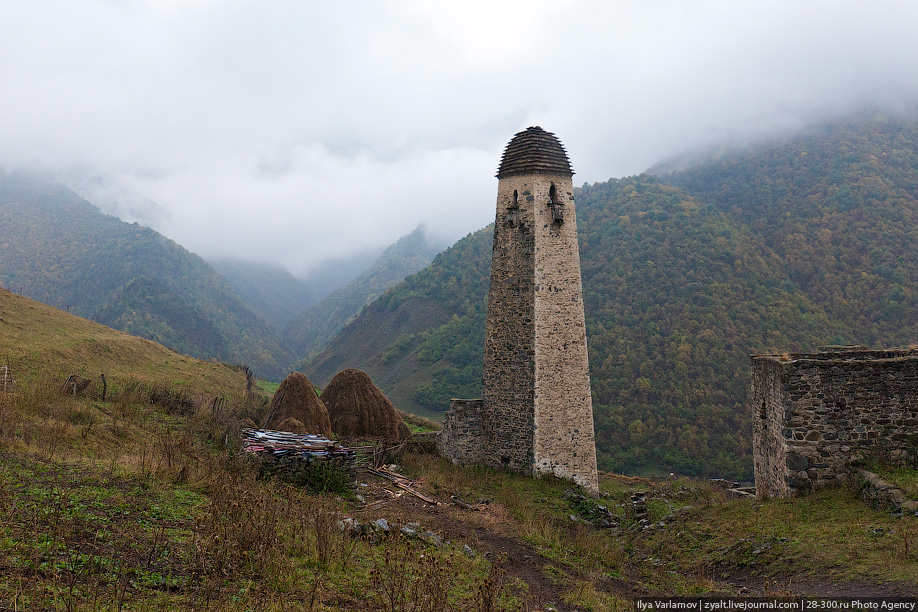
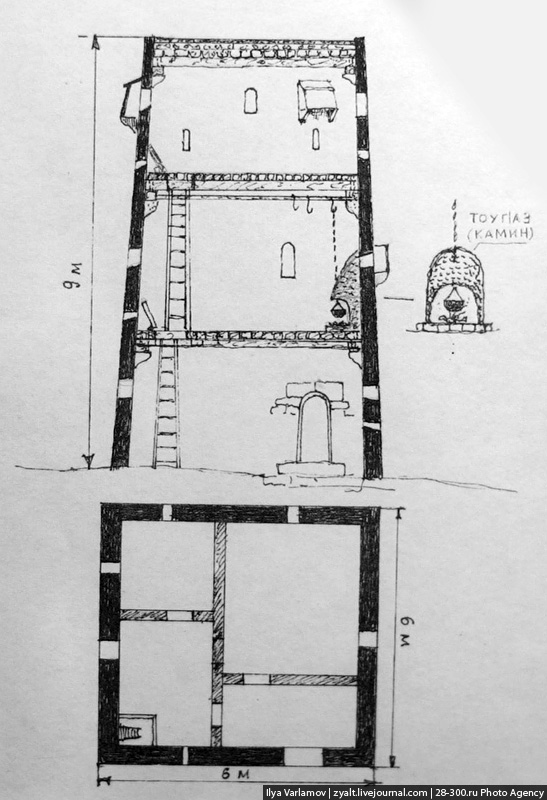
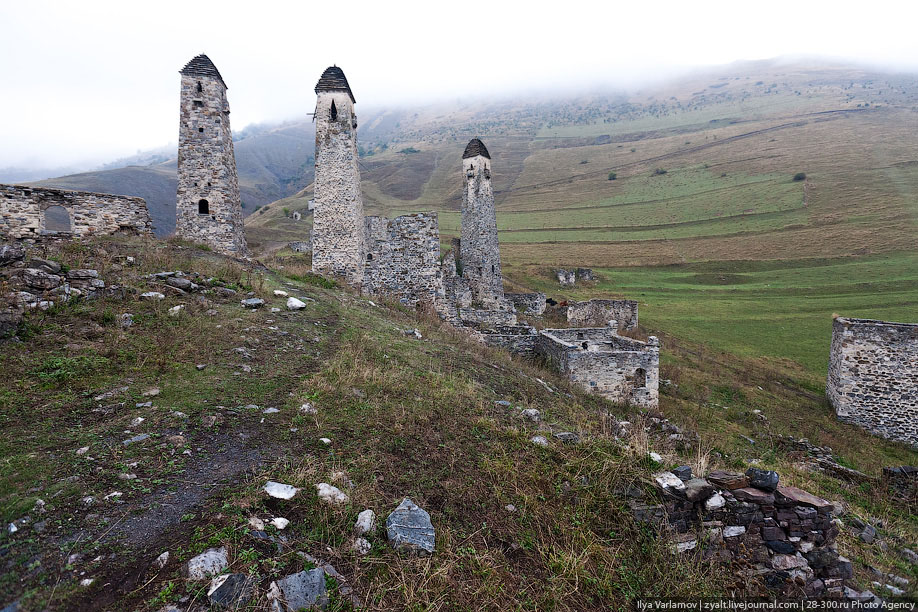
Clan towers – родовые башни – or, named after the people building them, Vainakh towers, combined multiple functions. They were living towers, impregnable fortifications, watchtowers dominating the valley controlled by the clan. And last but not least sacred asylums where blood-revenge was forbidden. Ismail Kadare in his Broken April tangibly describes the asylum towers that once stood all over the Albanian mountains and where men sometimes lived for years without ever coming out.More information at the link. And more photos. I find the landscape almost as fascinating as the architecture.
The towers have generally three to four floors. The first level – or, in four-storey towers, the first two levels – are the stall, in the latter case the second level is for the goats and sheep. The next floor is the living room, here’s the stove. The top floor serves for larder, treasure-house and armory as well as for guest accommodation, with projecting balconies for the ease of control...
The oldest surviving towers were built dry, but since the 16th and 17th century, the golden age of tower building – which was a period of turbulent external and internal wars in the Caucasus – they were reinforced with mortar. The internal structures, gates and shutters were made of oak, while the floors of pine wood. Beginning with the 16th century, loopholes became more and more frequent, which helps the researchers to reconstruct the spreading of firearms in the Caucasus...
Nowadays, most towers are uninhabited. The clan wars and external threats being over, the Ingushes went down to live in the more fertile river valleys. There are only a few old people sticking to their dwelling place or some shepherds left around to take care of them.
Ingushetia broke away from the Chechen-Ingush Republic in 1992. This is how the Russian government wanted to isolate the more pacific part of the republic from the Chechens, at that time in war against the Russians...More at the link, including some photos of, and observations about, Ingush weddings.
During WWII the Ingush and Chechen people, following the tradition of several centuries of wars of independence, rose up against the Soviet power. This is why after the war Stalin deported both nations to Kazakstan, and settled Russians on their place. The survivors of the cruel deportation were permitted to return to their native land only by Khrushchev in the late 1950s. However, in the meantime a part of Ingushetia, including their former capital Vladikavkaz, and even the town of Ongush (in Russian Tarskoye) which had given name to the whole republic, were annexed by the Soviet authorities following the old policy of divide to the western neighbor, Northern Ossetia: this is the egg-shaped hole on the map of the republic.
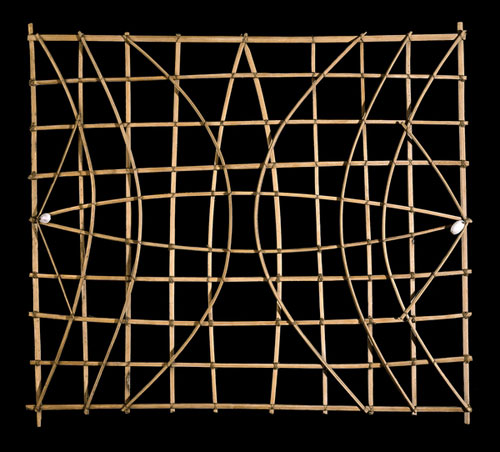
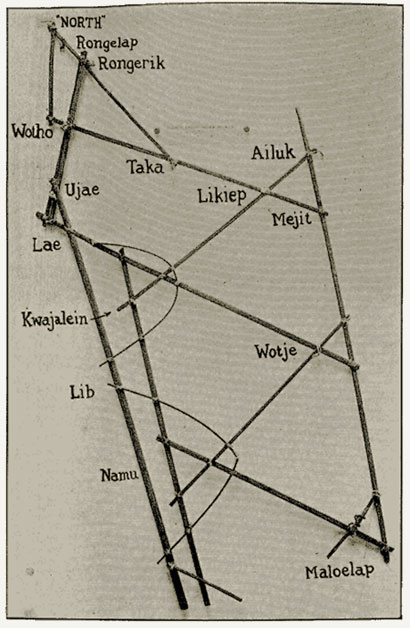
The Polynesians, scattered as they were over 1,000 islands across the central and southern Pacific Ocean, were master navigators who tracked their way over a huge expanses of ocean without any of the complex mechanical aids we associate with sea fairing. They didn’t have the astrolabe or the sextant, the compass or the chronometer. They did however have aids of a sort, which though seemingly humble, were in fact the repositories of an extremely complex kind of knowledge. Called Rebbelibs, Medos. and Mattangs, today we call them simply “Stick Charts.”The three basic types of stick charts are shown, followed by addtional explanation:
The charts were made by men from thin strips of coconut frond midribs or pandanus root. They were then bound together with coconut sennit in geometric patterns depicting sea currents around the low lying atolls. Small money cowrie shells or coral pebbles indicated islands and curved sticks represent wave patterns.
And how could a Neolithic people with simple canoes and no navigation gear manage to find, let alone colonize, hundreds of far-flung island specks scattered across an ocean that spans nearly a third of the globe?...
They were daring blue-water adventurers who roved the sea not just as explorers but also as pioneers, bringing along everything they would need to build new lives—their families and livestock, taro seedlings and stone tools. Within the span of a few centuries the Lapita stretched the boundaries of their world from the jungle-clad volcanoes of Papua New Guinea to the loneliest coral outliers of Tonga, at least 2,000 miles eastward in the Pacific. Along the way they explored millions of square miles of unknown sea...
Reaching Fiji, as they did a century or so later, meant crossing more than 500 miles of ocean, pressing on day after day into the great blue void of the Pacific... By the time Europeans came on the scene, virtually every speck of habitable land, hundreds of islands and atolls in all, had already been discovered by native seafarers—who ultimately made it all the way to South America...


Great white sharks in the Mediterranean may have first arrived from the seas around Australia 450,000 years ago, genetic studies have suggested.
Researchers writing in Proceedings of the Royal Society B believe the arrival may have been simply a migratory "wrong turn" by a few pregnant females.
A tumultuous climate between ice ages may have been the cause.
The species - Carcharodon carcharias - would have remained in the Med because it returns to spawn where it was born.


A US Army staff sergeant, now serving in Afghanistan, writes about the new enhanced pat-down procedure from the TSA. Summary of his very powerful message: to avoid giving gross offense to the Afghan public, and to prevent the appearance of an uncontrolled security state, the US military forbids use on Afghan civilians of the very practices the TSA is now making routine for civilian travelers at US airports...Further details and discussion at The Atlantic.
At no time were we permitted or even encouraged to search children or women. In fact, this would have been considered an extreme violation of acceptable cultural practice and given the way word travels here, been a propaganda victory for the Taliban.
Yet somehow the TSA is engaged in this at home while my unit and I spent our tour unable to safeguard ourselves equally in an environment where the Taliban have often disguised themselves in burkas and used children as both spies and fighters...
Dr. David Brenner, head of the center for radiological research at Columbia University in New York, told the London Telegraph in a June 29 story that considering the large number of people who frequent the nation's airports, wide-ranging exposure, even to minimal amounts of radiation, could add up to one big concern.
"If all 800 million people who use airports every year were screened with X-rays, then the very small individual risk multiplied by the large number of screened people might imply a potential public health or societal risk," he said. "The population risk has the potential to be significant."
Scientists with the University of California at San Francisco were so worried that they wrote a letter to the White House Office of Science and Technology in April raising "a number of red flags" on the scanners' safety.
"While the dose would be safe if it were distributed throughout the volume of the entire body, the dose to the skin may be dangerously high," the letter said in part, adding concerns that "independent safety data do not exist" and raising the potential for further harm if a high dosage was accidentally emitted.

[repugican Andy Harris] A wingnut Maryland physician elected to Congress on an anti-Obamacare platform surprised fellow freshmen at a Monday orientation session by demanding to know why his government-subsidized health care plan takes a month to kick in.
“He stood up and asked the two ladies who were answering questions why it had to take so long, what he would do without 28 days of health care,” said a congressional staffer who saw the exchange. The benefits session, held behind closed doors, drew about 250 freshman members, staffers and family members to the Capitol Visitors Center auditorium late Monday morning,”.
“Harris then asked if he could purchase insurance from the government to cover the gap,” added the aide, who was struck by the similarity to Harris’s request and the public option he denounced as a gateway to socialized medicine.
Under COBRA law, Harris can pay a premium to extend his current health insurance an additional month.


The case highlighted complaints by critics who claim Singapore uses criminal defamation laws to silence them.
"This sentence is yet another blow against freedom of expression in Singapore," said Phil Robertson, deputy director of Human Rights Watch in Asia. "Sadly, it comes as no surprise, given the long history of the authorities in Singapore using the courts to silence vocal critics of government policies and personnel."
The government says any statement that damages the reputations of its leaders will hinder their ability to rule effectively.
Prosecution lawyer Hema Subramaniam said Shadrake had shown "a complete lack of good faith in making these allegations against the judiciary".
Shadrake was arrested July 18 and freed on bail two days later. A criminal defamation investigation against him is still pending.


NASA’s Fermi Gamma-ray Space Telescope has unveiled a previously unseen structure centered in the Milky Way. The feature spans 50,000 light-years and may be the remnant of an eruption from a supersized black hole at the center of our galaxy. [...]
One possibility includes a particle jet from the supermassive black hole at the galactic center. In many other galaxies, astronomers see fast particle jets powered by matter falling toward a central black hole. While there is no evidence the Milky Way’s black hole has such a jet today, it may have in the past. The bubbles also may have formed as a result of gas outflows from a burst of star formation, perhaps the one that produced many massive star clusters in the Milky Way’s center several million years ago.