Carolina Naturally is read in 194 countries around the world daily.
In the high country ... !
 Today is - International Mountain Day

Don't forget to visit our sister blog: It Is What It Is
Some of our readers today have been in:
The Americas
Blainville, Mississauga, Toronto, Pikangikum, Lethbridge, Ottawa, Vancouver, Byward Market and Winnipeg, Canada
The Bottom Saba, Sint Eustatius and Saba
Santo Domingo, Dominican Republic
San Juan, Puerto Rico
Buenos Aires, Argentina
Petoskey, Duluth, Batavia, Wasilla, Parsippany, Shamokin and Azle, United States
Tegucigalpa Honduras
Tipitapa, Nicaragua
Guatemala City, Guatemala
Santiago, Chile
Cochabamba, Bolivia
Caracas, Venezuela
Rio De Janeiro, Brazil
Europe
Chelyabinsk, Saint Petersburg, Moscow, Vladivostok and Novgorod, Russia
Vienna, Austria
Dublin and Swords, Ireland
Madrid, L'Olleria and Basauri, Spain
Rome, Pistoia, Milan and Padova, Italy
Zhovti Vody and Kiev, Ukraine
Boulogne-Billancourt, Laval, Rouen, Drap and Salon-De-Provence, France
Vilnius, Lithuania
Covilha, Portugal
Istanbul, Bursa and Ankara, Turkey
Sofia and Ruse, Bulgaria
Shrewsbury and London, England
Zurich, Switzerland
Tranbjerg and Vojens, Denmark
Athens, Greece
Tallinn, Estonia
Chisinau, Moldova
Mechelen, Belgium
Kista, Sweden
Kecskemet, Hungary
Sulzbach, Hannover and Mannheim, Germany
Sarajevo, Bosnia and Herzegovina
Asia
Thiruvananthapuram,
Jaipur, Bhubaneshwar, Bangalore, Kottayam, Kakinada, Pune, Hyderabed,
Kolkata, Surat, New Delhi, Lohardaga and Hojai, India
Hong Kong, Hong Kong
Islamabad, Pakistan
Manama, Bahrain
Thanh Pho Ho Chi Minh, Vietnam
Baku, Azerbaijan
Kuala Lumpur, Putrajaya, Cheras and Sungai Petani, Malaysia
Colombo, Sri Lanka
Tehran, Iran
Ramla and Lod, Israel
Doha, Qatar
Bangkok and Krung Thep, Thailand
Muscat, Oman
Yogyakarta and Jakarta, Indonesia
Beijing, China
Africa
Cape Town, Johannesburg and Pretoria, South Africa
Al Jizah, Egypt
Algiers, Algeria
Pacific
Makati, Mandaluyong City and Paraiso, Philippines
Melbourne and Homebush, Australia







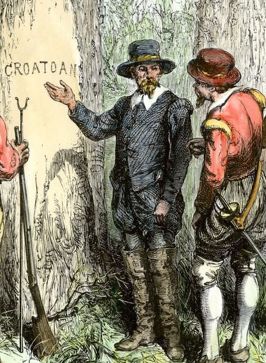 Sir
Walter Raleigh sponsored a colony of English immigrants on Roanoake
Island, on the Outer Banks of North Carolina. They arrived in 1587 and
had disappeared by 1590. It has since been called "The Lost Colony"
because no one knows what happened to the 90 men, 17 women, and 11
children who established the colony. They may had died from disease or
violence from Native Americans, or they may have left, possibly
splitting up to join tribal villages. In recent years, research into the
mystery was sparked by a discovery on a map drawn by the colony's
governor John White.
Sir
Walter Raleigh sponsored a colony of English immigrants on Roanoake
Island, on the Outer Banks of North Carolina. They arrived in 1587 and
had disappeared by 1590. It has since been called "The Lost Colony"
because no one knows what happened to the 90 men, 17 women, and 11
children who established the colony. They may had died from disease or
violence from Native Americans, or they may have left, possibly
splitting up to join tribal villages. In recent years, research into the
mystery was sparked by a discovery on a map drawn by the colony's
governor John White.