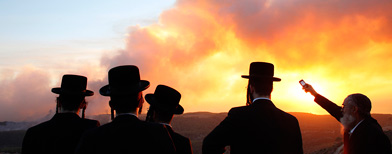
The largest fire in the country's history prompts an unprecedented call for international help.
Also: 

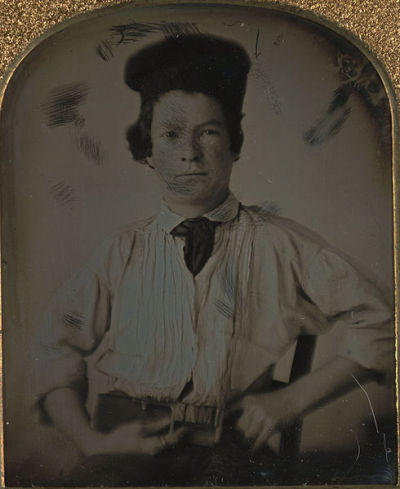
‘It was a big river, below Memphis; banks brimming full, everywhere, and very frequently more than full, the waters pouring out over the land, flooding the woods and fields for miles into the interior; and in places, to a depth of fifteen feet; signs, all about, of men’s hard work gone to ruin, and all to be done over again, with straitened means and a weakened courage. A melancholy picture, and a continuous one;—hundreds of miles of it. Sometimes the beacon lights stood in water three feet deep, in the edge of dense forests which extended for miles without farm, wood-yard, clearing, or break of any kind; which meant that the keeper of the light must come in a skiff a great distance to discharge his trust,—and often in desperate weather. Yet I was told that the work is faithfully performed, in all weathers; and not always by men, sometimes by women, if the man is sick or absent. The Government furnishes oil, and pays ten or fifteen dollars a month for the lighting and tending. A Government boat distributes oil and pays wages once a month.’
—from Life on the Mississippi (1883)


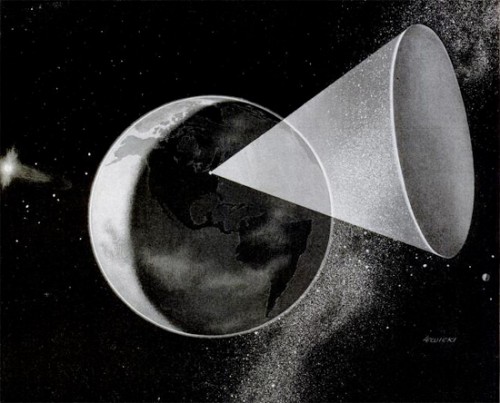
Plausible schemes to build a station in space were engineered on paper long before the war. European rocket enthusiasts, including Dr. Hermann Oberth, who may have been the designer of the V-2, had planned to use the space station not as a weapon but as a refueling point for rockets starting off on journeys into space. … The only major obstacle: constructing a rocket powerful enough to reach a point where a space station could be built. If the modern German scientists had been able to make such a rocket, they might have ben able to set up their sun gun. Whether the sun gun would have accomplished what they expected, however, is another matter.”
The German idea of using the sun as a military weapon is not new. There is an ancient legend that Archimedes designed great burning mirrors which set the Roman fleet afire during the siege of Syracuse, in which Archimedes later died. This legend, and the German plan for building may be proved physically impossible by a simple axiom of optics. This is that light cannot be brought to a sharp, pointed focus with lenses or mirrors unless it comes from a sharp, pointed source. Since the sun appears in the sky as a disk and not as a point, the best any optical system can produce is an image of this disk. At very short focal lengths, the image is small and hot but as the focal length is increased the image becomes progressively bigger and cooler. At the distance the Germans proposed to set up their mirror (3,100 miles) the image of the sun cast on the earth would be about 40 miles in diameter and not hot enough to do any damage.
 How can you tell when you are in a room, restroom, motel etc. with a mirror or a 2-way glass?

At around 8 p.m., the tide was high and the night sufficiently dark as the ocean water tugged at the submersible. A speedboat pulled the vessel out to sea, where the crew started the engines. They accelerated to 12 knots and set off on a 270-degree course heading west, toward the open ocean. The guard provided by the drug mafia for each transport, armed with a revolver and an assault rifle, stood at the door to the engine room. It was incredibly hot in the submersible, where the engines remove oxygen from the air and enrich it with carbon monoxide, despite ventilation pipes. "You constantly feel like you're suffocating," says Alonso. "Every four hours, we reduced the speed from 12 to six knots. Then we opened the hatch in the front for exactly one minute, let some fresh air in and accelerated again." The four-man team worked in shifts, while Alonso kept monitoring the route. Once they were in the open ocean, the man with the assault rifle gave him a piece of paper showing the target position. Their instructions were to arrive there on a specific day and at a specific time.
Each of the men tried to sleep after his shift, but the stench and the noise on board made this impossible. They had to drink copious amounts of water to make up for the buckets of sweat constantly running off their bodies. Their main source of nourishment was condensed milk, the Peruvian "Leche Gloria" brand. The stench from fecal matter, which couldn't be disposed of during the trip, soon became almost unbearable.



 Absolute zero sounds like an unbreachable limit, but there is a weird realm of negative temperatures that could reveal new states of matter.

 Peruvian foraging societies were already chewing coca leaves 8,000 years ago, archaeological evidence has shown.