
The congresswoman's brain injury will pose specific challenges as she moves to a rehab facility.
Also: 


In 1993, the visitor began leaving notes, starting with one that read: "The torch will be passed." A note in 1998 indicated the originator of the tradition had died and passed it on to his two sons. The sons didn't seem to take the duty as seriously as the father. One left a note in 2001 referencing the Super Bowl and another in 2004 implying criticism of France over its objections to the U.S. invasion of Iraq, upsetting many of the traditionalists. When the Poe toaster didn't show last year, Mr. Jerome theorized that the 200th anniversary of Poe's birth in 2009 might have been considered the appropriate stopping point.
Or, it was thought at the time, perhaps the toaster just had a flat tire on the way to the cemetery.
But that's the sort of happenstance unlikely to happen two years in a row. Mr. Jerome says he'll return one more year. If the visitor fails to show in 2012, he'll considered the tradition over and done.
"It's sort of like a marriage that ends," Mr. Jerome said. "Part of you still wants the warmth that was part of it, and you go looking for the same woman. No, it's over with. And if it's over with, it's over with. If people want to continue the tradition, it's going to be without me."


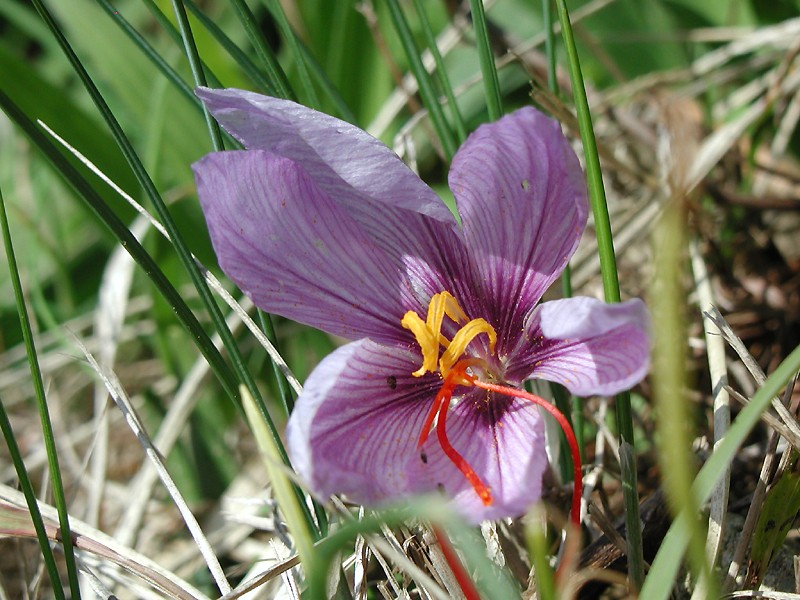
Costing US$4,000 per kilogram, this pricey ingredient is used in medicine and South Asian cuisine... The biggest long-term challenge is the adulteration of saffron. Cheap, fake brands of saffron sell briskly on the streets of Srinagar. And it is virtually impossible for a non-professional to distinguish between a fake and the real one. This fact has dented saffron's image, and resulted in a drop in prices.The word "saffron" (and Italian zafferano and Spanish azafrán) come from the Latin word safranum, probably ultimately from Persian and Arabic precursors. The spice itself is extracted from the saffron crocus (C. sativus). [The photo above is of non-saffron Wisconsin crocuses].
Saffron-based pigments have been found in 50,000 year-old depictions of prehistoric places in northwest Iran. Later, the Sumerians used wild-growing saffron in their remedies and magical potions. Saffron was an article of long-distance trade before the Minoan palace culture's 2nd millennium BC peak... During his Asian campaigns, Alexander the Great used Persian saffron in his infusions, rice, and baths as a curative for battle wounds. Alexander's troops imitated the practice from the Persians and brought saffron-bathing to Greece...
During the 14th century Black Death, demand for saffron-based medicine skyrocketed, and much saffron had to be imported via Venetian and Genoan ships from southern and Mediterranean lands... Cultivation and trade then spread to Nuremberg... Soon after, saffron cultivation spread throughout England, especially Norfolk and Suffolk... By 1730, the Pennsylvania Dutch were cultivating saffron throughout eastern Pennsylvania. Spanish colonies in the Caribbean bought large amounts of this new American saffron, and high demand ensured that saffron's list price on the Philadelphia commodities exchange was set equal to that of gold...
Saffron is widely used in Iranian (Persian), Arab, Central Asian, European, Pakistani, Indian, Turkish, and Cornish cuisines. Confectionaries and liquors also often include saffron. Common saffron substitutes include safflower, annatto, and turmeric...
A pound (454 grams) of dry saffron requires 50,000–75,000 flowers, the equivalent of a football field's area of cultivation... Forty hours of labour are needed to pick 150,000 flowers... The price in Canada recently rose to CAN$18,000 per kilogram. In Western countries, the average retail price is $1,000/£500/€700 per pound (US$2,200/£1,100/€1,550 per kilogram)...
Saffron is graded via laboratory measurement of crocin (colour), picrocrocin (taste), and safranal (fragrance) content. Determination of non-stigma content ("floral waste content") and other extraneous matter such as inorganic material ("ash") are also key... Adulteration was first documented in Europe's Middle Ages, when those found selling adulterated saffron were executed under the Safranschou code. Typical methods include mixing in extraneous substances like beets, pomegranate fibers, red-dyed silk fibers, or the saffron crocus's tasteless and odorless yellow stamens. Other methods included dousing saffron fibers with viscid substances like honey or vegetable oil. However, powdered saffron is more prone to adulteration, with turmeric, paprika, and other powders used as diluting fillers. Adulteration can also consist of selling mislabeled mixes of different saffron grades. Thus, in India, high-grade Kashmiri saffron is often sold and mixed with cheaper Iranian imports; these mixes are then marketed as pure Kashmiri saffron, a development that has cost Kashmiri growers much of their income...
In 2003, the Sun, the Moon, Antarctica, and two photographers all lined up in Antarctica during an unusual total solar eclipse. Even given the extreme location, a group of enthusiastic eclipse chasers ventured near the bottom of the world to experience the surreal momentary disappearance of the Sun behind the Moon.From: Astronomy Picture of the Day.
One of the treasures collected was the above picture — a composite of four separate images digitally combined to realistically simulate how the adaptive human eye saw the eclipse.
As the image was taken, both the Moon and the Sun peaked together over an Antarctic ridge. In the sudden darkness, the magnificent corona of the Sun became visible around the Moon.
Quite by accident, another photographer was caught in one of the images checking his video camera. Visible to his left are an equipment bag and a collapsible chair.

The oblique wing was the brainchild of NASA aeronautical engineer Robert T. Jones, whose analytical and wind tunnel studies at the NASA Ames Research Center, Moffet Field, California, indicated that an oblique wing, supersonic transport might achieve twice the fuel economy of an aircraft sporting more conventional wings.[...]
The oblique wing on the AD-1 pivoted about the fuselage, remaining perpendicular to it during slow flight and swinging to angles of up to 60 degrees as aircraft speed increased.
The swing wing concept was first evaluated by a small, propeller-driven, remotely-piloted research vehicle (RPRV) flown at Dryden in 1976. These early techniques for gathering data about the oblique wing aircraft were applied to the twin turbojet, piloted AD-1, which was flown from 1979 to 1982.

 Louis Mantin inherited a fortune and became a patron of the arts and of high living. He constructed a fine mansion in his home of Moulins, France and filled it with custom woodwork, relics from antiquity, and art. Mantin died in 1905, and had stipulated in his will that his home should become a museum in 100 years.
Mantin only had a few years to indulge his aesthetic fantasies. Knowing that his death was approaching, he made a will in which he made sure his treasured house would be saved.When the 100-year mark passed, the house remained abandoned and in no shape to open to the public. Isabelle de Chavagnac, a descendant of Mantin’s, threatened to exercise her right to inherit the mansion if it didn’t open as a museum. She didn’t really want the estate, but her actions forced the local government to allocate funds for renovation. The house then opened as a museum, as Mantin wished, in 2010. BBC News has a video tour of the home.
“In the will, he says that he wants the people of Moulins in 100 years time to be able to see what was the life of a cultured gentleman of his day,” said assistant curator Maud Leyoudec.
“A bachelor with no children, he was obsessed with death and the passage of time. It was his way of becoming eternal.”
[The soldier now known as] Towton 25 suffered eight wounds to his head that day... The first five blows were delivered by a bladed weapon to the left-hand side of his head, presumably by a right-handed opponent standing in front of him. None is likely to have been lethal.The next one almost certainly was... The blow opened a huge horizontal gash into the back of his head... Fractures raced down to the base of his skull and around the sides of his head...
 George Phillips was going up to bed when his wife told him that he'd left the light on in the garden shed, which she could see from the bedroom window.


Budget
huge deficit was
preexisting condition
no press coverage


 If you’ve ever had to deal with debt collectors, you know that they’re relentless. How relentless? Let’s just say that they don’t let a little pesky thing like death deter them from getting back every penny they’re owed!
Martha Kunkle has come back to life.Jessica Silver-Greenberg of The Wall Street Journal has more.
She died in 1995. Yet her signature later appeared on thousands of affidavits submitted by one of the nation’s largest debt collectors, Portfolio Recovery Associates Inc., in lawsuits filed against borrowers.
Some regulators complain that the use of Ms. Kunkle’s name reflects an epidemic of mass-produced, sloppy and inaccurate documentation in the debt-collection industry. Lawsuits have surged as more borrowers fall behind on payments and collection firms turn to courts to get what they are owed.
After being sued for fraud, Portfolio Recovery Associates decided in early 2008 that any documents bearing Ms. Kunkle’s name had "defects" and shouldn’t be used when trying to collect debts, a company spokeswoman said.


 Don’t like to do chores? Well, now you’ve got valid *medical* excuse not to do so. Turns out that doing housework may be dangerous to your health:
Researchers in the US have discovered that in busy people housework such as cleaning, cooking, home maintenance, and even budgeting, can raise blood pressure. Those at greatest risk are the people who believe they are doing most of the work.Why, you’re welcome.


