3 of the Aurora Shooting Victims Were Boyfriends Defending Their Girlfriends

It's amazing what people will do instinctually for the people they love.
By Lauren Passell
We're starting to see the names of the Colorado theater shooting victims, and it is really gut-wrenching.
Joe Blunk, Matt McQuinn, and Alex Teves were three of the casualties.
Joe Blunk, 25, according to reports, threw his girlfriend Jansen Young to the ground, pushing her under the theater seat, and throwing himself on top of her. (He was a veteran of the US Navy.)
Alex Teves, 24 also protected his girlfriend, Amanda by throwing her to the ground. He was about to put his body on top of hers to protect her when he was shot and killed.
Matt McQuinn, 27, too, was protecting his girlfriend Samantha Yowler with his body when they were both shot. But Samantha, who was shot in the knee, made it out with the help of her brother Nick.
It's amazing what people will do instinctually for the people they love. And let this be a reminder -- guys aren't always jerks.
Hannah Rosin, author of The End Of Men and co-founder of Slate's DoubleX says: Couples will often insist that the man is the head of the household even when he doesn't seem to be checking any of the traditional boxes. When I ask how it's possible that he should retain the title without any of the attending duties, I almost always get some version of the same answer: If anyone threatened us, he would rescue us. If someone broke into the house, I would call him. If anything happened to the children, if a fire, if a tornado, etc. Papers have described what happened in the theater as "chivalry." But it's not really that. Chivalry is a code of conduct connected to social propriety. Throwing your body in front of your girlfriend when people all around you are getting shot is an instinct that's basic, and deeper. It's the same reason these Batman and Spider-Man franchises endure: Because whatever else is fading away, women still seem to want their superhero, and men still seem to want to be him.

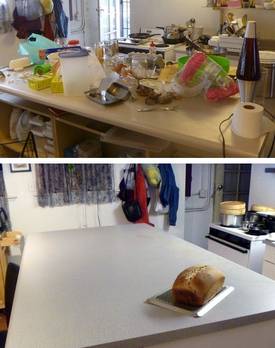 At least once a day, someone asks: “Why should I make my bed? Isn’t it kind of pointless?”





 Scientists
have tried and tried to recreate nacre or mother of pearl, the iridescent
material in the inner shell of many mollusks. Their attempts in copying
nature have failed ... until now:
Scientists
have tried and tried to recreate nacre or mother of pearl, the iridescent
material in the inner shell of many mollusks. Their attempts in copying
nature have failed ... until now:

 The conviction that witches were behind dangerous storms and other
unexpected perils highlights a curious reversal that had taken place
with regard to sympathetic magic. If it had once been used as a ward
against uncertainties, against the caprices of nature and sudden death,
now many saw it primarily as a cause of these dangers. (The Malleus
Maleficarum warns that witches “can also, before the eyes of their
parents, and when no one is in sight, throw into the water children
walking by the waterside; they make horses go mad under their riders.”)
These primal anxieties, of course, hadn’t gone away, and James, afraid
of drowning at sea, certainly hadn’t yet learned the Christian art of
dying well.
The conviction that witches were behind dangerous storms and other
unexpected perils highlights a curious reversal that had taken place
with regard to sympathetic magic. If it had once been used as a ward
against uncertainties, against the caprices of nature and sudden death,
now many saw it primarily as a cause of these dangers. (The Malleus
Maleficarum warns that witches “can also, before the eyes of their
parents, and when no one is in sight, throw into the water children
walking by the waterside; they make horses go mad under their riders.”)
These primal anxieties, of course, hadn’t gone away, and James, afraid
of drowning at sea, certainly hadn’t yet learned the Christian art of
dying well.