
The elusive and rare Sierra Nevada red fox has been spotted
in Yosemite National Park for the first time in nearly a century.

Monday, February 2, 2015


Eye Never Before Seen

There's a new kind of eye in town, and it belongs to
Paraphronima gracilis, a tiny, transparent, aquatic crustacean that sees
kind of like a bee but whose eye structure, researchers say, is one of a
kind.

Sunday, February 1, 2015
The Daily Drift

Carolina Naturally is read in 200 countries around the world daily.
Shipwrecked ... !

Today is - Robinson Crusoe Day
Don't forget to visit our sister blog: NNN
Don't forget to visit: It Is What It Is
Some of our readers today have been in:
The Americas
Brazil - Canada - Ecuador - Honduras - Mexico - Nicaragua - Peru - Puerto Rico - United States
Europe
Bosnia/Herzegovina - Croatia - England - France - Germany - Greece - Ireland - Italy - Latvia - Romania Russia - Serbia - Slovakia - Spain - Sweden
Asia
India - Indonesia - Iran - Israel - Japan - Malaysia - Pakistan - Qatar - Singapore - Sri Lanka - Thailand
Africa
Egypt - Nigeria - South Africa - Zambia
The Pacific
Australia
Today in History
1327
Edward III is coronated King of England.
1587 Elizabeth I, Queen of England, signs the Warrant of Execution for Mary Queen of Scots.
1633 The tobacco laws of Virginia are codified, limiting tobacco production to reduce dependence on a single-crop economy.
1793 France declares war on Britain and the Netherlands.
1861 A furious Governor Sam Houston storms out of a legislative session upon learning that Texas has voted 167-7 to secede from the Union.
1902 U.S. Secretary of State John Hay protests Russian privileges in China as a violation of the "open door policy."
1905 Germany contests French rule in Morocco.
1909 U.S. troops leave Cuba after installing Jose Miguel Gomez as president.
1930 A Loening Air Yacht of Air Ferries makes its first passenger run between San Francisco and Oakland, California..
1942 Planes of the U.S. Pacific fleet attack Japanese bases in the Marshall and Gilbert Islands.
1943 American tanks and infantry are battered at German positions at Fais pass in North Africa.
1944 U.S. Army troops invade two Kwajalein Islands in the Pacific.
1945 U.S. Rangers and Filipino guerrillas rescue 513 American survivors of the Bataan Death March.
1951 Third A-bomb tests are completed in the desert of Nevada.
1960 Four black students stage a sit-in at a segregated Greensboro, N.C. lunch counter.
1964 President Lyndon B. Johnson rejects Charles de Gaulle's plan for a neutral Vietnam.
1965 Reverend Martin Luther King Jr. and 770 others are arrested in protest against voter discrimination in Alabama.
1968 U.S. troops drive the North Vietnamese out of Tan Son Nhut airport in Saigon.
1968 South Vietnam President Nguyen Van Thieu declares martial law.
1986 Two days of anti-government riots in Port-au-Prince result in 14 dead.
1587 Elizabeth I, Queen of England, signs the Warrant of Execution for Mary Queen of Scots.
1633 The tobacco laws of Virginia are codified, limiting tobacco production to reduce dependence on a single-crop economy.
1793 France declares war on Britain and the Netherlands.
1861 A furious Governor Sam Houston storms out of a legislative session upon learning that Texas has voted 167-7 to secede from the Union.
1902 U.S. Secretary of State John Hay protests Russian privileges in China as a violation of the "open door policy."
1905 Germany contests French rule in Morocco.
1909 U.S. troops leave Cuba after installing Jose Miguel Gomez as president.
1930 A Loening Air Yacht of Air Ferries makes its first passenger run between San Francisco and Oakland, California..
1942 Planes of the U.S. Pacific fleet attack Japanese bases in the Marshall and Gilbert Islands.
1943 American tanks and infantry are battered at German positions at Fais pass in North Africa.
1944 U.S. Army troops invade two Kwajalein Islands in the Pacific.
1945 U.S. Rangers and Filipino guerrillas rescue 513 American survivors of the Bataan Death March.
1951 Third A-bomb tests are completed in the desert of Nevada.
1960 Four black students stage a sit-in at a segregated Greensboro, N.C. lunch counter.
1964 President Lyndon B. Johnson rejects Charles de Gaulle's plan for a neutral Vietnam.
1965 Reverend Martin Luther King Jr. and 770 others are arrested in protest against voter discrimination in Alabama.
1968 U.S. troops drive the North Vietnamese out of Tan Son Nhut airport in Saigon.
1968 South Vietnam President Nguyen Van Thieu declares martial law.
1986 Two days of anti-government riots in Port-au-Prince result in 14 dead.
Not Only The Great War But Our Perceptions of it Have Created Our Modern World
The Great War has cast a long shadow and we are living with its
effects today, as much from the defects of our understanding as the war…
 David Reynolds’ The Long Shadow: The Legacies of the Great War in the Twentieth Century
(2014) is one of those rare books that is as good as its press. But it
is not a book to be simply read, but to be read and absorbed. The Long Shadow
is, as we are told it will be by reviewers, thought-provoking: In its
approximately 400 pages, this book explains the huge role played by the
Great War in shaping the twentieth century, and even the force it has
continued to exert in the twenty-first.
David Reynolds’ The Long Shadow: The Legacies of the Great War in the Twentieth Century
(2014) is one of those rare books that is as good as its press. But it
is not a book to be simply read, but to be read and absorbed. The Long Shadow
is, as we are told it will be by reviewers, thought-provoking: In its
approximately 400 pages, this book explains the huge role played by the
Great War in shaping the twentieth century, and even the force it has
continued to exert in the twenty-first.

David Reynolds’ The Long Shadow: The Legacies of the Great War in the Twentieth Century
(2014) is one of those rare books that is as good as its press. But it
is not a book to be simply read, but to be read and absorbed. The Long Shadow
is, as we are told it will be by reviewers, thought-provoking: In its
approximately 400 pages, this book explains the huge role played by the
Great War in shaping the twentieth century, and even the force it has
continued to exert in the twenty-first.
We tend to see the Great War as a monolithic thing,
but it was a great many things to a great many different people, from
those who experienced it first hand, to those who grew up in its shadow,
and to those growing up in a world where the last veteran has died.
And it was a great many different things to the
nations that fought it. As Reynolds points out, the twentieth century
also shaped the Great War “in its own light, with different nations and
eras persistently reinterpreting the conflict through their own
preoccupations.”
Great Britain’s direct experience of the war from
safely across the channel was very different than that of France, over
which trench warfare raged for five years, let alone that of Russia,
which saw defeat and civil war (and the resultant consignment of the
Great War to ‘ideological oblivion’), or that of Germany, defeated, but
in its own mind, not defeated but betrayed. And America, 3,000 miles
across the Atlantic, had a different experience altogether.
Not only did these countries deal with staggering
numbers of casualties, in dead and wounded and psychologically
destroyed, but there was the economic cost, and the societal changes
forced on them by years of total war, for example, the expansion of the
voting franchise, not only to women, but to men who had found themselves
able to fight but not to vote. All that changed. Think about it:
Reynolds tells us that a quarter of the adult male population of the UK
served in the British army, with an unbelievable 43 percent of those
being volunteers.
Whereas before these largely property-less men could
not vote, those who were previously seen as rootless were in the wake of
victory now seen as patriotic. As of 1918, all men over 21 and soldiers
of any age, Reynolds tells us, could vote (conscientious objectors
could not). Then there were the 800,000 women working in the munitions
industry, the Rosie and Riveters of their time, called “Tommy’s sister”
(a British soldier was a ‘Tommy’).
Not all women, just as not all men, earned the right
to vote as a result of the war, but women over the age of 30 who were
“householders or their wives” earned the right to vote, as did women
university graduates (the vote did not reach the other women until
1928). The problem was, the powers that be did not want an electorate
that had more female voters than male because women vote based on
emotion and looks, don’t you know.
Change came, but if change was incremental, it was
also significant. The world of 1918 and into the 20s and 30s was not the
world of 1914. How drastically that post-war world varied depended upon
where you lived, safely in America or England, or a ruined Germany or
Eastern Europe and Russia, where the end of the Great War did not bring
an end to war.
The Great War saw not only fighting on the front
lines, but commerce raiding and submarine warfare on the world’s oceans,
shortages of food and other resources, strikes, violence in Ireland (to
become a war for independence in 1919), and mutinies on the front
lines.
As “peace” came in 1918, the West had respite, but
Eastern Europe and the Balkans sank into chaos, as did the old Ottoman
Empire, and in China, as a result of the Paris Peace Conference, we saw
Mao Zedong turn to communism with consequences of which we have yet to
see the conclusion.
The Baltic States of Latvia, Lithuania and Estonia
made themselves independent (and had to fight to show they meant it) as
did Poland. The Ukraine even tried for a short-lived independence but
was divided instead at the Paris Peace Conference between Poland and
Russia. Yugoslavia and Czechoslovakia arose out of what had been the
Austro-Hungarian Empire, and in the Balkans, the Great War was more a
continuation of a series of Balkan Wars, dating back not to 1914 but to
1912, a Third Balkan War to follow the Second.
The Long Shadow points to the different
ways in which the war was remembered as time passed (If you think this
sounds strange, look at how quickly we were able to ‘remember’ we were
fighting to spread democracy in Iraq rather than for revenge). As
Reynolds tells us, what we think of as the “interwar years” between the
Great War and World War Two, were the “post-war years” for
contemporaries, years whose failures only became apparent after 1939,
and he recommends in our attempts to understand that we try to view that
period as contemporaries saw them. But after a second world war had
begun, some started to see the Great War as only the first part of a
thirty years war. The Great War itself became the ‘First World War.’
Only now, he says, is some detachment from the
conflict possible. From early and strictly nationalist memorials we have
seen the rise of ‘remembrance as reconciliation’ with joint monuments
to the dead. One of these is at Kobarid (old Caporetto), where, in one
of those ironies of history, hundreds of thousands of Italians died or
became casualties in a dozen futile battles during the First World War
for a slice of real estate that would, as a result of a right wing shift
in response to a Marxism unleashed by that war, end up as part of
Slovenia after the Second.
The changes wrought on America, and by
America on the world, were also extensive, and we are feeling their
effects still (as is Iraq). The World was the recipient of the idea of
being made “safe for democracy,” what Reynolds calls the “Wilsonian
vision.” For America, the Great War became the first phase of American
leadership, with the Second World War finishing the task. And the Great
War, which had been seen as a mistake before the Second World War, now
was reinterpreted as a “stepping stone” and a “second chance” to spread
democracy.
And it’s not only what we did to the world with this
second chance, but what we did to ourselves. Europe faced firsthand the
spread of Marxism, and on the continent the response was a rise of an
equally diabolical wingnut fascism, but as Reynolds points out,
though the United States withstood Marxism, “the backlash against alien
radicalism was in its own way destabilizing. Wartime ‘100% Americanism’
and the postwar Red Scare, though a brief spasm, laid the basis for a
Manichean ideology of hyperpatriotism and vehement animosity toward the
political left.”
When we think of recent repugican efforts to
de-legitimize all things Democrat, we must realize that this demonetization
has, by now, a century-long history.
The Great War has cast a long shadow indeed, and we
are living with its effects today, but as much from the defects of our
understanding of the war as because of the real changes it wrought. We
must seek to understand the past, but realize that through our
understanding, we are also shaping it through the lens of the present,
because we have no other perspective from which to view it.
It is all too easy, as events have proved, to put a
spin on the past to serve the needs of the present. All countries have
done it, but there are real lessons here for Americans of today, badly
in need of an antidote to that Manichean ideology born of a war none of
us remember and about which many of us remain in ignorance.
Obama sets up battle with repugicans as budget fully reverses sequestration cuts

President Barack Obama will ask
Congress to boost government spending by roughly 7 percent above current
limits, the White House said Thursday, setting up a certain clash with repugicans who insist that federal spending must be held in check.
Obama’s budget, to be formally released Monday, will
call for $74 billion more than the levels frozen in place by
across-the-board cuts agreed to by both Democrats and repugicans and
signed by Obama into law. The White House said his new budget proposals
will “fully reverse” the so-called sequestration on the domestic side,
while raising military spending.
Under Obama’s proposal, national security programs
would see an increase of $38 billion over current spending limits,
raising the defense budget to $561 billion. On the domestic side, Obama
is calling for $530 billion in spending — an increase of $37 billion.
“If Congress rejects my plan and refuses to undo
these arbitrary cuts, it will threaten our economy and our military,”
Obama warned in an op-ed article Thursday in The Huffington Post.
The proposal from the president, two months after
voters booted his party from control of the Senate, reflects the White
House’s newfound confidence in the economy. Obama’s aides believe that
improving conditions give Obama credibility to push his spending
priorities unabashedly — despite the fact that Republicans still believe
government spends far too much.
Federal deficits, gas prices and unemployment are
all falling, while Obama’s poll numbers have crept upward. The president
has been newly combative as he argues it’s time to ease the harsh
measures that were taken to help pull the economy out of recession.
Obama was to promote his proposed spending levels to
House Democrats at their annual retreat in Philadelphia on Thursday
evening. The White House said his budget will be “fully paid for with
cuts to inefficient spending programs and closing tax loopholes,” but
taxpayers will have to wait until the budget is made public to find out
exactly how.
While the proposal to spend more on things like
education, sick leave and health care was sure to delight many members
of Obama’s own party, the repugicans now fully control Congress.
“This is not a surprise,” said Don Stewart, Mitch McConnell’s deputy chief of staff. “Previous
budgets submitted by the president have purported to reverse the
bipartisan spending limits through tax increases that the Congress —
even under Democrats — could never accept.”
Yet Obama’s move also puts repugicans in a precarious position.
Many in the repugican cabal want to spend more on defense,
especially in light of threats from terrorism and extremist groups. But repugicans are divided about how to pay. While some have argued for
ignoring the spending limits, others want to offset the hikes with cuts
to either domestic programs or so-called mandatory programs like Social
Security and Medicare.
By proposing to raise defense spending by about the
same amount as domestic programs, Obama is putting the repugican cabal on notice
that he won’t accept cuts to his own priorities just to make way for
more spending on national security programs that both parties are in the
mood to support.
The Pentagon’s base budget is currently $496
billion, plus another $64 billion for overseas missions. Obama’s
increases would allow for next-generation F-35 fighter jets, for ships
and submarines and for long-range Air Force tankers. Military leaders
have also said the earlier cuts forced reductions in pilots’ flying
hours, training and equipment maintenance.
On the domestic side, Obama has proposed two free
years of community college and creating new or expanded tax credits for
child care and spouses who both work. He’s called for raising the top
capital gains rate on some wealthy couples and consolidating education
tax breaks, although some of those ideas have already faced intense
opposition.
“Until he gets serious about solving our long-term
spending problem, it’s hard to take him seriously,” said Cory Fritz, a
spokesman for John Boehner.
The president’s budget proposal is just that — a proposal— and will not become law.
The budget frames Obama’s opening offer as Democrats
and repugicans head toward an inevitable clash. It’s an agenda that
Obama started selling in the run-up to his State of the Union address
this month, and that House Democrats have sought to echo as they regroup
after losing more members in the midterms.
In his meeting Thursday with House Democrats, Obama
was also to insist that House repugicans not use a funding bill for the
Homeland Security Department to try to quash the executive actions he
took late last year on immigration and deportations. The White House
called that a “dangerous view” by the repugican cabal that would risk the country’s
national security.
Democrats Slam Boehner for Using Netanyahu To Undermine President Obama
House Democrats accused Boehner of undermining the
President's foreign policy and inviting a foreign leader to influence
United States policy.…

After three painful weeks of power gone so bad that Dana Milbank
corrected Boehner’s attempt to label it a “stumble”, writing it
is more of a “pratfall”, repugicans are facing yet another humiliating
moment after John Boehner invited Israeli Prime Minister
Benjamin Netanyahu to address to Congress on March 3.
A few problems with this scenario: It takes place in
the lead up to the Israeli elections and Boehner never asked
the White House, in fact he went around the White House in an attempt to
use Netanyahu to force a play against the President’s foreign policy.
In a letter three House Democrats plan to send to the Speaker, according to Jake Sherman at Politico,
they don’t mince words, accusing Boehner of undermining the
President’s foreign policy and inviting a foreign leader to influence
United States policy.
The Democrats urged Boehner to postpone the visit,
writing according to Sherman, “Our relationship with Israel is too
important to use as a pawn in political gamesmanship.” More via Politico:
Reps. Keith Ellison of Minnesota, Steve Cohen of Tennessee and Maxine Waters of California said Boehner’s invitation for Netanyahu to speak March 3 is “harmful for three reasons: it undermines the president’s foreign policy; it puts a close ally in the middle of a domestic political debate, and it elevates a candidate in a foreign election.”The letter accuses Boehner of launching “an attempt to promote new sanctions legislation against Iran that could undermine critical negotiations between the P5+1 and Iran.”“At the State of the Union President Obama made it clear that he will veto new Iran sanctions legislation,” they write. “The invitation to Prime Minister Netanyahu enlists a foreign leader to influence a Presidential policy initiative. We should be able to disagree on foreign policy within our American political system and without undermining the Presidency. Aside from being improper, this places Israel, a close and valued ally, in the middle of a policy debate between Congress and the White House.They add: “As members of Congress who support Israel, we share concern that it appears that you are using a foreign leader as a political tool against the president. We should not turn our diplomatic friendship into a partisan issue. Beyond threatening our diplomatic priorities, the timing of this invitation offers the Congressional platform to elevate a candidate in a foreign election.”
The Prime Minister has spoken two times to Congress, as Leader Pelosi pointed out in a press conference Wednesday:
On the other hand, in terms of invitations to speak to Congress – the Prime Minister has spoken two times. The only person who has spoken more is Winston Churchill. One of the times, my father was in the room; December 26 – the day after Christmas – 1941, right when we were going into World War II. It’s a serious, big honor that we extend. That it should be extended two weeks before an election in a country, without collaboration among the Leaders of Congress, and without collaboration with the White House, is not appropriate. It is not appropriate.
It is not appropriate and since it forced Democrats
to chose between their President and the course of action Boehner is
angling for that some of them were going to support, it has left Boehner
with legislative egg on his face again. But this time the stench is
more ominous than just blatant incompetence.
As Milbank summed it up, repugican leadership has thus far amounted to a long, legislative pratfall involving a banana peel and a slide into a wedding cake:
What has happened since repugicans stole full control of Congress three weeks ago has been less a stumble than a pratfall involving the legislative equivalent of a banana peel, flailing arms, an upended bookcase, torn drapes and a slide across a laden banquet table into a wedding cake.
Not exactly screaming “competence”.
And now repugicans — in their eagerness to
outmaneuver a President who won’t play Lame Duck and pretend he wasn’t
elected twice – have invited a foreign leader to influence the foreign
policy of the United States.
There are surely better ways to show their patriotism than this.
The political press like to call this repugicans
learning that it’s hard to govern, but if that were the case, this would
happen to both parties when they suddenly got power and it has not. In
recent times, this kind of heady drunken delusion has befallen only one
party. It’s the party that former President Bill Clinton turned into
festering hypocrites cutting off their own noses to spite him.
But hey. President Obama is just in the fragile
middle of an attempt to stop the spread of nuclear weapons. By all
means, let’s watch Boehner trip over another repugican banana peel
and just hope he doesn’t land in nuclear disaster.
Have you heard the one about the banana peel and the traitor? Stay tuned.
The repugicans Have Failed As Obamacare Enrollment Spreads Like Wildfire In Red States

Despite the protests of repugicans and red state wingnuts, millions of people in repugican misled states have
enrolled in the federal health insurance exchange. The repugican
efforts to stop Obamacare at the state level have been a complete failure.
But from Maine to Mississippi, Texas to Wisconsin, enrollment numbers keep rising, no matter how they are sliced — total number of people enrolled, percentage of eligible people getting covered, the overall drop in the uninsured rate.Those gains pose a challenge in the coming months for repugicans, who face the prospect that millions of people in 37 states will lose insurance subsidies if the Supreme Court rules against the Obama administration in King v. Burwell this June.A Robert Wood Johnson Foundation study found that a ruling against the administration would disproportionately affect people who are white, Southern and employed — a demographic crucial to the repugican base. The foundation estimated that 6.3 million people could lose coverage if the subsidies end. Of those, 82 percent have modest incomes but are not poor, 62 percent live in the South and 61 percent are white.
The repugicans who thought that they were stopping the
law by refusing to set up their own state exchanges have created a trap
for themselves. Florida, Maine, Georgia, Michigan and North Carolina
have all covered at least 40% of their eligible residents under the
federal exchange. Arkansas also depends on subsidies to fund their
“private option” plan. All of these states will face an immediate
backlash if the Supreme Court rules that only states that have set up
exchanges are eligible for subsidies.
In spite of their efforts to deny their residents
access to affordable health care, millions of wingnuts are
enrolling. Pressure will grow on repugicans if their residents lose
their subsidies. The vast majority of those who lose their subsidies
live in states that are misled by repugicans. President Obama has
won. The president was correct. All people want access to affordable
health care. This isn’t a liberal or wingnut issue. The repugicans
express a burning desire to repeal the Affordable Care Act, but they
will be outraged if their subsidies are taken away.
The great irony is that by not setting up their own exchanges red state repugicans have dug their own graves. The American people have spoken. The repugicans have lost the Obamacare war.
Koch Congress Still Pushing Keystone After Four Pipeline Explosions In A Month
Of all the reasons to not build the Keystone pipeline, one that is
often overlooked, and ignored by the corporate media, is the real and
present danger…

After their 2012 general election defeat, repugicans performed a self-autopsy and concluded that they had to
convince the American people that they cared more about the “regular
people” and not solely their special interest donors. Obviously they
ignored their own diagnosis and have committed to serving the interests
of their owners the Koch brothers. Despite a looming veto
threat from President Obama, after House and Senate repugicans passed a bill
subverting the President’s purview over a foreign nation’s pipeline. Of all the reasons to
not build the Keystone pipeline, one that is often overlooked, and
ignored by the corporate media, is the real and present danger of a
break in TransCanada’s rupture-prone pipeline the company claims is safe
and environmentally friendly.
It is absurd to think the Canadian tar sand pipeline
is even remotely environmentally friendly, particularly when Canada
will not allow the pipeline to be constructed on its own soil. Now,
based on the fourth in a string of pipeline explosions just this month,
it is also not close to what any thinking human being would regard as
safe. However, repugicans could care one iota less about the safety of
the pipeline any more than they care about the environment, and in spite
of the fourth pipeline explosion in a very brief amount of time, they
are going forward to enrich the Koch brothers, a foreign corporation,
and of course John Boehner’s stock portfolio.
The latest pipeline explosion took place in West Virginia and fortunately there were no deaths or injuries. Residents reported seeing
a massive fireball shooting hundreds of feet into the air, and an
emergency dispatcher said the heat from the flames melted siding off of
one house and damaged a power line. The Texas-based owners of the
pipeline, Enterprise Products, L.P. said it was investigating the cause
of the rupture and explosion, but they like TransCanada, claim oil and
gas pipelines are safe. It is likely exactly what three other pipeline
owners claimed just this month as repugicans are attempting to force
construction of a foreign corporations pipeline carrying incredibly
dangers and nearly impossible to clean up tar sand.
In Mississippi early this month, a different pipeline operated by GulfSouth rattled nearby residents’ windows when it exploded
sending a smoke plume big enough to register on the National Weather
Service’s radar screens. GulfSouth, like TransCanada, touted the safety
of their pipeline. Another “very safe and environmentally-friendly
pipeline” owned by Bridger Pipeline ruptured
in Montana less than two weeks ago dumping as much as 50,000 gallons of
crude oil into the Yellowstone River and left thousands of Montana
residents “without drinkable tap water.” Within days of the Montana pipeline spill, a North Dakota pipeline ruptured and spilled
over 3 million gallons of “drilling waste saltwater” that is regarded
as the state’s largest environmental contaminant release since the
so-called “North Dakota oil boom began.”
Although Democrats have attempted to add clever
amendments to the Keystone authorization legislation in the Senate,
there is precious little debate about the prevalence of ruptures and
spills inherent with pipes carrying more corrosive tar sand oil across
America en route to China, Japan, and Europe. Democrats will never have a
better opportunity to demonstrate their concern for Americans’ health,
water supply, and the environment than during what is becoming a regular
occurring rash of oil pipeline leaks, ruptures, and spills. It is not
that the inherent danger of pipelines would convince contemptible repugicans to oppose the Kochs’ demand for authorizing the pipeline’s
construction, but Democrats should be screaming and advertising the
pipeline’s inherent dangers while recent pipeline incidents are fresh in
people’s minds.
Opponents of the pipeline should be educating the
ignorant public about how much more dangerous to the environment,
particularly the water supply, a 1,700-mile pipeline carrying over
860,000 barrels of nasty, carcinogenic, and extremely corrosive tar sand
crude oil is compared to conventional oil, and conventional oil is not
easy to clean up. The biggest problem with tar sand oil is that it is
not just harder, but nearly impossible to clean up due to its viscosity
that prevents it from floating. Instead, it sinks and with a projected
path over the Ogallala aquifer, Nebraska residents’ and farmers’ primary
source of water would be decimated. Nebraska Republicans care as little
about their populations’ source of water as they do their health, and
have claimed a tar sand spill “will only affect local residents’ source
of water;” obviously nothing residents should worry about.
To get an idea of the devastation and long-term
effects of a tar sand rupture over a major water source, it is worth
noting the nation’s first and largest tar sand spill happened nearly
five years ago and is still a posing monumental challenge to clean up.
The company responsible for the spill, Enbridge claimed their primary
concern has always been pipeline safety and environmental consciousness.
The 2010 spill has oil industry and environmental
experts stumped about how to clean up, much less recover, all the tar
sand oil. As the EPA said in 2012, after two years of struggling to
clean up the spill, they have been unsuccessful in cleanup and recovery
attempts because “there is no known procedure to clean up tar sands
bitumen.” An agency spokesman said “they had to write the book” on how
best to clean up nasty tar sand (dil-bit) in Michigan. Tar sand bitumen,
the type of “oil” repugicans want flowing through the Keystone
pipeline spilled into the Kalamazoo River and promptly sunk to the
bottom. Local residents and EPA officials are still struggling to save
the water supply nearly five years later. It has cost roughly $725
million to recover 1.2 million gallons of the tar sand so far, and
environmentalists at the EPA say just attempting to recover the
carcinogenic tar sand is decimating the environment.
Residents in and around the Michigan spill have
complained and reported nausea, migraines, and burning in the eyes and
throat due to the toxins needed to allow the tar to flow. Tar sand will
not flow unless it is diluted with toxic chemicals and after it does
spill, the tar separates from the toxic “dilutant” and sinks. The
chemical-laden dilutant evaporates into the nearby atmosphere affecting
air quality. It is obviously a hazard that Republicans are comfortable
imposing on Americans in their drive to serve the oil industry.
There is no good reason to allow a foreign
corporation to build an environmental hazard waiting to happen on
American soil, and yet repugicans are Hell-bent and duty-bound to do
the bidding of the Koch brothers; despite President Obama’s pledge to
veto legislation approving the permit. A permitting approval process, by
the way, that is constitutionally the purview of the President and
State Department; not the Koch brothers, a foreign corporation, or repugicans indebted to the oil industry. Still, repugicans continue
lying about the pipeline, and wasting taxpayer’s time and money, to pass
legislation to construct a pipeline that is certain to rupture,
explode, and decimate the environment. And they are lying about
Keystone while four pipelines ruptured or exploded amid ever-present
promises it is a safe and environmentally-friendly means of enriching
the Kochs, a foreign corporation, and corrupt John A. Boehner.
SCOTUS, Interrupted
Enter Wolf PAC. A grassroots effort spawned by the enormously popular
Young Turk Network, Wolf's mission is boldly simple. Per the group's
website, "We must reverse Citizens United,…

Close your eyes and imagine America circumventing a
do-nothing Congress, and a blatantly partisan Supreme Court of the
United States, to effect necessary democratic change. Daydream for a
moment about empowered citizens successfully lobbying State governments
to create a mechanism for reversing the corrosive influence of private
money into local, regional and national elections.
Now open your eyes. Because the fantasy is rapidly becoming reality.
According to Kira Elliot, an Illinois volunteer for Wolf PAC, “The sad fact is that most of us have no idea about the power offered by Article V of the Constitution.” It is with regret I report that until earlier this week, this columnist was of that number.
Slightly excerpted, Article V reads as follows:
“The Congress…on the application of the legislatures
of two thirds of the several states, shall call a convention for
proposing amendments, which, in either case, shall be valid to all
intents and purposes, as part of this Constitution, when ratified by the
legislatures of three fourths of the several states, or by conventions
in three fourths thereof, as the one or the other mode of ratification
may be proposed by the Congress.”
Enter Wolf PAC. A grassroots effort spawned by the enormously popular Young Turk Network,
Wolf’s mission is boldly simple. Per the group’s website, “We must
reverse Citizens United, Restore our Democracy, and Save the Republic.
Join the Fight for Free and Fair Elections in America!” But the message
is more than mere rhetoric. Using the basis of Article V, Wolf PAC has a
plan – and it’s working.
Elliott says, “We need 34 states to pass a
resolution calling for the aforementioned convention of States. Once
convened, if 75 percent of those States vote to remove all private money
from politics – individual, corporate and labor union – the vote will
be on its way to becoming the 28th amendment to the Constitution.”
She admits that some States will be a tougher sell
than others. The group began its work seeking sign-on from the largest
and most liberal in the Union. After initial success with Vermont and
California, the Wolf PAC enjoyed perhaps its most unlikely victory on
December 3, 2014. That is the day when SJR 42 was adopted by both houses of the Illinois Congress.
When asked how the Wolf PAC managed to pull this off
in a State so notorious for corruption and machine politics that two of
the last three Governors have gone on to serve time in Federal prison,
Elliot says that is precisely the point. She observes, “The reason
Illinois was able to get it done, and so quickly, is BECAUSE we are
infamously corrupt. When Wolf PAC started getting its campaign together
in the State, we found plenty of people willing to get involved.”
So passionate are the Wolf Packers about removing
outside financial influence from our elections, State volunteers often
stay on to lobby the next legislature on the list. The committed members
of the group understand that this must be more than a cause of the
moment. It took us decades to get to this place of moneyed electoral
exploitation. To that end, according to Elliott, “We’re now calling
citizens of other States and asking them to contact their legislators.
We provide them with a list of names. New Jersey is looking ever more
realistic. The resolution just needs to get past the House.”
She offers one other reason for the political action
committee’s growing success – a sense of shared responsibility and
community. Quite apart from the cynical, shortsighted and selfish halls
of Capitol Hill, or the disingenuously impartial pretensions of the
SCOTUS, Wolf Packers understand the power of relationship building and
sustained teamwork. Elliott offers, “Anyone can join the Wolf PAC and
there are meetups all over the country. I believe that’s where
camaraderie spawns and the activism gels. We are just as dedicated to
each other as we are the cause!”
For more information on Wolf PAC, and to learn how you can start taking action right now, click here.
It’s easy to forget who we are sometimes, lost in
the daily shuffle of life and the dysfunctional workings of our
political system as we become. But we are a nation of self-starters and
entrepreneurs. Armed with the right information and energy, we can work
together to fix some of our biggest problems – including the financial
takeover of our democracy. The Koch Brothers are on notice.

Hockey fans hurl beer and racial slurs, chasing dozens of Native American kids from game
A group of Native American students said that they were forced to leave a
hockey game in South Dakota over the weekend after men in a skybox
poured beer on them and targeted them with racial slurs.
In a Facebook post, Justin Poor Bear explained that his child was one of the 57 American Horse School students who he accompanied to the Rush hockey game in Rapid City on Saturday night. Poor Bear said that men in a skybox at the Rushmore Plaza Civic Center poured beer down onto the students, who were sitting in a rented suite.
"They were getting drunk and around the third quarter they were talking crap to our kids and throwing down beer on some of them, including our staff and students … telling our students to go back to the rez," Poor Bear wrote.
Eventually school staff decided to leave the game early for the safety of the students.
"The harassment they received in there [SIC] young lives, something they should have never went thru tonight, it's child abuse, they went thru racism tonight," Poor Bear observed.
Rushmore Plaza Civic Center Executive Director Craig Baltzer told KOTA that the students had been invited to hockey games for the last five years, and this was the first year that there was a problem.
"I've never seen anything like this before," he said. "Some of the things being said to the children were racially charged. I don't know how to perceive people would behave that way."
"I'm very disappointed in how people behaved," Baltzer added. "We have to bring these kids back to have a good experience."
Eagle Sales, a South-Dakota based beer distributor, released a statement this week, revealing that it had rented the skybox, and that one of its clients had borrowed it the night the incident occurred.
"I would like to formally apologize to the students of American Horse School who worked so hard to get the opportunity to attend a Rush game, and to their parents and chaperones for the incident that occurred Saturday night," company president Tom Helland said. "My company Eagle Sales of the Black Hills is investigating the situation and taking appropriate action."
In a Facebook post, Justin Poor Bear explained that his child was one of the 57 American Horse School students who he accompanied to the Rush hockey game in Rapid City on Saturday night. Poor Bear said that men in a skybox at the Rushmore Plaza Civic Center poured beer down onto the students, who were sitting in a rented suite.
"They were getting drunk and around the third quarter they were talking crap to our kids and throwing down beer on some of them, including our staff and students … telling our students to go back to the rez," Poor Bear wrote.
Eventually school staff decided to leave the game early for the safety of the students.
"The harassment they received in there [SIC] young lives, something they should have never went thru tonight, it's child abuse, they went thru racism tonight," Poor Bear observed.
Rushmore Plaza Civic Center Executive Director Craig Baltzer told KOTA that the students had been invited to hockey games for the last five years, and this was the first year that there was a problem.
"I've never seen anything like this before," he said. "Some of the things being said to the children were racially charged. I don't know how to perceive people would behave that way."
"I'm very disappointed in how people behaved," Baltzer added. "We have to bring these kids back to have a good experience."
Eagle Sales, a South-Dakota based beer distributor, released a statement this week, revealing that it had rented the skybox, and that one of its clients had borrowed it the night the incident occurred.
"I would like to formally apologize to the students of American Horse School who worked so hard to get the opportunity to attend a Rush game, and to their parents and chaperones for the incident that occurred Saturday night," company president Tom Helland said. "My company Eagle Sales of the Black Hills is investigating the situation and taking appropriate action."
The Prosecutor Who Filed Murder Charges Against The Cops Is Becoming A Police Target
At
least professionally, the Bernalillo County District Attorney's office
has already paid for filing murder charges against two cops who shot and
killed a homeless man in Albuquerque, New Mexico.
Just a day after DA Kari Brandenburg announced for the first time in recent memory that she would pursue criminal charges against cops for an on-duty deadly shooting, there was another police shooting in the city, which has seen a spate of fatal police shootings since 2010 at eight times the rate of New York City.
And when a prosecutor from Brandenburg's office went to the scene and sought to attend an investigative briefing, as prosecutors had been doing for years as part of their collection of evidence, police wouldn't let her in. They claimed that now that the DA's office had filed criminal charges against a cop, they had a "conflict of interest" and should be excluded.
"Clearly, this could compromise the integrity of the investigation of this shooting," an outraged Brandenburg told KRQE of the police department's behavior.
But this isn't the only way Brandenburg may have paid for her decision to file murder charges. Buried deep in an expansive New Yorker report on Albuquerque's investigation of police shootings, reporter Rachel Aviv lays out how Brandenburg may have faced other personal pressures aimed at intimidating her out of using her enforcement powers.
As the nation grapples to figure out why cops are so rarely punished for using deadly force, the story of Albuquerque is a window into what can happen when local officials do try to punish their own police for perceived wrongdoing.
Last October, Brandenburg told an attorney for the police union that she was considering filing charges against the cops who killed James Boyd, a homeless schizophrenic man approached by the officers for sleeping in the Albuquerque foothills. "Within weeks, Brandenburg found herself the target of an investigation by the Albuquerque Police Department," Aviv explains.
The investigation related to theft by Brandenburg's son, who had stolen money from friends to feed his heroin addiction. Brandenburg had offered to pay back the victims of the theft, and somewhere along the way, police developed a claim that Brandenburg had bribed witnesses related to the case.
A detective working on the case admitted in a recording that the claims were "super-weak - it's probably not gonna go anywhere," but "it's gonna destroy her career." Aviv writes:
The city is now in the final stages of entering into an agreement with the Justice Department to improve some of its police practices. And part of what will become a court-enforceable agreement if approved by a judge is a mandate that "charges be filed against a shooting officer if they are warranted," according to KRQE's Jeff Proctor.
Nonetheless, while in most cities like Ferguson it has been the community members who have called for a special prosecutor to investigate police shootings to avoid the bias of working with police on a regular basis, it is now the local police in Albuquerque who are asking for a special prosecutor to replace Brandenburg. And they only started asking after she filed charges against a police officer for the very first time.
"Given recent incidents," Chief Administrative Officer Robert Perry wrote in a letter to Brandenburg, "it is imperative the Community have confidence in the Police Department, prosecution, and justice system."
Just a day after DA Kari Brandenburg announced for the first time in recent memory that she would pursue criminal charges against cops for an on-duty deadly shooting, there was another police shooting in the city, which has seen a spate of fatal police shootings since 2010 at eight times the rate of New York City.
And when a prosecutor from Brandenburg's office went to the scene and sought to attend an investigative briefing, as prosecutors had been doing for years as part of their collection of evidence, police wouldn't let her in. They claimed that now that the DA's office had filed criminal charges against a cop, they had a "conflict of interest" and should be excluded.
"Clearly, this could compromise the integrity of the investigation of this shooting," an outraged Brandenburg told KRQE of the police department's behavior.
But this isn't the only way Brandenburg may have paid for her decision to file murder charges. Buried deep in an expansive New Yorker report on Albuquerque's investigation of police shootings, reporter Rachel Aviv lays out how Brandenburg may have faced other personal pressures aimed at intimidating her out of using her enforcement powers.
As the nation grapples to figure out why cops are so rarely punished for using deadly force, the story of Albuquerque is a window into what can happen when local officials do try to punish their own police for perceived wrongdoing.
Last October, Brandenburg told an attorney for the police union that she was considering filing charges against the cops who killed James Boyd, a homeless schizophrenic man approached by the officers for sleeping in the Albuquerque foothills. "Within weeks, Brandenburg found herself the target of an investigation by the Albuquerque Police Department," Aviv explains.
The investigation related to theft by Brandenburg's son, who had stolen money from friends to feed his heroin addiction. Brandenburg had offered to pay back the victims of the theft, and somewhere along the way, police developed a claim that Brandenburg had bribed witnesses related to the case.
A detective working on the case admitted in a recording that the claims were "super-weak - it's probably not gonna go anywhere," but "it's gonna destroy her career." Aviv writes:
A week after the investigation became public, Brandenburg told me that she would continue as district attorney, despite calls for her to leave the office. When I asked her if she saw the investigation as a form of intimidation, a way to prevent her from indicting the officers who shot Boyd, she said, "I think right now it's best if other people connect the dots."
.Despite this perceived intimidation, Brandenburg has some reason to feel more empowered than most prosecutors most of the time who are mulling filing charges against their own police departments. Albuquerque has faced a rash of police shootings that has garnered national attention. The 37 police shootings that have rocked the small city since 2010 engendered a 10-hour protest months before events unfolded in Ferguson, Missouri. The cops involved in many of these shootings were hardly punished at all, with officers in some cases merely suspended for three days. And in the wake of all of this, a scathing U.S. Department of Justice report found rampant constitutional violations in police use of force.
On January 12th, Brandenburg filed counts of murder against the two officers who shot Boyd. The case will now go before a district judge, who will determine if there is probable cause to send the officers to trial. At a press conference announcing the charges, Brandenburg said, "I am not going to be intimidated."
The city is now in the final stages of entering into an agreement with the Justice Department to improve some of its police practices. And part of what will become a court-enforceable agreement if approved by a judge is a mandate that "charges be filed against a shooting officer if they are warranted," according to KRQE's Jeff Proctor.
Nonetheless, while in most cities like Ferguson it has been the community members who have called for a special prosecutor to investigate police shootings to avoid the bias of working with police on a regular basis, it is now the local police in Albuquerque who are asking for a special prosecutor to replace Brandenburg. And they only started asking after she filed charges against a police officer for the very first time.
"Given recent incidents," Chief Administrative Officer Robert Perry wrote in a letter to Brandenburg, "it is imperative the Community have confidence in the Police Department, prosecution, and justice system."
5 Criminals Who Were Hilariously Good at Escaping Jail
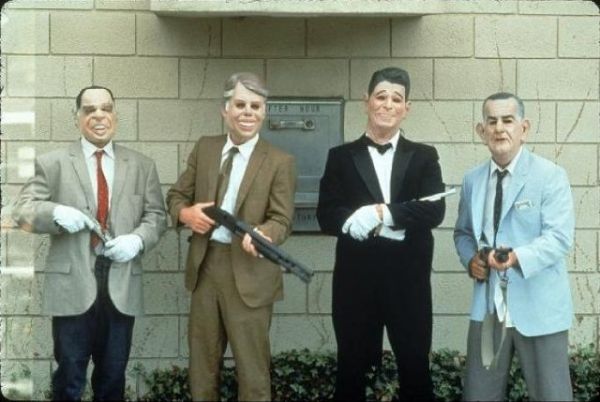
Harry Houdini was known as the world’s greatest escape artist. But he was never kept confined as a prisoner of the state, where the stakes are higher. Some folks developed a talent for escaping from real incarceration, because by golly, they kept getting arrested and jailed! There’s the story of Paddy Mitchell, a bank robber who, along with his gang who wore masks of presidents, robbed over 100 banks. Their exploits inspired the movie Point Break. Paddy almost killed himself during his second prison break.
Now, you probably know from decades' worth of depictions of prison life in the media that cigarettes are as good as gold on the inside, but you probably don't know about something else they're good for -- namely, faking a heart attack, which you can do by simply soaking a cigarette butt in water overnight and then drinking the resulting liquid nicotine goodness (don't try that at home, kids). Mitchell, obviously a big fan of the "more is more" approach, soaked an entire pack of cigs in water, ran three miles around the prison exercise yard, and then drank that refreshing cancer sludge.Paddy Mitchell is only one of the five prison escape artists profiled in a list at Cracked.
His ticker damn nigh exploded. His heart attack symptoms were so real -- because, basically, they were -- that guards rushed him to the local hospital ... where his two partners were posing as emergency room workers. Mitchell made a quick getaway to the Philippines, only returning to the U.S. to pull an occasional bank heist until he was finally caught for good ... 15 years later.
Suspected serial gumball machine bandit on the loose
 Gumball machines are going missing in North Carolina.
The gumball bandit most recently hit the Golden Corral restaurant in
Gastonia sometime on Saturday night. That marked the sixth such machine
stolen from a business in the area in the last month.
Gumball machines are going missing in North Carolina.
The gumball bandit most recently hit the Golden Corral restaurant in
Gastonia sometime on Saturday night. That marked the sixth such machine
stolen from a business in the area in the last month.
Falling victim were two restaurants, a nonprofit store and a barber's
shop.
The first stolen gumball machine was reported on Dec. 19 at Jackson’s
Cafeteria. The front window was smashed, and the gumball machine was
taken from the foyer.
The cafeteria would be hit again weeks later on Jan. 5.
Again the window was smashed and another gumball machine was taken. The Habitat for Humanity Restore also had a gumball machine stolen, as did a Gastonia barber's shop. Police reports estimate the machines cost anywhere from $100 to $750. Investigators think the same person is committing all the thefts, according to Gastonia Police Sgt. Heath McMullan.
He is described as a white male, wearing blue jeans, a dark, thick jacket and boots. He could be driving a burgundy Toyota Camry. Police believe he may be taking the machines for the coins secured inside. Years ago, Gastonia Police say, there were similar crimes targeting gumball machines. Generally there’s not much more than $10 in each machine, McMullan estimates. Anyone with information on the cases is asked to call Gastonia Crime Stoppers.
Again the window was smashed and another gumball machine was taken. The Habitat for Humanity Restore also had a gumball machine stolen, as did a Gastonia barber's shop. Police reports estimate the machines cost anywhere from $100 to $750. Investigators think the same person is committing all the thefts, according to Gastonia Police Sgt. Heath McMullan.
He is described as a white male, wearing blue jeans, a dark, thick jacket and boots. He could be driving a burgundy Toyota Camry. Police believe he may be taking the machines for the coins secured inside. Years ago, Gastonia Police say, there were similar crimes targeting gumball machines. Generally there’s not much more than $10 in each machine, McMullan estimates. Anyone with information on the cases is asked to call Gastonia Crime Stoppers.
Diet and Nutrition and Mental Health

Sex Differences

Gender roles

Lonely, Depressed and TV

Archaic Jawbone Could Represent New Hominin Species
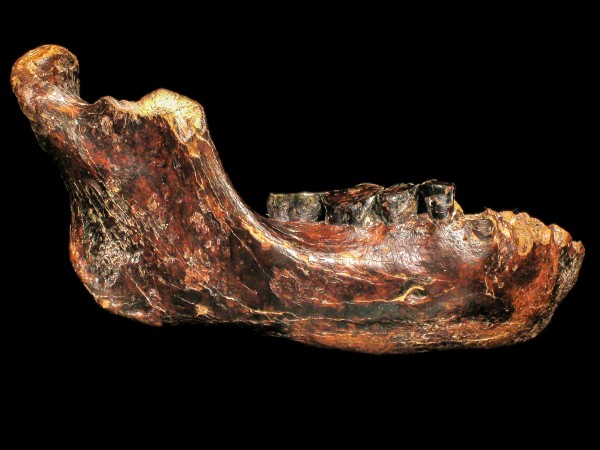
A robust jawbone pulled from a fisherman’s net in the Penghu Channel, off the coast of Taiwan, has been dated to between 10,000 and 190,000 years old by a team of scientists from Taiwan, Japan, and Australia, who published their findings in the journal Nature Communications. They compared the levels of fluorine and sodium in the fossil and other animal bones recovered from the same region, which was once a part of the Asian mainland when water levels were lower, to date the jawbone. The four-inch-long fossil still has four teeth attached, including two large molars, which look primitive for their age. The Penghu fossil does resemble a 400,000-year-old fossil from southern China, however. “We need other skeletal parts to evaluate the degree of its uniqueness. The question of species can be effectively discussed after those steps,” study co-author Yousuke Kaifu of Japan’s National Museum of Nature and Science told Live Science. To read about the recent discovery of a Paleolithic tool in the region, see "China's Oldest Bone Hand Ax."
9 Roman Gods Who Weren't Just Rip Offs Of Greek Gods

Lotus Position

The mummified body, which was covered in animal skin, was found in Mongolia. Continue reading

The Buried Fortress Town Of Gonur Tepe In Turkmenistan

Nothing much was known about the complex of Gonur Tepe until 1972 when the Margiana Archaeological Expedition directed by the Greek-Russian archaeologist Victor Sarianidi discovered the fortress town.
Mesoamerican city of Cantona abandoned after 650-year period of droughts

The
maar lake Aljojuca, 20 miles south of Cantona, yielded sediments that
recorded a lengthy series of droughts between A.D. 500 and 1150 that
likely led to the abandonment of Cantona in A.D. 1050.
A new study shows that a
prolonged period of below-average rainfall was partly responsible for
the abandonment of the Mesoamerican city of Cantona, between A.D. 900
and A.D. 1050.
At its peak, Cantona, located in a dry, volcanic basin (La Cuenca
Oriental) east of today’s Mexico City, was one of the largest cities in
the New World, with 90,000 inhabitants. The area was a major source of
obsidian and the city may have played a military role alongside an
important trade route from the Veracruz coast into the highlands.
A ballcourt in Cantona.
Sediment coresTo assess the climate in that area before and after Cantona’s collapse, UC Berkeley geographers analyzed sediment cores from a lake located 20 miles south of the former city. They found evidence of a 650-year period of frequent droughts that extended from around A.D. 500 to about A.D. 1150. This was part of a long-term drying trend in highland Mexico that started 2,200 years ago, around 200 B.C. The climate became wetter again in about A.D. 1300, just prior to the rise of the Aztec empire.
“The decline of Cantona occurred during this dry interval, and we conclude that climate change probably played a role, at least towards the end of the city’s existence,” said lead author Tripti Bhattacharya, a UC Berkeley graduate student.
Surprisingly, the population of Cantona increased during the early part of the dry period, perhaps because of political upheaval elsewhere that increased the importance of the heavily fortified city, she said. Teotihuacan, less than 100 miles to the west, was in decline at the time, also possibly because of more frequent droughts.
“In a sense the area became important because of the increased frequency of drought,” said UC Berkeley associate professor of geography Roger Byrne. “But when the droughts continued on such a scale, the subsistence base for the whole area changed and people just had to leave. The city was abandoned.”
Bhattacharya, Byrne and their colleagues report their findings in the Proceedings of the National Academy of Sciences. The UC Berkeley researchers analyzed lake cores provided by scientists at the National Autonomous University of Mexico in Juriquilla, Querétaro, Mexico and the German Research Center for Geosciences in Potsdam, Germany.
Frequent short-term droughts
Byrne emphasized that the area’s typical monsoon weather with wet summers and dry winters did not stop, but was interrupted by frequent short-term droughts, no doubt affecting crops and water supplies. Today the area is close to the northern limit of maize production without irrigation, and would have been particularly vulnerable to drier conditions, he said.
Byrne, a member of the Berkeley Initiative on Global Change Biology (BiGCB) and curator of fossil pollen in the Museum of Palaeontology, has studied sediment cores from many lakes in Mexico and California.
Maar lakes created by magma explosions
Nearly 20 years ago, he learned of Cantona and traveled with students to the areas three times to obtain cores from lakes near the site, most of which are maar lakes created by magma explosions. They are deep and often contain undisturbed and regularly layered sediments ideal for chronological studies.
German colleagues cored this particular lake, Aljojuca, in 2007, and Bhattacharya travelled to Potsdam to collect sediment samples. Oxygen isotope ratios in carbonate sediments are correlated with the ratio of precipitation to evaporation and thus indicate aridity. Organic material in the sediments was used for accelerator mass spectroscopy carbon-14 dating.
“We can show that both the growth and decline of the site took place during a time period of frequent drought, which forces us to think in more nuanced ways about how political and social factors interact with environmental factors to cause social and cultural change,” Bhattacharya said. “That makes the study particularly interesting.”
Bhattacharya noted that more studies are necessary to reconstruct the prehistoric climate of highland Mexico. Such studies could reveal the causes of prehistoric climatic change and whether they were similar to the factors that regulate the region’s climate today, such as the El Niño/Southern Oscillation.
The Birth of an Iceberg

The birth of an iceberg comes with its own characteristic sound, according to new research.
Habitable Planets

Rare Megamouth Shark Washes Ashore in the Philippines
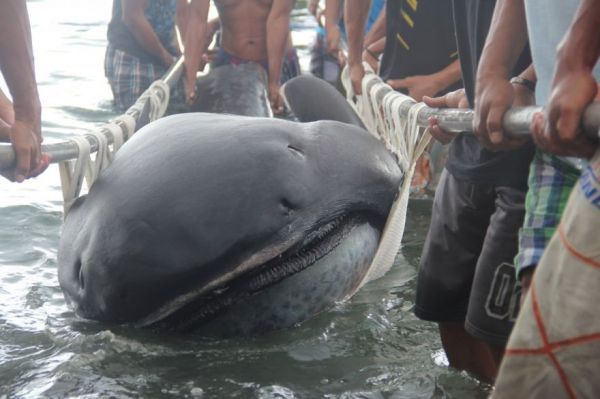
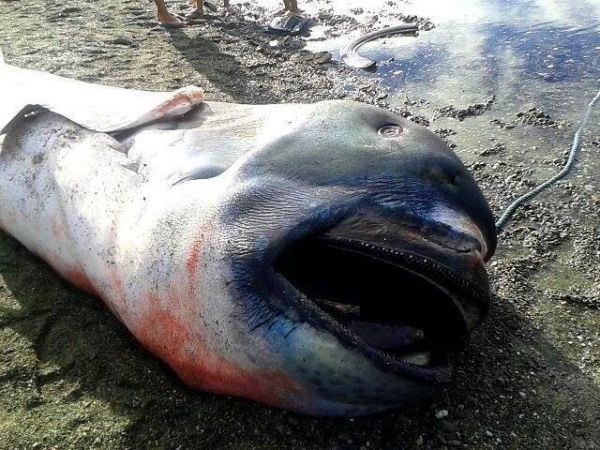 According
to the Marine Wildlife Watch of the Philippines, an exceedingly rare
megamouth shark washed ashore in Marigondon, Pioduran, Albay yesterday
morning. The specimen, which was no longer alive, was thought to be
only the 60th sighting of the species ever (though experts are still
debating the number).
According
to the Marine Wildlife Watch of the Philippines, an exceedingly rare
megamouth shark washed ashore in Marigondon, Pioduran, Albay yesterday
morning. The specimen, which was no longer alive, was thought to be
only the 60th sighting of the species ever (though experts are still
debating the number).
Cause of death of
the 15-foot long shark is still unknown. The specimen has been stored
on ice until specialists arrive to examine it.
The common name of this docile, deep-dwelling species refers to the disproportionate size of its massive head and the large capacity of its mouth, which the shark keeps open as it swims in order to catch plankton and jellyfish.
See a video about a scientist's fascinating encounter with a megamouth in the wild below. Read more about the Philippines specimen here, and see the Marine Wildlife Watch of the Philippines' Facebook post about the event here.
Snake with feet found in the Philippines
 Residents in Mallig, Isabela, Philippines, were puzzled after a family caught and killed a snake that had a pair of feet.
Norberto was doing his usual routine of cleaning his house, which is located at the Gambol in Barangay Olango in Isabela, when he saw a snake on the floor.
The snake tried to hide in a box, but was caught. When the family examined the reptile, they were surprised to see that it had feet like those of a lizard. After killing the snake they put in a bottle along with formalin to preserve it.
Some people have said the snake is a sign of good luck, while others
have connected it with the second coming of dog. However, a forestry
specialist said the feet were the result of a “genetic mutation”.
The snake tried to hide in a box, but was caught. When the family examined the reptile, they were surprised to see that it had feet like those of a lizard. After killing the snake they put in a bottle along with formalin to preserve it.
Subscribe to:
Posts (Atom)
