

Tuesday, October 29, 2013

What happens to a pocket hose when it goes bad
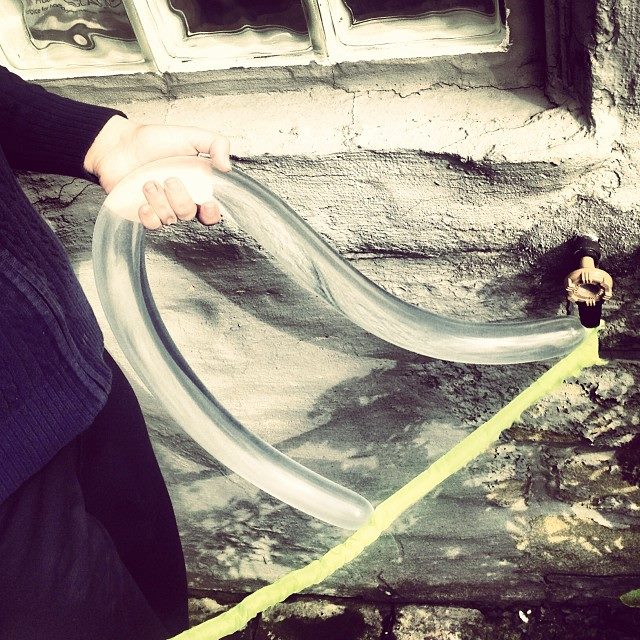
Today, a wrinkly as-seen-on-TV impulse buy. Tomorrow, a nightmare creature from The Abyss.


Louie, Louie – The Language of the Lyrics
In 1963, a group named the
Kingsmen covered the song “Louie Louie,” originally recorded by Richard
Berry eight years prior. The Kingsmen’s version is a classic and you’ve
almost certainly heard it (but if not, here you go) and likely can sing
the whole thing — kind of. You probably have no idea what the actual
words are because they’re a garbled mess which is impossible to
understand. But that didn’t stop an angry parent from writing to
then-U.S. Attorney General Robert F. Kennedy and insisting that the
lyrics were obscene. For some reason, this led to an FBI investigation
(!) which concluded, no, the lyrics are just unintelligible.
The FBI was right, but they missed something. At about 0:53 into the
song, Lynn Easton, the band’s drummer, dropped a drumstick and yelled
out the f-word. It’s audible (but not obvious) in the recording.

The Water Cycle

Water what? You know, the water cycle you learn in elementary school: how the sun heats up and evaporates water in the ocean and seas, then the water condenses into clouds and then rains back to earth, and so on and so on.
You can probably imagine why the water cycle is important, but have you given a thought as to how big this process is? Like, for example, how much water evaporates from the ocean every year anyhow? Try 92 quadrillion gallons. That's 92,000,000,000,000,000.

Why is Snot Green?
 We
should be grateful for snot, the nasal mucous that works overtime to
combat the nasty bugs we inhale when we breathe. What causes it to be
green is an enzyme, myeloperoxidase, which actually makes bleach to kill
microbial invaders. This tiny bleach factory is safely (for us)
contained in a special kind of white blood cell called a neutrophil,
which is a particularly active part of our immune system that hunts down
and swallows up invasive cells.
We
should be grateful for snot, the nasal mucous that works overtime to
combat the nasty bugs we inhale when we breathe. What causes it to be
green is an enzyme, myeloperoxidase, which actually makes bleach to kill
microbial invaders. This tiny bleach factory is safely (for us)
contained in a special kind of white blood cell called a neutrophil,
which is a particularly active part of our immune system that hunts down
and swallows up invasive cells. Even though green snot may be disgusting at times, it could be worse. The chemical explanation of snot at Infectious Enthusiasm links the operant molecule, haem, to the red in our red blood cells. Just imagine how horrible it would be to blow your nose and see red come out!Researchers in Germany have captured some fantastic (and terrifying) videos of a neutrophil mercilessly stalking the bad guys, before engulfing them whole – these cells are truly voracious. You do not want to make an enemy of a neutrophil. It will find you, and it will kill you.Once captured, the neutrophil proceeds to douse its captives with bleach manufactured by our recent acquaintance, myeloperoxidase. Doing this internally allows a degree of damage limitation, tantamount to a controlled explosion. Sadly though, much like Monty Python’s Mr Creosote, the neutrophils can’t keep consuming forever. Eventually they take a suicidal step, rupturing open and spewing their digested contents out into the warzone, ready for you to honk out of your nose and admire.

Two mummies found in ancient Peru cemetery
Two pre-Columbian mummies more than a thousand years old were found in a
pre-Incan cemetery in a suburb of Lima, archeologists said Thursday.
"This is one of the most important finds in more than three decades of
excavation, because both mummies are intact," Gladys Paz told AFP at the
foot of the Huaca Pucllana tomb, an ancient religious complex in the
Miraflores neighborhood.
The first signs of the tomb were found five days ago, but the process of unearthing the mummies of an adult and child took time.
The Pacific Ocean and Lima's concrete buildings are visible from part of
the huaca -- a Quechua word for religious sites -- that towers more
than 20 meters (66 feet) high.
The grave was found intact with offerings and a sacrificed companion, Paz said in reference to the mummified child.
"This is the third intact find among more than 70 tombs excavated since
1981," when researchers began their work at the Huaca Pucllana, a
pyramid-like temple built on six acres (2.5 hectares) of land between AD
100 and 600.
In 2010, archeologists discovered the tomb of a woman who was buried with her four children. In 2008, the mummy of a 13-year-old girl was found.
The two recent mummies remain unopened in the place where they were
found. They will be taken to a lab in the next four to six months to
determine the age and sex of each individual.
In the tomb, researchers also found seven vessels with feline designs used to drink a matte tea concoction, 12 fabric bags and the remains of three guinea pigs.
Dozens of journalists thronged to the site for a chance to catch a
glimpse.Project director Isabel Flores said archeologists have yet to
search through 40 percent of the Huaca Pucllana, built during the
pre-Hispanic Wari culture.
There are about 350 huacas in Peru's capital region, interspersed among buildings and homes, hinting Lima's pre-Hispanic ancestors.
 |
| Archaeologists
work at the pre-Inca religious complex "Huaca Pucllana", in the residential district of Miraflores, in Lima [Credit: AFP] |
The first signs of the tomb were found five days ago, but the process of unearthing the mummies of an adult and child took time.
 |
| Craftwork
around a mummy bundle at the pre-Inca religious complex "Huaca Pucllana"[Credit: AFP] |
 |
| An archaeologist cleans a recently discovered tomb of an intact mummy of the Wari prehispanic culture[Credit: Reuters/Mariana Bazo] |
In 2010, archeologists discovered the tomb of a woman who was buried with her four children. In 2008, the mummy of a 13-year-old girl was found.
 |
| Some of the items found in the tomb [Credit: Cris Bouroncle/AFP] |
In the tomb, researchers also found seven vessels with feline designs used to drink a matte tea concoction, 12 fabric bags and the remains of three guinea pigs.
 |
| The site is in the heart of one of Peru's bustling suburbs [Credit: Reuters/Mariana Bazo] |
There are about 350 huacas in Peru's capital region, interspersed among buildings and homes, hinting Lima's pre-Hispanic ancestors.
Archaeologists unearth a 6,500-year-old mystery
Archaeologists have found a prehistoric wetland site near Bamburgh which was a hive of human activity for at least 2,000 years.
The dry summer gave archaeologists from the Bamburgh Research Project a
valuable opportunity to excavate part of the site at Bradford Kaims.
It is now wet pasture but was once a series of shallow lakes connected by streams, which drained into Budle Bay.
They uncovered a wooden paddle, sitting on a brushwood platform, which dates from around 6,500 years ago at the start of the Neolithic period - the time of the very first farmers. The paddle and platform were next to a burnt mound - piles of stones which had been heated by fire.
These heated stones could have been used for a number of activities, from cooking and brewing to tanning, metal extraction, canoe making or even sweat lodges - the forerunner of saunas.
Four small artificial islands have also been found, made of stone rubble on wood foundations.
These may have been used to reach deeper water for the ritual offering of gifts, or as a base from which to set fish traps.
Project co-director Graeme Young said: “To find preserved organic material like this from this period is incredibly rare in Britain.
The timber paddle. was lying just on top of a timber platform, formed from round wood lengths pegged into the underlying layers.
“The platform would have been exciting enough but the paddle is just outstanding,” said Mr Young. “We think from parallels that it may be for moving the hot rocks off the burnt mound rather than paddling a canoe.
“At this moment we think the platform and paddle are very, very early Neolithic, making it in the order of 6,000 or more years old.”
The paddle was obviously in a very fragile state and if left to dry out would have been lost so the team lifted it in a block with the supporting deposits.
It is currently in safe storage at Edinburgh University. The process of freeing the find from its protective covers will start soon.
The project has been backed by the Heritage Lottery Fund and English Heritage but funding is needed to continue the investigation next year.
 |
| Archaeologists have unearthed a 6,500 year-old timber paddle at Bradford Kaims, near Bamburgh [Credit: Berwick Advertiser] |
It is now wet pasture but was once a series of shallow lakes connected by streams, which drained into Budle Bay.
They uncovered a wooden paddle, sitting on a brushwood platform, which dates from around 6,500 years ago at the start of the Neolithic period - the time of the very first farmers. The paddle and platform were next to a burnt mound - piles of stones which had been heated by fire.
These heated stones could have been used for a number of activities, from cooking and brewing to tanning, metal extraction, canoe making or even sweat lodges - the forerunner of saunas.
Four small artificial islands have also been found, made of stone rubble on wood foundations.
These may have been used to reach deeper water for the ritual offering of gifts, or as a base from which to set fish traps.
Project co-director Graeme Young said: “To find preserved organic material like this from this period is incredibly rare in Britain.
The timber paddle. was lying just on top of a timber platform, formed from round wood lengths pegged into the underlying layers.
“The platform would have been exciting enough but the paddle is just outstanding,” said Mr Young. “We think from parallels that it may be for moving the hot rocks off the burnt mound rather than paddling a canoe.
“At this moment we think the platform and paddle are very, very early Neolithic, making it in the order of 6,000 or more years old.”
The paddle was obviously in a very fragile state and if left to dry out would have been lost so the team lifted it in a block with the supporting deposits.
It is currently in safe storage at Edinburgh University. The process of freeing the find from its protective covers will start soon.
The project has been backed by the Heritage Lottery Fund and English Heritage but funding is needed to continue the investigation next year.


Chemists show life on Earth was not a fluke
How life came about from inanimate sets of chemicals is still a mystery.
While we may never be certain which chemicals existed on prebiotic
Earth, we can study the biomolecules we have today to give us clues
about what happened three billion years ago.
Now scientists have used a set of these biomolecules to show one way in
which life might have started. They found that these molecular machines,
which exist in living cells today, don’t do much on their own. But as
soon as they add fatty chemicals, which form a primitive version of a
cell membrane, it got the chemicals close enough to react in a highly
specific manner.
This form of self-organisation is remarkable, and figuring out how it happens may hold the key to understanding life on earth formed and perhaps how it might form on other planets.
The 1987 Nobel Prize in Chemistry was given to chemists for showing how complex molecules can perform very precise functions. One of the behaviours of these molecules is called self-organisation, where different chemicals come together because of the many forces acting on them and become a molecular machine capable of even more complex tasks. Each living cell is full of these molecular machines.
Pasquale Stano at the University of Roma Tre and his colleagues were interested in using this knowledge to probe the origins of life. To make things simple, they chose an assembly that produces proteins. This assembly consists of 83 different molecules including DNA, which was programmed to produce a special green fluorescent protein (GFP) that could be observed under a confocal microscope.
The assembly can only produce proteins when its molecules are close enough together to react with each other. When the assembly is diluted with water, they can no longer react. This is one reason that the insides of living cells are very crowded, concentrated places: to allow the chemistry of life to work.
In order to recreate this molecular crowding, Stano added a chemical called POPC to the dilute solution. Fatty molecules such as POPC do not mix with water, and when placed into water they automatically form liposomes. These have a very similar structure to the membranes of living cells and are widely used to study the evolution of cells.
Stano reports in the journal Angewandte Chemie that many of these liposomes trapped some molecules of the assembly. But remarkably, five in every 1,000 such liposomes had all 83 of the molecules needed to produce a protein. These liposomes produced large amount of GFP and glowed green under a microscope.
Computer calculations reveal that even by chance, five liposomes in 1,000 could not have trapped all 83 molecules of the assembly. Their calculated probability for even one such liposome to form is essentially zero. The fact that any such liposomes formed and that GFP was produced means something quite unique is happening.
Stano and his colleagues do not yet understand why this happened. It may yet be a random process that a better statistical model will explain. It may be that these particular molecules are suited to this kind of self-organisation because they are already highly evolved. An important next step is to see if similar, but less complex, molecules are also capable of this feat.
Regardless of the limitations, Stano’s experiment has shown for the first time that self-assembly of molecular machines into simple cells may be an inevitable physical process. Finding out how exactly this self-assembly happens will mean taking a big step towards understanding how life was formed.
 |
| In them, began life [Credit: University of Utah] |
This form of self-organisation is remarkable, and figuring out how it happens may hold the key to understanding life on earth formed and perhaps how it might form on other planets.
The 1987 Nobel Prize in Chemistry was given to chemists for showing how complex molecules can perform very precise functions. One of the behaviours of these molecules is called self-organisation, where different chemicals come together because of the many forces acting on them and become a molecular machine capable of even more complex tasks. Each living cell is full of these molecular machines.
Pasquale Stano at the University of Roma Tre and his colleagues were interested in using this knowledge to probe the origins of life. To make things simple, they chose an assembly that produces proteins. This assembly consists of 83 different molecules including DNA, which was programmed to produce a special green fluorescent protein (GFP) that could be observed under a confocal microscope.
The assembly can only produce proteins when its molecules are close enough together to react with each other. When the assembly is diluted with water, they can no longer react. This is one reason that the insides of living cells are very crowded, concentrated places: to allow the chemistry of life to work.
In order to recreate this molecular crowding, Stano added a chemical called POPC to the dilute solution. Fatty molecules such as POPC do not mix with water, and when placed into water they automatically form liposomes. These have a very similar structure to the membranes of living cells and are widely used to study the evolution of cells.
Stano reports in the journal Angewandte Chemie that many of these liposomes trapped some molecules of the assembly. But remarkably, five in every 1,000 such liposomes had all 83 of the molecules needed to produce a protein. These liposomes produced large amount of GFP and glowed green under a microscope.
Computer calculations reveal that even by chance, five liposomes in 1,000 could not have trapped all 83 molecules of the assembly. Their calculated probability for even one such liposome to form is essentially zero. The fact that any such liposomes formed and that GFP was produced means something quite unique is happening.
Stano and his colleagues do not yet understand why this happened. It may yet be a random process that a better statistical model will explain. It may be that these particular molecules are suited to this kind of self-organisation because they are already highly evolved. An important next step is to see if similar, but less complex, molecules are also capable of this feat.
Regardless of the limitations, Stano’s experiment has shown for the first time that self-assembly of molecular machines into simple cells may be an inevitable physical process. Finding out how exactly this self-assembly happens will mean taking a big step towards understanding how life was formed.


Subscribe to:
Posts (Atom)
