
How the first excavations in an ancient city are supporting its claim as the oldest continuously inhabited place in the world
 The
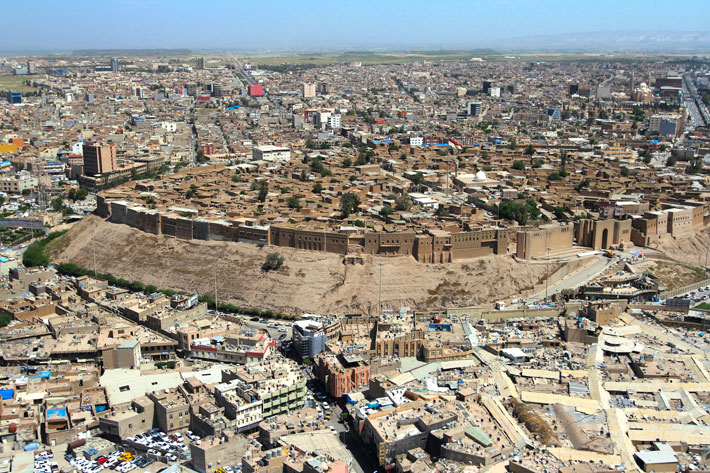
booming city of Erbil (ancient Arbela) in Kurdistan encircles the
ancient citadel where evidence of more than six millennia of human
habitation is just beginning to be uncovered.
The
booming city of Erbil (ancient Arbela) in Kurdistan encircles the
ancient citadel where evidence of more than six millennia of human
habitation is just beginning to be uncovered.
The 100-foot-high, oval-shaped citadel of Erbil towers high above the northern Mesopotamian plain, within sight of the Zagros Mountains that lead to the Iranian plateau. The massive mound, with its vertiginous man-made slope, built up by its inhabitants over at least the last 6,000 years, is the heart of what may be the world’s oldest continuously occupied settlement. At various times over its long history, the city has been a pilgrimage site dedicated to a great goddess, a prosperous trading center, a town on the frontier of several empires, and a rebel stronghold.
 Yet despite its place as one of the ancient Near East’s most
significant cities, Erbil’s past has been largely hidden. A dense
concentration of nineteenth- and twentieth-century houses stands atop
the mound, and these have long prevented archaeologists from exploring
the city’s older layers. As a consequence, almost everything known about
the metropolis—called Arbela in antiquity—has been cobbled together
from a handful of ancient texts and artifacts unearthed at other sites.
Yet despite its place as one of the ancient Near East’s most
significant cities, Erbil’s past has been largely hidden. A dense
concentration of nineteenth- and twentieth-century houses stands atop
the mound, and these have long prevented archaeologists from exploring
the city’s older layers. As a consequence, almost everything known about
the metropolis—called Arbela in antiquity—has been cobbled together
from a handful of ancient texts and artifacts unearthed at other sites.

No comments:
Post a Comment