
Today, the rare Smoky Mountain fireflies are a tourist attraction.
Twenty years ago, science didn’t believe they existed.
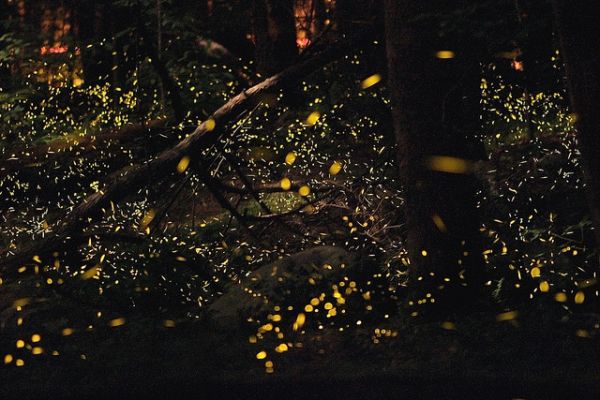
As a child, Lynn Faust would huddle with her family on the cabin porch to watch the spectacle. They’d sit, mesmerized by the “drumbeat with no sound.” And though they’d appreciated the show for generations, Faust never thought the event was newsworthy. “I’d assumed there was only one kind of firefly and thought they did a nice show in the Smokies,” she says.
 The
natural world has long enchanted Faust. In college, she majored in
forensic anthropology and minored in forestry. In her twenties, she
circumnavigated the globe for three years, visiting islands you could
only get to by boat, learning about cultures before they disappeared,
pursuing underwater photography. Today, at 60, she’s a naturalist who
writes scientific papers and field guides about fireflies. But she
wasn’t always obsessed with the insect. In fact, her academic interest
began only in the ’90s, when she read an article by Steven Strogatz, a
Cornell mathematician, in which he marveled at a species of Southeast
Asian firefly that synchronized its flashes. Highlighting how rare this
phenomenon was, Strogatz noted that there were no synchronous fireflies
in the Western Hemisphere.
The
natural world has long enchanted Faust. In college, she majored in
forensic anthropology and minored in forestry. In her twenties, she
circumnavigated the globe for three years, visiting islands you could
only get to by boat, learning about cultures before they disappeared,
pursuing underwater photography. Today, at 60, she’s a naturalist who
writes scientific papers and field guides about fireflies. But she
wasn’t always obsessed with the insect. In fact, her academic interest
began only in the ’90s, when she read an article by Steven Strogatz, a
Cornell mathematician, in which he marveled at a species of Southeast
Asian firefly that synchronized its flashes. Highlighting how rare this
phenomenon was, Strogatz noted that there were no synchronous fireflies
in the Western Hemisphere.This struck Faust as odd. It contradicted the light shows she had seen growing up. As she dug deeper, Faust found that while there had been more than 100 years of colloquial accounts of North American fireflies flashing in sync, scientists discounted those reports, attributing them to lore or optical illusion. Faust knew the truth: that her Tennessse fireflies were every bit as special as the species in Asia. But how could she prove it?


No comments:
Post a Comment