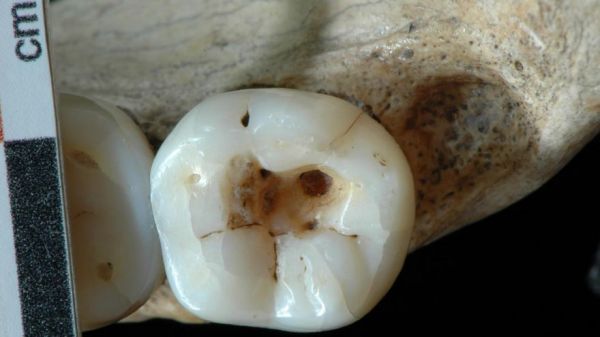
The
current thinking about the history of dentistry tells us that humans
didn’t have many dental problems until we settled down and developed
agriculture. With the rise of carbohydrates in our diets (although there
may be other factors), we started to get tooth decay. It must have been
horrible. If a rotten tooth eventually fell out, it must have seemed a
blessing. But people tried to do something about it even before dental
drills were developed. A 14,000-year-old skull shows evidence of
dentistry, in which a decayed tooth was deliberately scraped with a
tool, possibly a flint blade. The first real dental drill is thought to
have arose in Pakistan, between 9,000 and 7,500 years ago. How did they
do it?
Some indigenous societies today carve holes in
objects using a tool called a bow-drill. This consists of a few sticks
of wood, a sharp stone, and a length of cord. The cord is tied to either
end of one flexible stick, making it look like a small version of an
archer’s bow.
The cord is then wrapped tightly around a second
stick held perpendicular to the “bow”. By simply moving the bow back and
forth, this second stick will rotate just as a drill does. Attaching a
sharp stone to the end of this drill increases its cutting power.
To
get an idea of whether a stone-tipped bow-drill could function in
dentistry, the research team working in Pakistan constructed a bow-drill
and attempted to drill holes in human enamel. The results were
surprising; it took under a minute to drill holes of the kind seen in
the 9,000-year-old teeth.
Evidence of prehistoric
dental drilling comes from other parts of the world, too. An wait until
you find out what they filled those teeth with! Read about
the history of dental drilling at BBC Earth. You’ll want to brush and floss as soon as you finish the article


No comments:
Post a Comment