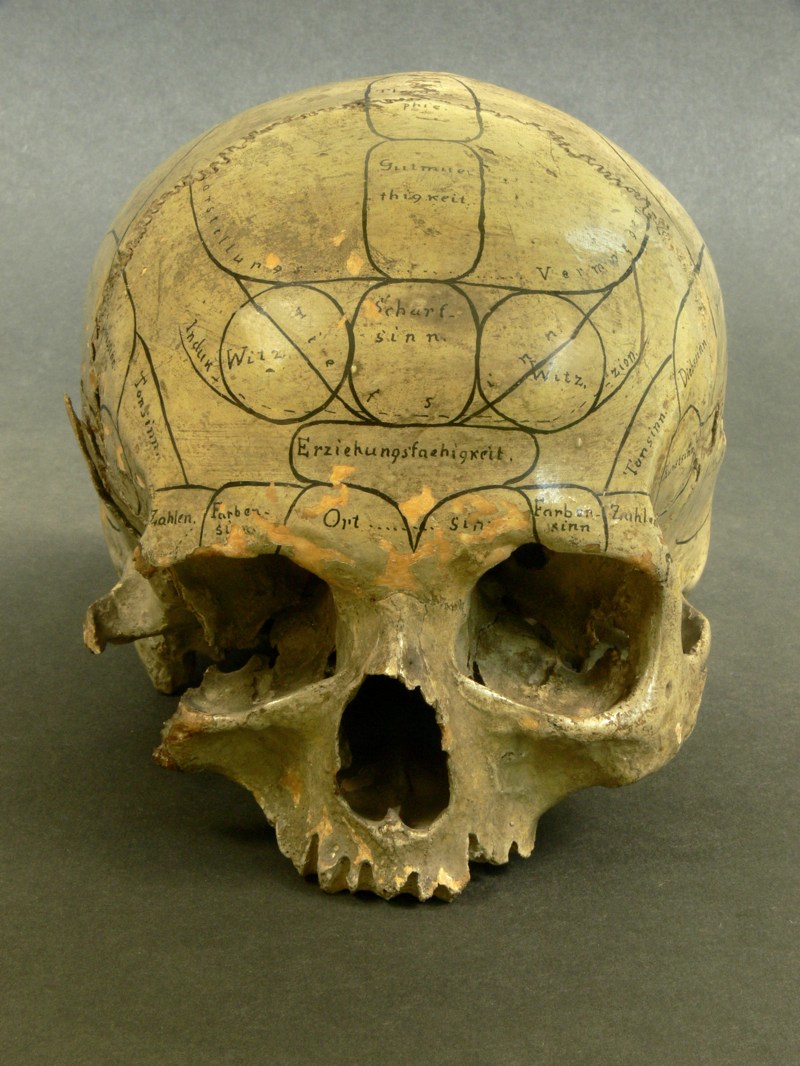
HUMAN SKULL INSCRIBED BY A PHRENOLOGIST
Anonymous, nineteenth century. Photograph by Eszter Blahak/Semmelweis Museum.
Historically, the primary concern of neuroscience has been location. In the mass of flesh that is the human body, where is the mind? Towards the end of the eighteenth century, Franz Joseph Gall built an influential theory that posited that distinct areas of the cerebrum serve distinct faculties such as emotions, moral impulses and the intellect. He also thought that these different brain areas grow and shrink according to their use, pushing out and creating bumps on the skull that betray the makeup an individual's mind. It is easy today to chalk up Gall's reasoning to quackery, and its service to subsequent commercial and ideological uses (such as racism) certainly does not help his case. But Gall ushered in the first modern theory ascribing different mental functions to different parts of the cerebrum. While he was entirely off the mark on the details, his paradigm guides us to this day -- only the coordinate system has shifted to indicate positions within the brain rather than on the skull.
Portraits of the Mind: Visualizing the Brain from Antiquity to the 21st Century, by Carl Schoonover, foreword by Jonah Lehrer, is published by Abrams


 OLD ALPHABET















 A young couple moves into a new neighborhood. The next morning while they are eating breakfast, the young woman sees her neighbor hanging the wash outside. “That laundry is not very clean”, she said. “She doesn’t know how to wash correctly. Perhaps she needs better laundry soap.”











 In Popular Science, Bjorn Carey imagines a scenario in which all of the elements on the periodic table were present in the same location simultaneously:

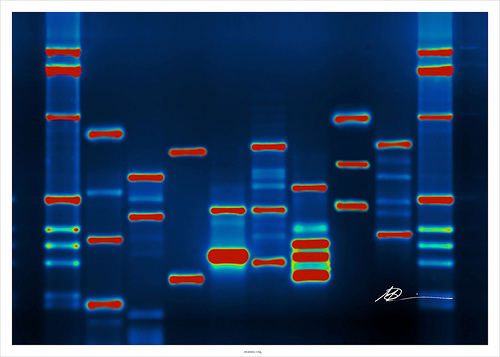

 Researchers led by Harvard Medical School geneticist Ronald A. DePinho have managed to partially reverse the physical degeneration that results from aging: