

Monday, December 10, 2012

Falling Off Fiscal Cliff: Good for the Environment?
Fiscal trouble can force people
to consume less -- and leave a smaller environmental footprint.
But
concern for environmental issues also drops.
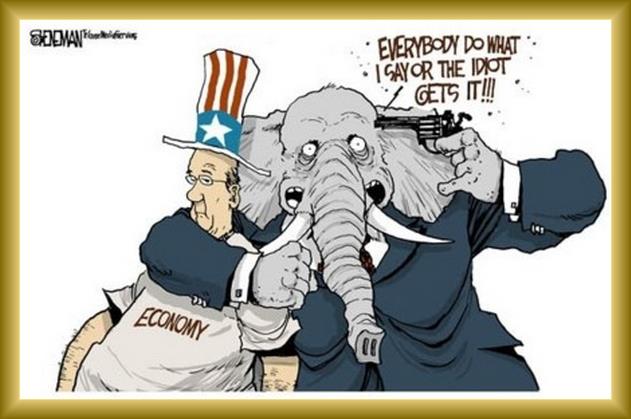

Tom Coburn: Medicare, Social Security “are things we don’t absolutely need”
Yes, he is a repugican (was there any doubt).
Tom Coburn, who’s considered the repugican “expert” on health care, because he’s a “doctor,” just said that Medicare and Social Security “are things we don’t absolutely need.” (Video below.) Coburn has had it out for Medicare for a while now.Other things Coburn doesn’t think we need include food safety, veterans’ benefits, and any kind of assistance to those who risked their lives responding to the September 11 attacks.
Ah yes, there’s nothing quite like the words of a pampered and entitled US senator preaching about what we need or don’t need, especially when it comes to Medicare and Social Security.
When you compare the government-subsidized healthcare plan, pension and benefits of anyone in Congress to the general population, it’s shocking how much better it is.

Tom Coburn.
Any normal person would be too embarrassed to call for cuts to middle class and poor benefits, but that doesn’t apply for obnoxious CEOs and the political class. Even Obama is tastelessly accepting unlimited corporate cash for his inauguration bash at the same time that he’s rumored to be agreeing to a bad deal with the repugicans over Medicare cuts. Let’s all hope that there’s a large misunderstanding with this rumor.What’s equally disturbing is that the national media sits back and accepts such nonsense without question. Why is it so difficult to ask people like Coburn or anyone else in Washington – potentially even Obama – what cuts they’re willing to accept. We’re not talking about cuts for their constituents, since we know they don’t give a damn about them, but actual cuts to their own benefits?
There used to be a time when in business or government that we had leadership by example. Is that now obsolete? I’m struggling to see why it’s fair to ask the middle class to pay for the mistakes of the likes of Coburn and the political class who created these problems through their ongoing tax cuts and their ongoing wars.
It’s immoral.
Not to mention, what’s to stop the repugicans from bankrupting us once again with even more tax cuts and even more wars? That’s what they did after President Clinton straightened out the budget. Why do we never tie their hands – why not make it harder for them to cut taxes and go to war in the future? Here’s John in a post last week:
If the repugicans and their blue dog allies are so concerned about the deficit, then let’s address the deficit by addressing the actual causes of the deficit. Here’s my proposal:Let the political class show us how tough they are by cutting their own fat benefits.
We can make it a surcharge on folks’ annual tax returns, a big red sticker or something – kind of like what Denny’s was talking about doing with Obamacare. This way people will know exactly what that tax cut, or defense increase, is going to cost us. And maybe we can list the members of Congress who voted for, kind of like those campaign ads: “I’m John Boehner and I approve this tax surcharge.”
- Pass whatever legislation or rule change is needed to require a super-majority in Congress for any future reduction in taxes or increase in defense spending.
- And for good measure, require that any tax cut or defense increase be accompanied by a corresponding tax surcharge to pay for it.
Maybe the cost savings isn’t that much, but that’s not the point, just as it isn’t the point of raising the Medicare age by two years when it will only, at most, save $15bn a year. Why should anyone take Washington seriously when they can’t even trim their own benefits, trim their own fat? Looking at friends and family working for businesses large and small, I can’t identify a single person that has such luxurious benefits as Coburn and the political class, and let’s no even talk about the military elite.
The commanders who lead the nation’s military services and those who oversee troops around the world enjoy an array of perquisites befitting a billionaire, including executive jets, palatial homes, drivers, security guards and aides to carry their bags, press their uniforms and track their schedules in 10-minute increments. Their food is prepared by gourmet chefs. If they want music with their dinner parties, their staff can summon a string quartet or a choir.Damn seniors. The general needs another plane.
The elite regional commanders who preside over large swaths of the planet don’t have to settle for Gulfstream V jets. They each have a C-40, the military equivalent of a Boeing 737, some of which are configured with beds.
The next time anyone from Congress or the White House spouts off about cutting middle class benefits, ask them what benefits they’re giving up first.
Here’s Coburn on Medicare and Social Security not being absolutely necessary.
It’s immoral to cut Medicare to pay for the shrub’s lies
The shrub’s Tax Cuts and War in Iraq Broke Us, So Let’s Cut Medicare!
I cannot believe that Democrats are even considering raising the eligibility age for Medicare as part of the “fiscal cliff” negotiations.First off, $15bn a year is hardly significant savings, and that’s what you save (at a maximum – some argue it’s significantly less) when you raise the Medicare eligibility age from 65 to 67: a whopping $15bn a year.

The shrub's tax cuts and Iraq, Afghanistan are causing the deficit.
You know how much the shrub’s little venture in Iraq has been
costing us per year? In FY 2011, $46 billion. That’s three times the
savings from cutting Medicare.And overall, the damn war is going to cost us $3 trillion, according to Joe Stiglitz. $3 trillion for the shrub’s lie. But let’s cut all of our Medicare coverage for two years in order to pay for the Republican party’s lie of the decade, along with their other lie of the decade, the shrub’s tax cuts, that supposedly were going to pay for themselves.
The tax cuts and the wars in Iraq and Afghanistan combined eat up the lion’s share of the deficit over the coming years. (See the chart to the right.) So let’s cuts Medicare instead!
Just to be clear, those tax cuts and the shrub’s little wars are going to be paid for by cutting your and my Medicare coverage.
Nice.
You don’t see John McCain and Lindsey Graham calling for any hearings on why were lied to about any of those subjects, do you?
How Do We Know Obamacare Will Take Up Medicare’s Slack When We Don’t Even Know What Obamacare Will Do Next Year?
As for the argument that Obamacare will protect us when we hit 65 and need health care that otherwise would have been covered by Medicare… maybe. The thing is, Obamacare hasn’t even been implemented yet. No one can tell us for sure if we’re going to be paying less for our premiums next year under Obamacare, let alone when we’re 65. Sure, they “think” it’ll be less. But they don’t know. But they’ll still willing to cut all of our access to Medicare for two yours on the promise – read: hope – that Obamacare “might” provide an affordable alternative. But it might not.But a side effect of raising the Medicare retirement age would be that a large cohort of 65- and 66-year-olds would suddenly find themselves needing the Affordable Care Act to buy their health insurance. Which is to say, repugicans attacking the Affordable Care Act would no longer be attacking the usual band of very poor or desperate people they can afford to ignore but a significant chunk of middle-class voters who have grown accustomed to the assumption that they will be able to afford health care. Strengthening the political coalition for universal coverage seems like a helpful side benefit — possibly even one conservatives come to regret, and liberals, to feel relief they accepted.
Where Exactly Are People Supposed to Come Up With the Money to Afford Private Health Insurance at 65 and 66?

Did you hear the one about how they’re going to cut our Medicare to pay for the repugican cabal’s lies?
And what exactly is “affordable” when you’re talking about health insurance for someone who’s 65 years old?
And how much more will we be paying for health coverage at that age under Obamacare than we would have been paying under Medicare?
I’m paying nearly $6,000 a year as it is for my health insurance, and I’m not even near 65 (yet). At one point, my rates were doubling every three years. Is it crazy to worry that they might triple in the next 15? They tripled on me in less time than that. So what am I going to be paying at 65 and 66? $20,000 a year? $30,000 a year? And mind you, we’ll be paying for two years – ages 65 and 66 – so are we going to be paying $40,000 or $60,000 to cover the two-year wasteland that people are now proposing?
Who knows.
What I see happening is a lot of people continuing to work past the age of 65 just so they’ll have health insurance until they’re 67, since they have no idea what Medicare covers anyway (I just went to the Medicare Web site, and it confused the hell out of me). But of course, as Karoli points out, good luck keeping your job until 65, let alone 67:
Workforce phase-outs of older employees - This is the dirty little elephant in the middle of the room that no one talks about. Because of the high demand for jobs right now, older employees are beingshoved phased out earlier. Beginning at around age 50 to 55, jobs become scarce for older workers, leaving them with a 10-15 year gap before they become eligible for Social Security and Medicare. That means they’re living on their savings, home equity, or odd jobs just to scratch their way to the social safety net. Moving that football means leaving them on the hook for 2 extra years, not only for living expenses, but also covering their health insurance, whether or not subsidized.I was talking to one of my neighbors the other day who was telling me his mother continued working until she was 70 so that they would have good health insurance to cover his dad’s lingering illness, as they weren’t convinced that Medicare was going to be good enough to keep dad alive. Now that his father has passed away, mom can finally retire. Why should anyone “have” to work to 70 in order to guarantee that their spouse can live?
And contrary to what Senate repugican health care “experts” are saying on TV these days, Medicare is not something “we don’t absolutely need.” Where exactly are people supposed to go for health insurance if they don’t have Medicare? Blue Cross? That’ll be fun.
Let the repugicans Pay For Their Own Damn Mess
We are talking about saving a measly $15bn a year by cutting two years of Medicare coverage from all Americans. That’s 1/3 of what we were paying just in FY2011 for the war in Iraq. We could have saved Medicare, and a lot of other programs, had the repugicans not lied to Americans about the cost of tax cuts and the need for war.The repugican lies got us into this mess, let them cut their own damn programs to get us out. And let them start with Congress’ own cushy health care plan.

Big Media's Power Play
Bill Moyers and senator Bernie Sanders talk about the dangers of "bigger" media control.
in 1983, 50 corporations controlled a majority of American media. now that number is six. and big media may get even bigger, thanks to the FCC's consideration of ending a rule preventing companies from owning a newspaper and radio and TV stations in the same city. such a move — which they’ve tried in 2003 and 2007 as well –would give these massive media companies free rein to devour more of the competition, control the public message, and also limit diversity across the media landscape. Bernie Sanders, one of several senators who have written FCC chairman Julius Genachowski asking him to suspend the plan, discusses with bill why big media is a threat to democracy, and what citizens can do to fight back. - Bill Moyers

Congressman calls for ban on 3D printed guns

However, what Rep Israel doesn't say is how he hopes to accomplish his goal. Firmware locks for 3D printers? A DMCA-like takedown regime for 3D shapefiles that can be used to generate plastic firearms (or parts of plastic firearms?). A mandate on 3D printer manufacturers to somehow magically make it impossible for their products to print out gun-parts?
Every one of those measures is a nonsense and worse: unworkable combinations of authoritarianism, censorship, and wishful thinking. Importantly, none of these would prevent people from manufacturing plastic guns. And all of these measures would grossly interfere with the lawful operation of 3D printers.
Why dictators (don't) shut down the Internet
Warren Ellis's Vice column, "How to Shut Down Internets," looks
at the phenomenon of Middle Eastern dictators shutting off their
nation's Internet during moments of extremis. Here's the money graf:
1. Why would a basket-case dictator even allow his citizenry to access the Internet in the first place? (A: Because the national economy can't function without it)
2. Why not shut down the Internet the instant trouble breaks out? (A: Because it would be immensely unpopular, even among your sympathizers; also, see 1.)
There are two reasons why these shutdowns happen in this manner. The first is that these governments wish to black out activities like, say, indiscriminate slaughter. That much is obvious. The second is sometimes not so obvious. These governments intend to turn the internet back on. Deep down, they believe they will be in their seats the next month and have the power to turn it back on. They believe they will win. It is the arrogance of power: they take their future for granted, and need only hide from the world the corpses it will be built on.For me, this raises a couple of much more interesting questions:
1. Why would a basket-case dictator even allow his citizenry to access the Internet in the first place? (A: Because the national economy can't function without it)
2. Why not shut down the Internet the instant trouble breaks out? (A: Because it would be immensely unpopular, even among your sympathizers; also, see 1.)
As Tibetan self-immolations rise, Beijing tightens grip

Some experts have said Communist Party chief Xi Jinping -- whose former vice premier father had a close bond with exiled Tibetan spiritual leader the Dalai Lama -- might adopt a more reformist approach to the troubled mountainous region when he takes over as president in March.
But so far, the anti-China protests, including 81
burning cases this year, have only been met with an intensified
crackdown by Chinese security forces.Beijing has defended its iron-fisted rule in Tibet, saying the remote region suffered from dire poverty, brutal exploitation of serfs and economic stagnation until 1950 when Communist troops "peacefully liberated" it.
The country's top court and public security authorities have now issued a directive that allows for criminal charges, including intentional homicide, to be filed against self-immolators and anyone who "organizes, plots, incites, coerces, entices, abets, or assists others" in such protest.
An official southwestern Gansu province newspaper explained the order on its website last week, saying authorities should prevent people from gathering to mourn a self-immolator or collect money for family members.
State media reported on Sunday that police in Sichuan province detained a Tibetan monk and his nephew for "inciting" eight people to set themselves on fire since 2009.
There has been a steep increase in cases of self immolation this year, and in November alone -- when Xi was named the new head of the Party -- 29 people set themselves on fire.
In all, there have been 94 burnings to protest Chinese
rule since 2009, according to the Tibet-government-in-exile. At least 77
people have died from their injuries.Few people know what Xi thinks of Tibet or the Dalai Lama, but his liberal-minded father's thinking is certain to be influential.
The Dalai Lama has never met Xi but his fondness for his father is, for some, a sign that China's
next leader may take a different line on Tibet. Some expect him to be
more tolerant of Muslim Uighurs in the western region of Xinjiang, and
also of Taiwan, the independently ruled island that China has vowed to
take back, by force if necessary.
INTERNATIONAL RESPONSEWhile the steep rise in cases of people setting themselves on fire appears to be strengthening solidarity among Tibetans, the grisly protests have drawn only a muted response from the international community and -- until very recently -- dwindling media coverage.
"The international community should be doing a lot more," Tibet's Prime Minister in-exile Lobsang Sangay told Reuters in Dharamsala, India, adding that the Tibetans are "definitely" dying in vain.
Last week, Washington did step up the pressure when Maria Otero, U.S. Special Coordinator for Tibetan Issues, said tensions in Tibetan areas, including self-immolations, had been exacerbated by tough Chinese policies and controls.
China's Foreign Ministry lashed back, calling the comments "disgusting" and saying it had prompted a formal diplomatic complaint with Washington.
The United States and several other countries have made calls for China to negotiate with the Dalai Lama and end repressive policies.
But Nicholas Bequelin, a researcher at Human Rights Watch, said the international community has failed in its response by not uniting to put multilateral pressure on Beijing.
"Nobody is going to cut trade relations with China. But decades of inactivity have been detrimental," he said.
INCREASED SOLIDARITY
Advocacy groups say the new wave of self-immolations mark an intensifying phase of the Tibet protests, with people increasingly setting themselves on fire in small groups or within short spans of time.
All but one of the protests since 2009 have come after the March 2011 self-immolation of a 20-year-old monk, Phuntsog, at the Kirti monastery in a Tibetan part of Sichuan province.
Months of sporadic self-immolations by sympathetic monks and nuns followed, all in the name of opposing Chinese rule and calling for the return of the Dalai Lama, who fled to India after a failed 1959 uprising.
As sentiment spread, lay people in scattered villages in eastern parts of the Tibetan plateau in Sichuan, Qinghai and Gansu provinces began to self-immolate as well.
Internationally, a single self-immolation appears to have lost the impact it once had.
"Appalling as it is to recognize, it now seems that these kinds of deaths become a politically effective tool only when they are done in clusters," said Robbie Barnett, a Tibetologist at Columbia University in New York.
Self-immolations have historically only been effective in achieving political concessions when carried out under weak governments, but they have increased solidarity within parts of the Tibetan community, Barnett said.
"It hasn't been effective in getting any change in policy, but it has been effective in mobilizing sentiment within the Tibetan community inside Tibet," he said.
The long lines of people going to pay respects and donate money to the families of people who have immolated are evidence of this, Barnett said. China's new regulations aim to suppress this practice.
But Barnett said Tibetans, including the exiled government in India, are playing the "politics of sympathy", a tactic that makes powerful symbolic statements, but does little to articulate coherent and urgent policy demands.
Homemade Syrian rebel-tank with gamepad gun controller
The unfortunately named "Sham II" is a homemade Syrian rebel tank whose main gun is directed with an off-brand video-game thumbstick/gamepad controller. Targetting is via webcam and cheap flat-panel display.
The Sham II, an updated version of a previously made Sham I light infantry by Syrian fighters from the al Ansar Brigade, cost approximately $10,000 (not including the gun), according to one rebel fighter whose brother had designed and built it. The vehicle is reportedly covered with steel plating approximately 2.5 centimeters thick. However, the Sham II is admittedly underprepared to defend against rocket-propelled grenades or tank fire. Rebels claimed the Sham II would soon be ushered into a combat role by members of al Ansar's Saad Benmoaz battalion near Aleppo.
Shieldmaiden


The Technical Challenges of Planting a US Flag on the Moon
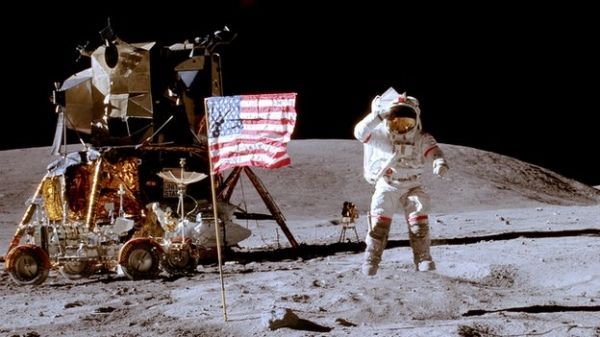
American flag on the moon.
Like
everything else in the Apollo 11 program, the construction,
transportation and raising of the American flag on the moon was
carefully thought out and planned. In 1992, Anne M. Platoff presented a
paper to the annual conference of the American Vexillological
Association on the topic. She covered in detail how NASA engineers
ensured that the flag planting went smoothly:Work on the lunar flag assembly began about three months prior to the Apollo 11 mission. Robert Gilruth, Director of the Manned Spacecraft Center (MSC) (footnote 8) and a member of the Committee on Symbolic Activities, asked Jack Kinzler, Chief of Technical Services Division at MSC, for ideas regarding the EVA. Kinzler suggested that a full-size U.S. flag could be deployed using a specially designed flagpole. He drew up a preliminary sketch (Fig. 2) and the idea was presented to the committee. Working with Deputy Division Chief Dave McCraw, he worked out the details of the lunar flag assembly over several days. The design was based on a number of engineering constraints. For example, to compensate for the lack of an atmosphere on the lunar surface, the flag assembly included a horizontal crossbar to give the illusion of a flag flying in the breeze. (footnote 9)
Two other major constraints were the weight of the assembly and the stowage space required. The team designed the entire assembly to be as lightweight as possible -- when completed it weighed only 9 pounds and 7 ounces. They reduced the size of the package by developing a two-part telescoping pole apparatus with a telescoping crossbar. It was also necessary to design a flagpole that could be easily assembled and deployed by astronauts wearing space suits. Space suits used for the lunar surface EVA were pressurized to approximately 3.7 pounds per square inch and, as a result, the amount of force that the astronauts could apply with their gloved hands was limited and their range of movement was restricted (Fig. 3).
Motopia
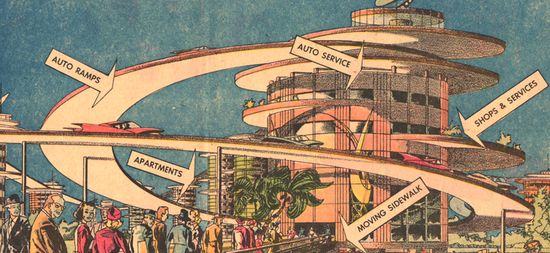
In 1960, British architect Geoffrey Alan Jellicoe proposed the city of the future for suburban London. Motopia was to be a residential town with all roadways elevated to the tops of the buildings. The ground was to be reserved for pedestrians -with moving sidewalks. He even had plans to insulate the overhead roadways to stifle traffic noise!
Planned for construction about 17 miles west of London with an estimated cost of about $170 million, Motopia was a bold—if somewhat impractical plan—for a city built from the ground up. The town was envisioned as being able to have a population of 30,000, all living in a grid-pattern of buildings with an expanse of rooftop motorways in the sky. There would be schools, shops, restaurants, churches and theaters all resting on a total footprint of about 1,000 acres.The biggest draw of the plan was that people never had to worry about being hit by a car. However, we all know that some drivers don't stay on the roadway, and being squashed by a falling car is even more terrifying than being hit by one. Motopia was never built, but you can read more about what could have been at Paleofuture.
Devil's Town And The Village Of Blood

The area is steeped in European folklore and it is little surprise that for centuries these naturally occurring erosions were looked upon with fear and suspicion. The Devil's Town is a series of hundreds of stone pyramids and is located in the watershed between the equally frighteningly named Devil's Gully and Hell's Gully.
Science News
 Sub-Antarctic lake to be explored
Final checks are under way in Antarctica before the launch of
a daring attempt to investigate an ancient lake beneath the ice-sheet.

Porcupine Quills Inspire Medical Devices
By learning how barbs on porcupine quills work, scientists may be able to design needles that hurt less. Read more
Forget Extinct: The Brontosaurus Never Even Existed
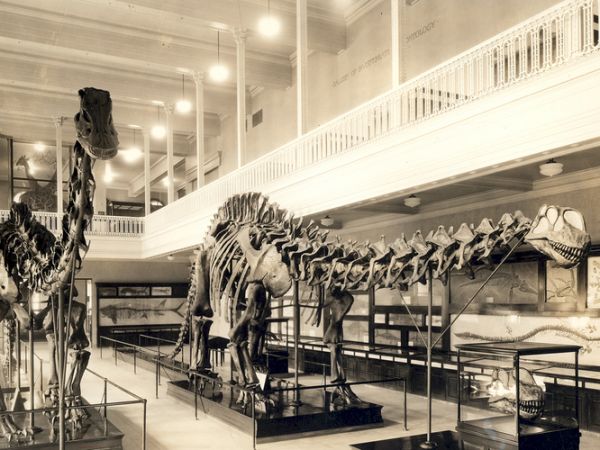
Scientists knew something was funny about the Brontosaurus fossil reconstruction as far back as 1903, and have been telling us there's no such thing since the 1970s. So how did the popular image of the dinosaur Brontosaurus ever come about?
It dates back 130 years, to a period of early U.S. paleontology known as the Bone Wars, says Matt Lamanna, curator at the Carnegie Museum of Natural History in Pittsburgh.Cutting corners led to a "hybrid" fossil that contained the body of an Apatosaurus and the head of a completely different dinosaur. When the correct head was found, it was thought to be a new species, which was named Brontosaurus. Read the complete story at NPR. Still, the Brontosaurus lives on in vintage Sinclair memorabilia and reruns of The Flintstones. More
The Bone Wars was the name given to a bitter competition between two paleontologists, Yale's O.C. Marsh and Edward Drinker Cope of Philadelphia. Lamanna says their mutual dislike, paired with their scientific ambition, led them to race dinosaur names into publication, each trying to outdo the other.
Upping the 'Cute Factor'
30 Baby Animals That Will Make You Go 'Aww'

Just like us, baby animals are curious, naive and big-eyed. Learning to tell right from wrong and the best ways to survive takes time, and definitely gives you some photo opportunities if you're around with a camera to capture it. Take a look at these cute baby animal pictures, radiating all the best vibrations and emotions
Elephant Custody Dispute
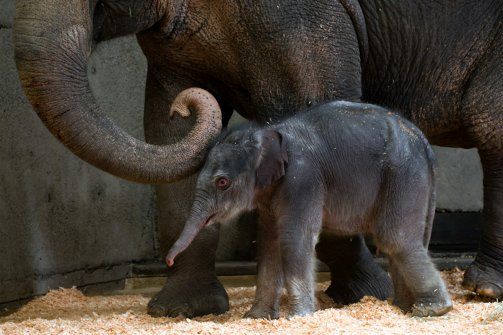
A new baby elephant was born Friday at the Oregon Zoo. The calf, a female, is doing fine so far. But animal rights activists discovered that although the mother belongs to the zoo, the actual owner of the yet-unnamed baby is the private elephant ranch Have Trunk Will Travel. That discovery sparked such an outcry that the zoo felt compelled to call a press conference.
Why the outcry? Coincidentally or not, the Seattle Times published an investigative series the same weekend the yet-to-be-named calf took her first bites of hay. The series’ thesis: pachyderms in captivity die way too often. And one of those stories was about this particular baby, the offspring of Rose-Tu (mom) and Tusko (dad.) About how that baby might be yanked away from her big gray loving mom at some point and shipped off to do tricks for Have Trunk Will Travel, which animal-rights activists accuse of abusing elephants. Turns out, Have Trunk Will Travel actually owns that little baby elephant, Rumpelstiltskin style. The company also owns Rose-Tu’s fourth offspring, and her sixth. And that means the company has the right to take her away.The agreement came about because Have Trunk Will Travel owns the baby's father, Tusko, which was loaned to the zoo for its breeding program. The show may never claim her, but activists don't want to take any chances. Read more about the complicated deal at The Daily Beast.
Monkey wearing winter coat found alone at Ikea
Mystery surrounds a little monkey who surprised shoppers at a Toronto
Ikea on Sunday.
Shoppers encountered the tiny creature adorned in a shearling coat and
diapers running around the store’s upper parking garage at around 2pm

“It was just running around screaming,” said shopper Bronwyn Page. “There was a crowd of us around it and it seemed really scared and agitated.” Security guards at Ikea eventually cornered the animal in the garage elevator and called police. Animal Services soon arrived at the store to pick up the tiny shopper.
“The monkey was in a bit of shock, but it’s calmed down now that we’ve been feeding it some grapes,” said a representative at the North York Animal Services Center. “At least it’s warm and safe now ... It tried to keep warm in the coat the best that an animal of its size could.”

Animal Services said it was unclear where the monkey came from or who its owner was. Police, meanwhile, believe it is unlikely the owner will come forward. “You’ll never find out [who the owner is] because it’s illegal to have exotic animals like that in the city of Toronto,” said Const. Reid of 33 Division. “So we’ll never find out who misplaced their monkey.”

“It was just running around screaming,” said shopper Bronwyn Page. “There was a crowd of us around it and it seemed really scared and agitated.” Security guards at Ikea eventually cornered the animal in the garage elevator and called police. Animal Services soon arrived at the store to pick up the tiny shopper.
“The monkey was in a bit of shock, but it’s calmed down now that we’ve been feeding it some grapes,” said a representative at the North York Animal Services Center. “At least it’s warm and safe now ... It tried to keep warm in the coat the best that an animal of its size could.”
Animal Services said it was unclear where the monkey came from or who its owner was. Police, meanwhile, believe it is unlikely the owner will come forward. “You’ll never find out [who the owner is] because it’s illegal to have exotic animals like that in the city of Toronto,” said Const. Reid of 33 Division. “So we’ll never find out who misplaced their monkey.”

Sunday, December 9, 2012
The Daily Drift

Curious
Some of our readers today have been in:
Dubai, United Arab Emirates
Kuala Lumpur, Malaysia
Tbilisi, Georgia
Shah Alam, Malaysia
Trana, Albania
Algiers, Algeria
Al Jizah, Egypt
Jakarta, Indonesia
Colombo, Sri Lanka
Thanh Pho Ho Chi Minh, Vietnam
Quito, Ecuador
Cebu City, Philippines
Caracas, Venezuela
Manila, Philippines
Hanoi, Vietnam
Sylhet, Bangladesh
Montreal, Canada
Luxembourg, Luxembourg
Montevideo, Uruguay
Riyadh, Saudi Arabia
Surabaya, Indonesia
Abay, Kazakhstan
Karachi, Pakistan
Sofia, Bulgaria
San Juan, Puerto Rico
Cairo, Egypt
Amman, Jordan
Bangkok, Thailand
As Salimiyah, Kuwait
Al Muharraq, Bahrain
Ankara, Turkey
Johannesburg, South Africa
Belgrade, Serbia
Today in History
| 536 | Having captured Naples earlier in the year, Belisarius takes Rome. | |
| 1861 | The U.S. Senate approves establishment of a committee that would become the Joint Committee on the Conduct of War. | |
| 1863 | Major General John G. Foster replaces Maj. Gen. Ambrose E. Burnside as Commander of the Department of Ohio. | |
| 1867 | The capital of Colorado Territory is moved from Golden to Denver. | |
| 1872 | P.B.S. Pinchback becomes the first African-American governor of Louisiana. | |
| 1900 | The Russian czar rejects Boer Paul Kruger's pleas for aid in South Africa against the British. | |
| 1908 | A child labor bill passes in the German Reichstag, forbidding work for children under age 13. | |
| 1917 | The new Finnish Republic demands the withdrawal of Russian troops. | |
| 1940 | The British army seizes 1,000 Italians in a sudden thrust in Egypt. | |
| 1941 | Franklin D. Roosevelt tells Americans to plan for a long war. | |
| 1948 | The United States abandons a plan to de-concentrate industry in Japan. | |
| 1949 | The United Nations takes trusteeship over Jerusalem. | |
| 1950 | President Harry Truman bans U.S. exports to Communist China. | |
| 1950 | Harry Gold gets 30 years imprisonment for passing atomic bomb secrets to the Soviet Union during World War II. | |
| 1955 | Sugar Ray Robinson knocks out Carl Olson to regain the world middleweight boxing title. | |
| 1960 | The Laos government flees to Cambodia as the capital city of Vientiane is engulfed in war. | |
| 1990 | Lech Walesa is elected president of Poland. | |
| 1992 | U.S. Marines land in Somalia to ensure food and medicine reaches the deprived areas of that country. |
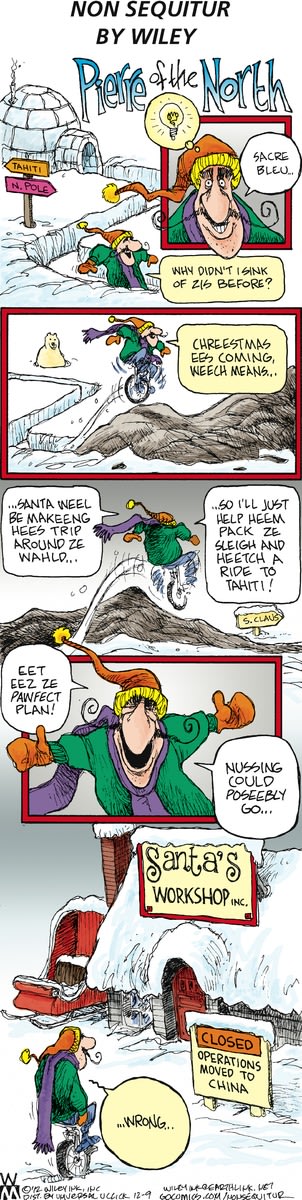
Talk is cheap, it’s time to act
Gore to Obama on climate change
Just as we’re discovering that the tough talk about the “fiscal cliff” is false, and that President Obama and the Democrats appear to possibly be folding, again, on the important topic of climate change, what we’re hearing from the Democrats is more talk than action.Al Gore spent a lot of time in Washington, so he has to be well aware of the ability of the political class to talk a lot, yet do nothing.
As we saw with Hurricane Sandy, the problem of climate change is getting worse and we can’t afford to keep letting the party of ignorance dictate the discussion.
The Hill:
Al Gore is calling on President Obama to make climate change a higher priority in his second term.

“I deeply respect our president and I am grateful for the steps that he has taken, but we cannot have four more years of mentioning this occasionally and saying it’s too bad that the Congress can’t act,” Gore said in New York City on Thursday, Reuters reports.
The remarks come three weeks after Obama pledged to focus on climate but offered no specific second-term plans and noted political hurdles to legislation.
“I don’t know what either Democrats or repugicans are prepared to do at this point, because this is one of those issues that’s not just a partisan issue,” Obama said at a post-election press conference on Nov. 14. If the pathetic “deal” on the fiscal cliff is accurate, there’s little reason to believe that the political class will do anything about climate change either.
Until the Faux News studio is underwater, the repugican flat-earth society will continue to mock Al Gore, and mock climate change, and pretend that it’s not a problem. And the Democrats will continue talking as though they care, but still will do nothing, because they don’t.

Some pretty important words
John Cassidy at the New Yorker ...
"With repugicans in Congress still intent on pursuing a strategy similar to the failed one adopted by the Brits, this is a story that needs trumpeting. Austerity policies are self-defeating: they cripple growth and reduce tax revenues. The only way to bring down the U.S. government’s deficit in a sustainable manner, and put the nation’s finances on a firmer footing, is to keep the economy growing. Spending cuts and tax increases can also play a role, but they need to be introduced gradually. [...] That austerity has led to recession is undeniable. … consumer and investment spending have remained depressed. [...] In adopting a fiscal stimulus of gradually declining magnitude over the past four years, the Obama Administration has administered what was, until recently, the standard medicine for a sick economy. As one would have expected on the basis of the textbooks, the American economy, while hardly racing ahead, has fared considerably better than its British counterpart. [...] Having adopted the policies of Keynes in response to a calamitous recession, the United States has grown more than twice as fast during the past three years as Britain, which adopted the economics of Hoover (and Paul Ryan)."
"With repugicans in Congress still intent on pursuing a strategy similar to the failed one adopted by the Brits, this is a story that needs trumpeting. Austerity policies are self-defeating: they cripple growth and reduce tax revenues. The only way to bring down the U.S. government’s deficit in a sustainable manner, and put the nation’s finances on a firmer footing, is to keep the economy growing. Spending cuts and tax increases can also play a role, but they need to be introduced gradually. [...] That austerity has led to recession is undeniable. … consumer and investment spending have remained depressed. [...] In adopting a fiscal stimulus of gradually declining magnitude over the past four years, the Obama Administration has administered what was, until recently, the standard medicine for a sick economy. As one would have expected on the basis of the textbooks, the American economy, while hardly racing ahead, has fared considerably better than its British counterpart. [...] Having adopted the policies of Keynes in response to a calamitous recession, the United States has grown more than twice as fast during the past three years as Britain, which adopted the economics of Hoover (and Paul Ryan)."

Rural America becoming less relevant

Agriculture Secretary Tom Vilsack has some harsh words for rural America: It's "becoming less and less relevant," he says.
A month after an election that
Democrats won even as rural parts of the country voted overwhelmingly
Republican, the former Democratic governor of Iowa told farm belt
leaders this past week that he's frustrated with their internecine
squabbles and says they need to be more strategic in picking their
political fights.
"It's time for us to have an
adult conversation with folks in rural America," Vilsack said in a
speech at a forum sponsored by the Farm Journal. "It's time for a
different thought process here, in my view."
He said rural America's biggest assets — the food supply,
recreational areas and energy, for example — can be overlooked by people
elsewhere as the U.S. population shifts more to cities, their suburbs
and exurbs."Why is it that we don't have a farm bill?" said Vilsack. "It isn't just the differences of policy. It's the fact that rural America with a shrinking population is becoming less and less relevant to the politics of this country, and we had better recognize that and we better begin to reverse it."
For the first time in recent
memory, farm-state lawmakers were not able to push a farm bill through
Congress in an election year, evidence of lost clout in farm states.
The Agriculture Department says about 50 percent of rural counties
have lost population in the past four years and poverty rates are higher
there than in metropolitan areas, despite the booming agricultural
economy.
Exit polls conducted for The
Associated Press and television networks found that rural voters
accounted for just 14 percent of the turnout in last month's election,
with 61 percent of them supporting Republican Mitt Romney and 37 percent
backing President Barack Obama. Two-thirds of those rural voters said the government is doing too many things better left to businesses and individuals.
Vilsack criticized farmers who have embraced wedge issues such as
regulation, citing the uproar over the idea that the Environmental
Protection Agency was going to start regulating farm dust after the
Obama administration said repeatedly it had no so such intention.In his Washington speech, he also cited criticism of a proposed Labor Department regulation, later dropped, that was intended to keep younger children away from the most dangerous farm jobs, and criticism of egg producers for dealing with the Humane Society on increasing the space that hens have in their coops. Livestock producers fearing they will be the next target of animal rights advocates have tried to undo that agreement.
"We need a proactive message, not
a reactive message," Vilsack said. "How are you going to encourage
young people to want to be involved in rural America or farming if you
don't have a proactive message? Because you are competing against the
world now."
John Weber, a pork producer in
Dysart, Iowa, said Friday that farmers have to defend their industries
against policies they see as unfair. He said there is great concern
among pork producers that animal welfare groups are using unfair tactics
and may hurt their business.
"Our role is to defend our producers and our industry in what we feel are issues important to us," he said.
Weber agreed, though, that rural
America is declining in influence. He said he is concerned that there
are not enough lawmakers from rural areas and complained that Congress
doesn't understand farm issues. He added that the farm industry needs to
communicate better with consumers.
"There's a huge communication gap" between farmers and the food-eating public, he said.
Vilsack, who has made the
revitalization of rural America a priority, encouraged farmers to
embrace new kinds of markets, work to promote global exports and replace
a "preservation mindset with a growth mindset." He said they also need
to embrace diversity because it is an issue important to young people
who are leaving rural areas.
"We've got something to market
here," he said. "We've got something to be proactive about. Let's spend
our time and our resources and our energy doing that and I think if we
do we're going to have a lot of young people who want to be part of that
future."

Hope and fear in gay marriage cases at high court
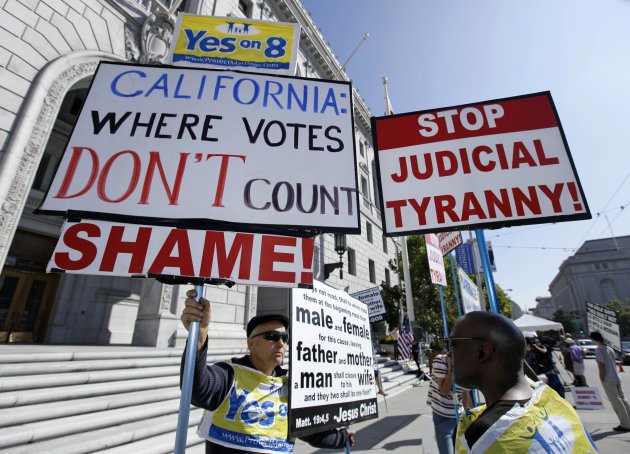
Gay marriage supporters see 41 reasons to fret over the Supreme Court's decision to take up the case of California's ban on same-sex unions.
While nine states allow same-sex
partners to marry, or will soon, 41 states do not. Of those, 30 have
written gay marriage bans into their state constitutions.
That fact is worrisome to those who firmly believe there is a
constitutional right to marry, regardless of sexual orientation, but who
also know that the Supreme Court does not often get too far ahead of
the country on hot-button social issues.
"Mindful of history, I can't help but be concerned," said Mary Bonauto,
director of the Civil Rights Project at Gay and Lesbian Advocates and
Defenders and a leader in the state-by-state push for marriage equality.
Bonauto was speaking before the
court decided on Friday to take up cases on California's constitutional
ban on gay marriage and a federal law that denies to gay Americans who
are legally married the favorable tax treatment and a range of health
and pension benefits otherwise available to married couples.
In 2008, California voters approved the ban, Proposition 8, after the
state Supreme Court ruled that gay Californians could marry. Since
then, a federal appeals court struck down the constitutional provision,
but did not authorize the resumption of same-sex marriages pending
appeal.Bonauto identified three earlier seminal rulings that once and for all outlawed state-backed discrimination, and observed that in each case the number of states that still had the discrimination on the books was far smaller.
Thirteen states still had laws
against sodomy when the court said in 2003 that states have no right to
intrude on the private, personal conduct of people, regardless of sexual
orientation.
Interracial marriage still was illegal in 16 states in 1967 before the high court outlawed race-based state marriage bans.
In 1954, when the court issued
its landmark decision in Brown v. Board of Education, 17 states had
formally segregated school systems.
Cornell University law professor Michael Dorf said those cases illustrate a widespread misperception about the justices.
"There is a commonly held but
inaccurate view that the Supreme Court does is to impose its views on
the country. It very rarely does that. Much more frequently, it will
take a view that is either a majority in some place or a majority of
elite opinion, and speed up acceptance," said Dorf, who was a Supreme
Court law clerk to Justice Anthony Kennedy.
The forces that mounted the legal challenge to Proposition 8 have
said all along that the right to marry is so fundamental that it should
not depend on success at the ballot box or the votes of state
legislatures. Washington lawyer Theodore Olson, representing gay
Californians who wish to marry, said he will argue that there is a
"fundamental constitutional right to marry for all citizens."But are there five justices, a majority of the court, willing to endorse that argument?
The fear among gay marriage proponents is that the court will refuse to declare that states can no longer define marriage as the union of a man and a woman, because to do so might provoke a backlash in public opinion and undermine acceptance of its authority.
A high court loss for gay marriage advocates would prevent same-sex marriages in the nation's largest state. It would not affect the District of Columbia and the nine states — Connecticut, Iowa, Maine, Maryland, Massachusetts, New Hampshire, New York, Vermont and Washington — where gay couples can or soon will be able to marry.
But it could push back the day
that many in the gay rights movement, looking at strong support for gay
marriage among younger Americans, see as inevitable: the Supreme Court's
endorsement of full marriage equality nationwide.
Commenting after the court's action, Bonauto said she believes the
court can uphold an appeals court ruling that struck down Proposition 8
in a way that applies to California only and "leave to a later day
questions about broader bans on committed same-sex couples marrying."Opponents of gay marriage look to another court case, Roe v. Wade, that they say should serve as a cautionary tale. In 1973, the court voted 7-2 to declare that the Constitution protects a woman's right to an abortion.
"Should the Supreme Court decide
to overturn the marriage laws of 41 states, the ruling would become even
more divisive than the court's infamous Roe v. Wade decision," said
Tony Perkins, president of the Family Research Council. "Marriage,
unlike abortion laws in the 1970s, has been incorporated into the state constitutions of 30 states. Voters in these states will not accept an activist court redefining our most fundamental social institution."
To a degree, Perkins and Bonauto get some support from one of the nine people with a say in the matter, Justice Ruth Bader Ginsburg.
In February, Ginsburg questioned
the timing of the abortion decision and suggested it may have
contributed to the ongoing bitter debate about abortion.
"It's not that the judgment was wrong, but it moved too far too fast," Ginsburg said at Columbia University.
At the time of Roe v. Wade,
abortion was legal on request in four states, allowed under limited
circumstances in about 16 others, and outlawed under nearly all
circumstances in the other states, including Texas, where the Roe case
originated.
The court could have put off
dealing with abortion while the state-by-state process evolved, she
said. Or her predecessors could have struck down just the Texas law,
which allowed abortions only to save a mother's life, without declaring a
right to privacy that legalized the procedure nationwide, Ginsburg
said.
"The court made a decision that
made every abortion law in the country invalid, even the most liberal,"
Ginsburg said. "We'll never know whether I'm right or wrong ... things
might have turned out differently if the court had been more
restrained."

Did you know you have stripes?

Though we still don't know where they come from, the current idea is that each tissue patch is made of cells all originating from a single cell during development. The clone cells then follow a set pattern, resulting in Blaschko's lines. The biologist PZ Myers uses the analogy of a clay figurine to describe this idea: "Imagine taking a piece of yellow clay and sandwiching it between two pieces of green clay into a block, and then pushing and stretching the clay block to make a human figurine. The yellow would make a band somewhere in the middle, all right, but it wouldn’t be a simple rectilinear slice anymore — it would express a more complex border that reflected the overall flow of the medium."
Though these stripes are invisible for the majority of people, some conditions cause them to become very visible. The best examples generally come from people who are mosaics/chimeras (mosaics have two or more genetically-distinct cell populations but come from a singly zygote, Chimeras also have geneticially distinct cell groups but come from two zygotes). The stripes betray the different genotypes. Additionally, if one of the genotypes is predisposed toward dermatological conditions, these conditions can develop according to the lines.
They can also become visible in women as a result of X-inactivation, where an X chromosome is shut down in each cell (you may have two, but you only need one to function). Some cells will have the father's X chromosome active, other cells have the mother's. Technically, this means all women are mosaics, because different X chromosomes are silenced in different cells. Visible Blaschko's lines can result from an X-linked skin condition.
So what do they mean? Well, we like Myers' take. "The cool thing about [Blaschko's lines] is that there is a hidden map of your secret history as an individual embedded in silent patterns in your skin - you were not defined as a single, simple, discrete genetic entity at fertilization, but are the product of complicated, subtle changes and errors and shufflings and sortings of cells. We’re all beautiful pointillist masterpieces."
Tax hike proposed for witch doctors
"A Swazi Member of Parliament has urged the government to hike taxes on traditional healers and soothsayers to help solve a funding crisis in Africa's last absolute monarchy."
Most Americans Sit During Commute
Just a fraction of Americans say they incorporate walking or biking during their daily commutes.
Multiple media use tied to depression, anxiety
Using multiple forms of media at the same time – such as playing a computer game while watching TV ...

The World's Most Expensive Cheese
It's Made From Donkey Milk
Produced in Zasavica - one of Serbia's most famous natural reserves - the cheese, known as pule, is made from donkey milk and costs a whopping €1,000 ($1,300) per kilogram.
The Museum of American Packaging

Flickr user Roadsidepictures, has quite a collection of photographs of vintage product packaging from most of the 20th century. Looking through these will surprise you (with items before your time) and bring back memories (with items you recall vividly). Surely I'm not the only one who remembers back when Tang came in metal cans! More
Solar system quilt from 1876
 Amateur astronomer Ellen Harding Baker of Cedar County, Iowa made this
stunning solar system quilt in 1876. The quilt is now in the collection
of the Smithsonian Institution. From the Smithsoian's History Explorer:
Amateur astronomer Ellen Harding Baker of Cedar County, Iowa made this
stunning solar system quilt in 1876. The quilt is now in the collection
of the Smithsonian Institution. From the Smithsoian's History Explorer:
Ellen used the quilt as a visual aid for lectures she gave on astronomy in the towns of West Branch, Moscow, and Lone Tree, Iowa. Astronomy was an acceptable interest for women in the nineteenth century and was sometimes even fostered in their education.

Natural Kazakhstan
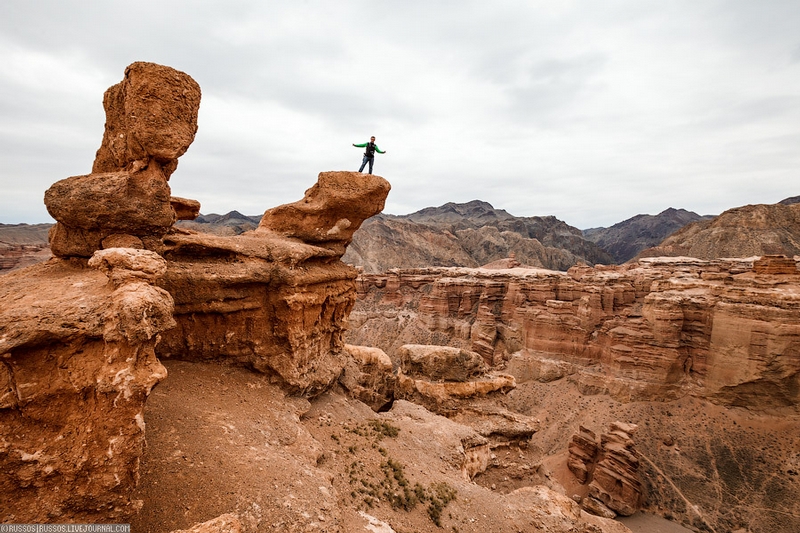
A Russian photographer Alexander Popov went to Kazakhstan to see its nature and take photographs of wonderful Charyn Canyon and a local ski resort Chimbulak. Some of his works are presented below. More
Canadian wingnut government guts protections for 99+% of waterways, spare handful of lakes with high-cost cottages
Canada used to have 2.5 million protected lakes and other
bodies of water.
After recent wingnut Omnibus bills, it's down to 97.
87 of which are located in wingnut ridings (rich cottage country).
Loughareema
The Lake That Randomly Vanishes

Interestingly, the road to Ballycastle runs right through the lake, though the modern road sits high enough to avoid flooding, unlike the original. It is quite possible that even the road engineers who built the road were fooled by the lake's trickery. In former days the route was frequently under water, sometimes for weeks on end, making crossing treacherous.
Incredible Boulder-Strewn Landscapes

Boulders of different shapes and sizes fill these seven stunning
landscapes around the world... Incredible boulder-strewn scenes. More

Fluorescent Coral Reefs
This footage was shot by scuba diving at night with a backlight in the Red Sea, off the coast of Egypt. After you marvel at the lovely bioluminescence of the coral reef, stop and marvel at what an adventure that had to have been. Then you can read more about the bioluminescence of the coral reef at Deep Sea News.
The Extinction of the Great Auk
The Little Ice Age
may have reduced the population of the Great Auk by exposing more of
their breeding islands to predation by Polar Bears, but massive
exploitation for their down drastically reduced the population.
By the mid-16th century, the nesting colonies along the European side
of the Atlantic were nearly all eliminated by humans killing this bird
for its down, which was used to make pillows.
 In 1553, the auk received its first official protection, and in 1794
Great Britain banned the killing of this species for its feathers. In St. John's,
individuals violating a 1775 law banning hunting the Great Auk for its
feathers or eggs were publicly flogged, though hunting for use as
fishing bait was still permitted...
In 1553, the auk received its first official protection, and in 1794
Great Britain banned the killing of this species for its feathers. In St. John's,
individuals violating a 1775 law banning hunting the Great Auk for its
feathers or eggs were publicly flogged, though hunting for use as
fishing bait was still permitted...

If you come for their Feathers you do not give yourself the trouble of killing them, but lay hold of one and pluck the best of the Feathers. You then turn the poor Penguin adrift, with his skin half naked and torn off, to perish at his leisure. This is not a very humane method but it is the common practice. While you abide on this island you are in the constant practice of horrid cruelties for you not only skin them Alive, but you burn them Alive also to cook their Bodies with. You take a kettle with you into which you put a Penguin or two, you kindle a fire under it, and this fire is absolutely made of the unfortunate Penguins themselves. Their bodies being oily soon produce a Flame; there is no wood on the island.It was on the islet of Stac an Armin, St Kilda, Scotland, in July 1840, that the last Great Auk seen in the British Isles was caught and killed. Three men from St Kilda caught a single "garefowl", noticing its little wings and the large white spot on its head. They tied it up and kept it alive for three days, until a large storm arose. Believing that the auk was a witch and the cause of the storm, they then killed it by beating it with a stick.
Subscribe to:
Posts (Atom)
