Welcome to ...

The place where the world comes together in honesty and mirth.
Windmills Tilted, Scared Cows Butchered, Lies Skewered on the Lance of Reality ... or something to that effect.


Sunday, September 29, 2013

Poker cheats used infra-red contact lenses and cards marked with invisible ink

An Italian man has been sentenced to two years in prison after using infra-red contact lenses to count cards marked with invisible ink, in a poker scam. The self-styled "player and cheat of international renown" impressed even the presiding judge for his sophisticated use of "old techniques and high-end technology" to win thousands of pounds at a casino in the French Côte d'Azur resort of Cannes. The court in Grasse heard how Stefano Ampollini, 56 – code name Parmesan – turned up to "Les Princes" casino in the Mediterranean resort in August 2011, wearing a set of infra-red contact lenses purchased online from China for 2,000 euros.
Opposite him on the other side of the stud poker table was a discreet accomplice, code name "The Israeli", who sniffed or snorted to help Ampollini choose the right cards. Two corrupt casino staff members had already marked the cards with invisible ink. Thanks to his special contact lenses, the card shark was then able to keep track of the game, racking up 70,000 euros between them without being caught.

"Casino security found his behavior rather strange as he won very easily and, above all, because he folded twice when he had an excellent hand, suggesting he knew the croupier's cards," said Marc Concas, lawyer for the Groupe Lucien Barrière, which owns the casino. They called the betting police, who launched an investigation. Thanks to telephone surveillance, they worked out that staff members had handed cards over to the Italians who had marked them with invisible ink. They were then placed under cellophane and returned to the casino cupboard, ready for use. When the Italian returned alone two months later, he won 21,000 euros for himself, but was then arrested by police as he left the casino.
Ampollini reportedly smiled as presiding judge Marc Joando marvelled at his sophisticated exploits. That did no stop the court on Wednesday slapping Ampollini with a two-year prison sentence, and 100,000-euro fine. Two other Italians were also convicted. Gianfranco Tirrito, 55, described as an elegant "professional cheat" and "probably the mastermind", was handed down a three-year prison term and 100,000-euro fine. Rocco Grassanno, 57, who claimed to have come to the Côte d'Azur "for tourism and to meet beautiful women", received a 30-month sentence and a 50,000 euro-fine.

Insurance industry pricing climate risk as a dead certainty

Insurance underwriters generally operate in the real world, where science trumps ideology (that's why terrorism insurance is pretty darned cheap -- despite the politically successful posturing of our leaders, terrorism just isn't a very big threat). That's why climate change insurance costs big bucks -- insurers know that it's real, it's coming, and it's really, really bad news.
The difference between the general Big Business propaganda intended to sow doubt about climate science and the cold, hard economic reality of underwriting the risk of climate catastrophe is telling. It's like the Texas Young Earth Creationists who profess a public belief in the 5,000-year-old Biblically accurate planet, but still allow their geoscientists to direct oil-drilling operations in accord with the blasphemous four-billion-year-old Earth. Money talks, bullshit walks.
And the industry expects the situation will get worse. “Numerous studies assume a rise in summer drought periods in North America in the future and an increasing probability of severe cyclones relatively far north along the U.S. East Coast in the long term,” said Peter Höppe, who heads Geo Risks Research at the reinsurance giant Munich Re. “The rise in sea level caused by climate change will further increase the risk of storm surge.” Most insurers, including the reinsurance companies that bear much of the ultimate risk in the industry, have little time for the arguments heard in some right-wing circles that climate change isn’t happening, and are quite comfortable with the scientific consensus that burning fossil fuels is the main culprit of global warming.
“Insurance is heavily dependent on scientific thought,” Frank Nutter, president of the Reinsurance Association of America, told me last week. “It is not as amenable to politicized scientific thought.”
Yet when I asked Mr. Nutter what the American insurance industry was doing to combat global warming, his answer was surprising: nothing much. “The industry has really not been engaged in advocacy related to carbon taxes or proposals addressing carbon,” he said. While some big European reinsurers like Munich Re and Swiss Re support efforts to reduce CO2 emissions, “in the United States the household names really have not engaged at all.” Instead, the focus of insurers’ advocacy efforts is zoning rules and disaster mitigation.


Allies: meth merchants and big pharma

014Laurel County 1493 630 In Mother Jones, Jonah Engle investigates the business of "shake and bake" methamphetamine labs and how legal drug manufacturers fighting to keep Sudafed, Claritin-D, and other medications containing pseudoephedrine available over the counter, or at least "behind the counter" without a prescription, unintentionally help illegal drug manufacturers stay in business. From Mother Jones:
If anyone wondered what would happen if heroin or cocaine addicts suddenly discovered how to make their own supply with a handful of cheap ingredients readily available over the counter, methamphetamine's recent history provides an answer. Since 2007, the number of clandestine meth sites discovered by police has increased 63 percent nationwide. In Kentucky, the number of labs has more than tripled. The Bluegrass State regularly joins its neighbors Missouri, Tennessee, and Indiana as the top four states for annual meth lab discoveries. As law enforcement agencies scramble to clean up and dispose of toxic labs, prosecute cooks, and find foster homes for their children, they are waging two battles: one against destitute, strung-out addicts, the other against some of the world's wealthiest and most politically connected drug manufacturers. In the past several years, lawmakers in 25 states have sought to make pseudoephedrine—the one irreplaceable ingredient in a shake-and-bake lab—a prescription drug. In all but two—Oregon and Mississippi—they have failed as the industry, which sells an estimated $605 million worth of pseudoephedrine-based drugs a year, has deployed all-star lobbying teams and campaign-trail tactics such as robocalls and advertising blitzes.

Man called police to report the theft of his meth and bicycle

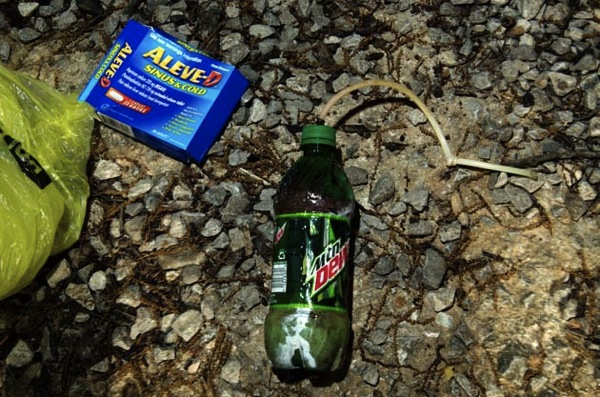
A 22-year-old Kansas man called police to report a man named “Jim” had broken into his mobile home, clubbed him over the head and stolen his meth and bicycle.

The incident occurred at at about 3 a.m. on Thursday, Lt. Steve Kenney said. The victim told police he didn’t know the attacker’s full name, just the name “Jim.”
After forcing his way in through the front door, the suspect hit the victim over the head with an unknown object, taking the victim’s meth and bicycle, Kenney said.

The suspect is a white man who is about 5 feet, 9 inches and weighs just 90 pounds, Kenney said. He has brown hair and was wearing blue jeans.

Scratch and sniff bandit stole fake hair

A woman labelled the 'Scratch and Sniff' bandit is being sought after stealing artificial hair from the Beauty Zone store in Sanford, Florida.
Sanford police said the woman stuffed five packages of artificial hair into her purse and walked out of the store. Police said two other women accompanied the suspect and assisted her by distracting store employees.

Shannon Cordingly, public information officer for the Sanford Police Department, explained how the woman came to be called the "Scratch and Sniff Bandit."

"When you watch the surveillance video, she does a big old scratch down the lower regions of her body area and takes a big old whiff with her nose," said Cordingly. The women left the store in a black 1999 Dodge 4x4 truck, police said.

How 8 Famous Writers Chose Their Pen Names

Ever heard of Charles Dodgson, Józef Korzeniowski, Ruth Crowley, or François-Marie Aroue? Some pen names are fairly well-known for what they are. Most people know that Mark Twain was the alias of Samuel Langhorne Clemens. The outing of Richard Bachman as a pen name used by Stephen King was well-publicized and inspired King's novel, The Dark Half.

Some pen names you don't see coming, though, and assume the name on the book cover is the real deal. Here are eight pen names used by famous writers.

Ten Hero Lawyers Who Helped The Poor And Marginalized

Legal help can be so expensive that the innocent and needy are often forced to suffer because they cannot afford the help they need to legally maintain their rights.

But there is hope for those who cannot hire an expensive lawyer to win a case in their favor: pro bono lawyers across the country are fighting public interest and social justice cases to defend those who deserve but cannot afford adequate legal assistance. Here are ten heroic lawyers whose activism has changed both lives and laws.

Ziggy

http://media.zenfs.com/en_us/News/ucomics.com/zi130928.gif

Simulation accurately captures the evolution of ancient complex societies

The question of how human societies evolve from small groups to the huge, anonymous and complex societies of today has been answered mathematically, accurately matching the historical record on the emergence of complex states in the ancient world.
Simulation accurately captures the evolution of ancient complex societies
Mongol horsemen. Intense warfare is the evolutionary driver of large complex societies, according to a new mathematical model whose findings accurately match those of the historical record in the ancient world [Credit: NIMBioS]
Intense warfare is the evolutionary driver of large complex societies, according to new research from a trans-disciplinary team at the University of Connecticut, the University of Exeter in England, and the National Institute for Mathematical and Biological Synthesis (NIMBioS). The study appears this week as an open-access article in the journal Proceedings of the National Academy of Sciences.

The study's cultural evolutionary model predicts where and when the largest-scale complex societies arose in human history.

Simulated within a realistic landscape of the Afro-Eurasian landmass during 1,500 BCE to 1,500 CE, the mathematical model was tested against the historical record. During the time period, horse-related military innovations, such as chariots and cavalry, dominated warfare within Afro-Eurasia. Geography also mattered, as nomads living in the Eurasian Steppe influenced nearby agrarian societies, thereby spreading intense forms of offensive warfare out from the steppe belt.

The study focuses on the interaction of ecology and geography as well as the spread of military innovations and predicts that selection for ultra-social institutions that allow for cooperation in huge groups of genetically unrelated individuals and large-scale complex states, is greater where warfare is more intense.

While existing theories on why there is so much variation in the ability of different human populations to construct viable states are usually formulated verbally, by contrast, the authors' work leads to sharply defined quantitative predictions, which can be tested empirically.

The model-predicted spread of large-scale societies was very similar to the observed one; the model was able to explain two-thirds of the variation in determining the rise of large-scale societies.

"What's so exciting about this area of research is that instead of just telling stories or describing what occurred, we can now explain general historical patterns with quantitative accuracy. Explaining historical events helps us better understand the present, and ultimately may help us predict the future," said the study's co-author Sergey Gavrilets, NIMBioS director for scientific activities.

Inca ruins discovered in Nazca, Peru

Excavators digging at the archaeological site in Paredones, in Nazca province, have discovered a number of Inca-style stone walls, a find that has some researchers very excited.
Inca ruins discovered in Nazca, Peru
Los Paredones ruins Nazca, Peru [Credit: 123RF]
Prior to this discovery, archaeologists had never found Cusco-style stone construction on the coast. As El Comercio reports, most ancient buildings along the Peruvian coastline were made of adobe. However, the walls at Paredones are unique: they combine a base of specially chiseled and perfectly shaped stones with adobe walls.

Giuseppe Orefici, the director of the dig, told El Comercio that the Cusco-style construction wasn’t just a happy coincidence. “We can confirm that we’re dealing with specialist carvers that were specially brought from Cusco to do this job and raise these walls,” he said.
Inca ruins discovered in Nazca, Peru
Inca wall in Cusco similar in style to the ruins found in Paredones [Credit: WikiCommons]
According to El Comercio, the stones may have been brought from a quarry in the highlands just for this construction. “This is the only case of carved stones that we’ve found on the coast that form a structure similar to what exists in Machu Picchu,” Orefici continued.

El Comercio reports that the area was probably an administrative and ceremonial center that would have been used in the last years of the Inca Empire. Orefici also revealed that they’ve discovered the tomb of an important figure, a man of around 40. According to El Comercio, offerings near the tomb and other evidence found at the site indicate that high-ranking elites may have occupied this site at one time.

Paredones was inhabited between 1470 and 1550 AD, reports El Comercio.

Archaeologists explore the last capital of the Mochica in Northern Peru


Archaeologists working at the Pampa Grande dig site about 50 kilometers outside of Chiclayo have made some fascinating discoveries.
Archaeologists explore the last capital of the Mochica in Northern Peru
The Pampa Grande dig site [Credit:  El Comercio]
El Comercio reports today that investigators have been able to draw some important conclusions about the late Mochica empire from new evidence discovered at Pampa Grande. The Mochica are one of the most well-investigated pre-Columbian cultures in Peru, as archaeologists have found a large number of Mochica sites and artifacts.

Objects found at the Pampa Grande site are helping researchers shed some more light on the last years of the Mochica. According to El Comercio, around the year 600 the El Niño weather phenomenon forced the Mochica authorities to move their capital from the site known as the Huaca Rajada (where the famous tomb of the Lord of Sipán was discovered) to Pampa Grande.

Now, archaeologists at Pampa Grande have discovered monumental architecture, including pyramids 45 meters in height. They’ve also found the remains of adolescent humans and camelids, which may have been placed there as an offering. Excavators have also found elaborate offerings of spondylus, a type of mollusc.

“There are a lot of offerings, but we still can’t say if they were put there for important people, or if maybe they were left there as part of a veneration of the impressive architecture, or if it’s a funerary context, which is also very important in Andean cosmovision,” head archaeologist Luis Chero told El Comercio.

The Mochica flourished in Peru from about 100-800 AD and are known for their skill in pottery.

Possible 'slave' skeletons found on Kenyan coast

Kenyan authorities are investigating some 100 human skeletons, including skulls, discovered in Kijipwa village of the Kilifi County in the coastal region, an area believed to have been a holding ground for African slaves before being sent across the Indian Ocean to the Middle East and other parts of the world.
Possible 'slave' skeletons found on Kenyan coast
Some 100 human skeletons have been discovered in Kijipwa village of the Kilifi County in Kenya's coastal region, an area believed to have been a holding ground for African slaves [Credit: Anadolu Agency]
"The National Museums of Kenya is working with key institutions including the National Environment Authority (NEMA) and the Kilifi County government to assess the site," Jambo Haro, the head of archeology at the Coast National Museums of Kenya, told Anadolu Agency.

Construction workers stumbled on the skeletons as they dug the trenches for the foundation of a new hotel.

Haro, accompanied by officials from NEMA and Kilifi County, visited the site earlier Monday.

"We have stopped the construction of the hotel apartments pending an environmental impact assessment," he asserted.

Haro said the authorities are engaging "both the private developer and the community to ensure no further damage is done to the site."

Haro had first visited the site on Saturday after being alerted by local residents of the excavation and the discovery of a large number of skeletons.

Slave settlement

Haro said most of the skeletons dug from the deep trench had been salvaged and moved to National Museum in Mombasa for safe custody and study. 

He believes the skeleton find had "potentially huge archeological deposits."

The official said the skeletons and all recovered artifacts would be subjected to various scientific analyses to determine the age of the fossils and the ruins to help arrive at a conclusion of who the inhabitants were.

The skeletons are thought to have been for slaves held at a settlement known in history as Kitoka, which existed more than 1,000 years ago.

The ruins of an ancient mosque still stand at the area.

Haro said the area is already recognized by the National Museums of Kenya as a heritage site.

"According to the National Museums and Heritage Act 2006, any site seen to have heritage resources, irrespective of whether it is private or public land, is recognized as such," Haro said.

He said the contractor bought the plot of land on which the new hotel is being constructed from the local community who has been taking care of the site near the ruins of a mosque.

Joseph Tondo, a local elder, told AA that some of the artifacts had already been stolen.

Daily Comic Relief

http://media.zenfs.com/en_us/News/ucomics.com/dp130928.gif

Wind and rain belts to shift north as planet warms

As humans continue to heat the planet, a northward shift of Earth's wind and rain belts could make a broad swath of regions drier, including the Middle East, American West and Amazonia, while making Monsoon Asia and equatorial Africa wetter, says a new study in Proceedings of the National Academy of Sciences.
Wind and rain belts to shift north as planet warms
Western China is growing drier, turning lakes like this one to dust. If wind and rain patterns shift north as the study predicts, drying in this region could continue [Credit: David Putnam]
The study authors base their prediction on the warming that brought Earth out of the last ice age, some 15,000 years ago. As the North Atlantic Ocean began to churn more vigorously, it melted Arctic sea ice, setting up a temperature contrast with the southern hemisphere where sea ice was expanding around Antarctica. The temperature gradient between the poles appears to have pushed the tropical rain belt and mid-latitude jet stream north, redistributing water in two bands around the planet.

Today, with Arctic sea ice again in retreat, and the northern hemisphere heating up faster than the south, history could repeat itself. "If the kinds of changes we saw during the deglaciation were to occur today that would have a very big impact," said the study's lead author, Wallace Broecker, a climate scientist at Columbia University's Lamont-Doherty Earth Observatory.

Marshaling climate data collected from around the world, from tree-rings, polar ice cores, cave formations, and lake and ocean sediments, Broecker and study coauthor, Aaron Putnam, a climate scientist at Lamont-Doherty, hypothesize that the wind and rain belts shifted north from about 14,600 years ago to 12,700 years ago as the northern hemisphere was heating up.

At the southern edge of the tropical rain belt, the great ancient Lake Tauca in the Bolivian Andes nearly dried up at this time while rivers in eastern Brazil slowed to a trickle and rain-fed stalagmites in the same region stopped growing. In the middle latitudes, the northward advance of the jet stream may have caused Lake Lisan, a precursor to the Dead Sea in Jordan's Rift Valley, to shrink, along with several prehistoric lakes in the western U.S., including Lake Bonneville in present day Utah.

Meanwhile, a northward shift of the tropical rains recharged the rivers that drain Venezuela's Cariaco Basin and East Africa's Lake Victoria and Lake Tanganyika. Stalagmites in China's Hulu Cave grew bigger. Evidence for a stronger Asian monsoon during this time also shows up in the Greenland ice cores.
Wind and rain belts to shift north as planet warms
During boreal summer, Earth’s tropical rain belt migrates north. A similar but prolonged shift could happen if the north continues to heat faster than the south, disrupting global rainfall patterns [Credit: Mats Halldin]
The process worked in reverse from about 1300 to 1850, the study authors hypothesize, as northern Europe transitioned from the relatively warm medieval era to a colder period known as the Little Ice Age. Ocean circulation slowed, and sea ice in the North Atlantic Ocean expanded, the climate record shows. At the same time, rainfall declined in Monsoon Asia, leading to a series of droughts that have been linked to the decline of Cambodia's ancient Khmer civilization, China's Ming dynasty and the collapse of kingdoms in present day Vietnam, Myanmar and Thailand.

In the southern hemisphere, the reconstruction of glacier extents in New Zealand's Southern Alps suggests that the mid-latitudes may have been colder during medieval times, supporting the idea of a temperature contrast between the hemispheres that altered rain and wind patterns.

A similar migration of Earth's wind and rain belts happens each year. During boreal summer, the tropical rain belt and mid-latitude jet stream migrate north as the northern hemisphere heats up disproportionately to the south, with more continents to absorb the sun's energy. As the northern hemisphere cools off in winter, the winds and rains revert south.

Sometimes the winds and rains have rearranged themselves for longer periods of time. In the 1970s and 1980s, a southward shift of the tropical rain belt, attributed to air pollution cooling the northern hemisphere, is thought to have brought devastating drought to Africa's Sahel region. The tropical rain belt has since reverted back, and may be moving north, the study authors say, as suggested by a number of recent droughts, including in Syria, northern China, western U.S., and northeastern Brazil.

Consistent with the study, at least one climate model shows the tropical rain belt moving north as carbon dioxide levels climb and temperatures warm. "It's really important to look at the paleo record," said Dargan Frierson, an atmospheric scientist at University of Washington whose modeling work supports the authors' hypothesis. "Those changes were huge, just like we're expecting with global warming."

The study authors acknowledge that their hypothesis has some holes. In the past, changes in sea ice cover drove the temperature gradient between the two hemispheres while today rapidly rising industrial carbon emissions are responsible. So far, there is also no clear evidence that ocean circulation is increasing in the North Atlantic or that the monsoon rains over Asia are strengthening (though there is speculation that sulfate aerosols produced by burning fossil fuels may be masking this effect).

As air pollution in the northern hemisphere declines, temperatures may warm, creating the kind of temperature contrast that could move the winds and rains north again, said Jeff Severinghaus, a climate scientist at Scripps Institution of Oceanography who was not involved in the study.

"Sulfate aerosols will probably get cleaned up in the next few decades because of their effects on acid rain and health," he said. "So Broecker and Putnam are probably on solid ground in predicting that northern warming will eventually greatly exceed southern warming."

Late Cretaceous Period was likely ice-free

For years, scientists have thought that a continental ice sheet formed during the Late Cretaceous Period more than 90 million years ago when the climate was much warmer than it is today. Now, a University of Missouri researcher has found evidence suggesting that no ice sheet formed at this time. This finding could help environmentalists and scientists predict what the earth's climate will be as carbon dioxide levels continue to rise.
Late Cretaceous Period was likely ice-free
In the study, MacLeod examined fossils of organisms that lived 90 million years ago. This photo is an image from a Scanning electron microscope of a planktic (left) and benthic (right) foraminifera from Tanzania. Both shells are less than 0.5 millimeters across [Credit: University of Missouri]
"Currently, carbon dioxide levels are just above 400 parts per million (ppm), up approximately 120 ppm in the last 150 years and rising about 2 ppm each year," said Ken MacLeod, a professor of geological sciences at MU. "In our study, we found that during the Late Cretaceous Period, when carbon dioxide levels were around 1,000 ppm, there were no continental ice sheets on earth. So, if carbon dioxide levels continue to rise, the earth will be ice-free once the climate comes into balance with the higher levels."

In his study, MacLeod analyzed the fossilized shells of 90 million-year-old planktic and benthic foraminifera, single-celled organisms about the size of a grain of salt. Measuring the ratios of different isotopes of oxygen and carbon in the fossils gives scientists information about past temperatures and other environmental conditions. The fossils, which were found in Tanzania, showed no evidence of cooling or changes in local water chemistry that would have been expected if a glacial event had occurred during that time period. 

"We know that the carbon dioxide (CO2) levels are rising currently and are at the highest they have been in millions of years. We have records of how conditions have changed as CO2 levels have risen from 280 to 400 ppm, but I believe it also is important to know what could happen when those levels reach 600 to 1000 ppm," MacLeod said. "At the rate that carbon dioxide levels are rising, we will reach 600 ppm around the end of this century. At that level of CO2, will ice sheets on Greenland and Antarctica be stable? If not, how will their melting affect the planet?"

Previously, many scientists have thought that doubling CO2 levels would cause earth's temperature to increase as much as 3 degrees Celsius, or approximately 6 degrees Fahrenheit. However, the temperatures MacLeod believes existed in Tanzania 90 million years ago are more consistent with predictions that a doubling of CO2 levels would cause the earth's temperature could rise an average of 6 degrees Celsius, or approximately 11 degrees Fahrenheit.

"While studying the past can help us predict the future, other challenges with modern warming still exist," MacLeod said. "The Late Cretaceous climate was very warm, but the earth adjusted as changes occurred over millions of years. We're seeing the same size changes, but they are happening over a couple of hundred years, maybe 10,000 times faster. How that affects the equation is a big and difficult question."

Astronomers discover densest galaxy ever

Imagine the distance between the sun and the star nearest to it -- a star called Alpha Centauri. That's a distance of about 4 light years. Now, imagine as many as 10,000 of our suns crammed into that relatively small space.
Astronomers discover densest galaxy ever
Astronomers have discovered what may be the densest galaxy in the nearby universe. The team that discovered the rare ultra-compact dwarf galaxy was led by MSU’s Jay Strader. The larger image was captured by NASA’s Chandra X-ray Observatory. The inset photo of the galaxy was taken by the Hubble Space Telescope [Credit: X-ray: NASA/CXC/MSU/J.Strader et al, Optical: NASA/STScI]
That is about the density of a galaxy that was recently discovered by an international team of astronomers led by a Michigan State University faculty member.

"This galaxy is more massive than any ultra-compact drawfs of comparable size," said Jay Strader, MSU assistant professor of physics and astronomy, "and is arguably the densest galaxy known in the local universe."

As detailed in the recent edition of the publication Astrophysical Journal Letters, the ultra-compact dwarf galaxy was found in what's known as the Virgo cluster of galaxies, a collection of galaxies located about 54 million light years from our own Milky Way.

What makes this galaxy, dubbed M60-UCD1, so remarkable is that about half of its mass is found within a radius of only about 80 light years. This would make the density of stars about 15,000 times greater than found in Earth's neighborhood in the Milky Way.

"Traveling from one star to another would be a lot easier in M60-UCD1 than it is in our galaxy," Strader said. "Since the stars are so much closer in this galaxy, it would take just a fraction of the time."

The discovery of ultra-compact galaxies is relatively new -- only within the past 10 years or so. Until then, astronomers could see these "things" way off in the distance but assumed they were either single stars or very-distant galaxies.

Another intriguing aspect of this galaxy is the presence of a bright X-ray source in its center. One explanation for this is a giant black hole weighing in at some 10 million times the mass of our sun.

Astronomers are trying to determine if M60-UCD1 and other ultra-compact dwarf galaxies are either born as really jam-packed star clusters or if they are galaxies that get smaller because they have stars ripped away from them. The possible massive black hole, combined with the high galaxy mass and sun-like levels of elements found in the stars, favor the latter idea.

A giant black hole at the center of M60-UCD1 helps tip the scales against the scenario where this galaxy was once a star cluster, since such large black holes are not found in these types of objects.

The galaxy was discovered using NASA's Hubble Space Telescope. Follow-up observations were done with NASA's Chandra X-ray Observatory and ground-based optical telescopes, including the Keck 10-meter telescope in Hawaii.

"Twenty years ago we couldn't have done this," Strader said. "We didn't have Hubble or Chandra. This is one of those projects where you bring together the full force of NASA's great observatories, plus ground-based resources."

Goldendoodle doggie-paddled for 2 hours before rescue from well in human body bag

A dog that plunged 23 feet into water in a 37-foot-deep well had to swim in a tiny circle for almost two hours before rescuers were able to bring him back to the surface. Arch and Judy Hopkins had been having water problems at their house in Granville, Putnam County, Illinois, and had hired someone to look at their well. They had opened the top of the well when Doogie, an 8-year-old goldendoodle, came running up to greet the well man and landed right in the open well, Arch said. “It was horrifying,” he said. The men got a light to look into the well.
“He was hanging on the brick edge of the well or dog paddling,” Arch said. “We knew he was at least alive.” They immediately called 911. Fire chief Mike Skowera said firefighters arrived, lowered a gas monitor into the well and determined the oxygen level was okay, though slightly lower than normal. He said the dog could be seen down in the well, treading water and occasionally putting out its legs to wedge itself from wall to wall to rest a bit. The department set up a sturdy tripod above the well, and firefighter Kyle Camatti rappelled down.
He could not immediately determine a way to safely raise the dog back up the well, however. The problem was, everything the department normally has for extraction work or harnesses is made for people. “The major delay was trying to figure out what to get around this dog,” Skowera said. They didn’t want to try one of the harnesses for humans and then possibly drop the dog. They brought the firefighter back up and decided to use a sturdy, nylon mesh body bag that they might otherwise have to use for recovery of bodies after drowning. Air and water could pass through, so the bag wouldn’t fill up with water and weigh 1,000 pounds and the dog would be able to breathe.
“Kyle went back down and somehow got Doogie into the body bag. Then they hauled Doogie up first. It was very impressive,” Arch said. Doogie appeared to be okay after the two-hour ordeal. “He just jumped up and started kissing everybody,” Hopkins said. Veterinarian Allison Spayer immediately came to the scene when she was called by Judy Hopkins. Once Doogie was rescued, she examined him, finding no injuries other than a bruised lip and a scratch on his eye, Hopkins said. “He’s amazingly resilient,” Arch said. “His body temperature even was good.” Arch and Judy Hopkins were very impressed with how the crew handled the situation. Arch said they were very professional and concerned for Doogie’s well-being. “It was a happy ending,” Arch said.

There's a news video here.

Animal Pictures

this-is-wild:

Mandrill(joke kok)

Saturday, September 28, 2013

The Daily Drift

Well, doggies ...

Carolina Naturally is read in 193 countries around the world daily.
 
 Love Note ... !


Today is Love Note Day  
 

Don't forget to visit our sister blog: It Is What It Is

Some of our readers today have been in:
The Americas
Santiago, Chile
Byward Market, Montreal, Sioux Lookout, Sarnia, Britannia, Ottawa and New Westminister, Canada
Managua and Tipitapa, Nicaragua
Buenos Aires, Argentina
Cayey, Puerto Rico
Bridgetown, Barbados
Panama, Panama
Rio De Janeiro and Sao Paulo, Brazil
Asuncion, Paraguay
Ladysmith, Oakland, Hollywood, Savannah, Pewaukee, Philadelphia, Tulsa, Phoenix and Plano, United States
Montevideo, Uruguay
Europe
Slough and Nottingham, England
Warsaw, Poland
Luxembourg, Luxembourg
Istanbul and Sisli, Turkey
Kharkiv and Mala Danylivka, Ukraine
Ivrea, Arezzo, Rome, Milan and Cormano, Italy
Madrid, Derio, Basauri, Alicante and Valencia, Spain
Sarajevo and Tuzla, Bosnia and Herzegovina
Chelyabinsk, Russia
Bucharest, Romania
Oslo, Norway
Kongens Lyngby, Denmark
Stockholm, Sweden
Rouen and Bais, France
Dublin, Ireland
Vantaa, Finland
Vilnius, Lithuania
Maribor, Slovenia
Lisbon, Portugal
Athens, Greece
Vinicne Sumice, Czech Republic
Ulm, Germany
Asia
Kuching, Malaysia
Dhaka, Bangladesh
Bangkok, Thailand
Lahore, Pakistan
Karaj, Tehran, Qazin and Mashhad, Iran
Colombo, Sri Lanka
Bangalore, Shillong, Thiruvananthapuram, Pune, Mumbai, Bhubaneshwar, Noida, Hyderabad, New Delhi and Jodhpur, India
Singapore, Singapore
Tel Aviv, Israel
Kuwait, Kuwait
Doha, Qatar
Riyadh, Saudi Arabia
Dubai, United Arab Emirates
Bejing, Guangzhou, China\
Tokyo, Japan
Africa
Cape Town, Pretoria and Johannesburg,  South Africa
Agadir, Morocco
Cairo, Egypt
Pacific
Cagayan De Oro and Makati, Philippines
Homebush, Australia

Today in History

48 BC On landing in Egypt, Pompey is murdered on the orders of Ptolemy.
855 The Emperor Lothar dies in Gaul, and his kingdom is divided between his three sons.
1066 William, Duke of Normandy, soon to be known as William the Conqueror invades England.
1106 King Henry of England defeats his brother Robert at the Battle of Tinchebrai and reunites England and Normandy.
1238 James of Aragon retakes Valencia, Spain, from the Arabs.
1607 Samuel de Champlain and his colonists return to France from Port Royal Nova Scotia.
1794 The Anglo-Russian-Austrian Alliance of St. Petersburg, which is directed against France, is signed.
1864 Union General William Rosecrans blames his defeat at Chickamauga on two of his subordinate generals. They are later exonerated by a court of inquiry.
1874 Colonel Ronald Mackenzie raids a war camp of Comanche and Kiowa at the Battle of Palo Duro Canyon, Texas, slaughtering 2,000 of their horses.
1904 A woman is placed under arrest for smoking a cigarette on New York's Fifth Avenue.
1912 W.C. Handy's "Memphis Blues" is published.
1913 Race riots in Harriston, Mississippi, kill 10 people.
1924 Three U.S. Army aircraft arrive in Seattle, Washington after completing a 22-day round-the-world flight.
1928 Sir Alexander Fleming discovers penicillin when he notices a bacteria-killing mold growing in his laboratory; it remained for Howard Florey and Ernst Chain to isolate the active ingredient, allowing the "miracle drug" to be developed in the 1940s.
1939 Nazi Germany and the Soviet Union agree on a division of Poland; Warsaw surrenders to German troops.
1958 France ratifies a new constitution.
1959 Explorer VI, the U.S. satellite, takes the first video pictures of earth.
1961 Military coup in Damacus ends the Egypt-Syria union known as the United Arab Republic that was formed Feb. 1, 1958.
1963 Roy Lichtenstein's pop art work Whaam!, depicting in comic-book style a US jet shooting down an enemy fighter, is exhibited for the first time; it will become one of the best known examples of pop art.
1995 Israel's Prime Minister Yitzhak Rabin and Palestinian Liberation Organization (PLO) leader Yasser Arafat sign an interim agreement concerning settlement on the Gaza Strip.
1996 Afghanistan's former president (1986-92) Mohammad Najibullah tortured and murdered by the Taliban.
2008 SpaceX launches the first private spacecraft, Falcon 1.

Non Sequitur

http://media.zenfs.com/en_us/News/ucomics.com/nq130927.gif

Should You Take Your Lottery Winnings in a Lump Sum or Annual Payments?


Playing the lottery, at least on a national scale, is often called "a tax on people who are bad at math." The odds of winning the top prize in the Powerball lottery are a constant 1 in 175 million. The number of people who buy lottery tickets does not affect the odds of winning, but it does affect the odds that more than one winner will have to split the jackpot.

That said, there can be benefits from buying a ticket even when you don't win, up to a point. If you buy a raffle ticket that will benefit a charity, you've made a donation. If you get as much pleasure out of hoping to win on your $2 ticket as you would have gotten out of the $2 candy bar you otherwise would have bought, then it's worth the $2. But if you buy more tickets, the net worth goes down as it cuts into the family's grocery budget. And if you will be sorely disappointed when you don't win, the value of the initial pleasure is wiped out.

But what happens when you win the jackpot? Business Insider take a look at the option you have of taking the winnings in a lump sum vs. an annual payout plan. They crunch the numbers as far as taxes and investments go. Taxes are going to take a lot of the money either way, but when the jackpot is $400 million, does that really matter? The real difference is in whether you invest your winnings. A decent investment plan will make a lump sum pay off big over time.
What the article does not cover are real-life headaches for a lottery winner. Here are your estimated payouts, which will vary depending on your state taxes:
You can take the cash up front. This is a $223.6 million check. After paying federal taxes on it, we calculated that you'd have $135.1 million left. Not bad.

You could also take the annuity, which pays $400 million over 30 years with an increasing annuity — $7.1 M the first year, $7.4M the next, increasing up to $22.2M in the 30th year — and pay the top rate every year for the next thirty. That makes the $400 million jackpot worth, assuming the tax rates don't change from here to 2043, $242.9 million after federal taxes.
Now factor in all your relatives, who know you've won a $400 million lottery. If you don't make each and every one of them a millionaire, they will be very disappointed. And you can't do that on $7 million. You have more relatives than you realize. You can set up large trusts for your children, but what about your grandchildren, nephews, siblings, and cousins? None of them will understand why you have to draw a line somewhere. You can hand out $10,000 at a time, but there will be at least one of your grandchildren and quite a few cousins who will spend it within weeks and come back for more. For years. Until they hate you, and vice versa. Of course, not all of your relatives are like that, but you don't know until you are confronted with vast wealth.

Here's another scenario: Say you have four children, and you want to treat them all equally. You set them each up with, say, a $10 million trust that pays out when they are adults. Maybe even as an annuity. Then those children grow up. Child one uses the money to buy a house (or two or three), set money aside for retirement, put their kids through college, invest for their heirs, and doesn't brag about how much money they have. Child two gives the entire amount to their church, and lives a marginal existence while working a low-wage job. Child three never works, becomes a drug addict, and refuses to have anything to do with the rest of the family. Child four enjoys the money, becomes a real ass, abuses his household servants, and invests in third-world sweatshops. Are you now regretting your promise to treat them all the same and give them money you no longer control?  
Those of a certain age will also need to factor in how long you expect to live to enjoy that money.

Oh sure, it's fun to dream. The question "What would you buy if you won $400 million?" is kind of silly, because you could buy whatever strikes your fancy. A more thoughtful question is "What would you do if you won $100,000?" That takes some real decision-making skills, because it's a large but limited amount that will not allow you to quit your job forever. The idea forces you to choose the most important things to do with your money. I once had some great ideas for this $100K, but now it would be a simple case of paying off my debts and using what little is left over to help pay my kids' college tuition. My life would not change much at all, except I'd have less stress.

What would you do with $100,000? What would you do with $400 million: would you take the lump sum or the annuity? How would you handle distributing that money? The question is moot for today; the $400 million winner has emerged, and the Powerball jackpot sits at $60 million. Which isn't bad, either.   

Did you know ...

About the gang rape epidemic in India

About the 10 members of congress who voted against food stamps that receive farm subsidies

That the charter school gravy train runs express to fat city

twitter v. facebook: a tale of two sites

Bill Clinton Shatters the repugican Attempts to Blame Obama For a Government Shutdown

clinton-stand-up-to-gop 
Former President Bill Clinton is pushing back, and pushing back hard against the Republican attempts to blame President Obama an the Democrats for a government shutdown.

Transcript:
CLINTON: If I were the president, I wouldn’t negotiate over these draconian cuts that are going to take food off the table of low-income working people, while they leave all the agricultural subsidies in for high-income farmers and everything else. I just think it’s — it’s chilling to me. The entitlement spending is going down as the unemployment rate drops and the economy grows. Half of the deficit has already disappeared. The rest of it, well this is just, it seems almost spiteful.
STEPHANOPOULOS: But doesn’t it all come undone if there is a default? I mean all this saying you’re not going to negotiate, you’re betting on the other side caving.
CLINTON: That’s right. This is the House repugicans and the tea party people saying we don’t want to negotiate with the Democrats. We want to dictate over the Senate, over the House Democrats, over the Speaker of the House of our own party, and over the president. We insist on dictating the course of the country.
STEPHANOPOULOS: So you’re saying that you just have to stand up to that, no matter what the consequences?
CLINTON: I think you do, because they haven’t asked for negotiations.
Former President Clinton made two points that the media is overlooking. The repugicans aren’t negotiating. They issued a series of public demands. Public ultimatums and demands are not the characteristics of a serious negotiation. The second point is critical. While repugicans have been complaining in the media that the president won’t negotiate with them, they haven’t asked for any negotiations. In fact, they aren’t speaking to the White House at all.
The idea that Obama is to blame for something that the constitutional responsibility of the House repugicans would be laughable if it didn’t demonstrate an ignorance in both the media and the public that the repugicans are happily exploiting. The reality is that Democrats have to stand up to the tea party extremists in the House and Senate. One compromise will only lead to more demands. The crisis aren’t going to stop.
It is a failed premise to assume that the group steering the House repugican caucus is composed of reasonable people who will sit down and fairly negotiate solutions to our problems. Instead of flexibility and reason, the Democrats are being opposed by inflexible ideologues. They aren’t going to stop. House repugicans don’t want to negotiate. They are trying to conqueror.
This is why all Democrats must stand united, and say no. Appeasement will only embolden. The House repugicans will only back down when they are defeated. Toughness and resolve always triumphs over extremism. Obama is doing the right thing, and Democrats need to show their support.

Know the difference!

The repugicans Want All Americans to Be Greedy Shills

Paul Ryan.The repugican cabal officially does not give a rat's ass about you or me.
Recently we shared how on the night that the president was first inaugurated, a group of senior repugican senators and congressmen including Paul Ryan and Jim DeMint got together at the Caucus Room restaurant and pledged to do everything they could to obstruct and destroy his presidency.
Congressman Pete Sessions later told the National Journal that their strategy was derived from the Taliban. He said that they learned from the Taliban how to "disrupt" a party or person's patterns, and, if they didn't get what they wanted from the president, would become a "Taliban insurgency."
Now comes a list, which will almost certainly not show up on repugican cabal TV, a.k.a. Faux so-called News, or on repugican cabal radio, a.k.a. wingnut hate speach radio, that shows clearly and says loudly the real priorities of the repugican cabal.
And those priorities have nothing to do with you or me, except in as how they want to let giant transnational corporations and billionaires steal more of our money and destroy more of our nation's commons.
The repugicans have issued their demand list in exchange for their hostage taking of the nation's debt ceiling.
The list is pretty simple and quite illustrative.
In order to raise the debt ceiling so that the United States government can pay off bills from the shrub's wars, bills already run up and committed to by the repugican cabal, they are demanding that President Obama do the following:
First, repugicans say the president must approve the Keystone pipeline right now. This of course is a pipeline on to buy a foreign corporation – TransCanada – which will transport foreign Canadian oil from a foreign country – Canada – to refineries owned in part by the Koch brothers along the Gulf Coast where it will be converted into diesel fuel and gasoline for export to China, Mexico, Brazil, and England. TransCanada itself has said that this pipeline will raise the cost of gasoline in the United States, because instead of refining it in the Midwest for domestic uses they are doing now, they will be able to refine it at the Gulf seaports where they can load it on giant tankers and ship it to other countries. So for the first repugican priority, billionaires get richer, oil companies get richer, foreign countries get Canadian oil, and Americans who drive get screwed – and get to keep the pollution and its attendant cancers from the refining process.
Second, repugicans say the president should postpone giving health care to 50 million uninsured Americans for at least a year. They also want him to cut $120 billion out of the Medicaid program, which is health care for poor people, mostly poor children, the disabled, and the poor elderly. Nobody can quite explain why they are so adamant about this. If Obamacare is going to be a big failure, you'd think they would want it to go into effect right away so the president could have egg on his face. So...could it be that they are afraid people will like it as much as people like Medicare and Social Security – two other programs that they fought tooth and nail and still hate – and thus it will be even harder to get rid of the future?
Third, repugicans demand that the president must abolish the Consumer Protection Bureau. They do not want you or me to be protected from predatory big banks, and they want to make it easier for banksters to get away with multibillion-dollar crimes and multimillion-dollar paydays. It's frankly astounding that they can even say this with a straight face.
Fourth, before they'll pay the bills for the shrub's wars, repugicans demand that the president make the big oil industry and its billionaire owners like the Koch brothers even more profitable, by cutting back on clean air standards and EPA regulations that save millions of lives and reduce Climate Change. They also want the president to give more of your and my federal lands to the giant oil companies and their billionaire owners. What do we get out of this? Nothing. What do the Koch brothers, who fund the tea party repugicans in Congress, get out of it? Billions.
If the president doesn't do all these things, repugicans say, they will refuse to raise the nation's debt ceiling so that we can pay for the bills brought up the shrub.
It's frankly astounding how the repugican cabal has officially given up even the pretense of caring about average Americans. They are now proudly the cabal of the billionaires and the transnational corporations.
The interesting question now is how much work repugican radio and TV will have to do to cover this up, and how long it will be before repugican-voting working-class Americans figure out what the hell is really going on here.

Secret Cold War documents show NSA spied on senators

President Lyndon B. Johnson meeting with members of his civil rights cabinet on 18 January including, from left to right, Martin Luther King Jr., Whitney Young, and James Farmer. King and Young were both future targets of the NSA watch list system. (Photo from Lyndon B. Johnson Presidential Library, On-line Photo Archive, W425-21).
New, historic NSA weirdness, as reported by Matthew M. Aid and William Burr at Foreign Policy:
As Vietnam War protests grew, the U.S. National Security Agency (NSA) tapped the overseas communications of prominent American critics of the war -- including a pair of sitting U.S. senators. That's according to a recently declassified NSA history, which called the effort "disreputable if not outright illegal."
The identities of the NSA's surveillance targets were kept secret for decades, but an Interagency Security Classification Appeals Panel decision in response to an appeal by the National Security Archive at George Washington University, has resulted in the declassification of these NSA records for the first time. Read more at the National Security Archives (not to be confused with the National Security Administration, also known as the NSA).

Daily Comic Relief

http://media.zenfs.com/en_us/News/ucomics.com/dp130927.gif

Scientists Invent Lightsaber, Claim Dubious Blog Headlines

Physicists Mikhail Lukin (Harvard) and Vladan Vuletic (MIT) claim to have invented a new form of matter: photons that act as though they have mass. I have no idea if it's true. But I am certain that Prof. Lukin knows exactly how to get media attention:
"Photonic molecules," however, behave less like traditional lasers and more like something you might find in science fiction – the light saber.
"Most of the properties of light we know about originate from the fact that photons are massless, and that they do not interact with each other," Lukin said. "What we have done is create a special type of medium in which photons interact with each other so strongly that they begin to act as though they have mass, and they bind together to form molecules. This type of photonic bound state has been discussed theoretically for quite a while, but until now it hadn't been observed.
"It's not an in-apt analogy to compare this to light sabers," Lukin added. "When these photons interact with each other, they're pushing against and deflect each other. The physics of what's happening in these molecules is similar to what we see in the movies."

AIG chief lamely apologizes for comparing outrage over bonuses to lynchings of Black people

The head of insurer American International Group (AIG) offered a half-assed apology for his "poor choice of words" today after outrage spread over his comments likening criticism of banker bonuses with the racist torture and murder of African-Americans in the South. Outrage over bonuses paid to bankers "was intended to stir public anger, to get everybody out there with their pitch forks and their hangman nooses, and all that -- sort of like what we did in the Deep South . And I think it was just as bad and just as wrong," he previously said.

New Prime Minister of Australia Can't Move into His Official Residence Because It's Infested with Possums

The Lodge, the official residence of the Prime Minister in Canberra, is overrun with possums. They're causing embarrassment. The Daily Telegraph reports:
Former prime minister Julia Gillard once recalled an embarrassing dinner with a visiting foreign leader in 2012 which was interrupted by possum urine dribbling from the roof towards a valuable painting.
"We had a celebrated incident where we had a visiting foreign leader," she told the Sunday Telegraph.
"There was much shooing of people out of the dining room because someone spotted wee making its way down the wall to one of the very precious paintings from the National Gallery."
The Lodge is currently undergoing restoration. In the meantime, the newly-elected Tony Abbott is living in a nearby flat with police recruits. He says that he doesn't mind.

Ziggy

http://media.zenfs.com/en_us/News/ucomics.com/zi130927.gif

Police officer handcuffed teenage girls and made them walk through manure in their socks

A police officer who forced two 15-year-old girls to walk shoeless through manure after being handcuffed and driven to a farmyard has avoided jail after ­quitting the force. Robert Ovenstone, 32, took teenagers from a care home to a nearby farm after a callout over ­disruptive behavior. There, he forced the girls to walk in darkness down a manure-covered farm track in their socks.

Ovenstone and his co-accused, 31-year-old Stuart Kelman, admitted behaving in a threatening manner during the incident in Invergordon, Easter Ross, in July 2011. Kevin McCallum, defending Ovenstone, told Tain Sheriff Court that Ovenstone had quit his job, adding: “He has already paid a heavy price for a bad decision with good intentions.
“The intention was to teach the young people a lesson and encourage them to mend their ways.” Sheriff Jamie Gilchrist QC dismissed the claim that Ovenstone was carrying out “old-fashioned policing”. The sheriff told ­Ovenstone that he should never have become a policeman in the first place. He said: “You hark back to some apparent golden age where it is claimed matters were dealt with by a clip round the ear.

“You abused the position of power you were in and I take a very serious view of what you did.” Ovenstone also admitted a charge of threatening a young boy at the same care home on the same night. Sentencing him to 240 hours of community service, the sheriff added: “There is little to gain by sending you to prison.” Kelman, who had told Ovenstone “That’s enough” when the girls were ordered to walk down the farm track, was fined £1500. He is still suspended by the police.

Woman who entered half-marathon won full marathon by mistake

Meredith Fitzmaurice never dreamed she’d win Sunday’s Run for Heroes Marathon in Amherstburg, Ontario, Canada. Especially since the Belle River runner planned to run the half marathon and not the full 26.2-mile race. But a wrong turn sent her onto the marathon course. “I just run with my watch, so I was watching my time since I planned to do my half in under 1:28,” she said. “I was doing the race as training for my first full marathon in Detroit. But I’m looking at the time and wondering where the finish line is.” Fitzmaurice, 34, asked one of the bike officials on the course where the turn was for the half marathon, although she admits by that point she pretty much figured out what she had done.

“Once I realized what I had done, I figured well I’ll just run 20 miles and use it as a long run and call it a day,” she said. But as she headed back from the turn-around in River Canard she started to count people ahead of her. She realized there were only nine men ahead, and no women. She asked the official on the bike if she finished the marathon, even though she was signed up for the half, if it would count as a finish and, more importantly, would she be able to use her time as a Boston Marathon qualifier. “The official said he was going to ask the race director and he’d be back,” she said. “So as I’m running I’m wondering if my race is going to count, I’m thinking about my friend who is at the finish line probably wondering where I am since I have the keys to the car. And my neighbor, who was going to be waiting for me at the finish line. I knew they were going to be worried about me. “
The bike official finally came back and said the race director, Chris Uszynski, would honor her race as a completion in the full distance. “While I was waiting for a response I wasn’t sure what to do,” she said. “I felt really good but I was scared because I hadn’t planned to run 26.2 miles that day and was worried if it didn’t count that I would burn myself out for Detroit.” So Fitzmaurice decided to continue on. She asked the official on the bike if he’d keep her company. As Fitzmaurice got near the finish line at the arena on Meloche Road the feeling was “surreal.” People were high-fiving her and telling her she was the first woman and to keep going. “I had only ever run 20 miles, but I think at that point the adrenalin just pulled me through,” she said. “I just kept thinking you can do this, just get it done. The last couple miles were really tough.”

When Fitzmaurice crossed the finish line in a time of 3:11:48 she was the first woman, 10th overall and had qualified for Boston. “I thought I was only running a half marathon so I really gave it out there,” she said. “If I knew I was going to be running the full marathon I probably wouldn’t have ran so fast. So maybe it was a good thing.” And, as for making the wrong turn, Fitzmaurice said when she got to the corner it was pretty quiet and there weren’t a lot of runners around her. She blames the mistake on the fact she had her headphones on and was definitely in a zone. “I just missed it,” she said. “I didn’t do it on purpose. When I crossed the finish line I saw my friend and I started to cry and then I hugged the guy on the bike. Without him I wouldn’t have been able to do it. This was my first one and even though my family was disappointed they weren’t there to see it, maybe this was meant to be. I was alone and maybe this was how I was meant to do it.”

There's an audio interview with Ms Fitzmaurice here.

Seven Things You Didn't Know About Redheads

There are a bunch of myths out there about redheads. Are they really going extinct? Are they more likely than others to develop cancer? Trace has all those answers and more.

Abandoned Treehouse Mansion


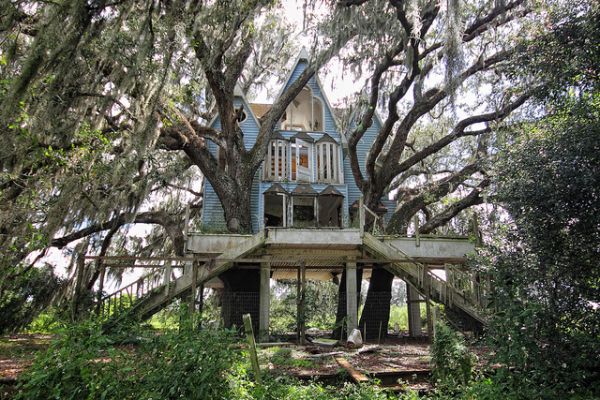
The former owner of this treehouse had to be the most popular kid in town! It appears to be built better than a lot of family homes. We don't know exactly where this abandoned, Victorian-style treehouse is, but urbex photographer Drew Perlmutter took pictures from several vantage points to share with us, including the interior. It's a shame that it's no longer maintained for a child's use. The Spanish moss gives it an otherworldly feeling. See more pictures at HuffPo Home: Here

Random Celebrity Photos

Bettie Page

Plant produces both tomatoes and potatoes

A plant which produces both potatoes and tomatoes has been launched in the UK. The TomTato can grow more than 500 sweet cherry tomatoes while producing white potatoes. Horticultural mail order company Thompson & Morgan, which is selling the plants for £14.99 each, said the hybrid plants were individually hand-crafted and not a product of genetic engineering.
Grafted potato-tomato plants have already been produced in the UK, but Thompson & Morgan says this is the first time they have been successfully produced commercially. The company says the tomatoes are far sweeter than those available in supermarkets. Paul Hansord, horticultural director at the company, said he first had the idea for the plant 15 years ago when he visited a garden where someone had planted a potato under a tomato as a joke.
He said: "The TomTato has been trialled for several years and the end result is far superior than anything I could have hoped for, trusses full of tomatoes which have a flavor that makes shop tomatoes inedible, as well as, a good hearty crop of potatoes for late in the season.

"It has been very difficult to achieve the TomTato because the tomato stem and the potato stem have to be the same thickness for the graft to work, it is a very highly skilled operation. We have seen similar products, however on closer inspection the potato is planted in a pot with a tomato planted in the same pot - our plant is one plant and produces no potato foliage." The plants can be grown either outside or inside, as long as they are in a large pot or bag.

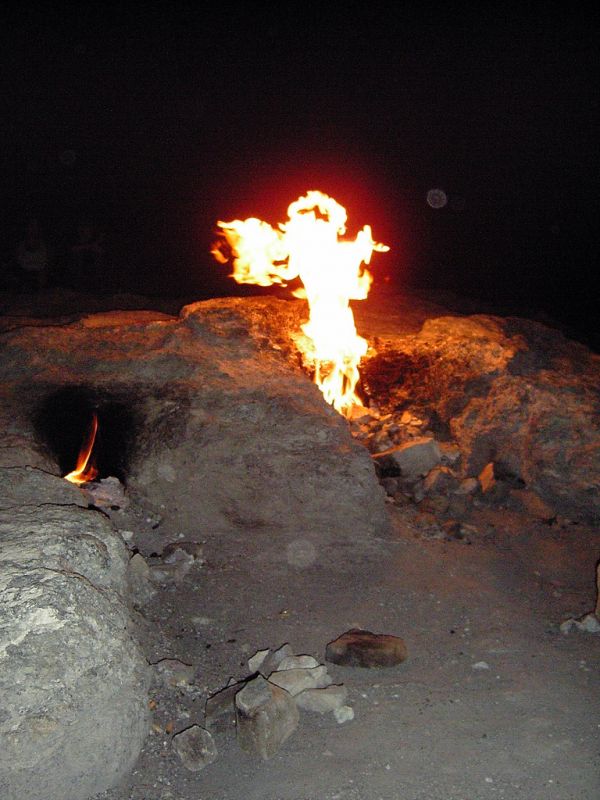
The Flaming Rocks of Chimera, Turkey

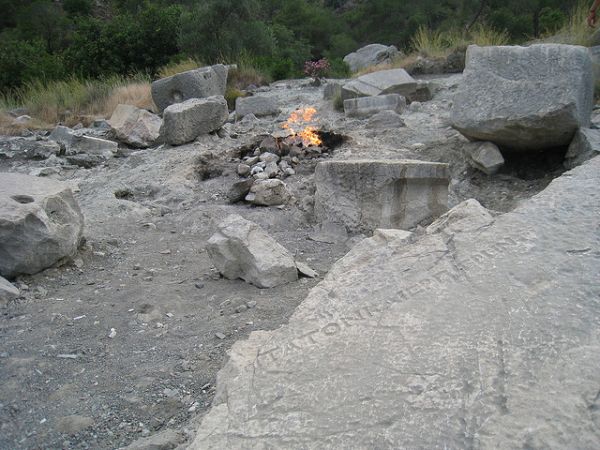
Near Çıralı, Turkey, on that nation's southwestern coast, you can find fires burning near the shore. They've burned for thousands of years, fueled by underground sources of methane and hydrogen. Kaushik of Amusing Planet writes about the impact they left on ancient observers:
For hundreds of years, sailors could see the flames from sea and used them as a landmark to navigate, but today they are more often used by hikers to brew tea. These flames, according to some ancient literature, gave birth to the myth of the Chimera, a fire breathing mythical beast with the body and head of a lion, with the head of a goat arising from its back, and a tail that ended in a snake's head.
You can find more photos here.

Scientists find a martian igneous rock that is surprisingly Earth-like