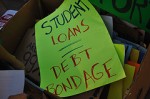
There
are no hard statistics about the number of suicides linked to student
debt, but once the question is asked, many debt-ridden former students
admit to thoughts of ending it all. And we know that the rate of suicide
rises during times of unemployment and economic crisis. Take the story
of 47-year-old John Koch, who has a law degree, but works as a painter
and lives with his parents.
Koch originally borrowed $69,000 in 1997. The majority of
that money was loans for law school, seemingly, he says, to “better
myself.” After he graduated from Touro Law School, Koch struggled to
find steady employment and eventually he defaulted on his loans. He was
immediately slapped with $50,000 in penalties. For years, he had been
filling out deferment forms every six months to buy himself more time
but in 2009, Sallie Mae declared him in default. At the time of this
writing, Koch owes over $320,000. That sounds staggering but it’s hardly
unusual. Once a person defaults on a student loan, the balance grows
exponentially, with interest compounding on interest, penalties and
fees. By the time he “retires,” in 23 years, Koch figures he will owe
close to $1.9 million. He can’t get even subprime credit, he tells me,
and it’s not like there’s any way out of his trap: student loan debt
cannot be absolved through bankruptcy.
Koch struggles with suicidal thoughts and admits to self-destructive
behavior, such as heavy drinking and cigarettes. Eventually he channeled
those feelings into a blog that draws more readers each month. In
January of 2012, though, the Suffolk County police paid his parents an
unpleasant visit to inquire about their son’s suicidal comments and
posts


No comments:
Post a Comment