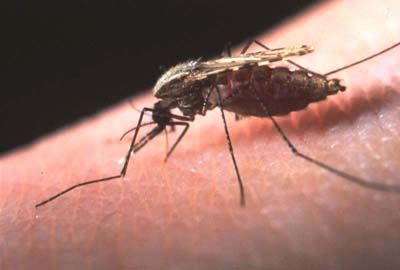
In
places where malaria is rampant, a common defense is to sleep under a
insecticide-laden mosquito net. The nocturnal mosquito of the genus
Anopheles can't penetrate the netting, and will die from the insecticide
if they try. But malaria rates did not plummet as expected. Did the bed
nets fail? No, the mosquitoes changed -they stopped being strictly
nocturnal and started feeding at dawn, after their human buffets got out
of bed!
First, we don’t know yet if this was an
evolutionary (i.e., genetic) change or a purely behavioral change. It is
possible that there was quite a lot of genetic variation in timing of
activity in the population a few years ago and that the bed nets
provided a selective regimen that skewed the population to consist
mainly of late night and dawn-active individuals. It is also possible
that there is sufficient behavioral plasticity in the mosquito allowing
it to learn the new best time of day to go out foraging. I’d love to see
the mosquitoes placed in isolation chambers to monitor purely genetic
patterns of circadian rhythms of activity.
If the
change is genetic, meaning the circadian rhythm is inborn and the
adaptive behavior is passed to future generations, malarial mosquitoes
may be much harder to defend against. If this is a learned behavior,
well, we have a ready-made horror movie plot. How scary are
mosquitoes that can
learn?
More


No comments:
Post a Comment