A candy billed as a luxury item helped a welterweight state export $5.8 billion last year.
Also: Welcome to ...
The place where the world comes together in honesty and mirth.
Windmills Tilted, Scared Cows Butchered, Lies Skewered on the Lance of Reality ... or something to that effect.
Thursday, November 18, 2010
Most Expensive Decanter of Whiskey in the World
The Macallan, founded in 1824, is produced at a distillery near Easter Elchies House in north east Scotland’s Speyside whisky region.
The Lalique decanter was created using the “cire perdue” or “lost wax” method.
Before the auction, the whisky was taken on a 12-city “tour du monde” to build up interest and raise funds for charity: water, an organization that provides access to clean, safe drinking water for people in developing nations.
A bottle of 200-year-old Champagne keeps its flavor
Lime blossom, coffee, chanterelles.
That's what sommeliers detected sampling two centuries-old Champagne salvaged from the wreckage of a schooner at the bottom of the Baltic Sea.
Scientists in a Bar
A Whole Bunch of Scientists walk into a bar...Rene Descartes was sitting at a bar. The bartender came over and asked if he would like another drink. He replied, "I think not." And he vanished.
Heisenburg was also sitting at the bar. After Descartes vanished in a puff of smoke, the bartender walked over to him and asked, "Did you see that?"
To which Heisenberg replied, "I can't be certain."
The bartender then noticed Einstein was there. So he asked him if he could believe what had happened. Einstein replied, "It's all relative."
Then the bartender noticed that Carl Sagan was there. He walked over to him and asked, "Can you believe that all these famous people are here in THIS bar?"
Sagan replied, "No. Why, there must be BILLIONS and BILLIONS of bars out there."
Meanwhile, Gustav Hertz was having such a great time, that he promised to return in the future at a much greater frequency.
Robert Boyle commented that he thought everyone was under too much pressure to come up with an answer to what was happening.
Erwin Schroedinger tried to explain that in the absence of an observer, Decartes left but at the same time did not leave.
But Alexander Volta disagreed stating there was a potential difference between his staying or going.
James Watt had had a bad day and said he had come in just to let off a little steam.
Charles Darwin refused to take a stand on the days events as he was waiting to see what would evolve.
Thomas Edison stated that he found the whole thing illuminating.
Andre Ampere helped the bartender ascertain that all the statements were kept current.
Eli Whitney said, "I believe I will have another gin."
Sir Isaac Newton pondered the gravity of the situation.
Robert Goddard said the situation was not rocket science.
Archimedes didn't participate. He was out having a screw.
Georg Ohm, though he resisted answering, did provide a tasty treat for the crowd. Everyone loved Ohm's slaw.
Max Karl Ernst Ludwig Planck thought it a constant drain of energy to contemplate the disappearance.
Gaston Plante thought Descartes should be put in a cell for battery.
William Sturgeon and Joseph Henry made a good gauss at where Descartes had gone.
Johann Salomo, Christoph Schweigger, and Jacques Arsene d'Arsonval were galvanized into instant action.Both Mr. and Mrs. Curie thought that Descartes had a radiating personality, even after his disappearance.
Nicola Tesla re-coiled at the sight.
Simple ways to beat the blues
Switch to full-spectrum light bulbs to ensure you're getting as much light as possible.
Also: Using hallucinogenic ibogaine to treat drug addicts
LA Weekly reports on Pangea Biomedics, a rehab clinic in Tijuana that gives hallucinogenic ibogaine to drug addicts.
Shock the Junkie: A hallucinogen called ibogaine has helped addicts kick heroin, meth and everything in between. Is it the trip that does the trick?Ron Price needs his milkshake. It's 10 o'clock on a Monday morning and the bald, barrel-chested former bodybuilder is shuffling around the kitchen of a posh rehab clinic in Tijuana, wearing slippers and a blue Gold's Gym T-shirt. Price had been employed as stockbroker in New Mexico, until his training regimen left him with debilitating injuries that forced him to undergo 33 surgeries in less than a decade. His doctor prescribed OxyContin, and Price quickly became dependent on the potent painkiller. More recently he started snorting cocaine and chugging booze to numb the pain. Now, 53 years old and three weeks into rehab, all he wants is a milkshake and to crawl back into bed. Clare Wilkins, the vivacious 40-year-old director of Pangea Biomedics, pops the lid of the blender to check the consistency of the concoction Price craves: peanut butter, soymilk, agave syrup, hemp protein powder and a few scoops of chocolate-flavored Green SuperFood.
Oh, and a half-teaspoon of root bark from the tabernanthe iboga plant.
One Human Brain Has More Switches Than All Computers on Earth
One synapse, by itself, is more like a microprocessor–with both memory-storage and information-processing elements–than a mere on/off switch. In fact, one synapse may contain on the order of 1,000 molecular-scale switches. A single human brain has more switches than all the computers and routers and Internet connections on Earth.
Scientists capture, hold antimatter atoms
Well, at least they didn't blow up the earth, or connect to some other universe. Scientists at CERN have confirmed that they have not just managed to produce antimatter atoms (specifically antihydrogen), they have trapped and held them for long enough to experiment on them.
Scientists crack huge riddle
For the first time, experts create and hold a substance that all but vanished from the universe.
Also: Astonishing close-up photos
Prize-winning microscopic photos offer up a startling new view of the world around us.
Also: The "Hoxne hoard"
"Clipped" Roman coins
Things you find reading a piece about the "Hoxne hoard," which included almost 15 THOUSAND Roman gold, silver, and bronze coins. Apparently clipping was rampant in that era; almost every silver siliqua in the hoard has been clipped. I found it interesting that a second reason was given for coin clipping: "a deliberate attempt to maintain a stable ratio between gold and silver coins."
Gold body chain of the Roman era
The most important gold item in the [Hoxne] hoard is the body chain, which consists of four finely looped gold chains, made using the "loop-in-loop" method called "fox tail" in modern jewellery, and attached at front and back to plaques. At the front, the chains have terminals in the shape of lions' heads and the plaque has jewels mounted in gold cells, with a large amethyst surrounded by four smaller garnets alternating with four empty cells, which probably held pearls that have decayed. At the back, the chains meet at a mount centred on a gold solidus of Gratian (r. 375–383), which has been converted from an earlier use, probably as a pendant, and which may have been a family heirloom. Body chains of this type appear in Roman art, sometimes on the goddess Venus or nymphs; some examples have erotic contexts, but they are also worn by respectable high-ranking ladies. They may have been regarded as a suitable gift for a bride. The Hoxne body chain, worn tightly, would fit a woman with a bust-size of 76–81 cm (30–32 inches).
Ancient temples designed for tripping
Acoustic archaeologists are exploring how the Chavin culture in Peru may have designed underground temples to blow worshipers' minds using low-tech sound and light shows. Of course, this thread continued in cathedrals with massive stained glass windows and organs all the way to today's high-end multimedia megachurches. According to Miriam Kolar of Stanford's Center for Computer Research and Acoustics, the temple's maze of tunnels "could be physically disorienting and the acoustic environment is very different than the natural world," and might be especially freaky for folks who were tripping balls.
"The iconography (of ancient Chavin drawings) shows people mixed with animal features in altered states of being," said Kolar, who is presenting her recent work at a conference in Cancun, Mexico this week. "There is peyote and mucus trails out of the nose indicative of people using psychoactive plant substances. They were taking drugs and having a hallucinogenic experience." If that wasn't enough, the mazes at Chavin de Huantar also include air ducts that use sunlight to produce distorted shadows of the maze's human participants. And sound waves from giant marine shells found in the maze in 2001 may have produced a frequency that actually rattled the eyeballs of those peyote-using ancients, Kolar said...
The Chavin de Huantar site in Peru isn't the only place where sound played an important role. The Mayan rulers at Chichen Itza in the Yucatan also figured out how to use sound for crowd control. David Lubman, an acoustic engineer who has spent the past 12 years studying the Mayan site, says a strange bird-like echo from the Kukulkan temple was actually constructed on purpose.
"It's sort of spooky," Lubman said from Irvine, Calif. "It's not an ordinary echo."
Lubman's analysis compared the acoustic soundprint of the quetzal bird, which was revered by Mayans, to the sound of the echo at Chichen Itza. The two sounds matched. Lublin said the secret is in the acoustic properties of the steep staircase on the temple's front.
The "clan towers" of Ingushetia
Three selections from an interesting photo gallery, discussed in English at Poemas del rio Wang:
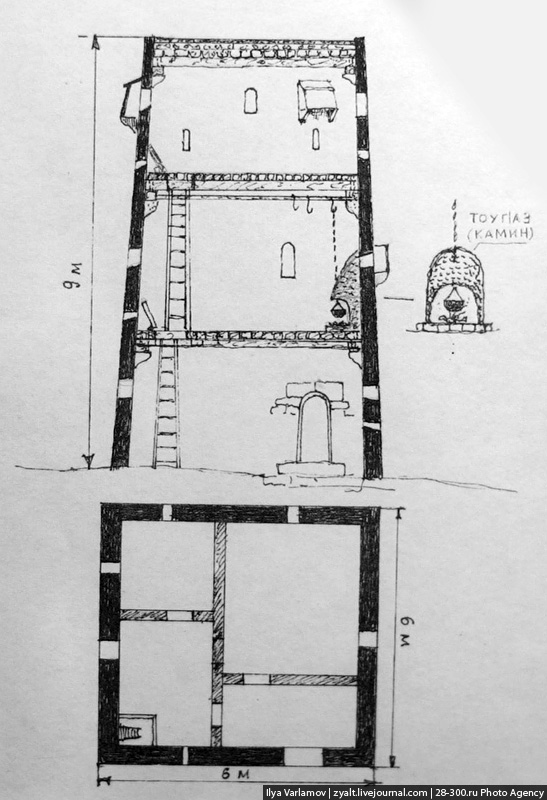
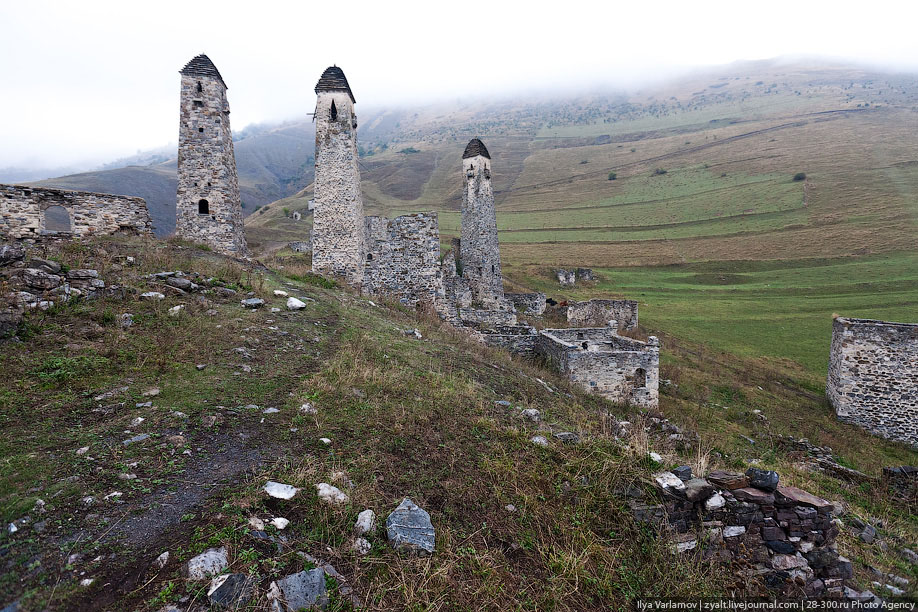
Clan towers – родовые башни – or, named after the people building them, Vainakh towers, combined multiple functions. They were living towers, impregnable fortifications, watchtowers dominating the valley controlled by the clan. And last but not least sacred asylums where blood-revenge was forbidden. Ismail Kadare in his Broken April tangibly describes the asylum towers that once stood all over the Albanian mountains and where men sometimes lived for years without ever coming out.More information at the link. And more photos. I find the landscape almost as fascinating as the architecture.
The towers have generally three to four floors. The first level – or, in four-storey towers, the first two levels – are the stall, in the latter case the second level is for the goats and sheep. The next floor is the living room, here’s the stove. The top floor serves for larder, treasure-house and armory as well as for guest accommodation, with projecting balconies for the ease of control...
The oldest surviving towers were built dry, but since the 16th and 17th century, the golden age of tower building – which was a period of turbulent external and internal wars in the Caucasus – they were reinforced with mortar. The internal structures, gates and shutters were made of oak, while the floors of pine wood. Beginning with the 16th century, loopholes became more and more frequent, which helps the researchers to reconstruct the spreading of firearms in the Caucasus...
Nowadays, most towers are uninhabited. The clan wars and external threats being over, the Ingushes went down to live in the more fertile river valleys. There are only a few old people sticking to their dwelling place or some shepherds left around to take care of them.
Additional information about Ingushetia is contained in another post at the same blog:
Ingushetia broke away from the Chechen-Ingush Republic in 1992. This is how the Russian government wanted to isolate the more pacific part of the republic from the Chechens, at that time in war against the Russians...More at the link, including some photos of, and observations about, Ingush weddings.
During WWII the Ingush and Chechen people, following the tradition of several centuries of wars of independence, rose up against the Soviet power. This is why after the war Stalin deported both nations to Kazakstan, and settled Russians on their place. The survivors of the cruel deportation were permitted to return to their native land only by Khrushchev in the late 1950s. However, in the meantime a part of Ingushetia, including their former capital Vladikavkaz, and even the town of Ongush (in Russian Tarskoye) which had given name to the whole republic, were annexed by the Soviet authorities following the old policy of divide to the western neighbor, Northern Ossetia: this is the egg-shaped hole on the map of the republic.
Polynesian "stick charts"
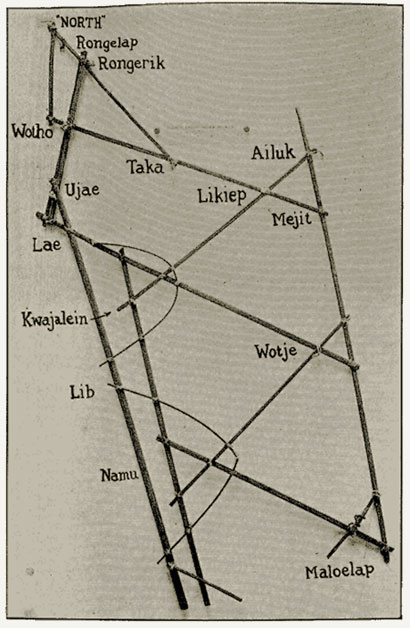
An excellent post at The Nonist discusses and illustrates the "stick charts" used by early Polynesian navigators.
The Polynesians, scattered as they were over 1,000 islands across the central and southern Pacific Ocean, were master navigators who tracked their way over a huge expanses of ocean without any of the complex mechanical aids we associate with sea fairing. They didn’t have the astrolabe or the sextant, the compass or the chronometer. They did however have aids of a sort, which though seemingly humble, were in fact the repositories of an extremely complex kind of knowledge. Called Rebbelibs, Medos. and Mattangs, today we call them simply “Stick Charts.”The three basic types of stick charts are shown, followed by addtional explanation:
The charts were made by men from thin strips of coconut frond midribs or pandanus root. They were then bound together with coconut sennit in geometric patterns depicting sea currents around the low lying atolls. Small money cowrie shells or coral pebbles indicated islands and curved sticks represent wave patterns.Via Uncertain Times. Those interested in early navigation and diffusion of knowledge through the prehistoric world should also read my post from two years ago about the Lapita people:
And how could a Neolithic people with simple canoes and no navigation gear manage to find, let alone colonize, hundreds of far-flung island specks scattered across an ocean that spans nearly a third of the globe?...
They were daring blue-water adventurers who roved the sea not just as explorers but also as pioneers, bringing along everything they would need to build new lives—their families and livestock, taro seedlings and stone tools. Within the span of a few centuries the Lapita stretched the boundaries of their world from the jungle-clad volcanoes of Papua New Guinea to the loneliest coral outliers of Tonga, at least 2,000 miles eastward in the Pacific. Along the way they explored millions of square miles of unknown sea...
Reaching Fiji, as they did a century or so later, meant crossing more than 500 miles of ocean, pressing on day after day into the great blue void of the Pacific... By the time Europeans came on the scene, virtually every speck of habitable land, hundreds of islands and atolls in all, had already been discovered by native seafarers—who ultimately made it all the way to South America...
Neanderthals Lived Fast, Died Young
- Our slower development and longer lives could have given humans an evolutionary edge over Neanderthals.
Whale Saved 10 Years Ago Reunites With Rescuers
Photo: Katya Kroch / IBJ
One morning in November 2000, a large humpback whale was found stranded on a beach near Ubatuba, Brazil, clinging to life in the crashing surf. It didn't take long before a team was assembled of nearly one hundred fishermen, firefighters, biologists, and locals who began working tirelessly to return the struggling animal back to sea -- and after twelve long hours, they were successful. Still, as that whale slipped beneath the waves and out of sight, those volunteers could only hope their efforts were not in vain, knowing full well that the whale's chances of survival were slim. But now, after ten years of guessing, rescuers are finally sure the whale is alive and well -- because they've seen it.Article continues: Whale Saved 10 Years Ago Reunites With Rescuers
Mediterranean great whites from Australian seas
BBC:
Great white sharks in the Mediterranean may have first arrived from the seas around Australia 450,000 years ago, genetic studies have suggested.
Researchers writing in Proceedings of the Royal Society B believe the arrival may have been simply a migratory "wrong turn" by a few pregnant females.
A tumultuous climate between ice ages may have been the cause.
The species - Carcharodon carcharias - would have remained in the Med because it returns to spawn where it was born.
In a parallel universe
One day while surfing through the many parallel universes out there I chanced upon this scene ...
Wednesday, November 17, 2010
The Daily Drift
The Daily Drift
Today's horoscope says:An elder relative or authority figure who's had their eye on you for awhile now is just about ready to let you know how well you've done -- especially based on recent stressful situations that you've passed through with flying colors.
In the meantime, don't ignore someone new and interesting (who's due to come along early today), sent by the emotional Moon to take your mind entirely off of this situation -- and anything that's even remotely unpleasant.
Some of our readers today have been in:
Melbourne, Victoria, Australia
Edithvale, Victoria, Australia
Brasov, Brasov, Romania
Chandigarh, Chandigarh, India
Wellington, Wellington, New Zealand
Kota Kinabalu, Sabah, Malaysia
Hamilton, Ontario, Canada
London, England, United Kingdom
Dublin, Dublin, Ireland
Sittard, Limburg, Netherlands
Paris, Ile-De-France, France
Madrid, Madrid, Spain
Perth, Western Australia, Australia
Milan, Lombardia, Italy
Moscow, Moskva, Russia
Groningen, Groningen, Netherlands
Sydney, New South Wales, Australia
Kuala Lumpur, Wilayah Persekutuan, Malaysia
Munich, Bayern, Germany
Frankfurt, Hessen, Germany
Bordeaux, Aquitaine, France
as well as Singapore, Czech Republic, Philippines, Brazil, Saudia Arabia, Argentina, Latvia, Mexico and in cities across the United States such as Costa Mesa, Germantown, Orchard Park, Spring Grove and more.
Today is:
Today is Wednesday, November 17, the 321st day of 2010.
There are 44 days left in the year.
Today's unusual holiday or celebration is:
Homemade Bread Day.
Don't forget to visit our sister blog!
Achtung! TSA!
Oleg Volk has a smashing new TSA checkpoint warning side: Achtung! TSA breast-groping ahead!
Is it acceptable to "pat down" women and children ?
In his blog for The Atlantic, James Fallows makes note of a curious conflict of ethics and pragmatism raised by a letter from and Army sergeant serving in Afghanistan:
A US Army staff sergeant, now serving in Afghanistan, writes about the new enhanced pat-down procedure from the TSA. Summary of his very powerful message: to avoid giving gross offense to the Afghan public, and to prevent the appearance of an uncontrolled security state, the US military forbids use on Afghan civilians of the very practices the TSA is now making routine for civilian travelers at US airports...Further details and discussion at The Atlantic.
At no time were we permitted or even encouraged to search children or women. In fact, this would have been considered an extreme violation of acceptable cultural practice and given the way word travels here, been a propaganda victory for the Taliban.
Yet somehow the TSA is engaged in this at home while my unit and I spent our tour unable to safeguard ourselves equally in an environment where the Taliban have often disguised themselves in burkas and used children as both spies and fighters...
Johns Hopkins doctor on TSA scanners: 'statistically someone is going to get skin cancer from these X-rays'
Despite what the TSA and Michael Chertoff say, the science is not settled on these machines.
Dr. David Brenner, head of the center for radiological research at Columbia University in New York, told the London Telegraph in a June 29 story that considering the large number of people who frequent the nation's airports, wide-ranging exposure, even to minimal amounts of radiation, could add up to one big concern.
"If all 800 million people who use airports every year were screened with X-rays, then the very small individual risk multiplied by the large number of screened people might imply a potential public health or societal risk," he said. "The population risk has the potential to be significant."
Scientists with the University of California at San Francisco were so worried that they wrote a letter to the White House Office of Science and Technology in April raising "a number of red flags" on the scanners' safety.
"While the dose would be safe if it were distributed throughout the volume of the entire body, the dose to the skin may be dangerously high," the letter said in part, adding concerns that "independent safety data do not exist" and raising the potential for further harm if a high dosage was accidentally emitted.
Bad Cops
LAPD officer resigns after being accused of tapping database on killer's behalf
Texas cop pleads no contest to indecency with a child
Witnesses see visitor to Rikers Island jail roughed up by correction officer
California prison guard arrested in sting operation
Kansas City police fire at backfiring van
California sheriff's deputy charged with child molestation
Former Texas deputy constable charged in carwash shooting
Retired Maryland police officer convicted of assault
Florida cop is arrested for child porn on police computer
Pennsylvania police officers accused of arrest frame-up
Repugican House freshman wants his govt subsidized health insurance NOW
You know of course he ran against "Obamacare":
[repugican Andy Harris] A wingnut Maryland physician elected to Congress on an anti-Obamacare platform surprised fellow freshmen at a Monday orientation session by demanding to know why his government-subsidized health care plan takes a month to kick in.
“He stood up and asked the two ladies who were answering questions why it had to take so long, what he would do without 28 days of health care,” said a congressional staffer who saw the exchange. The benefits session, held behind closed doors, drew about 250 freshman members, staffers and family members to the Capitol Visitors Center auditorium late Monday morning,”.
“Harris then asked if he could purchase insurance from the government to cover the gap,” added the aide, who was struck by the similarity to Harris’s request and the public option he denounced as a gateway to socialized medicine.
Under COBRA law, Harris can pay a premium to extend his current health insurance an additional month.
America's dirtiest cities
Their residents suffer from the highest risk of asthma and chronic bronchitis.
Also: Secrets of fancy 'man caves'
The hangout spaces have morphed from cold garage outposts into luxurious spreads.
Also: How to save on heating costs
Keeping your home warm this year won't be cheap, but there are ways to lower your bills.
Also: How to become your own boss
Lots of people dream of starting their own business doing something they love.
Also: So, you think you had a bad day at work
Rob is a commercial saturation diver for Global Divers in Louisiana. He performs underwater repairs on offshore drilling rigs. Below is an E-mail he sent to his sister. She then sent it to a radio station in Ft.Wayne, Indiana, who was sponsoring a worst job experience contest. She won first prize.
Hi Sue, Just another note from your bottom-dwelling brother. Last week I had a bad day at the office. I know you've been feeling down lately at work, so I thought I would share my dilemma with you to make you realize it's not so bad after all. Before I can tell you what happened to me, I first must bore you with a few technicalities of my job. As you know, my office lies at the bottom of the sea I wear a suit to the office. It's a wetsuit. This time of year the water is quite cool...
So what we do to keep warm is this: We have a diesel powered industrial 'water heater'; this $20,000 piece of equipment sucks water out of the sea. It heats it to a delightful temperature. It then pumps it down to the diver through a hose, which is taped to the air hose. Now this sounds like a darn good plan, and I've used it several times with no complaints.
What I do, when I get to the bottom and start working, is take the hose and stuff it down the back of my wetsuit. This floods my whole suit with warm water. It's like working in a Jacuzzi. Everything was going well until all of a sudden, my ass started to itch. So, of course, I scratched it. This only made things worse.
Within a few seconds my ass started to burn. I pulled the hose out from my back, but the damage was done. In agony I realized what had happened. The machine had sucked up a jellyfish and pumped it into my suit.
Now, since I don't have any hair on my back, the jellyfish couldn't stick to it. However, the crack of my ass was not as fortunate.
When I scratched what I thought was an itch, I was actually grinding the jellyfish into the crack of my ass. I informed the dive supervisor of my dilemma over the communicator. His instructions were unclear due to the fact that he, along with five other divers, were all laughing hysterically.
Needless to say I aborted the dive. I was instructed to make three agonizing in-water decompression stops totaling thirty-five minutes before I could reach the surface to begin my chamber dry decompression. When I arrived at the surface, I was wearing nothing but my brass helmet. As I climbed out of the water, the medic, with tears of laughter running down his face, handed me a tube of cream and told me to rub it on my ass as soon as I got in the chamber.
The cream put the fire out, but I couldn't poop for two days because my ass was swollen shut.
Love Rob
So, next time you're having a bad day at work, think about how much worse it would be if you had a jellyfish shoved up your butt.
Now repeat to yourself, "I love my job, I love my job, I love my job."
Why Ireland is near bankruptcy
Ireland is on the brink of insolvency, sending shivers throughout the world.
Also: Singapore jails British author who criticized their courts
This is pathetic.
The case highlighted complaints by critics who claim Singapore uses criminal defamation laws to silence them.
"This sentence is yet another blow against freedom of expression in Singapore," said Phil Robertson, deputy director of Human Rights Watch in Asia. "Sadly, it comes as no surprise, given the long history of the authorities in Singapore using the courts to silence vocal critics of government policies and personnel."
The government says any statement that damages the reputations of its leaders will hinder their ability to rule effectively.
Prosecution lawyer Hema Subramaniam said Shadrake had shown "a complete lack of good faith in making these allegations against the judiciary".
Shadrake was arrested July 18 and freed on bail two days later. A criminal defamation investigation against him is still pending.
Ten Well Known People And Their Phobias
We all have fears. They range from the subtler things like a fear of spiders to the more serious fear of people. But did you know there are many celebrities and historical figures who have suffered from phobias just like you?
While most of them fear simple things like you and me, some are just a little bit more extreme. Here's a list of the top ten well-known people and their phobias.
Hunt for clues in 17th-Century mystery
New clues may solve the mysterious death of a world-famous 17th-century astronomer.
Also: Dazzling sky show tonight
You won't need a telescope to spot up to 15-20 "shooting stars" per hour in tonight's display.
Also: New views of the planet
The International Space Station's Cupola window bay provides dazzling new views of Earth.
Also: View from the International Space Station
This excellent image captured by NASA shows astronaut Tracy Caldwell Dyson gazing out of a window on the International Space Station. It was taken last September. Dyson, a chemist, went into orbit on April 2, 2010 and remained on the station for 174 days.
NASA May Have Found Remnants of a Black Hole at the Center of the Galaxy
NASA’s Fermi Gamma-ray Space Telescope has unveiled a previously unseen structure centered in the Milky Way. The feature spans 50,000 light-years and may be the remnant of an eruption from a supersized black hole at the center of our galaxy. [...]
One possibility includes a particle jet from the supermassive black hole at the galactic center. In many other galaxies, astronomers see fast particle jets powered by matter falling toward a central black hole. While there is no evidence the Milky Way’s black hole has such a jet today, it may have in the past. The bubbles also may have formed as a result of gas outflows from a burst of star formation, perhaps the one that produced many massive star clusters in the Milky Way’s center several million years ago.
World Record Panorama of London
Jeffrey Martin shot 8,000 photographs of London and then spent six weeks stitching them together to create this amazing seamless 360-degree panorama of the city. You can zoom in and lose yourself looking at details, or zoom back and admire the city as a whole. The quality of this panorama was impossible to achieve only a year ago -and at 80 gigapixels, it is the largest 360-degree panorama in the world! Open the map to find specific landmarks, or take the tour to see places you’d never think to look for on your own. This is the next best thing to traveling to London, and you don’t even have to leave your desk!
Origami Glass Building
This building which houses the health department in BilBao, Spain is described as “origami-like”. I can see that, but my first impression was that some special-effects giant monster is trying to burst out of it! The unique design is not just for looks. The city building code requires multi-story buildings to have stepped setbacks, so they incorporated that into an artful design. There are also environmental benefits from the folded glass appearance. Read about it and see more pictures at Jetsetta.
Bacon Gift Wrap

To Go Cup: The Alcoholic Open Carry Equivalent
Would you be willing to put all your possessions in storage, except your laptop, a few clothes and your dog, and say adiós to the idea of having a home? That’s just what Michael Powell and Juergen Horn have done. Armed with just the internet and a spirit of adventure, they’ve become digital nomads, roaming the earth in three-month stints.Over a long lunch and a bottle of red wine, the idea formed. They’d been making their living online for awhile, running websites like Criticker and Random Good Stuff, and promoting Juergen’s photography. Traveling is their shared passion and, as long as they had high-speed internet, they figured they could do it on a permanent basis. For three months, or about 91 days, they could fully explore a new city or country and, before they had time to get weary of it, would be off to the next spot.
Their first leg was in Oviedo, in Northern Spain and about two weeks ago they touched down in Savannah, GA. On their blog For 91 Days, Juergen and Mike document their exploration of the history, sights, culture, and the bizarre and wonderful customs of their new temporary homes.

That’s Juergen sportin’ an open container of alcohol in public. Posing near a cop, no less. Now, for most of us, this is an illegal act – but not in Savannah, Georgia. Thanks to the "To-Go Cup" – the alcoholic equivalent of the Open Carry law – you can walk around the Historic District and enjoy your favorite beer in broad daylight. No need for sipping furtively out of a brown bag.
Their first leg was in Oviedo, in Northern Spain and about two weeks ago they touched down in Savannah, GA. On their blog For 91 Days, Juergen and Mike document their exploration of the history, sights, culture, and the bizarre and wonderful customs of their new temporary homes.
That’s Juergen sportin’ an open container of alcohol in public. Posing near a cop, no less. Now, for most of us, this is an illegal act – but not in Savannah, Georgia. Thanks to the "To-Go Cup" – the alcoholic equivalent of the Open Carry law – you can walk around the Historic District and enjoy your favorite beer in broad daylight. No need for sipping furtively out of a brown bag.
Endangered Species
Habitat destruction is the single greatest threat to species around the globe. Humans have altered, degraded, and destroyed habitat in many different ways. Logging around the world has destroyed forests that are habitat to many species.
Agriculture has also resulted in habitat destruction. Mining has destroyed habitat because the landscape often must be altered in order to access the minerals. Finally, water development, especially in arid regions, has fundamentally altered habitat for many species.
Here's a list of endangered species.
Subscribe to:
Posts (Atom)