Svante Paabo's genome-sequencing project hopes to point up the
differences that enabled humans, unlike the Neanderthals, with whom they
interbred, to build complex societies.
Welcome to ...
The place where the world comes together in honesty and mirth.
Windmills Tilted, Scared Cows Butchered, Lies Skewered on the Lance of Reality ... or something to that effect.
Saturday, May 19, 2012
More Americans using acupuncture for common ailments
A new survey demonstrates increasing acceptance and utilization of acupuncture for treatment and health promotion.
CDC considers recommending Hepatitis C test for boomers
It's a "silent epidemic," an "unrecognized health crisis," according to the Centers for Disease Control and Prevention.
More
More
US doctors "rewire" paralyzed hand
This is an exciting medical development:
In a pioneering operation, US doctors took healthy nerves from the man and used them to bridge the damaged wiring that stopped signals getting from the man's brain to his hands.
Surgeons at Washington University's school of medicine said the operation may prove to be a breakthrough for some patients paralyzed by spinal cord injuries.
The 71-year-old broke his neck in a car crash in 2008 that left him unable to walk. Though he could still move his arms, he had lost the ability to grasp or hold things in either hand.
Where two oceans meet
When two bodies of water merge in the middle of The Gulf of Alaska and a frothy foam develops at their meeting line. It is a result of the melting glaciers being composed of fresh water and the ocean has a higher percentage of salt causing the two bodies of water to have different densities and therefore makes it more difficult to mix.
Science News
Fighting bacteria’s strength in numbers
Scientists at The University of Nottingham have opened the way for more accurate research into new ways to fight dangerous [...]
The Future of Fighting Blindness
Retinal
degeneration is a leading cause of blindness. Patients with age related
macular degeneration, retinitis pigmentosa, and diabetes-associated
blindness have [...]
Annular solar eclipse, transit of Venus and other non-doomsday celestial phenomena
By Vera H-C Chan
Why settle for dusty ol' Mayan calendars and 12/12/12 apocalyptic visions,
when 2012 has been offering up so many stellar—and planetary—sightings?
We Earthlings have already been treated to nice meteor showers as well
as a magnificent supermoon, and this weekend brings an annular solar
eclipse.
That's not even the best treat:
Venus will be ambling between Earth and the sun in a rare (though
non-earth-shattering) planetary alignment. Sure, the event might look
like a black pimple floating across the face of the sun, but this
celestial rarity once guided adventurous astronomers in their quest to
determine the size of the solar system and yielded the first-ever global
scientific collaboration. Don't blink—Venus doesn't cross our path
again until December 2117.
Annular Solar Eclipse, Jan. 4, 2011
An annular solar eclipse and that ring of fire: A solar eclipse happens this Sunday, except for the Eastern seaboard (sorry). It's an "annular" eclipse rather than a total one, which means the sun's edges peek out from behind the moon, creating the illusion of a ring of fire. (The word "annular" comes from the Latin word for ring.) The lower 48 states will have to wait until Aug. 17, 2017, for a total shutout. This weekend's eclipse
begins at dawn in southern China. It then sweeps across the Pacific Ocean, passing south of Alaska, and makes landfall on the Pacific coast near the California-Oregon border. It ends near Lubbock, Texas, at sunset. Partial phases of this eclipse will be visible over most of western North America. (May 9, Space.com)
Those of you in the annular path
should head to higher ground (avoiding clouds and light pollution) and
put solar filters either over your eyes or on your equipment.
Thirty-three national parks will be hosting solar gatherings. Lucky Coloradans get to hang out for free at the University of Colorado at Boulder's Folsom stadium, starting 5:30 p.m. local time, thanks to the Fiske Planetarium.
Below, a chart of solar eclipse times. (Credit: Geoff Gaherty/Starry Night Software/SPACE.com)What kind of solar glasses to get: Designer sunglasses don't cut it. At this late date, check telescope stores or call your local planetarium. No. 14 welder's glass, carried in specialty welding stores, works too. Don't forget solar filters for your camera equipment. Then there's the cardboard method:
If you don't buy binoculars for this weekend, you may want to consider ordering a pair for the transit of Venus.The safest and simplest technique is perhaps to watch the eclipse indirectly with the solar projection method. Use your telescope, or one side of your binoculars, to project a magnified image of the sun's disk onto a shaded white piece of cardboard.The image on the cardboard will be safe to view and photograph. But make sure to cover the telescope's finder scope or the unused half of the binoculars, and don't let anybody look through them. (May 9, Space.com)

Transit of Venus, June 8, 2004
Measuring the solar system with the transit of Venus: Yes, there's an app. With just the tap of a finger on a screen, people can do in hours what 18th-century scientists needed years to do: measure the solar system. This year's transit of Venus—the second of a pair—begins on the evening of June 5 for North Americans. Our previous glimpse was in June 2004, and before that, back in the 19th century. An explanation of this planetary alignment:
Mercury and Venus are the only planets closer to the Sun than Earth, both moving faster in their orbits and passing us regularly. But rather than crossing directly between us and the Sun, these planets are usually slightly above or below the Sun as we see them. When they line up just right we see the round, black silhouette of the planet slowly crossing the Sun, an even referred to as a "transit." Mercury transits the Sun 13 or 14 times each century. But Venus transits happen in pairs—two transits eight years apart—with more than 100 years between each pair. (Transit of Venus, Astronomers Without Borders)How to see the transit of Venus: Astronomy Without Borders will stream a webcast from Mount Wilson Observatory. See above about solar glasses.
Measuring the solar system the old-fashioned way:
In 1761 and 1769, obsessed stargazers undertook glorious, and sometimes
fatal, journeys, in an orchestrated effort that took 45 years to
coordinate.
Most were not swashbuckling men by any measure, but they risked traveling with instruments and rum, barely surviving shipwrecks and warship attacks. In 1761 Venus didn't quite cooperate and messed up the calculations. The second transit—on June 3, 1769—saw more success. Sharing the information took years, but the calculated distance between Earth and the sun wasn't far off the 92,960,000 miles that scientists agree on today.In 1716, British astronomer Edmond Halley had called upon scientists to unite in a project spanning the entire globe. He predicted that on June 6, 1761, Venus would traverse the burning disc of the sun for about six hours.At a time when it took six days to travel from London to Newcastle, dozens of them travelled to remote outposts of the world to observe the phenomenon, laden with clocks, huge telescopes and other instruments.Many risked their lives. With the Seven Years' War [1756-63] tearing Europe apart, they were even sent into war zones. (May 12, The Daily Mail)
Bacteria 'Good Bet' For Alien Life
Bacteria Survive Being Buried for 86 Million Years
The scientists jammed a large metal pipe 30 meters into the sea bottom and used a piston to suck out a long column of reddish clay. After hauling the sediment onboard, they probed the core with a needlelike sensor to measure the oxygen concentration in each layer. The researchers knew how much oxygen should have diffused down into each section of sediment from the seawater, so any "missing" oxygen meant microbes had consumed it.
Moving deeper through the core is like moving back in time, studying older and older communities of microorganisms. "We can use the Pacific as a natural experiment that has been running for 86 million years," Røy says.
Friday, May 18, 2012
The Daily Drift
It is International Museum Day today.
Today's readers have been in:
Prague, Czech Republic
Dhaka, Bangladesh
Sampaloc, Philippines
Singapore, Singapore
Zagreb, Croatia
Amman, Jordan
Bangkok, Thailand
Karachi, Pakistan
Vantaa, Finland
Antwerp, Belgium
Amsterdam, Netherlands
Dublin, Ireland
Groningen, Netherlands
Cork, Ireland
Puchong, Malaysia
Taipei, Taiwan
Jakarta, Indonesia
Ampang, Malaysia
Limerick, Ireland
Athens, Greece
Klang, Malaysia
Bratislava, Slovakia
Petaling Jaya, Malaysia
Zurich, Switzerland
Kuala Lumpur, Malaysia
Bern, Switzerland
Guatemala City, Guatemala
Saint Petersburg, Russia
Nyon, Switzerland
Seoul, Korea
Dubai, United Arab Emirates
Reykjavik, Iceland
Today in History
| 526 | St. John I ends his reign as Catholic Pope. | |
| 1643 | Queen Anne, the widow of Louis XIII, is granted sole and absolute power as regent by the Paris parliament, overriding the late king's will. | |
| 1652 | A law is passed in Rhode Island banning slavery in the colonies but it causes little stir and seems unlikely to be enforced. | |
| 1792 | Russian troops invade Poland. | |
| 1802 | Britain declares war on France. | |
| 1804 | Napoleon Bonaparte becomes the Emperor of France. | |
| 1828 | The Battle of Las Piedras, between Uruguay and Brazil, ends. | |
| 1860 | Abraham Lincoln is nominated for president. | |
| 1864 | The fighting at Spotsylvania in Virginia, reaches its peak at the Bloody Angle. | |
| 1896 | The Supreme Court's decision on Plessy v. Ferguson upholds the "separate but equal" policy in the United States. | |
| 1904 | Brigand Raizuli kidnaps American Ion H. Perdicaris in Morocco. | |
| 1917 | The U.S. Congress passes the Selective Service act, calling up soldiers to fight World War I. | |
| 1931 | Japanese pilot Seiji Yoshihara crashes his plane in the Pacific Ocean while trying to be the first to cross the ocean nonstop. He is picked up seven hours later by a passing ship. | |
| 1933 | President Franklin Roosevelt signs the Tennessee Valley Authority Act. | |
| 1942 | New York ends night baseball games for the rest of World War II. | |
| 1944 | The Allies finally capture Monte Cassino in Italy. | |
| 1951 | The United Nations moves its headquarters to New York city. | |
| 1969 | Two battalions of the 101st Airborne Division assault Hill 937 but cannot reach the top because of muddy conditions. | |
| 1974 | India becomes sixth nation to explode an atomic bomb. | |
| 1980 | After rumbling for two months, Mount Saint Helens, in Washington, erupts 3 times in 24 hours. |
Repugicans hate women

Back in 1920 women knew repugicans hated them.
Things haven't changed in the 92 years since then.
Rupert Murdoch New Corp employees hid evidence during investigation
Oh my, my, another blow for Rupert Murdoch's News Corp. Does this sound
like a law abiding organization? As Faux News would surely say, if they have nothing to hide, why were they hiding boxes of information?
Last July when London prosecutors claim Rebekah Brooks was attempting to hide seven boxes of relevant evidence from a police probe, the former top lieutenant of Rupert Murdoch’s News Corp. was dealing with the crisis point of the phone-hacking scandal under investigation.
According to the Crown Prosecution Service, Brooks allegedly conspired with Cheryl Carter, her personal assistant, to remove the boxes from the premises of News International, the News Corp. U.K. unit she headed, between Wednesday July 6 and Saturday July 9.
News International and the London Metropolitan Police Service, which has been collecting evidence related to phone- hacking and other illegal activities at Murdoch-owned newspapers in the U.K., declined to comment on the contents of the boxes or to explain how they know about their removal.
Man Scales Airport Fence, Breaks into Jet for Fun
Mexico army generals probed for cartel ties
Two army generals, including a former assistant defense secretary,
were detained by anti-drug prosecutors and are being questioned for
alleged links to drug traffickers, authorities said Wednesday.
Cuban president's daughter gets US visa
A new category of heel
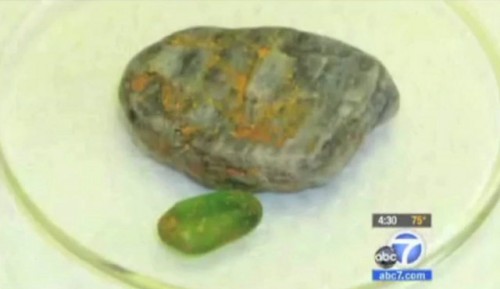
Lying Isn’t The Only Way To Set Your Pants On Fire

Here’s the scoop:
Orange County Fire Authority officials tell the newspaper that the woman collected the rocks on a nearby beach, returned home and “was standing in her kitchen … when the pocket of her cargo shorts caught fire.”And they say hobbies like rock and shell collecting are a safe and relaxing activity.
“I talked to the paramedic who treated her, and in his 27 years in responding to calls near the beach, he’s never seen this,” Fire Authority Capt. Marc Stone told the Register. “The rocks were still smoking when firefighters took them to the hospital.”
Now, they’re being tested. It’s possible, Stone said, that phosphorus in the stones may have caused the combustion.
The Complicated World of Modern Baby Naming
Then came the Internet, and baby naming suddenly became a bit more complicated:
Fast forward to after a baby is born, and it’s becoming more and more popular to reserve a child’s email, domain name and maybe even Twitter handle, so they don’t have to be something like, “Sophie Miller 582” or “Oscar Sheppard 4”” when they grow up and want their own Internet identity.Jacoba Urist of MSNBC's TODAY Moms has more here.
“When our son was a month old, we got him a Gmail account,” says Joanna Goldstein, a first time mother in New York City. “For now, I send emails out to our family every week, attaching pictures and sharing his latest triumphs. I hope somebody it will be nice for him to have this journal of his early adventures in his email.”
And then, there’s Jay Z and Beyonce, who took the whole laying claim to a baby name to the next level. They made headlines last winter when they filed an application with the U.S. Patent and Trademark Office to protect their daughter’s name -- Blue Ivy Carter .
Some parents found the whole thing downright crazy. Trademarking a baby name -- only in tinsel town, right?
The World's Most Remote Resorts
By Nicole Frehsee
Getting away from it all gets harder and harder, as cell phones and 4G devices keep us tapped into our lives. These 10 getaways take up that challenge, spiriting you away from worldly cares. And we promise you won't miss civilization one bit.
Don't feel like sharing? The 9-acre island of Motu Teta rises out of the ocean like a South Pacific day-dream: swaying palm trees, powdery beaches, aqua waters lapping at the shore. Once you get there, it's just you and the staff.
Cost: Two people each pay $1,707 a night, but the bigger the group, the more the rate dips. Includes transport from Rangiroa plus food, liquor and unlimited use of sporting equipment.
Getting there: The most arduous part of a Motu Teta vacation is arriving, which requires two flights - one to Papeete, Tahiti's capital, and another to the atoll of Rangiroa - then a 90-minute boat ride to the resort.
What to expect: Sail in one of the resort's six boats, windsurf, spear fish by day - naked if you like, since bathing suits are optional. By night, retreat to your 2,250-square-foot villa facing the lagoon and eat fresh fish and French-inspired cuisine prepared by your private chef.
Located nearly 200 miles north of Anchorage on the Iditarod Trail, Winterlake Lodge's 15 acres are so deep in Alaska's backcountry that no roads or waterways reach it.
Cost: Starts at $1,395 per person per night, and includes meals and transportation from Anchorage to Winterlake.
Getting there: From Anchorage, take a puddle-jumper - a ski plane in winter, a floatplane in summer - that lands on the lodge's mile-long lake.
What to expect: Fifteen cabins, each with artisan furniture and wood-burning stoves, are a short walk to the main lodge, where you'll find daily yoga classes, massages and wine and cheese tastings (samples flown in weekly from Murray's Cheese Shop in New York). Outdoors, there's dog-mushing school and bear-viewing. Or take one of Winterlake's two choppers to a glacier in the Tordrillo Mountains or a remote fly-fishing spot.
Kauri Cliffs, poised on the edge of the Totara forest, offers panoramic ocean views in 22 guest rooms - with his-and-her walk-in closets - on 6,000-acres. The resort is owned by American hedge-fund tycoon Julian Robertson.
Cost: Starts at $623 a night per person, double occupancy, with meals and drinks all-in. For $7,171 nightly, though, you can book the 4,200-square-foot Owner's Suite, with a private infinity pool and kitchen - so the chef can come to you.
Getting there: Hop Air New Zealand's daily 40-minute flight to Kerikeri Bay from Auckland, then drive. Or take an hour-long helicopter ride from Auckland directly to the resort.
What to expect: The main draw are the links, ranked the world's 18th best by Golf Magazine, but you can also chill out on the pink-sand beaches, go boar hunting (pick your weapon: gun or knife), deep-sea fishing or play a little polo. Tip: book the Private Beach Barbecue, where a Kauri chef cooks up a feast of fresh seafood and local produce surfside.
Amangiri is a 34-suite resort nestled in a rocky valley in the southern Utah desert and has hosted celeb guests from Brad and Angelina to Katy Perry.
Cost: $1,000 to $3,600 a night
Getting there: Fly to St. George Municipal Airport via Los Angeles or Salt Lake City and take a 2 1/2-hour road trip. From Page Municipal Airport in Arizona the drive is just 25 minutes, but you'll have to book a charter from Phoenix, Denver or Las Vegas.
What to expect: Surrounded by the Grand Canyon, Monument Valley, the Grand Staircase and Bryce and Zion national parks, Amangiri has abundant natural beauty, plus a swimming pool carved out of a canyon. Activities include outdoor yoga and fly-fishing on the nearby Colorado River.
A string of 15 tents dotting a sand dune in the Outback may not sound luxurious, but the tents of Longitude 131 cover 430-square-feet and have air-conditioning, retracting blinds and Bose sound systems.
Cost: Double occupancy starts at $2,070 per room per night. If you stay three nights or more, the price drops to $1,758.
Getting there: Catch a direct flight to Ayers Rock Airport from Sydney to catch a 4-wheel-drive vehicle for the last six miles through the Outback to the resort.
What to expect: Watching the sunrise over Uluru (a natural sandstone rock formation and UNESCO World Heritage site); sip cocktails by sunset over the vast Kantju Gorge; and dine under the Outback stars.
More doctors are ditching the old prescription pad
Doctors increasingly are ditching the prescription pad: More than a
third of the nation's prescriptions now are electronic, according to the
latest count.
Private-equity driven dentists accused of "dentally abusing" poor kids on Medicaid with painful, unnecessary procedures
Sydney P. Freedberg writes in Bloomberg:
Isaac Gagnon stepped off the school bus sobbing last October and opened his mouth to show his mother where it hurt. She saw steel crowns on two of the 4-year-old’s back teeth. A dentist’s statement in his backpack showed he had received two pulpotomies, or baby root canals, along with the crowns and 10 X-rays -- all while he was at school. Isaac, who suffers from seizures from a brain injury in infancy, didn’t need the work, according to his mother, Stacey Gagnon...
In August 2010, Green’s lawyer appeared before the Arizona dental board to answer a complaint that ReachOut did unnecessary drilling on a Phoenix student’s teeth -- even after the student’s mother told the company she was seeing a family dentist and didn’t need any work...
There were two children with the same name at the school, and the work was done on the wrong Sabrina Martinez, Green’s lawyer, Jeff Tonner, told the dental board. Although the board agreed that work was done on the wrong child, it dismissed the case, noting Davila had complained about “the business entity,” not a dentist...
In San Diego, Tina Richardson’s third grader, Alexander Henry, came home in March with four baby teeth missing after a school session with a ReachOut-affiliated dentist that was so painful he “waved his arms frantically,” “pushed everyone off him” and “bled so badly that they had to send him to the nurse’s office,” according to her complaint with the state dental board. Among other things, Richardson said the consent process wasn’t valid.
Richardson said Alexander had seen a dentist nine days earlier who didn’t recommend any teeth pulling. Although she signed a consent form in September covering many procedures including extractions, she said she didn’t sign another one that came in November seeking permission to take out three teeth. No one from ReachOut called to discuss the proposed procedures, she said.
Second case of flesh-eating bacteria reported
Science and Health
Zebrafish could hold the key to understanding psychiatric disorders
Scientists at Queen Mary, University of London have shown that zebrafish could be used to study the underlying causes of ...
Higher pain tolerance in athletes may hold clues for pain management
Stories
of athletes bravely “playing through the pain” are relatively common
and support the widespread belief that they experience pain ...
Man turns Nerf gun into 20,000-volt Tesla gun
Live nude planets!
Rachel Hobson says: "Who needs to watch a web cam of baby pandas when you can watch Venus live?
Welcome to the Public Observatory channel, where you can see live video of the Sun, moon, or the planets taken through one of our telescopes. The Public Observatory is located at the National Air and Space Museum on the National Mall in Washington, DC.
This month, the Observatory is open to visitors from 1-3 p.m. EDT, Wednesday through Saturday, weather permitting. During these hours we will often stream live video through one of our telescopes so that you can see what we're looking at!
Super Flares
'Superflares' from stars counted
Nasa's Kepler space telescope provides new insight on the
colossal explosions that can occur in the atmospheres of some stars.
Stone Tree

Man killed rabid mountain lion with frying pan
Chino Valley resident Brandon Arnold killed a rabid mountain lion with a
frying pan, and he has witnesses to prove it. Arnold, 24, his
girlfriend Tessa Gerdes and seven of their Chino Valley friends,
including three children, were camping on May 4 at a remote spot on the
Tonto National Forest, near the Verde River off Bloody Basin Road, when
the story of a lifetime unfolded. They were getting ready to make
breakfast at about 6:45 a.m. when a large animal jumped out of the
bushes onto the back of Arnold's dog Apollo, a 90-pound lab-pit bull
mix.
"It was hard to tell what it was when it jumped out of there covered with grass and smelling like a skunk," Arnold's friend Donald Jones said. "I thought it was somebody's dog, so I was just pissed off somebody brought a mean dog to camp." Jones grabbed the neck of both the animals to try to pull them apart. That's when they all figured out the other animal wasn't a dog. Jones let go real fast. "I started screaming at the top of my lungs, 'Holy (bleep), it's a mountain lion!'" Arnold recalled.
The lion ran into the mesquite bushes and Apollo ran after it while the men frantically looked for the nearest weapon. Jones grabbed a camping table and Arnold grabbed a 14-inch cast-iron skillet heating up on the propane stove. Arnold got to the lion and dog fight first and did what he had to do to save Apollo. "The first time I had a clear shot I just swung the pan and hit him right on the head," Arnold said. "It was like a cartoon - he just kind of stopped and I hit him again. He got stiff and fell over." He hit it several more times, then another friend shot it a couple of times just to make sure it was dead.
Figuring only a rabid lion would act like that, they contacted the Arizona Game and Fish Department. The positive rabies results came back on Monday. Amazingly, no one besides Apollo was scratched, or they'd have to get expensive and painful rabies shots. Apollo already had his rabies shots. He suffered gashes and scratches but they weren't life-threatening. He has to stay in quarantine at home for 45 days. "Everybody was lucky," Jones said. "Even the dog was lucky. We'll never win the lottery because we used up all our luck right there." The group continued their camping weekend, although they moved to a site with fewer bushes around it.
"It was hard to tell what it was when it jumped out of there covered with grass and smelling like a skunk," Arnold's friend Donald Jones said. "I thought it was somebody's dog, so I was just pissed off somebody brought a mean dog to camp." Jones grabbed the neck of both the animals to try to pull them apart. That's when they all figured out the other animal wasn't a dog. Jones let go real fast. "I started screaming at the top of my lungs, 'Holy (bleep), it's a mountain lion!'" Arnold recalled.

The lion ran into the mesquite bushes and Apollo ran after it while the men frantically looked for the nearest weapon. Jones grabbed a camping table and Arnold grabbed a 14-inch cast-iron skillet heating up on the propane stove. Arnold got to the lion and dog fight first and did what he had to do to save Apollo. "The first time I had a clear shot I just swung the pan and hit him right on the head," Arnold said. "It was like a cartoon - he just kind of stopped and I hit him again. He got stiff and fell over." He hit it several more times, then another friend shot it a couple of times just to make sure it was dead.
Figuring only a rabid lion would act like that, they contacted the Arizona Game and Fish Department. The positive rabies results came back on Monday. Amazingly, no one besides Apollo was scratched, or they'd have to get expensive and painful rabies shots. Apollo already had his rabies shots. He suffered gashes and scratches but they weren't life-threatening. He has to stay in quarantine at home for 45 days. "Everybody was lucky," Jones said. "Even the dog was lucky. We'll never win the lottery because we used up all our luck right there." The group continued their camping weekend, although they moved to a site with fewer bushes around it.
Turkish villagers mistook migratory bird for Israeli spy
A migratory bird has caused alarm in a village in south-eastern Turkey
after locals mistook it for an Israeli spy. Villagers' suspicions were
aroused when the bird, a common European bee-eater, was found dead in a
field with a metal ring around its leg stamped "Israel".
They called the police after deciding its nostrils were unusually large and may have carried a microchip fitted by Israeli intelligence for spying. It was taken to government experts for examination and declared safe.
The regional office of the Turkish agriculture ministry examined the colorfully plumed corpse and assured residents of the village, near the city of Gaziantep, that it was common practice to fit a ring to migratory birds in order to track their movements. An official at the ministry said that it took some effort to persuade local police that the little bee-eater posed no threat to national security.
At one point a counter-terrorism unit became involved in the case. Wildly implausible conspiracy theories take root easily in Turkey, with alleged Israeli plots among the most widely believed. Ties between Turkey and Israel deteriorated sharply after nine Turkish pro-Palestinian Islamic activists died in a raid by Israeli security forces on a boat trying to break the blockade on Gaza two years ago.
They called the police after deciding its nostrils were unusually large and may have carried a microchip fitted by Israeli intelligence for spying. It was taken to government experts for examination and declared safe.

The regional office of the Turkish agriculture ministry examined the colorfully plumed corpse and assured residents of the village, near the city of Gaziantep, that it was common practice to fit a ring to migratory birds in order to track their movements. An official at the ministry said that it took some effort to persuade local police that the little bee-eater posed no threat to national security.
At one point a counter-terrorism unit became involved in the case. Wildly implausible conspiracy theories take root easily in Turkey, with alleged Israeli plots among the most widely believed. Ties between Turkey and Israel deteriorated sharply after nine Turkish pro-Palestinian Islamic activists died in a raid by Israeli security forces on a boat trying to break the blockade on Gaza two years ago.
Let me introduce to you - The Frogmouth
It's important that you get to know these adorably expressive birds. Not to be confused with owls, the frogmouth
is a nocturnal bird related to the nightjars and native to Southeast
Asia and Australia. They are named for their large flattened hooked
bills and huge frog-like gape, which they use to capture insects.
Subscribe to:
Posts (Atom)