Want the lowdown on one of the world's most popular seasonings? Eating
garlic isn't for wimps, but despite the stink, garlic actually has many
benefits.
More
Welcome to ...
The place where the world comes together in honesty and mirth.
Windmills Tilted, Scared Cows Butchered, Lies Skewered on the Lance of Reality ... or something to that effect.
Thursday, May 31, 2012
Researchers say tart cherries have ‘the highest anti-inflammatory content of any food’
Study shows link between night shift and health risks
The disruptions to sleep patterns makes sense but I wouldn't have guessed the end results could be so serious.
The Guardian:
The Guardian:
In the latest study, from the Danish Cancer Society's institute of epidemiology, those who had worked nights at least three times a week for at least six years were more than twice as likely to have the disease as those who had not. But there was "a neutral link" for those who worked only one or two night shifts per week.
The study also challenged a hypothesis that less exposure to the sun and vitamin D might be a risk factor for those women who worked night shifts. The researchers found that in fact night workers tended to sunbathe more than those who worked during the day.
Night work can not only disrupt body clocks and result in sleep deprivation, however. It has been argued that it also suppresses production of the hormone melatonin and other metabolic and physiological processes that may increase the growth of tumors.
Goodbye flu season, for now
Now that summer has unofficially begun, the Centers for the Disease
Control and Prevention is closing the books on the past flu season.
This Spring Was the Hottest Ever
In case, you know, you haven't been outside in the past three month,
it's about to become official: unless a freak blizzard blankets the
country by Thursday, the spring of 2012 will go down as the warmest for
the U.S. in 117 years of record-keeping. The National Climatic Data
Center won't release a report on the temperatures in May until sometime
...
More
More
Short movies stored in an atomic vapor
Are we prepared to talk with aliens?
In 1997 such messages confirmed that it
is impossible to hide it. Doctor Seth Shostak says that we were waiting
and watching what would be told about it officially. But nobody bothered
to know about it else the media. So is there any planning according to
such situation? If we receive any signal, whom are we supposed to
inform? Doctor Seth Shostak says there isn’t any such plan at the
moment. If any signal is received it will be announced. When SETI
contacted with office of United Nations Organization in Vienna, in order
to know that what steps should be taken after receiving the signal then
the office replied “We don’t know.” At the moment it is responsibility
of Arizona State University to make the proper plan about it. They said
they have no idea what kind of signal they receive and it can take many
years to understand them. May be a very short signal is received in
which it is said “hello people of earth” or a very complicated message.
The scientists of SETI say that signal
must be answered. But nobody agrees what should be replied. We will have
to be careful about their likes and dislikes while replying about what
we don’t have any information. And the thing that is common between them
and us are Mathematics and physics. SETI says whatever we reply but we
should have consensus on it.
Redneckus Americanus


And in answer to the question posed in the previous post ... What do YOU think?!
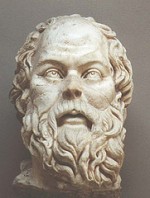
Socrates Narrowly Acquitted at Retrial 2,400 Years after His Execution
The Greek philosopher Socrates
was accused of irreverence to the gods and corrupting the young people
of Athens. For this, he was tried, convicted and sentenced to death.
Socrates drank a cup of hemlock and died.This, it has seemed to some observers of history, was a bum rap. So a panel of legal experts in Athens retried him. Their votes tied 5 to 5, thus narrowly securing an acquittal:
“Socrates comes before us feigning humility, yet demonstrating arrogance,” said Loretta Preska, a New York district judge who presided at Friday’s trial and voted to convict him.That was probably a prudent decision.
“He is a dangerous subversive.”
Pleading earlier in Socrates’ defence, prominent French lawyer Patrick Simon said: “An opinion is not a crime. Socrates was searching for the truth.
He added: “My client has one fault: he likes to poke fun and is fiercely ironic. By acquitting him, you will show how solid and reliable democracy is.”
Versed in Socratic literature, the legal brains came from Britain, France, Germany, Greece, Switzerland and the United States.
“In order not to complicate this trial unnecessarily, penalty will not be decided,” Preska said.
Ancient Harappan Civilization’s Collapse Explained
The mysterious fall of the largest of the world's earliest
urban civilizations nearly 4,000 years ago in what is now India,
Pakistan, Nepal and Bangladesh now appears to have a key culprit —
ancient climate change, researchers say.
Ancient Egypt and Mesopotamia may be the best known of the first great urban cultures, but the largest was the Indus or Harappan civilization.
This culture once extended over more than 386,000 square miles (1 million square kilometers) across the plains of the Indus River from the Arabian Sea to the Ganges, and at its peak may have accounted for 10 percent of the world population.
The civilization developed about 5,200 years ago, and slowly disintegrated between 3,900 and 3,000 years ago — populations largely abandoned cities, migrating toward the east.
"Antiquity knew about Egypt and Mesopotamia, but the Indus civilization, which was bigger than these two, was completely forgotten until the 1920s," said researcher Liviu Giosan, a geologist at Woods Hole Oceanographic Institution in Massachusetts.
"There are still many things we don't know about them."
Nearly a century ago, researchers began discovering numerous remains of Harappan settlements along the Indus River and its tributaries, as well as in a vast desert region at the border of India and Pakistan.
Evidence was uncovered for sophisticated cities, sea links with Mesopotamia, internal trade routes, arts and crafts, and as-yet undeciphered writing.
"They had cities ordered into grids, with exquisite plumbing, which was not encountered again until the Romans," Giosan said.
"They seem to have been a more democratic society than Mesopotamia and Egypt — no large structures were built for important personalities like kings or pharaohs."
Like their contemporaries in Egypt and Mesopotamia, the Harappans, who were named after one of their largest cities, lived next to rivers.
"Until now, speculations abounded about the links between this mysterious ancient culture and its life-giving mighty rivers," Giosan said.
Now Giosan and his colleagues have reconstructed the landscape of the plain and rivers where this long-forgotten civilization developed. Their findings now shed light on the enigmatic fate of this culture.
"Our research provides one of the clearest examples of climate change leading to the collapse of an entire civilization," Giosan said.
The researchers first analyzed satellite data of the landscape influenced by the Indus and neighboring rivers.
From 2003 to 2008, the researchers then collected samples of sediment from the coast of the Arabian Sea into the fertile irrigated valleys of Punjab and the northern Thar Desert to determine the origins and ages of those sediments and develop a timeline of landscape changes.
"It was challenging working in the desert — temperatures were over 110 degrees Fahrenheit all day long (43 degrees C)," Giosan recalled.
After collecting data on geological history, "we could reexamine what we know about settlements, what crops people were planting and when, and how both agriculture and settlement patterns changed," said researcher Dorian Fuller, an archaeologist with University College London.
"This brought new insights into the process of eastward population shift, the change towards many more small farming communities, and the decline of cities during late Harappan times."
Some had suggested that the Harappan heartland received its waters from a large glacier-fed Himalayan river, thought by some to be the Sarasvati, a sacred river of Hindu mythology. However, the researchers found that only rivers fed by monsoon rains flowed through the region.
Previous studies suggest the Ghaggar, an intermittent river that flows only during strong monsoons, may best approximate the location of the Sarasvati.
Archaeological evidence suggested the river, which dissipates into the desert along the dried course of Hakra valley, was home to intensive settlement during Harappan times.
"We think we settled a long controversy about the mythic Sarasvati River," Giosan said.
Initially, the monsoon-drenched rivers the researchers identified were prone to devastating floods.
Over time, monsoons weakened, enabling agriculture and civilization to flourish along flood-fed riverbanks for nearly 2,000 years.
"The insolation — the solar energy received by the Earth from the sun — varies in cycles, which can impact monsoons," Giosan said.
"In the last 10,000 years, the Northern Hemisphere had the highest insolation from 7,000 to 5,000 years ago, and since then insolation there decreased.
All climate on Earth is driven by the sun, and so the monsoons were affected by the lower insolation, decreasing in force.
This meant less rain got into continental regions affected by monsoons over time."
Eventually, these monsoon-based rivers held too little water and dried, making them unfavorable for civilization.
"The Harappans were an enterprising people taking advantage of a window of opportunity — a kind of "Goldilocks civilization," Giosan said.
Eventually, over the course of centuries, Harappans apparently fled along an escape route to the east toward the Ganges basin, where monsoon rains remained reliable.
"We can envision that this eastern shift involved a change to more localized forms of economy — smaller communities supported by local rain-fed farming and dwindling streams," Fuller said.
"This may have produced smaller surpluses, and would not have supported large cities, but would have been reliable."
This change would have spelled disaster for the cities of the Indus, which were built on the large surpluses seen during the earlier, wetter era.
The dispersal of the population to the east would have meant there was no longer a concentrated workforce to support urbanism.
"Cities collapsed, but smaller agricultural communities were sustainable and flourished," Fuller said. "Many of the urban arts, such as writing, faded away, but agriculture continued and actually diversified."
These findings could help guide future archaeological explorations of the Indus civilization.
Researchers can now better guess which settlements might have been more significant, based on their relationships with rivers, Giosan said.
It remains uncertain how monsoons will react to modern climate change. "If we take the devastating floods that caused the largest humanitarian disaster in Pakistan's history as a sign of increased monsoon activity, than this doesn't bode well for the region," Giosan said.
"The region has the largest irrigation scheme in the world, and all those dams and channels would become obsolete in the face of the large floods an increased monsoon would bring."
Ancient Egypt and Mesopotamia may be the best known of the first great urban cultures, but the largest was the Indus or Harappan civilization.
This culture once extended over more than 386,000 square miles (1 million square kilometers) across the plains of the Indus River from the Arabian Sea to the Ganges, and at its peak may have accounted for 10 percent of the world population.
The civilization developed about 5,200 years ago, and slowly disintegrated between 3,900 and 3,000 years ago — populations largely abandoned cities, migrating toward the east.
"Antiquity knew about Egypt and Mesopotamia, but the Indus civilization, which was bigger than these two, was completely forgotten until the 1920s," said researcher Liviu Giosan, a geologist at Woods Hole Oceanographic Institution in Massachusetts.
"There are still many things we don't know about them."
Nearly a century ago, researchers began discovering numerous remains of Harappan settlements along the Indus River and its tributaries, as well as in a vast desert region at the border of India and Pakistan.
Evidence was uncovered for sophisticated cities, sea links with Mesopotamia, internal trade routes, arts and crafts, and as-yet undeciphered writing.
"They had cities ordered into grids, with exquisite plumbing, which was not encountered again until the Romans," Giosan said.
"They seem to have been a more democratic society than Mesopotamia and Egypt — no large structures were built for important personalities like kings or pharaohs."
Like their contemporaries in Egypt and Mesopotamia, the Harappans, who were named after one of their largest cities, lived next to rivers.
"Until now, speculations abounded about the links between this mysterious ancient culture and its life-giving mighty rivers," Giosan said.
Now Giosan and his colleagues have reconstructed the landscape of the plain and rivers where this long-forgotten civilization developed. Their findings now shed light on the enigmatic fate of this culture.
"Our research provides one of the clearest examples of climate change leading to the collapse of an entire civilization," Giosan said.
The researchers first analyzed satellite data of the landscape influenced by the Indus and neighboring rivers.
From 2003 to 2008, the researchers then collected samples of sediment from the coast of the Arabian Sea into the fertile irrigated valleys of Punjab and the northern Thar Desert to determine the origins and ages of those sediments and develop a timeline of landscape changes.
"It was challenging working in the desert — temperatures were over 110 degrees Fahrenheit all day long (43 degrees C)," Giosan recalled.
After collecting data on geological history, "we could reexamine what we know about settlements, what crops people were planting and when, and how both agriculture and settlement patterns changed," said researcher Dorian Fuller, an archaeologist with University College London.
"This brought new insights into the process of eastward population shift, the change towards many more small farming communities, and the decline of cities during late Harappan times."
Some had suggested that the Harappan heartland received its waters from a large glacier-fed Himalayan river, thought by some to be the Sarasvati, a sacred river of Hindu mythology. However, the researchers found that only rivers fed by monsoon rains flowed through the region.
Previous studies suggest the Ghaggar, an intermittent river that flows only during strong monsoons, may best approximate the location of the Sarasvati.
Archaeological evidence suggested the river, which dissipates into the desert along the dried course of Hakra valley, was home to intensive settlement during Harappan times.
"We think we settled a long controversy about the mythic Sarasvati River," Giosan said.
Initially, the monsoon-drenched rivers the researchers identified were prone to devastating floods.
Over time, monsoons weakened, enabling agriculture and civilization to flourish along flood-fed riverbanks for nearly 2,000 years.
"The insolation — the solar energy received by the Earth from the sun — varies in cycles, which can impact monsoons," Giosan said.
"In the last 10,000 years, the Northern Hemisphere had the highest insolation from 7,000 to 5,000 years ago, and since then insolation there decreased.
All climate on Earth is driven by the sun, and so the monsoons were affected by the lower insolation, decreasing in force.
This meant less rain got into continental regions affected by monsoons over time."
Eventually, these monsoon-based rivers held too little water and dried, making them unfavorable for civilization.
"The Harappans were an enterprising people taking advantage of a window of opportunity — a kind of "Goldilocks civilization," Giosan said.
Eventually, over the course of centuries, Harappans apparently fled along an escape route to the east toward the Ganges basin, where monsoon rains remained reliable.
"We can envision that this eastern shift involved a change to more localized forms of economy — smaller communities supported by local rain-fed farming and dwindling streams," Fuller said.
"This may have produced smaller surpluses, and would not have supported large cities, but would have been reliable."
This change would have spelled disaster for the cities of the Indus, which were built on the large surpluses seen during the earlier, wetter era.
The dispersal of the population to the east would have meant there was no longer a concentrated workforce to support urbanism.
"Cities collapsed, but smaller agricultural communities were sustainable and flourished," Fuller said. "Many of the urban arts, such as writing, faded away, but agriculture continued and actually diversified."
These findings could help guide future archaeological explorations of the Indus civilization.
Researchers can now better guess which settlements might have been more significant, based on their relationships with rivers, Giosan said.
It remains uncertain how monsoons will react to modern climate change. "If we take the devastating floods that caused the largest humanitarian disaster in Pakistan's history as a sign of increased monsoon activity, than this doesn't bode well for the region," Giosan said.
"The region has the largest irrigation scheme in the world, and all those dams and channels would become obsolete in the face of the large floods an increased monsoon would bring."
Geological News
Greenland shedding ice
The Greenland ice sheet continues to lose mass and thus contributes at about 0.7 millimeters per year to the currently ...
Auction House and Mongolian President to Cooperate in Fight Over Fossil
'Steak-Knife Teeth'
Reptile has 'steak-knife teeth'
The unique saw-like chew of a New Zealand reptile could be the secret of its success, say scientists. BBC Nature
Wednesday, May 30, 2012
The Daily Drift
Today's readers have been in:
Amersfoort, Netherlands
Kuala Lumpur, Malaysia
Liege, Belgium
Groningen, Netherlands
Palermo, Italy
Singapore, Singapore
Dhaka, Bangladesh
Port-Of-Spain, Trinidad and Tobago
Jerudong, Brunei Darussalam
Petaling Jaya, Malaysia
London, England
Marrakesh, Morocco
Glasgow, Scotland
Haderslev, Denmark
Budapest, Hungary
Zurich, Switzerland
Karachi, Pakistan
Zenica, Bosnia and Herzegovina
Maseru, Lesotho
Warsaw, Poland
Varna, Bulgaria
Bern, Switzerland
Jakarta, Indonesia
Bangkok, Thailand
Shah Alam, Malaysia
Cape Town, South Africa
San Juan, Puerto Rico
Sampaloc, Philippines
Hanoi, Vietnam
Johannesburg, South Africa
Today in HIstroy
| 1416 | Jerome of Prague is burned as a heretic by the Church. | |
| 1431 | Joan of Arc is burned at the stake by the English. | |
| 1527 | The University of Marburg is founded in Germany. | |
| 1539 | Hernando de Soto lands in Florida with 600 soldiers in search of gold. | |
| 1783 | The first American daily newspaper, The Pennsylvania Evening Post, begins publishing in Philadelphia. | |
| 1814 | The First Treaty of Paris is declared, returning France to its 1792 borders. | |
| 1848 | William Young patents the ice cream freezer. | |
| 1854 | The Kansas-Nebraska Act repeals the Missouri Compromise. | |
| 1859 | The Piedmontese army crosses the Sesia River and defeats the Austrians at Palestro. | |
| 1862 | Union General Henry Halleck enters Corinth, Mississippi. | |
| 1868 | Memorial Day begins when two women place flowers on both Confederate and Union graves. | |
| 1889 | The brassiere is invented. | |
| 1912 | U.S. Marines are sent to Nicaragua to protect American interests. | |
| 1913 | The First Balkan War ends. | |
| 1921 | The U.S. Navy transfers the Teapot Dome oil reserves to the Department of the Interior. | |
| 1942 | The Royal Air Force launches the first 1,000 plane raid over Germany. | |
| 1971 | NASA launches Mariner 9, the first satellite to orbit Mars. |
MarketWatch debunks Romney's spending lie
Eugene Robinson in the Washington Post:
“Since President Obama assumed office three years ago, federal spending has accelerated at a pace without precedent in recent history,” Romney claims on his campaign Web site. This is utterly false. The truth is that spending has slowed markedly under Obama.The repugicans don't, and can't, win by telling the truth. That's why they had to set up their own TV network, in order to make their own truth. It's why they routinely try to take down the traditional media - because independent truth-checkers are dangerous, fatal, to a party based on lies.
An analysis published last week by MarketWatch, a financial news Web site owned by Dow Jones & Co., compared the yearly growth of federal spending under presidents going back to Ronald Reagan. Citing figures from the Office of Management and Budget and the Congressional Budget Office, MarketWatch concluded that “there has been no huge increase in spending under the current president, despite what you hear.”
Quite the contrary: Spending has increased at a yearly rate of only 1.4 percent during Obama’s tenure, even if you include some stimulus spending (in the 2009 fiscal year) that technically should be attributed to President George W. Bush. This is by far the smallest — I repeat, smallest — increase in spending of any recent president. (The Washington Post’s Fact Checker concluded the spending increase figure should have been 3.3 percent.)
Did BP execs lie to Congress?
Does a bear shit in the woods?
Obama has often been timid in his support of environmental issues, though maybe with the election coming into focus, he may be keen to connect with this group of voters. Despite his early cover for BP after the Deepwater Horizon disaster, he's received nothing but the typical bashing by Big Oil who pump millions into GOP campaign coffers.
Outside of the repugican party, few really like Big Oil so they are always going to be an easy target. If they lied to Congress about the Deepwater Horizon accident as the Justice Department is alleging then they're going to be an even easier target.
Will the Justice Department finally get around to actual justice? It would make for a nice change after years of inaction and ass-kissing for special interests.
The U.S. Justice Department is investigating whether BP executives lied to Congress about how much oil leaked in the company's 2010 Gulf of Mexico oil spill, the Wall Street Journal reported on Monday, citing people familiar with the investigation.
According to the Journal, prosecutors are looking into statements the company made to members of Congress at a closed-door briefing of members of the House Energy and Commerce Committee by officials from BP, Halliburton Co. and Transocean Ltd.
Dave Nagel, the executive vice president of BP America, and David Rainey, the company's former head of Gulf of Mexico exploration, were involved in the briefing, the Journal said.
Man Tried to Pay for Denny's Meal in Pot
Niagara Falls police were reportedly on the hunt for a man who tried to settle his $9.91 Denny's bill with a bag of marijuana.
The Scandalous History of Arlington National Cemetery
Arlington National Cemetery saw a great number of people visit to pay their
respects to service members killed in wartime on Memorial Day. But how much do you
know about the history of the cemetery? In 148 years, Arlington has
seen its share of scandals, including how it came to be where it is.Arlington isn’t actually located in Washington, DC, but just outside it, in Virginia. That’s because the land was seized from Robert E. Lee’s plantation in 1864. There were other options for the location of a National Cemetery, but the government specifically wanted to bury Union soldiers on Lee’s land as an insult to the Confederate general. Brig. Gen. Montgomery C. Meigs wanted to make sure the place was uninhabitable if the Lees ever tried to return. He ordered the graves placed as close to the mansion as possible.But then Lee’s grandson sued to get the property back.
After the war, the Lees owed about $1,400 in today’s money in taxes on the estate. Mrs. Lee sent someone to pay the tax, but the government refused to accept it. Instead they took half the land in a public auction and ordered the establishment of a National Cemetery.
Child survivor of Syrian massacre details shooting
The details on the latest bloody attack
in Syria are emerging and it's as bad as you might expect. Somehow one
eleven year old boy managed to save himself during a deadly visit by
Assad's forces. Five others in the household were murdered and had the
young boy not smeared blood on his face and acted dead, he too likely
would have been murdered.
Until Assad steps aside or is taken to The Hague for war crimes, there's not going to be an end to such madness in Syria.
The Guardian:
Until Assad steps aside or is taken to The Hague for war crimes, there's not going to be an end to such madness in Syria.
The Guardian:
Shivering with fear, the boy stood towards the back of the entrance to his family home as gunmen then shot dead every family member in front of him.
"My mum yelled at them," said the boy. "She asked: 'What do you want from my husband and son?' A bald man with a beard shot her with a machine gun from the neck down. Then they killed my sister, Rasha, with the same gun. She was five years old. Then they shot my brother Nader in the head and in the back. I saw his soul leave his body in front of me.
"They shot at me, but the bullet passed me and I wasn't hit. I was shaking so much I thought they would notice me. I put blood on my face to make them think I'm dead."
Sentenced to death for singing at a wedding
Four women and two men have been sentenced to death in northern Pakistan for singing and dancing at a wedding, police say.
Clerics issued a decree after a mobile phone video emerged of the six enjoying themselves in a remote village in the mountainous district of Kohistan, 176km north of the capital Islamabad.
"The local clerics issued a decree to kill all four women and two men shown in the video," district police officer Abdul Majeed Afridi said.
"It was decided that the men will be killed first, but they ran away so the women are safe for the moment. I have sent a team to capture them and am waiting to hear some news," he said, adding that the women had been confined to their homes.
Afridi said the events stemmed from a dispute between two tribes and that there was no evidence the men and women had been mingling.
"All of them were shown separately in the video. I've seen the video taken on a cell phone myself. It shows four women singing and a man dancing in separate scenes and then another man sitting in a separate shot," he said.
"This is tribal enmity. The video has been engineered to defame the tribe," he added.
The Human Rights Commission of Pakistan said at least 943 women and girls were murdered last year for allegedly defaming their family's honor.
The statistics highlight the scale of violence suffered by many women in conservative Muslim Pakistan, where they are frequently treated as second-class citizens.
Science News
Mediterranean diet definitively linked to quality of life
Monogamy owes a lot to weak males, faithful females
In
early human evolution, when faithful females began to choose good
providers as mates, pair-bonding replaced promiscuity, laying the
foundation ...
Inequality dates back to the Stone Age
Hereditary
inequality began over 7,000 years ago in the early Neolithic era, with
new evidence showing that farmers buried with ...
What Employers Are Looking for on Facebook
By Korin Miller
According to a new CareerBuilder.com survey, employers say they're on the hunt for these red flags:
* Inappropriate or provocative photos (49 percent)
* Information about a candidate drinking or using drugs (45 percent)
* Poor communication skills (35 percent)
* Discriminatory comments about other people (28 percent)
* Lying about qualifications (22 percent)
Apparently you don't have to stress over your Twitter feed as much: 65 percent of employers said they home in on Facebook, while 63 percent look at LinkedIn. Only 16 percent look at Twitter.
Neat Tricks to Clean Your Car
Hair conditioner for shine
Fizz windshields clean with cola When it rains after a long dry spell, a dirty windshield turns into one big mess. Get rid of streaks and blotches by pouring cola over the glass. (Stretch a towel along the bottom of the windshield to protect hood paint.) The bubbles in the cola will fizz away the grime. Just be sure to wash the sticky cola off thoroughly or your cleaning efforts will end up attracting dust and dirt.
Vodka on the job When your windshield-washer reservoir needs filling, raid the liquor cabinet to make your own washing fluid. In a screw-top gallon jug, mix 3 cups vodka (the cheapest you can find) with 4 cups water and 2 teaspoons liquid dishwashing detergent. Screw on the cap and shake well, then pour as much fluid as needed into the reservoir.
Shine those car lights Keep your headlights polished (and yourself, safe) by applying window cleaner and rubbing vigorously with an old pair of panty hose.
A one-step window cleaner Clean your windshield and car windows by rubbing them with baby wipes stored in your glove compartment. What could be easier?
No windshield washing fluid? If the reservoir is empty (and doesn't it always seem to be?), use an unlikely substitute to clean your windshield: feminine hygiene maxi-pads, a box of which you could stash in the trunk. Hold a pad on the sticky side and rub the windshield vigorously. The glass will really shine once you've wiped it to the max.
Disasters that Can Hit Your House While You're on Vacation
(and How You Can Avoid Them)
A summer getaway is supposed to be a time for rest and relaxation. But if your heart is on vacation while your head is worrying about home, you won't get much out of your time off. That's why we've brought you this handy guide of some bad things that can befall your house when you leave it alone. Don't fret-we also share with you expert advice on how to avoid these pitfalls. That way, you can take off worry-free, and know that there will still be a house standing when you pull back into the drive.
By Jeanne Baron, from thisoldhouse.com
House Fires. One of summer's many lightning storms can start a fire, and with no one to call 911 it can take out a whole house. The best defense, says TOH general contractor Tom Silva, is lightning rods. "This is not by any means a homeowner job," he warns. "You need a pro to install them." Any highly placed metal protrusion on your house should be grounded, in fact, including weather vanes and satellite dishes.
Don't overlook the health of your wiring, as well. Curtis Niles Sr. of Armored Home Inspections in Upper Darby, Pennsylvania, and President of the National Association of Home Inspectors, advises homeowners to keep up with maintenance. "Wiring is the last thing on a homeowner's mind, but I've seen exterior service cables in poor condition all too often." he says. "If there's short or a spark in the line, a fire can start, and you won't be there to put it out."
Break-ins and Robbery. Unmowed grass, piles of newspapers, and revealing posts on Facebook might as well be an open invitation to burglars, says Ralph Sevinor, President of Wayne Alarm Systems in Lynn, Massachusetts. Sevinor suggests putting a hold on the mail, asking a neighbor to park in the drive, testing your alarm system, and keeping your travel plans off the Internet. "Even if it's your kid on Facebook telling her 2,300 friends about the family trip to Hawaii, you have to watch out. That message can get picked up by criminals who troll the Internet constantly," says Sevinor.
Flood. Niles says aging washing-machine systems are notorious for busting when you least expect it. "A bulge in the hose line indicates it's weak and ready to go," he says. Check the hoses before you go, and turn off the water supply to the laundry area, just in case.
An aging water heater can also break down and send water cascading. "Lots of times there are signs that a water heater's failing," says Tom. "Water on the floor around it, or rust on the outside." Rust can mean that the sacrificial anode rod inside the tank has been depleted and the water is affecting the tank itself. Tom suggests checking the anode rod and turning off the water supply before you go away. "That way if your it dumps out, the only thing that happens is you get a wet basement," says Tom.
Why We Pay More for Walkable Neighborhoods
Instinct probably tells you that you'll pay a lot more to live in a
downtown apartment, above a grocery store, next to a bar strip and
within walking distance of your work place than you will to settle into a
comparable home in a bedroom community outside of the city.
Seeing Black and White Make People More Judgmental
Schnall and her colleagues conducted a series of five experiments investigating both the black-and-white metaphor and the effect of "balance." In the first, they recruited 111 participants online through Amazon's crowd-sourcing website Mechanical Turk. Each participant read the fictional story of Heinz, a man forced to steal life-saving medication for his wife's cancer because he couldn't afford the drugs. After reading the story, the participants rated how moral Heinz's actions had been.
In some cases, participants saw this tale bordered by a black-and-white checkerboard. Others say a gray border. A third group saw a yellow-and-blue checkerboard.
The results revealed that people reported stronger judgments — both on the moral and immoral sides of the rating scale — when they had read the story against a black-and-white background. There was no difference between the gray and the colorful checkerboard.
"People gave more polarized judgments when they saw some black-and-white checkered background that was in principle irrelevant and incidental," Schnall said.
Have Germans Lost the “Joy DNA”?
The main thing standing in their way is their own perfectionism. During hours of individual and group interviews, the researchers analyzed how 60 subjects felt pleasure. They also scrutinized the results of a representative survey of 1,000 men and women commissioned by the liquor companies Diageo and Pernod Ricard.
Among survey respondents, 81 percent said that they experience pleasure best when they have managed to achieve something first. "As the saying goes, business before pleasure," said 61-year-old female participant Wiltrud.
But this maxim doesn't seem to serve the Germans well -- they even feel burdened by the pressure to enjoy things. "People often told us that they would come home after a stressful day, but were unable to even say what they'd accomplished," Imdahl reported. "And then the people around them say, 'Hey, just relax.' Enjoyment then turns into an obligation."
Meanwhile, chances to create a sense of well-being lurk everywhere -- a glass of wine, a relaxing bubble bath, or a nice restaurant with delicious food. These, of all things, also rankle the Germans. "This glut of offerings pressures people into thinking, 'I must enjoy everything'," Imdahl says.
How Your Sleep Schedule is Making You Gain Weight
You know that sleep and weight gain may be linked, but why is that?
Here's what the earth-shattering new research has revealed, and why lack of sleep could be stalling your ability to lose weight and keep it off:
Sleep less, burn less. In a study at the department of neuroendocrinology at the University of Lübeck, Germany, published in the American Journal of Clinical Nutrition, researchers had a group of men sleep for 12 hours a night but didn't allow them to sleep the next night, and then had them eat an opulent buffet the following morning. Then the researchers measured the subjects' energy expenditure-the calories you burn just by being. When the men were sleep-deprived, their general energy expenditure was 5 percent less than it was when they got a good night's sleep, and their post-meal energy expenditure was 20 percent less.
Sleep less, eat more. In research presented at the American Heart Association's 2011 Scientific Sessions, it was shown that women who got only 4 hours of sleep at night ate 329 additional calories the next day than they did after they slept 9 hours. (Men ate 263 calories more.) In another study published in the American Journal of Clinical Nutrition, 11 volunteers spent 14 days at a sleep center on two occasions. During one period, they slept 5.5 hours a night, and during the other, they slept 8.5 hours. When the subjects were sleep-deprived, they increased their nighttime snacking and were more likely to choose high-carbohydrate snacks.
Sleep less, crave more. This is probably the biggest revelation about the connection between sleep and weight loss-and the biggest challenge for you if you're not getting at least 7 solid hours of sleep each night. Sleeping too little impacts your hormone levels in ways that can undermine the efforts of even the most determined dieter. That's because insufficient sleep raises the levels of ghrelin, the hormone that tells you to eat. When it comes to weight gain and loss, this hormone plays a leading role.
Ghrelin's job is to boost your appetite, increase fat production, and make your body grow-all of which are fine things if you're a lanky 12-year-old. But as you get older, ghrelin's effects can seem pretty darned undesirable. It's a cinch to figure out why this hormone is the last thing a dieter needs to have circulating in excess.
Lack of sleep also lowers levels of leptin, the hormone that says, "I'm full; put the fork down." And leptin has a circadian rhythm all its own: Leptin's levels run high during the night, which tells your body while you're sleeping that you don't need to eat. Its levels drop during the day, when you need food as energy. So high leptin levels keep hunger at bay. In studies, for example, mice lost weight because leptin made them eat less and exercise more: the holy grail of dieting. But if you don't get enough sleep, your leptin levels plummet.
So after even one night of too little sleep, leptin and ghrelin become dietary gremlins bent on diet-wrecking mischief. The lower leptin levels mean that you still feel hungry after you eat. And ghrelin, for its part, magnifies the problem by stimulating your appetite, setting the stage for a day of unsatisfying, high-cal feasting after a restless night.
In the Wisconsin Sleep Cohort Study of more than 1,000 people, researchers found that people who got 5 hours of sleep a night had 15.5 percent lower leptin levels and 14.9 percent higher levels of ghrelin, compared with those who got 8 hours of sleep. Know what else the nonsleepers scored higher numbers in? BMI. So more ghrelin plus less leptin equals greater body mass index and weight gain.
In a study at the University of Chicago, researchers discovered that restricting the sleep of 12 healthy young men to 4 hours a night lowered their leptin levels by 18 percent. The men rated themselves as having a 24 percent increase in hunger.
Sleep less, hang on to fat more. Lack of sleep may also affect the kind of weight you lose.
In another study at the University of Chicago, researchers followed 10 overweight but healthy subjects who were placed on a balanced diet, then observed in two 14-day increments, one in which they got about 7.5 hours of sleep, and another in which they got 5 hours and 15 minutes. During both periods, the subjects lost an average of 6.6 pounds. But when they got more sleep, they lost 3.1 pounds of fat, whereas during the short sleep period, they lost only 1.3 pounds of fat. Those who got more sleep reported less hunger, which makes sense: When they got enough sleep, their ghrelin levels stayed the same. On the 5-hour nights, their ghrelin levels rose by 9 points.
Since ghrelin also promotes the retention of fat, researchers theorize that a lack of sleep explains why the nonsleepers held on to body fat. This happens because the diet-unfriendly hormone reduces the number of calories you burn off and increases glucose production.
Sleep less, have more time to eat. It hasn't been scientifically proven, but some experts believe that the 2 hours or more that we're no longer using to sleep is giving us another 2 hours to raid the fridge. Instead, get in that bed!
Twenty Solitary Desert Plants Surviving Against the Odds
Take inspiration from these 20 tough and determined desert plants
surviving alone in harsh environments where the earth is parched and
water is seldom seen.
More
More
Kansas Is Flatter Than a Pancake

1. Department of Geography, Texas State University, San Marcos, Texas
2. Department of Geography, Arizona State University, Tempe, Arizona
In this report, we apply basic scientific techniques to answer the question “Is Kansas as flat as a pancake?”
While driving across the American Midwest, it is common to hear travelers remark, “This state is as flat as a pancake.” To the authors, this adage seems to qualitatively capture some characteristic of a topographic geodetic survey 2. This obvious question “how flat is a pancake” spurned our analytical interest, and we set out to find the ‘flatness’ of both a pancake and one particular state: Kansas.A Technical Approach to Pancakes and Kansas

Figure 1. (a) A well-cooked pancake; and (b) Kansas. 1
Barring the acquisition of either a Kansas-sized pancake or a pancake-sized Kansas, mathematical techniques are needed to do a proper comparison. Some readers may find the comparing of a pancake and Kansas to be analogous to the comparing of apples and oranges; we refer those readers to a 1995 publication by NASA’s Scott Sandford 3, who used spectrographic techniques to do a comparison of apples and oranges.
One common method of quantifying ‘flatness’ in geodesy is the ‘flattening’ ratio. The length of an ellipse’s (or arc’s) semi-major axis a is compared with its measured semi-minor axis b using the formula for flattening, f = (a – b) / a. A perfectly flat surface will have a flattening f of one, whereas an ellipsoid with equal axis lengths will have no flattening, and f will equal zero.
For example, the earth is slightly flattened at the poles due to the earth’s rotation, making its semi-major axis slightly longer than its semi-minor axis, giving a global f of 0.00335. For both Kansas and the pancake, we approximated the local ellipsoid with a second-order polynomial line fit to the cross-sections. These polynomial equations allowed us to estimate the local ellipsoid’s semi-major and semi-minor axes and thus we can calculate the flattening measure f.
Materials and Methods
Figure 2. Pancake cross-sectional surface being digitized.
We purchased a well-cooked pancake from a local restaurant, the International House of Pancakes, and prepared it for analysis by separating a 2-cm wide sample strip that had not had time to desiccate. We collected macro-pancake topography through digital image processing of a pancake image and ruler for scale calibration (see Figure 2).
We made another topographic profile from the sample, using a confocal laser microscope. The importance of this research dictated that we not be daunted by the “No Food or Drink” sign posted in the microscopy room. The microscope collects one elevation point every 10 mm and has a maximum surface diameter of 2 cm (see Figure 3).
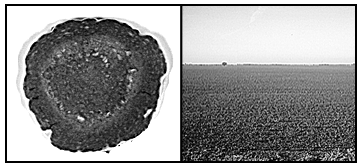
Figure 3. When viewed at a scale of 50 mm, a pancake appears more rugged than the Grand Canyon.
We measured a west-east profile across Kansas taken from merged 1:250,000 scale digital elevation model (DEM) data from the United States Geological Survey. In general, the spacing between adjacent elevation points on the landscape transects was approximately 90 meters. We extracted surface transects and flatness estimates from the Kansas and pancake DEM data using a geographic information system.
Results
The topographic transects of both Kansas and a pancake at millimeter scale are both quite flat, but this first analysis showed that Kansas is clearly flatter (see Figure 4).
Figure 4. Surface topography of Kansas and of a pancake.
Mathematically, a value of 1.000 would indicate perfect, platonic flatness. The calculated flatness of the pancake transect from the digital image is approximately 0.957, which is pretty flat, but far from perfectly flat. The confocal laser scan showed the pancake surface to be slightly rougher, still.
Measuring the flatness of Kansas presented us with a greater challenge than measuring the flatness of the pancake. The state is so flat that the off-the-shelf software produced a flatness value for it of 1. This value was, as they say, too good to be true, so we did a more complex analysis, and after many hours of programming work, we were able to estimate that Kansas’s flatness is approximately 0.9997. That degree of flatness might be described, mathematically, as “damn flat.”
Conclusion
Simply put, our results show that Kansas is considerably flatter than a pancake.Notes
1. The photograph of Kansas is of an area near Wichita, Kansas. It may be of significance that the town of Liberal, Kansas hosts the annual ‘International Pancake Day’ festival.2. To pump up our cross-disciplinary name-dropping, we should also mention that recently some quick-thinking cosmologists also described the universe as being “flatter than a pancake” after making detailed measurements of the cosmic background radiation.
3. “Comparing Apples and Oranges,” S.A. Sandford, Annals of Improbable Research, vol. 1, no. 3, May/June 1995.
Radioactive bluefin tuna cross Pacific
Across the vast Pacific, the mighty bluefin tuna carried
radioactive contamination that leaked from Japan's crippled nuclear
plant to the shores of the United States, almost 10,000 kilometers away -
the first time a huge migrating fish has been shown to carry
radioactivity such a distance.
"We were frankly kind of startled," said Nicholas Fisher, one of the researchers reporting the findings online in the Proceedings of the National Academy of Sciences.
The
levels of radioactive cesium were 10 times higher than the amount
measured in tuna off the California coast in previous years. But even
so, that's still far below safe-to-eat limits set by the US and Japanese
governments.
Previously, smaller fish and plankton were found with elevated levels of radiation in Japanese waters after a magnitude-nine earthquake in March 2011 triggered a tsunami that badly damaged the Fukushima Dai-ichi reactors.
But scientists did not expect the fallout to linger in huge fish that sail the world as they can shed radioactive substances.
One of the largest and speediest fish, Pacific bluefin tuna can grow to three meters and weigh more than 450kg. They spawn off Japan's coast and swim east to school in waters off California and Mexico.
Five months after the Fukushima disaster, Fisher of Stony Brook University in New York and a team tested Pacific bluefin caught off the coast of San Diego.
Tissue samples from all 15 tuna contained levels of radioactive ceisum-134 and cesium-137 higher than in previous catches.
The team also analyzed yellowfin tuna, found in the eastern Pacific, and bluefin that migrated to southern California before the crisis. They found no trace of cesium-134 and only background levels of cesium-137 left over from nuclear weapons testing in the 1960s.
The results "are unequivocal. Fukushima was the source," said Ken Buesseler of the Woods Hole Oceanographic Institution, which had no role in the research.
"We were frankly kind of startled," said Nicholas Fisher, one of the researchers reporting the findings online in the Proceedings of the National Academy of Sciences.
Previously, smaller fish and plankton were found with elevated levels of radiation in Japanese waters after a magnitude-nine earthquake in March 2011 triggered a tsunami that badly damaged the Fukushima Dai-ichi reactors.
But scientists did not expect the fallout to linger in huge fish that sail the world as they can shed radioactive substances.
One of the largest and speediest fish, Pacific bluefin tuna can grow to three meters and weigh more than 450kg. They spawn off Japan's coast and swim east to school in waters off California and Mexico.
Five months after the Fukushima disaster, Fisher of Stony Brook University in New York and a team tested Pacific bluefin caught off the coast of San Diego.
Tissue samples from all 15 tuna contained levels of radioactive ceisum-134 and cesium-137 higher than in previous catches.
The team also analyzed yellowfin tuna, found in the eastern Pacific, and bluefin that migrated to southern California before the crisis. They found no trace of cesium-134 and only background levels of cesium-137 left over from nuclear weapons testing in the 1960s.
The results "are unequivocal. Fukushima was the source," said Ken Buesseler of the Woods Hole Oceanographic Institution, which had no role in the research.
Forty ancient sites discovered in Iraq
Teams of Iraqi archaeologists have
discovered 40 ancient sites in the country's south from the Sumerian,
Akkadian and Babylonian periods, an Iraqi antiquities official said on
Monday.
"Teams, which have been working since 2010, were able to
discover 40 archaeological sites belonging to the Sumerian, Akkadian and
Babylonian periods," Amer al-Zaidi, the head of the antiquities
inspectorate in Dhi Qar province said.

The sites, which have not yet been fully explored, are located in Al-Shatra, Al-Diwaya, Al-Rifai, Al-Nasr and Al-Fajr areas north of Dhi Qar capital Nasiriyah, which lies 305 kilometers (190 miles) south of Baghdad.
The new discoveries bring the number of archaeological sites in the province to 1,240, the most of any province in Iraq, he said.
Iraq has a wealth of ancient sites, but both excavation of sites and tourism to those that have already been excavated has been curbed by violence that tore across the country following the 2003 US-led invasion.
While violence has decreased significantly from its peak in 2006 and 2007, attacks remain common, killing 126 people in April, according to Iraqi government figures.
The sites, which have not yet been fully explored, are located in Al-Shatra, Al-Diwaya, Al-Rifai, Al-Nasr and Al-Fajr areas north of Dhi Qar capital Nasiriyah, which lies 305 kilometers (190 miles) south of Baghdad.
The new discoveries bring the number of archaeological sites in the province to 1,240, the most of any province in Iraq, he said.
Iraq has a wealth of ancient sites, but both excavation of sites and tourism to those that have already been excavated has been curbed by violence that tore across the country following the 2003 US-led invasion.
While violence has decreased significantly from its peak in 2006 and 2007, attacks remain common, killing 126 people in April, according to Iraqi government figures.
Re-wilding
Firemaking, roadkill-cooking, primitivism: photos from a "rewilding" camp
The Firefly Gathering is one of several "rewinding" or "primitivism"
camps for learning self-sufficiency and wilderness skills and crafts
like fire-making, mushroom hunting, canning, diaper-free parenting,
trapping, and cooking wild game (and, er, road kill). Turnstyle's Mike
Belleme brought his camera to camp. (Warning, some of the photos of
animal "processing" may be upsetting to some.)From Turnstyle:
Tanning a hide and making buckskin shorts is hard work, and making fire by rubbing sticks together is frustrating and tedious, but participants say the result is a profound sense of understanding the materials that you work with. Firefly co-founder Natalie Bogwalker explained, “Firefly is here to stave off the amnesia of modern technocratic culture…When normal people come here they are really inspired and feel that things are possible…"
To some who attend the Firefly gathering, the primitive skills that they learn simply serve as a novelty or a fun way to spend a weekend. To others, the skills that are taught and shared at the gathering are a part of daily life and survival. If the predictions of many of the primitivists at Firefly are accurate, the imminent collapse of civilization will soon make these skills a matter of life or death for us all. If there is one theme that seems to permeate all aspects of the gathering it is connectedness. “It’s all about rooting ourselves deep into the earth and into our connections with each other,” said Bogwalker. She continued, “…when we look all around us and people aren’t interacting with each other, they’re like, looking at their iPads…they’re all like robots, half human half machine… it’s really creepy to me.”
Poisonous vs. Venomous
The key difference, writes blogger Jason Bittel, is in the biting. Venomous animals internally create a toxin and then inject it into prey or foes. Poisonous animals usually secrete their toxins on the outside.
So here's a rule of thumb: If you are dying because an animal has bitten you, chances are, it was a venomous animal. If you're dying because you touched an animal or (foolishly) put it in your mouth, that's poisonous.
And then, of course, there's the slow loris:
Because the loris manufactures toxin from specialized glands on its elbows, then transfers that liquid to small, curved teeth for injection, the loris is venomous. Alternately, mother lorises cover their offspring’s fur in the same potion, rendering them poisonous.More
Honduran White Bats
Twenty Freakish Creatures from the Depths of Russia's White Sea
Russia's White Sea contains many surprises – marine life as strange as anything you've ever seen!
More
More
Seven Bioluminescent Creatures That Light Up the Ocean
Imagine lighting up a room literally all by yourself. Well, that's what
these bioluminescent sea creatures are born to do! Bioluminescence
rarely looked so beautiful.
More
More
Subscribe to:
Posts (Atom)