| 1817 | Mississippi is admitted as the 20th state. | |
| 1861 | Kentucky is admitted to the Confederate States of America. | |
| 1862 | The U.S. House of Representatives passes a bill creating the state of West Virginia. | |
| 1869 | Governor John Campbell signs the bill that grants women in Wyoming Territory the right to vote as well as hold public office. | |
| 1898 | The United States and Spain sign the Treaty of Paris, ceding Spanish possessions, including the Philippines, to the United States. | |
| 1917 | The Nobel Peace Prize is awarded to the International Red Cross. | |
| 1918 | U.S. troops are called to guard Berlin as a coup is feared. | |
| 1919 | Captain Ross Smith becomes the first person to fly 11,500 miles from England to Australia. | |
| 1936 | Edward VIII abdicates to marry Wallis Warfield Simpson, an American-born divorcee. | |
| 1941 | Japanese troops invade the Philippine island of Luzon. | |
| 1941 | The siege of Tobruk in North Africa is raised. | |
| 1943 | Franklin D. Roosevelt signs a bill that postpones a draft of pre-Pearl Harbor fathers. | |
| 1943 | Allied forces bomb Sofia, the capital of Bulgaria. | |
| 1949 | 150,000 French troops mass at the border in Vietnam to prevent a Chinese invasion. | |
| 1950 | Dr. Ralph J. Bunche becomes the first African-American to be awarded the Nobel Peace Prize. | |
| 1977 | On UN Human Rights Day, the Soviet Union places 20 prominent dissidents under house arrest, cutting off telephones and threatening to break up a planned silent demonstration in Moscow's Pushkin Square. Soviet newspapers decry human rights violations elsewhere in the world. | |
| 1978 | President of Egypt Anwar Sadat and Prime Minister of Israel Menachem Begin are jointly awarded the Nobel Peace Prize. | |
| 1983 | Democracy restored to Argentina with the assumption of Raul Alfonsin. | |
| 1989 | Tsakhiagiin Elbegdorj announces the establishment of Mongolia's democratic movement that changes the second oldest communist country into a democracy. | |
| 1993 | The Wearmouth Colliery in Sunderland, East England, closes, marking the end of the County Durham coalfield, which had been in operation since the Middle Ages. |

Tuesday, December 10, 2013
Today in History


Xmas Countdown Xmas Stories
At Xmas Time
I
Vasilissa had not seen her daughter for four years. Efimia had gone away to St. Petersburg with her husband after her wedding, had written two letters, and then had vanished as if the earth had engulfed her, not a word nor a sound had come from her since. So now, whether the aged mother was milking the cow at daybreak, or lighting the stove, or dozing at night, the tenor of her thoughts was always the same: "How is Efimia? Is she alive and well?" She wanted to send her a letter, but the old father could not write, and there was no one whom they could ask to write it for them.
But now Xmas had come, and Vasilissa could endure the silence no longer. She went to the tavern to see Yegor, the innkeeper's wife's brother, who had done nothing but sit idly at home in the tavern since he had come back from military service, but of whom people said that he wrote the most beautiful letters, if only one paid him enough. Vasilissa talked with the cook at the tavern, and with the innkeeper's wife, and finally with Yegor himself, and at last they agreed on a price of fifteen copecks.
So now, on the second day of the Xmas festival, Yegor was sitting at a table in the inn kitchen with a pen in his hand. Vasilissa was standing in front of him, plunged in thought, with a look of care and sorrow on her face. Her husband, Peter, a tall, gaunt old man with a bald, brown head, had accompanied her. He was staring steadily in front of him like a blind man; a pan of pork that was frying on the stove was sizzling and puffing, and seeming to say: "Hush, hush, hush!" The kitchen was hot and close.
"What shall I write?" Yegor asked again.
"What's that?" asked Vasilissa, looking at him angrily and suspiciously. "Don't hurry me! You are writing this letter for money, not for love! Now then, begin. To our esteemed son-in-law, Andrei Khrisanfltch, and our only and beloved daughter Efimia, we send greetings and love, and the everlasting blessing of their parents."
"All right, fire away!"
"We wish them a happy Xmas. We are alive and well, and we wish the same for you in the name of god, our Father in heaven--our Father in heaven--"
Vasilissa stopped to think, and exchanged glances with the old man.
"We wish the same for you in the name of god, our Father in Heaven--" she repeated and burst into tears.
That was all she could say. Yet she had thought, as she had lain awake thinking night after night, that ten letters could not contain all she wanted to say. Much water had flowed into the sea since their daughter had gone away with her husband, and the old people had been as lonely as orphans, sighing sadly in the night hours, as if they had buried their child. How many things had happened in the village in all these years! How many people had married, how many had died! How long the winters had been, and how long the nights!
"My, but it's hot!" exclaimed Yegor, unbuttoning his waistcoat. "The temperature must be seventy! Well, what next?" he asked.
The old people answered nothing.
"What is your son-in-law's profession?"
"He used to be a soldier, brother; you know that," replied the old man in a feeble voice. "He went into military service at the same time you did. He used to be a soldier, but now he is in a hospital where a doctor treats sick people with water. He is the door-keeper there."
"You can see it written here," said the old woman, taking a letter out of her handkerchief. "We got this from Efimia a long, long time ago. She may not be alive now."
Yegor reflected a moment, and then began to write swiftly.
"Fate has ordained you for the military profession," he wrote, "therefore we recommend you to look into the articles on disciplinary punishment and penal laws of the war department, and to find there the laws of civilisation for members of that department."
When this was written he read it aloud whilst Vasilissa thought of how she would like to write that there had been a famine last year, and that their flour had not even lasted until Xmas, so that they had been obliged to sell their cow; that the old man was often ill, and must soon surrender his soul to god; that they needed money--but how could she put all this into words? What should she say first and what last?
"Turn your attention to the fifth volume of military definitions," Yegor wrote. "The word soldier is a general appellation, a distinguishing term. Both the commander-in-chief of an army and the last infantryman in the ranks are alike called soldiers--"
The old man's lips moved and he said in a low voice:
"I should like to see my little grandchildren!"
"What grandchildren?" asked the old woman crossly. "Perhaps there are no grandchildren."
"No grandchildren? But perhaps there are! Who knows?"
"And from this you may deduce," Yegor hurried on, "which is an internal, and which is a foreign enemy. Our greatest internal enemy is Bacehus--"
The pen scraped and scratched, and drew long, curly lines like fish-hooks across the paper. Yegor wrote at full speed and underlined each sentence two or three times. He was sitting on a stool with his legs stretched far apart under the table, a fat, lusty creature with a fiery nape and the face of a bulldog. He was the very essence of coarse, arrogant, stiff-necked vulgarity, proud to have been born and bred in a pot-house, and Vasilissa well knew how vulgar he was, but could not find words to express it, and could only glare angrily and suspiciously at him. Her head ached from the sound of his voice and his unintelligible words, and from the oppressive heat of the room, and her mind was confused. She could neither think nor speak, and could only stand and wait for Yegor's pen to stop scratching. But the old man was looking at the writer with unbounded confidence in his eyes. He trusted his old woman who had brought him here, he trusted Yegor, and, when he had spoken of the hydropathic establishment just now, his face had shown that he trusted that, and the healing power of its waters.
When the letter was written, Yegor got up and read it aloud from beginning to end. The old man understood not a word, but he nodded his head confidingly, and said:
"Very good. It runs smoothly. Thank you kindly, it is very good."
They laid three five-copeck pieces on the table and went out. The old man walked away staring straight ahead of him like a blind man, and a look of utmost confidence lay in his eyes, but Vasilissa, as she left the tavern, struck at a dog in her path and exclaimed angrily:
"Ugh--the plague!"
All that night the old woman lay awake full of restless thoughts, and at dawn she rose, said her prayers, and walked eleven miles to the station to post the letter.
II
It was morning. Andrei was standing at the door reading a paper. At ten o'clock precisely an old general came in who was one of the regular visitors of the establishment. Behind him came the postman. Andrei took the general's cloak, and said:
"A happy New Year to your Excellency!"
"Thank you, friend, the same to you!"
And as he mounted the stairs the general nodded toward a closed door and asked, as he did every day, always forgetting the answer:
"And what is there in there?"
"A room for massage, your Excellency."
When the general's footsteps had died away, Andrei looked over the letters and found one addressed to him. He opened it, read a few lines, and then, still looking at his newspaper, sauntered toward the little room down-stairs at the end of a passage where he and his family lived. His wife Efimia was sitting on the bed feeding a baby, her oldest boy was standing at her knee with his curly head in her lap, and a third child was lying asleep on the bed.
Andrei entered their little room, and handed the letter to his wife, saying:
"This must be from the village."
Then he went out again, without raising his eyes from his newspaper, and stopped in the passage not far from the door. He heard Efimia read the first lines in a trembling voice. She could go no farther, but these were enough. Tears streamed from her eyes and she threw her arms round her eldest child and began talking to him and covering him with kisses. It was hard to tell whether she was laughing or crying.
"This is from granny and granddaddy," she cried-- "from the village--oh, Queen of Heaven!-- Oh! holy saints! The roofs are piled with snow there now--and the trees are white, oh, so white! The little children are out coasting on their dear little sleddies--and granddaddy darling, with his dear bald head is sitting by the big, old, warm stove, and the little brown doggie--oh, my precious chickabiddies--"
Andrei remembered as he listened to her that his wife had given him letters at three or four different times, and had asked him to send them to the village, but important business had always interfered, and the letters had remained lying about unposted.
"And the little white hares are skipping about in the fields now--" sobbed Efimia, embracing her boy with streaming eyes. "Granddaddy dear is so kind and good, and granny is so kind and so full of pity. People's hearts are soft and warm in the village-- There is a little church there, and the men sing in the choir. Oh, take us away from here, Queen of Heaven! Intercede for us, merciful mother!"
Andrei returned to his room to smoke until the next patient should come in, and Efimia suddenly grew still and wiped her eyes; only her lips quivered. She was afraid of him, oh, so afraid! She quaked and shuddered at every look and every footstep of his, and never dared to open her mouth in his presence.
Andrei lit a cigarette, but at that moment a bell rang up-stairs. He put out his cigarette, and assuming a very solemn expression, hurried to the front door.
The old general, rosy and fresh from his bath, was descending the stairs.
"And what is there in there?" he asked, pointing to a closed door.
Andrei drew himself up at attention, and answered in a loud voice:
"The hot douche, your Excellency."

Something Extra
A
mermaid is a legendary aquatic creature with the upper body of a female
human and the tail of a fish. Mermaids appear in the folklore of many
cultures worldwide, including the Near East, Europe, Africa and Asia.
The first stories appeared in ancient Assyria, in which the goddess
Atargatis transformed herself into a mermaid out of shame for
accidentally killing her human lover. Mermaids are sometimes
associated with perilous events such as floods, storms, shipwrecks and
drownings. In other folk traditions (or sometimes within the same
tradition), they can be benevolent or beneficent, bestowing boons or
falling in love with humans.
Mermaids are associated with the mythological Greek sirens as well as with sirenia, a biological order comprising dugongs and manatees. Some of the historical sightings by sailors may have been misunderstood encounters with these aquatic mammals. Christopher Columbus reported seeing mermaids while exploring the Caribbean, and sightings have been reported in the 20th and 21st centuries in Canada, Israel and Zimbabwe. The U.S. National Ocean Service stated in 2012 that no evidence of mermaids has ever been found.
Sirenia is an order of fully aquatic, herbivorous mammals that inhabit rivers, estuaries, coastal marine waters, swamps and marine wetlands. Sirenians, including manatees and dugongs, possess major aquatic adaptations: arms used for steering, a paddle used for propulsion, and remnants of hind limbs (legs) in the form of two small bones floating deep in the muscle. They look ponderous and clumsy but are actually fusiform, hydrodynamic and highly muscular, and mariners before the mid-nineteenth century referred to them as mermaids.
Mermaids are associated with the mythological Greek sirens as well as with sirenia, a biological order comprising dugongs and manatees. Some of the historical sightings by sailors may have been misunderstood encounters with these aquatic mammals. Christopher Columbus reported seeing mermaids while exploring the Caribbean, and sightings have been reported in the 20th and 21st centuries in Canada, Israel and Zimbabwe. The U.S. National Ocean Service stated in 2012 that no evidence of mermaids has ever been found.
Sirenia is an order of fully aquatic, herbivorous mammals that inhabit rivers, estuaries, coastal marine waters, swamps and marine wetlands. Sirenians, including manatees and dugongs, possess major aquatic adaptations: arms used for steering, a paddle used for propulsion, and remnants of hind limbs (legs) in the form of two small bones floating deep in the muscle. They look ponderous and clumsy but are actually fusiform, hydrodynamic and highly muscular, and mariners before the mid-nineteenth century referred to them as mermaids.
Oreos
The Greatest Cookie In The World

The Oreo Biscuit was first developed and produced by the National Biscuit Company (today known as Nabisco) in 1912 at its Chelsea factory in New York City.
Ten Amazing Innovations Of The Near Future

Why Do We Value Gold?

Did you know ...
That the labor board told wal-mart it can't silence workers any longer
That California shuts down 10 fraudulent healthcare websites
About why the Koch brothers want to end public education
That human babies are 75% water; the elderly only about 50%
Sarah Palin anti-American
Foreign Press Says What America’s Won’t: Sarah Palin is a Traitor
Sarah Palin has made it to the big time; she’s been called out by international media. Three years ago, the Russian newspaper Pravda (this same paper has been quoted in numerous wingnut publications when it criticized President Obama, and was considered a paper of merit at such time) eviscerated Sarah Palin for her unrelenting attacks upon the democratically elected President, at a time when America needs to stand together, united. When members of the International Press call Sarah Palin out for her lack of American patriotism, it’s time for the American Press to pay attention. It’s about time someone did.Timothy Bancroft-Hinchey wrote in Pravda:
“By attacking the democratically elected President of the United States of America at a sensitive time in her country’s history, she shows the tact of a boorish drunkard bawling obscenities at a funeral….
And now she turns not only against the fibre and backbone of her country, but against its democratically elected President, accusing him of being incompetent for not stopping Wikileaks. Where was she and where was her repugican cabal before and during the 9/11 attacks? She accuses President Obama of not taking “steps” to assure the leaks were not published. What “steps”?……
If anything is a threat to the national security of the United States of America, it is this screaming, unrefined oaf with as much class as a searing release of flatulence followed by hysterical giggling at a state banquet. Is this what the people of the USA deserve?
To attack the President of the country at a time when the USA needs to close ranks and stand together to consolidate the enormous strides his (President Obama’s) intelligent and respectful approach has achieved in building bridges, when her party’s period in government bombed them, Spankin’ Sarah Palin comes across as a pitifully inadequate anachronism from the times of the Far West.”
Bancroft-Hinchey has been proven correct by the way MSNBC handled Martin Bashir. Palin was engaging in more treasonous talk when she compared the national debt to slavery. Her comments were more of Palin reminding everyone that the president is black, and in her view that is a very bad thing.
Koch Brothers Illegally Funnel Millions Into Campaign to Eliminate Pensions and Sick Pay
The Koch Brothers are are launching a nationwide campaign to
eliminate public sector workers' wages, pensions, sick pay, workers'
compensation.…
 Greed is the inordinate desire to possess wealth, goods, or objects
of abstract value with the intention to keep it for one’s self, far
beyond what one needs for basic survival; for the wealthy it is in
excess of any reasonable definition of luxurious comfort. Typically it
is applied to those with a dangerous desire for, and pursuit of, status
and unrestricted power that includes enriching oneself at the expense of
others. There is a movement in America that transcends the normal
definition of greed and selfishness, and not only do they desire to
possess all the wealth, they are driven to impoverish the population
with no apparent gain for themselves. It is not enough that they are
rich beyond imagination, they subscribe to a philosophy that no-one in
America except a certain class should have anything, and they are
launching a nationwide campaign to eliminate public sector workers’
wages, pensions, sick pay, workers’ compensation because if they cannot
have it no-one can.
Greed is the inordinate desire to possess wealth, goods, or objects
of abstract value with the intention to keep it for one’s self, far
beyond what one needs for basic survival; for the wealthy it is in
excess of any reasonable definition of luxurious comfort. Typically it
is applied to those with a dangerous desire for, and pursuit of, status
and unrestricted power that includes enriching oneself at the expense of
others. There is a movement in America that transcends the normal
definition of greed and selfishness, and not only do they desire to
possess all the wealth, they are driven to impoverish the population
with no apparent gain for themselves. It is not enough that they are
rich beyond imagination, they subscribe to a philosophy that no-one in
America except a certain class should have anything, and they are
launching a nationwide campaign to eliminate public sector workers’
wages, pensions, sick pay, workers’ compensation because if they cannot
have it no-one can.
It is no surprise that the funding mechanism behind the 50-state crusade to create a nation of peasants is headed by the Koch brothers, tobacco giant Phillip Morris, and Kraft Foods with model legislation provided by the American Legislative Exchange Council (ALEC). The groups’ $83 million seed money is being funneled through various 501(C) tax-exempt “social welfare” organizations intent on illegally using dark money to lobby legislators and convince voters that no-one in America deserves anything other than a poverty existence. The purely libertarian-driven group, State Policy Network (SPN), describes itself as “free-market think tanks” and will initially targets six different states to eliminate public sector pensions, cut government wages to the federal minimum, privatize public education, and eliminate Medicaid. As an extra affront to the people’s rights to clean air, the seek to end regional efforts to combat greenhouse gas emissions that cause climate change.
The 501(C) social welfare groups are staying out of election campaigns, and despite restrictions on their lobbying efforts, they will launch media campaigns to change state laws, advance ALEC model legislation, and “brief repugican candidates” in strategies necessary to achieve SPN’s goals; it is the definition of lobbying. One of SPN’S affiliates denied they engaged in lobbying and said, “There is never any lobbying, lobbying consists of convincing legislators and other policymakers to get a particular result on a particular issue, and we never do that.” The groups’ lobbying efforts are to achieve their stated goals that go beyond “a commitment to free enterprise” and include: “reforming” public employee pensions, eliminate taxation, promote private and home schooling through a voucher system, end worker and union rights, and eliminate Medicaid in repugican-controlled states.
Tracie Sharp, president of SPN, said that “as a pro-freedom network of think tanks, we focus on issues like workplace freedom, education reform, and individual choice: backbone issues of a free people and a free society.” It is an oft-heard reiteration of the Koch brothers’ “vision of a transformed America.” It is noteworthy that the group has close ties to Texas Public Policy Foundation (TPPF) funded by the Koch brothers that is targeting state’s participation in Medicaid and featured Ted Cruz, a former executive, as keynote speaker at a national conference yesterday hosted by SPN and its sister organization ALEC.
The executive director of the Center for Media and Democracy, Lisa Graves, recently issued a report on SPN and said that SPN’s local identity belied a larger purpose. “They appear to be advocating purely local interests but what they are promoting is part of a larger national template to radically remake our government in a way that undermines public institutions and the rights of workers;” particularly public sector workers. It cannot be overstated that eliminating public sector workers’ rights to their pensions, sick pay, living wages, and protections at the state level will not add one penny to the Koch brothers, Philip Morris, or Kraft Foods’ substantial riches any more than eliminating Medicaid, taxes, or public education at the state level, but adding to their personal wealth is not their intent. Their resolve is to deny public workers a decent wage, pensions, sick pay, and workplace protections to create an American labor force struggling to survive on minimum wages, no retirement, and no healthcare to achieve the Koch brothers’ stated mission of a nation where there is “unrestricted prosperity for the ‘wealthy class’ while keeping the poor productive and content.”
The Koch brothers and their fascist cabal face a barrier at the federal level to cut Social Security retirement, withhold healthcare from tens-of-millions of Americans, and eliminate worker protections, so they are taking their crusade to the states. It is unfortunate, but they will have success in repugican-controlled states to destroy public education, eliminate Medicaid, and decimate public sector employees’ pensions, wages, and worker protections as a crucial aspect of their campaign to eliminate the middle class. The repugican voters in red states are notorious for voting against their own self-interest and survival, so it is no exaggeration to assume they will gladly support any attempt to drag public sector workers down into poverty to achieve what SPN and the Koch brothers’ portray as necessary for a nation of “a free people and a free society.” It is a sad commentary, but it is the price Americans pay for allowing fascists free rein to pursue unrestricted power that is borne of a form of greed founded on taking everything from the people just because they can.
Eliminating state public sector workers’ pensions, like federal Social Security pensions, will not enrich a few wealthy Americans any more than cutting their public sector employees’ wages, ending sick pay, or ending workplace protections, but that is not the Koch brothers, Philip Morris, or Kraft Foods’ intent. Their goal is transforming this country into an oligarchy with the masses serving the rich, and as long as there is even a dwindling middle class their vision of a transformed America will not be realized. They have successfully raped the economic life out of the private sector, and are now turning their undivided and well-funded attention to the public sector, and repugicans will dutifully serve their interests until they achieve their “vision,” or until repugicans are eliminated from the decision-making process. What is incredibly tragic is the Kochs and their wealthy cohort have announced their intent unabashedly and their ignorant supporters will give them the victory the seek; at least in repugican-controlled states.
This is just the opening salvo of the final push by the Kochs et al to realize their “vision” and “radically remake government in a way that undermines public institutions, the rights of workers” and destroy the middle class once and for all. Over the coming months, Americans will learn much more about how their nation, and well-being, is being threatened by the Kochs and their legislative arm the repugican cabal, and this column will attempt to warn Americans how their existence is being threatened. Obviously the Kochs are confident their 2014 crusade will be successful and once they achieve their goal in repugican-controlled states, they will focus their full attention and substantial resources to the national level to transform America into their John Birch vision of a “free people and a free society” existing at the mercy of a few wealthy fascists.
It is no surprise that the funding mechanism behind the 50-state crusade to create a nation of peasants is headed by the Koch brothers, tobacco giant Phillip Morris, and Kraft Foods with model legislation provided by the American Legislative Exchange Council (ALEC). The groups’ $83 million seed money is being funneled through various 501(C) tax-exempt “social welfare” organizations intent on illegally using dark money to lobby legislators and convince voters that no-one in America deserves anything other than a poverty existence. The purely libertarian-driven group, State Policy Network (SPN), describes itself as “free-market think tanks” and will initially targets six different states to eliminate public sector pensions, cut government wages to the federal minimum, privatize public education, and eliminate Medicaid. As an extra affront to the people’s rights to clean air, the seek to end regional efforts to combat greenhouse gas emissions that cause climate change.
The 501(C) social welfare groups are staying out of election campaigns, and despite restrictions on their lobbying efforts, they will launch media campaigns to change state laws, advance ALEC model legislation, and “brief repugican candidates” in strategies necessary to achieve SPN’s goals; it is the definition of lobbying. One of SPN’S affiliates denied they engaged in lobbying and said, “There is never any lobbying, lobbying consists of convincing legislators and other policymakers to get a particular result on a particular issue, and we never do that.” The groups’ lobbying efforts are to achieve their stated goals that go beyond “a commitment to free enterprise” and include: “reforming” public employee pensions, eliminate taxation, promote private and home schooling through a voucher system, end worker and union rights, and eliminate Medicaid in repugican-controlled states.
Tracie Sharp, president of SPN, said that “as a pro-freedom network of think tanks, we focus on issues like workplace freedom, education reform, and individual choice: backbone issues of a free people and a free society.” It is an oft-heard reiteration of the Koch brothers’ “vision of a transformed America.” It is noteworthy that the group has close ties to Texas Public Policy Foundation (TPPF) funded by the Koch brothers that is targeting state’s participation in Medicaid and featured Ted Cruz, a former executive, as keynote speaker at a national conference yesterday hosted by SPN and its sister organization ALEC.
The executive director of the Center for Media and Democracy, Lisa Graves, recently issued a report on SPN and said that SPN’s local identity belied a larger purpose. “They appear to be advocating purely local interests but what they are promoting is part of a larger national template to radically remake our government in a way that undermines public institutions and the rights of workers;” particularly public sector workers. It cannot be overstated that eliminating public sector workers’ rights to their pensions, sick pay, living wages, and protections at the state level will not add one penny to the Koch brothers, Philip Morris, or Kraft Foods’ substantial riches any more than eliminating Medicaid, taxes, or public education at the state level, but adding to their personal wealth is not their intent. Their resolve is to deny public workers a decent wage, pensions, sick pay, and workplace protections to create an American labor force struggling to survive on minimum wages, no retirement, and no healthcare to achieve the Koch brothers’ stated mission of a nation where there is “unrestricted prosperity for the ‘wealthy class’ while keeping the poor productive and content.”
The Koch brothers and their fascist cabal face a barrier at the federal level to cut Social Security retirement, withhold healthcare from tens-of-millions of Americans, and eliminate worker protections, so they are taking their crusade to the states. It is unfortunate, but they will have success in repugican-controlled states to destroy public education, eliminate Medicaid, and decimate public sector employees’ pensions, wages, and worker protections as a crucial aspect of their campaign to eliminate the middle class. The repugican voters in red states are notorious for voting against their own self-interest and survival, so it is no exaggeration to assume they will gladly support any attempt to drag public sector workers down into poverty to achieve what SPN and the Koch brothers’ portray as necessary for a nation of “a free people and a free society.” It is a sad commentary, but it is the price Americans pay for allowing fascists free rein to pursue unrestricted power that is borne of a form of greed founded on taking everything from the people just because they can.
Eliminating state public sector workers’ pensions, like federal Social Security pensions, will not enrich a few wealthy Americans any more than cutting their public sector employees’ wages, ending sick pay, or ending workplace protections, but that is not the Koch brothers, Philip Morris, or Kraft Foods’ intent. Their goal is transforming this country into an oligarchy with the masses serving the rich, and as long as there is even a dwindling middle class their vision of a transformed America will not be realized. They have successfully raped the economic life out of the private sector, and are now turning their undivided and well-funded attention to the public sector, and repugicans will dutifully serve their interests until they achieve their “vision,” or until repugicans are eliminated from the decision-making process. What is incredibly tragic is the Kochs and their wealthy cohort have announced their intent unabashedly and their ignorant supporters will give them the victory the seek; at least in repugican-controlled states.
This is just the opening salvo of the final push by the Kochs et al to realize their “vision” and “radically remake government in a way that undermines public institutions, the rights of workers” and destroy the middle class once and for all. Over the coming months, Americans will learn much more about how their nation, and well-being, is being threatened by the Kochs and their legislative arm the repugican cabal, and this column will attempt to warn Americans how their existence is being threatened. Obviously the Kochs are confident their 2014 crusade will be successful and once they achieve their goal in repugican-controlled states, they will focus their full attention and substantial resources to the national level to transform America into their John Birch vision of a “free people and a free society” existing at the mercy of a few wealthy fascists.
If you are poor, the repugican cabal wants you to suffer
Despite its governor's best efforts, South Carolina is expanding Medicaid

South Carolina, she says, “will not expand Medicaid. Ever.” Except that it is. The state expects to see a 16 percent jump in Medicaid enrollments by June, 2015. That's higher than the average 12 percent growth many states which have accepted the expansion money are predicting. Why is this? Because South Carolina has so many poor people, many of whom just didn't know that Medicaid was an option for them until they found out about the health insurance mandate and looked for insurance.
The NSA's spying is not benevolent - they ARE out to get you
AT&T rejects ‘transparency report’ shareholder demand; FBI can secretly turn your laptop camera on

Shareholders are pressing AT&T to disclose what it does with its customers’ data in light of NSA requests. But AT&T has flatly refused to do so, and sent a letter Thursday to the U.S. Securities and Exchange Commission to that effect.
The AP reported Saturday that AT&T said it protects customer information and complies with government requests for records “only to the extent required by law
Last month, the New York State Common Retirement Fund, an AT&T shareholder, filed a shareholder resolution calling on the telecom giant to be more transparent about the way subscriber data is shared with the government. The resolution calls for semi-annual reports detailing information about government data requests, similar to the transparency reports now being issued by Facebook, Google and Microsoft.
“AT&T acknowledges in its corporate code of conduct that privacy is critical to the success of its business. Yet, the Company has not disclosed to customers and investors any information regarding the extent and nature of requests for customer data made on the Company by government agencies,” the resolution states.
The resolution will not be addressed at the coming shareholder meeting, AP reported that AT&T said in its letter to the SEC.
News of AT&T’s reluctance to be more transparent comes on the heels of more revelations about how the NSA uses computer malware to electronically spy on people. The FBI and NSA can use software to secretly turn on the laptop cameras of some people under surveillance, and can do so without activating the red recording light, the Washington Post reported Friday.
Still more NSA spying revelations
5 Shocking New Revelations on NSA Cellphone Tracking
Not a month goes by without former National Security Agency contractor Edward Snowden, unleashing new government surveillance allegations, but on Wednesday, the Washington Post dropped a bombshell: The NSA is tracking cellphones around the world at a rate of almost five billion records per day. This revelation is particularly shocking because it affirms fears that the government is keeping tabs on the physical location of Americans. The newspaper notes that in terms of potential impact on privacy, the location-tracking report may be "unsurpassed." Here's five things you need to know from the mind-boggling new report:1. The NSA can find you in a hotel and can probably tell if you're having an affair:
2. Americans are definitely being tracked, but providing the exact number is "awkward:"
3. All the collected location data wouldn't fit in the Library of Congress:
4. Don't bother trying to hide. The NSA knows if you're trying to avoid them:
5. And you don't need to be a suspect to be targeted:

Deputy principal accused of getting girls drunk so they would vandalize home of headmaster
A deputy principal at a high school in Coffs Harbour, New South Wales,
Australia allegedly plied three female students with alcohol, then
encouraged them to vandalize the home of their headmaster.
Andrew Peter Minisini,
59, was suspended from duties at Orara High School this week after
police charged him over an alleged incident last month. Police allege
that on November 29, Minisini took female students, aged 16 and 17, to a
motel room and gave them alcohol until they were drunk.
 It is alleged he had struck up a friendship with one of the students and
suggested she bring two friends along to a gathering. Police allege
that once the girls were intoxicated, Minisini drove them to the home of the headmaster, where he encouraged them to graffiti obscene works and illustrations on the brickwork and fence.
It is alleged he had struck up a friendship with one of the students and
suggested she bring two friends along to a gathering. Police allege
that once the girls were intoxicated, Minisini drove them to the home of the headmaster, where he encouraged them to graffiti obscene works and illustrations on the brickwork and fence.
The headmaster was not home at the time but reported it later. Detectives searched Minisini's home and office, arresting him on Thursday night. He was questioned and charged with two counts of recruiting a child to engage in criminal activity, one count of malicious damage and one count of supplying a minor with alcohol. He will face Coffs Harbour Local Court on January 20.
The headmaster was not home at the time but reported it later. Detectives searched Minisini's home and office, arresting him on Thursday night. He was questioned and charged with two counts of recruiting a child to engage in criminal activity, one count of malicious damage and one count of supplying a minor with alcohol. He will face Coffs Harbour Local Court on January 20.
Thieves stripped entire field of Brussels sprouts from nun’s farm
A group of thieves broke into a convent garden in Wicklow, Ireland to
strip an entire field of Brussels sprouts. The thieves stole the sprouts,
which would have been worth around €300, from the Dominican Farm and
Ecology Center on Wednesday night.
 Sister Julie Newman from the farm said she is ‘very upset’ over the
thieves’ cull, which she said is a huge setback for the staff who have
tended to the sprout plants over the last two years. The theft was
deliberate, according to the nun, and she believes the sprouts will now
be sold as high-end organic produce for the Xmas market.
Sister Julie Newman from the farm said she is ‘very upset’ over the
thieves’ cull, which she said is a huge setback for the staff who have
tended to the sprout plants over the last two years. The theft was
deliberate, according to the nun, and she believes the sprouts will now
be sold as high-end organic produce for the Xmas market.
“We went up this morning, and they were all gone - completely stripped - the stalks and everything,” she said. “We had just been saying that we’d start harvesting this weekend for the farm shop and then continue harvesting right up until Xmas. It’s not just the monetary value. It’s when you think of the effort that people went to in caring for them.” The vegetables are biennial, so it takes two years to bring Brussels sprouts to full maturity.
 While some produce at the farm has been stolen before, Sister Newman
says the thievery was never on this scale. “I feel sorry for our staff.
They have minded them and cared for them all along, and someone came in the dead of the night and stole all of them.
We would have the odd bit of pilfering of potatoes and onions, but this
was deliberate. It wasn’t just someone looking for a few vegetables for
their dinner.”
While some produce at the farm has been stolen before, Sister Newman
says the thievery was never on this scale. “I feel sorry for our staff.
They have minded them and cared for them all along, and someone came in the dead of the night and stole all of them.
We would have the odd bit of pilfering of potatoes and onions, but this
was deliberate. It wasn’t just someone looking for a few vegetables for
their dinner.”
“We went up this morning, and they were all gone - completely stripped - the stalks and everything,” she said. “We had just been saying that we’d start harvesting this weekend for the farm shop and then continue harvesting right up until Xmas. It’s not just the monetary value. It’s when you think of the effort that people went to in caring for them.” The vegetables are biennial, so it takes two years to bring Brussels sprouts to full maturity.
On the Vampire Trail in Scotland

In 1894, while taking holiday here in Cruden Bay, Bram Stoker may have experienced a similar palette and sense of delicious anticipation as he came upon the ruined castle grounds. According to multiple sources on New Slains Castle, Bram Stoker was invited by the 18th Earl of Erroll to visit his humble home. A dark and foreboding sky combined with a sense of awe at the majestic structure before him and curiosity about the nobleman who ordered its construction and walked its candlelit hallways at night, is all reportedly real inspiration for the fantastical fictional Romanian castle in Dracula and its eccentric master. The Kilmarnock Arms website even affirms that the castle was a tangible inspiration.Sirgent also had information about the ties between a Countess of Erroll and the original Dracula family in Romania. Read the rest of the story, and see New Slains Castle in many pictures, at Atlas Obscura.
If Stoker was invited to cross the darkness to New Slains by its Earl, then his own story isn’t much different from his protagonist, Jonathan Harker. As Stoker might have done politely with the Earl, Harker returns the invitation to Count Dracula. Now, collective consciousness would tell us, though we may not be sure how exactly we know, that a vampire cannot enter a home without being invited. This is something Jacques Sirgent touched on in his recent lecture at the Shakespeare and Company bookstore in Paris.
Possible voodoo curse victim filed police report 'just in case'
A Florida man thought someone put a voodoo curse on him, telling police
he wanted it documented in case he experienced "ill effects from the
voodoo" in the future.
The 35-year-old man told Fort Pierce police he thought "others in the
Haitian community had turned against him and placed a voodoo curse on
him." The man said he thought the curse was designed to glean his
personal information.
 He suspected the curse had been in place for about a year, though
indicated he hadn't experienced any identity theft type issues. "(The
man) explained other Haitian people were jealous of him, and that is the
reason they burdened him with the curse," the police report states.
He suspected the curse had been in place for about a year, though
indicated he hadn't experienced any identity theft type issues. "(The
man) explained other Haitian people were jealous of him, and that is the
reason they burdened him with the curse," the police report states.
The man, whose listed address is on South 17 Street in Fort Pierce, appeared "normal," according to the document. "(He) said he did not want to harm anyone else or himself, and added that he loved everybody." The man said he wanted the situation documented in case "he were to suffer ill effects from the voodoo at some point in the future."
The man, whose listed address is on South 17 Street in Fort Pierce, appeared "normal," according to the document. "(He) said he did not want to harm anyone else or himself, and added that he loved everybody." The man said he wanted the situation documented in case "he were to suffer ill effects from the voodoo at some point in the future."

How a Road in Canada Was Named after a Pillaged American Town

 After
Napoleon abdicated in 1814, Britain began a series of offensives
designed to bring about victory over the Americans in the War of 1812.
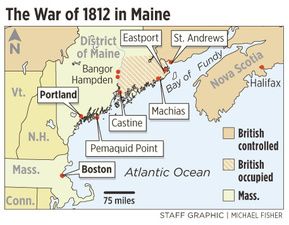
Among them was an invasion of eastern Maine in the summer of 1814. British forces conquered the area fairly easily.
After
Napoleon abdicated in 1814, Britain began a series of offensives
designed to bring about victory over the Americans in the War of 1812.
Among them was an invasion of eastern Maine in the summer of 1814. British forces conquered the area fairly easily.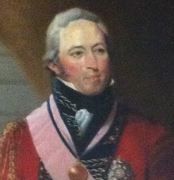 Naval
expeditions under Sir John Sherbrooke (left) and his subordinates
captured the coastal towns of Eastport, Machias and Castine, then sailed
inland up the Penobscot River, capturing Hampden and Bangor. Sherbrooke
declared that Maine east of the Penobscot was now a British colony
named New Ireland.
Naval
expeditions under Sir John Sherbrooke (left) and his subordinates
captured the coastal towns of Eastport, Machias and Castine, then sailed
inland up the Penobscot River, capturing Hampden and Bangor. Sherbrooke
declared that Maine east of the Penobscot was now a British colony
named New Ireland.The British goals in the establishment of New Ireland were:
1. to create a buffer zone between the United States and the Maritime provinces.
2. to acquire land for an overload route between Quebec and the Maritimes.
3. to punish the Americans for going to war.
Meanwhile, the rest of the British offensives ended in failure. At Plattsburgh, New York, the US Navy defeated an invasion of New York down the Lake Champlain corridor. In the Chesapeake, the British burned Washington, but were unable to advance into and past Baltimore.
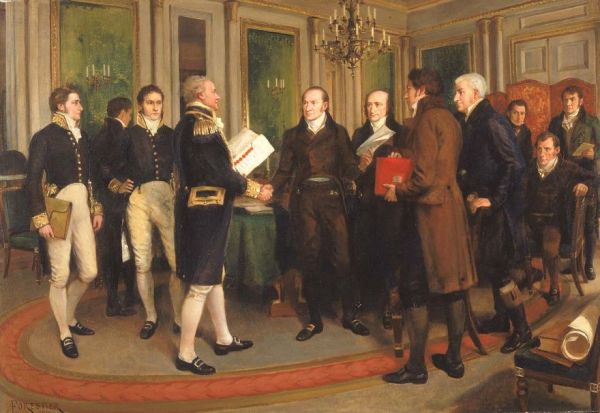
In the Flemish city of Ghent, British and American negotiators were at an impasse. The British were in a superior military position, but the Americans would not accept anything less than status quo ante bellum--the conditions that existed before the war. After the Duke of Wellington advised the British to accept the American position, the British signed the peace treaty (pictured above). The treaty, after ratification by the Prince Regent and United States Senate, officially ended the war.
It also ended New Ireland and John Sherbrooke’s ambitions for eastern Maine. He withdrew. But he had treated the area as British territory and collected £10,750 in tariffs during that time. Sherbrooke donated most of it to the founding of a university in Nova Scotia. The “Castine Fund,” named after the occupied town of Castine, Maine, launched Dalhousie University.
The university named a road on its campus after its unwilling financial benefactor. That’s how Castine Way got its name.
Shicheng
China’s Atlantis

Once upon a time, an ancient city in China was named Lion City because Five Lion Mountain loomed large behind it. The city, also known as Shi Cheng, has been buried beneath the water for 53 years. Like the lost Incan City of Machu Picchu was ‘rediscovered,’ so was this lost underwater city that had been founded about 1,300 years ago. Lion City is now located about 85 – 131 feet (26-40 meters) beneath the gorgeous Thousand Island Lake (Qiandao Lake). This valley was submerged when a dam was constructed and a lake was needed. The lake and thousands of islands were man-made. Shi Cheng ‘defied’ the Chinese norm since 5 gates and 5 towers were built into the city instead of 4. Lion City is about the size of 62 football fields. International archaeologists and a film crew recorded the amazing perservation of the lost ‘ruins.’
Earthquake scars Earth's gravity
ESA's GOCE satellite has revealed that the devastating Japanese
earthquake of 2011 left its mark in Earth's gravity – yet another
example of this extraordinary mission surpassing its original scope.
GOCE mapped Earth's gravity with unrivaled precision for over four
years, but nobody really expected the data to show changes over time.
Now, careful analysis shows the effects of the 9.0 earthquake that struck east of Japan's Honshu Island on 11 March 2011 are clearly visible in GOCE's gravity data. Large earthquakes not only deform Earth's crust, but can also cause tiny changes in local gravity.
The strength of gravity varies from place to place on our planet's surface and it was GOCE's task to map these variations very precisely.
There are a number of reasons why values of gravity differ, but one is a consequence of material inside Earth being inhomogeneous and unevenly distributed. Since earthquakes shift around rock and other material tens of km below the surface, they also cause small changes in the local gravity.
Earthquakes under oceans, as in the 2011 Japanese quake, can also change
the shape of the sea bed. This displaces water and changes the sea
level, which in turn also affects gravity.
After more than doubling its planned life in orbit, the satellite recently ran out of fuel and reentered the atmosphere, largely disintegrating in the process. Although it is no longer in orbit, the real mission is only just starting because scientists will be analyzing the data for years to come to help understand many aspects of our world.
Information from GOCE is being used to understand how oceans transport huge quantities of heat around the planet and to develop a global height reference system, for example.
The mission has already shed new light on different aspects of Earth – from atmospheric density and winds, to mapping the boundary between the crust and upper mantle, and to understand geodynamic processes occurring in these layers far below our feet.
In a surprising discovery earlier this year unrelated to gravity
changes, the satellite's accelerometer and ion thruster also revealed
that GOCE had 'felt' sound waves in space from the Japanese quake.
Recently, scientists from the German Geodetic Research Institute, DGFI, and from Delft University of Technology in the Netherlands analyzed the high-resolution vertical gravity gradients measured over Japan. They discovered that the quake had clearly ruptured the gravity field.
This is the first time that GOCE has been shown to have found changes over time. This work was carried out through ESA's Earth Observation Support to Science Element.
Moreover, the gravity change measured by GOCE differs in size and location compared to those predicted by standard models.
GOCE's results are consistent with coarser observations from the NASA–German Grace satellite, which is designed to measure changes over time. This suggests that GOCE data will be important in improving models and will therefore contribute to our understanding of earthquakes.
Martin Fuchs from DGFI said, "Thus, we see that GOCE gravity gradients complement other types of data such as seismic, GPS and GRACE satellite gravimetry.
"We are now working in an interdisciplinary team to combine GOCE data with other information to obtain a better picture of the actual rupture in the gravity field than is currently available."
 |
| Gravity scar over Japan [Credit: DGFI/TU Delft] |
Now, careful analysis shows the effects of the 9.0 earthquake that struck east of Japan's Honshu Island on 11 March 2011 are clearly visible in GOCE's gravity data. Large earthquakes not only deform Earth's crust, but can also cause tiny changes in local gravity.
The strength of gravity varies from place to place on our planet's surface and it was GOCE's task to map these variations very precisely.
There are a number of reasons why values of gravity differ, but one is a consequence of material inside Earth being inhomogeneous and unevenly distributed. Since earthquakes shift around rock and other material tens of km below the surface, they also cause small changes in the local gravity.
 |
| GOCE [Credit: ESA /AOES Medialab] |
After more than doubling its planned life in orbit, the satellite recently ran out of fuel and reentered the atmosphere, largely disintegrating in the process. Although it is no longer in orbit, the real mission is only just starting because scientists will be analyzing the data for years to come to help understand many aspects of our world.
Information from GOCE is being used to understand how oceans transport huge quantities of heat around the planet and to develop a global height reference system, for example.
The mission has already shed new light on different aspects of Earth – from atmospheric density and winds, to mapping the boundary between the crust and upper mantle, and to understand geodynamic processes occurring in these layers far below our feet.
 |
| GOCE gravity results (left) compared to model [Credit: DGFI/TU Delft] |
Recently, scientists from the German Geodetic Research Institute, DGFI, and from Delft University of Technology in the Netherlands analyzed the high-resolution vertical gravity gradients measured over Japan. They discovered that the quake had clearly ruptured the gravity field.
This is the first time that GOCE has been shown to have found changes over time. This work was carried out through ESA's Earth Observation Support to Science Element.
Moreover, the gravity change measured by GOCE differs in size and location compared to those predicted by standard models.
GOCE's results are consistent with coarser observations from the NASA–German Grace satellite, which is designed to measure changes over time. This suggests that GOCE data will be important in improving models and will therefore contribute to our understanding of earthquakes.
Martin Fuchs from DGFI said, "Thus, we see that GOCE gravity gradients complement other types of data such as seismic, GPS and GRACE satellite gravimetry.
"We are now working in an interdisciplinary team to combine GOCE data with other information to obtain a better picture of the actual rupture in the gravity field than is currently available."
Discovery of partial skeleton suggests ruggedly built, tree-climbing human ancestor
A human ancestor characterized by "robust" jaw and skull bones was a
muscular creature with a gorilla-like upper body and more adaptive to
its environment than previously thought, scientists have discovered.
Researchers found a partial skeleton -- including arm, hand, leg and
foot fragments -- dated to 1.34 million years old and belonging to
Paranthropus boisei at the Olduvai Gorge World Heritage fossil site in
Tanzania. The find, published in the latest edition of the scientific journal PLOS ONE, represents one of the most recent occurrences of P. boisei before its extinction in East Africa.
"This is the first time we've found bones that suggest that this creature was more ruggedly built -- combining terrestrial bipedal locomotion and some arboreal behaviors -- than we'd previously thought," said Charles Musiba, Ph.D., associate professor of anthropology at the University of Colorado Denver, part of the international research team. "It seems to have more well-formed forearm muscles that were used for climbing, fine-manipulation and all sorts of behavior."
While P. boisei was known for its massive jaws and cranium -- anthropologist Mary Leakey discovered the first skull in 1959 in northern Tanzania -- the build and skeletal adaptations of the rest of the archaic hominin's body have been unknown until recently.
During excavations at Olduvai in 2010-2011, the team discovered the
partial skeleton of a large adult individual who is represented by
various teeth and skeletal parts. Other team members are Manuel
Dominguez-Rodrigo, Ph.D., professor of anthropology and prehistory at
Complutense University, Madrid; Audax Mabulla, Ph.D., associate
professor of archaeology, University of Dar es Salaam, Tanzania, Gail
Ashley, Ph.D., professor of geological sciences, Rutgers University;
David Uribelarrea, Ph.D. a professor of geology at Complutense
University of Madrid; Henry Bunn, Ph.D., professor of anthropology,
University of Wisconsin-Madison; and Travis Pickering, Ph.D., professor
of anthropology, University of Wisconsin-Madison.
P. boisei was a long-lived species of archaic hominin that first evolved in East Africa about 2.3 million years ago. In the absence of evidence of other skeletal remains, it was commonly assumed that the skeleton of P. boisei was like that of more ancient species of the genus Australopithecus, from which P. boisei likely evolved.
"We are starting to understand the physiology of these individuals of this particular species and how it actually adapted to the kind of habitat it lived in," Musiba said. "We knew about the kind of food it ate -- it was omnivorous, leaning more toward plant material -- but now we know more: how it walked around and now we know it was a tree climber."
The size of the arm bones suggests strong forearms and a powerful upper
body. "It's a different branch on our ancestry tree," Musiba said. "It
came later than the other hominins, so the question now is 'what
happened to it?' We're going to do more work on biomechanics and see
what else this creature was doing."
He noted that the creature likely stood 3.5 to 4.5 feet tall and possessed a robust frame. "We know that it was very strong," Musiba said. "It's unprecedented to find how strong this individual was. The stronger you are the more adaptive you are."
In summer 2014, the bones will be displayed as part of a large exhibit on human origins in Dar es Salaam, Tanzania. The joint-museum exhibit involves the Museum of Human Evolution in Burgos, Spain, the Regional Museum of Archaeology in Madrid, and the National Museum of Dar es Salaam.
With each find scientists are adding to the understanding of how humans evolved and adapted to their surroundings through time. "The more we are finding of these fossils, the more we are learning about the history of these species," Musiba said.
 |
| Arm bone fragments from a 1.34-million-year-old hominin, Paranthropus boisei, were discovered by an international research team, including a CU Denver anthropologist, in Tanzania [Credit: University of Colorado Denver] |
"This is the first time we've found bones that suggest that this creature was more ruggedly built -- combining terrestrial bipedal locomotion and some arboreal behaviors -- than we'd previously thought," said Charles Musiba, Ph.D., associate professor of anthropology at the University of Colorado Denver, part of the international research team. "It seems to have more well-formed forearm muscles that were used for climbing, fine-manipulation and all sorts of behavior."
While P. boisei was known for its massive jaws and cranium -- anthropologist Mary Leakey discovered the first skull in 1959 in northern Tanzania -- the build and skeletal adaptations of the rest of the archaic hominin's body have been unknown until recently.
 |
| Paranthropus boisei was a long-lived species of archaic hominin that first evolved in East Africa about 2.3 million years ago [Credit: Reuters] |
P. boisei was a long-lived species of archaic hominin that first evolved in East Africa about 2.3 million years ago. In the absence of evidence of other skeletal remains, it was commonly assumed that the skeleton of P. boisei was like that of more ancient species of the genus Australopithecus, from which P. boisei likely evolved.
"We are starting to understand the physiology of these individuals of this particular species and how it actually adapted to the kind of habitat it lived in," Musiba said. "We knew about the kind of food it ate -- it was omnivorous, leaning more toward plant material -- but now we know more: how it walked around and now we know it was a tree climber."
 |
| Earlier analysis of the species teeth had given researchers clues about the kind of food it ate. They believe it was omnivorous, leaning more toward plant material [Credit: University of Colorado Denver] |
He noted that the creature likely stood 3.5 to 4.5 feet tall and possessed a robust frame. "We know that it was very strong," Musiba said. "It's unprecedented to find how strong this individual was. The stronger you are the more adaptive you are."
In summer 2014, the bones will be displayed as part of a large exhibit on human origins in Dar es Salaam, Tanzania. The joint-museum exhibit involves the Museum of Human Evolution in Burgos, Spain, the Regional Museum of Archaeology in Madrid, and the National Museum of Dar es Salaam.
With each find scientists are adding to the understanding of how humans evolved and adapted to their surroundings through time. "The more we are finding of these fossils, the more we are learning about the history of these species," Musiba said.

Ancient 'fig wasp' lived tens of millions of years before figs
A 115-million-year-old fossilized wasp from northeast Brazil presents a
baffling puzzle to researchers. The wasp’s ovipositor, the organ through
which it lays its eggs, looks a lot like those of present-day wasps
that lay their eggs in figs. The problem, researchers say, is that figs
arose about 65 million years after this wasp was alive. A report of the
findings appears in the journal Cretaceous Research.
The wasp belongs to the Hymenoptera superfamily known as Chalcidoidea,
which parasitize other insects, spiders and some plants. The group
includes about 22,000 known species and is estimated to contain up to
500,000 species.
“This is a tiny parasitic wasp, it’s the smallest fossil wasp found in this particular deposit and it’s the oldest representative of its family,” said Sam Heads, a paleoentomologist at the Illinois Natural History Survey at the University of Illinois. “More importantly, it’s possible that this wasp was fig-associated, which is interesting because it’s Early Cretaceous, about 115 to 120 million years old. That’s a good 65 million years or so prior to the first occurrence of figs in the fossil record.”
Heads worked in collaboration with University of Portsmouth scientists Nathan Barling and David Martill.
The new findings demonstrate the value of studying insect fossils, Heads said.
“The fossil record of insects is very extensive both geographically and temporally. It goes back 415 to 420 million years and preserves the ancestral forms of a lot of the insects that are alive today,“ he said. ”So it’s a great resource for understanding insect evolutionary history and the distribution of insects across the planet in the past.”
The presence of a wasp with an ovipositor that looks like those used by
fig wasps today is not hard evidence that figs were around in the fossil
wasp’s day – a time of dinosaurs, Heads said.
“There is no evidence of the existence of figs at this time and the most recent molecular study doesn’t place figs that far back,” he said. While it is possible that figs are older than current studies indicate, it is also possible that “something like a fig was around and this wasp was parasitizing whatever that was.”
This could be an example of convergent evolution, where separate species independently evolve similar traits, he said. Or the fossil wasp could be the ancestor of the fig wasp, and its ovipositor, first adapted to a plant or fruit that was around long before the fig, later found a use in figs.
Comparing insect fossils with living organisms offers new insights into the natural history of insects, the plants they pollinate and their hosts or prey, Heads said. This differs significantly from studies of the fossils of animals that have become extinct.
“When you talk about paleontology to people the first thing they think of is dinosaurs,” he said. “And that’s great. Dinosaurs are really exciting, wonderful animals. But for the most part, they’re extinct. With insects and other arthropods like spiders and scorpions, they’re around still. So we have modern forms to compare our fossil forms to, which is incredibly useful.”
 |
| Although it lived roughly 65 million years before the earliest known occurrence of figs, the fossil wasp’s ovipositor closely resembles those of today’s fig wasps. [Credit: Sam Heads] |
“This is a tiny parasitic wasp, it’s the smallest fossil wasp found in this particular deposit and it’s the oldest representative of its family,” said Sam Heads, a paleoentomologist at the Illinois Natural History Survey at the University of Illinois. “More importantly, it’s possible that this wasp was fig-associated, which is interesting because it’s Early Cretaceous, about 115 to 120 million years old. That’s a good 65 million years or so prior to the first occurrence of figs in the fossil record.”
Heads worked in collaboration with University of Portsmouth scientists Nathan Barling and David Martill.
The new findings demonstrate the value of studying insect fossils, Heads said.
“The fossil record of insects is very extensive both geographically and temporally. It goes back 415 to 420 million years and preserves the ancestral forms of a lot of the insects that are alive today,“ he said. ”So it’s a great resource for understanding insect evolutionary history and the distribution of insects across the planet in the past.”
 |
| Today's fig wasps have ovipositors that are strikingly similar to those of the fossil wasp. Pictured: Avispa de higo, “Fig wasp” Idarnes sp. flavicollis) (Hymenoptera: Chalcidoidea: Sycophaginae) [Credit: Sergio Jansen Gonzalez] |
“There is no evidence of the existence of figs at this time and the most recent molecular study doesn’t place figs that far back,” he said. While it is possible that figs are older than current studies indicate, it is also possible that “something like a fig was around and this wasp was parasitizing whatever that was.”
This could be an example of convergent evolution, where separate species independently evolve similar traits, he said. Or the fossil wasp could be the ancestor of the fig wasp, and its ovipositor, first adapted to a plant or fruit that was around long before the fig, later found a use in figs.
Comparing insect fossils with living organisms offers new insights into the natural history of insects, the plants they pollinate and their hosts or prey, Heads said. This differs significantly from studies of the fossils of animals that have become extinct.
“When you talk about paleontology to people the first thing they think of is dinosaurs,” he said. “And that’s great. Dinosaurs are really exciting, wonderful animals. But for the most part, they’re extinct. With insects and other arthropods like spiders and scorpions, they’re around still. So we have modern forms to compare our fossil forms to, which is incredibly useful.”
New armored dinosaur species found in Spain
Palaeontologists have uncovered a new species of tank-like dinosaur in a century-old Spanish coal mine.
The species was discovered after two incredibly-well preserved dinosaurs
were unearthed near the town of Arino in north eastern Spain.
The armored dinosaurs are believed to have been around five meters long, a meter tall and two tons in weight.
The specimens initially appeared to belong to a sub-species of armored dinosaur in the Ankylosauria group, but there were some key differences.
For instance, Ankylosaurs have triangular heads, whereas these dinosaurs
were found to have a rounded, tear-drop-shaped skull as well as a
strongly arched pelvis.
Describing their research in the journal PLOS One, researchers named the species Europelta carbonensis, which means ‘Europe’s shield from coal’.
Europelta carbonensis is part of the nodosauridae family which were around during the Late Jurassic to the Late Cretaceous Period in North America, Asia, Antarctica and Europe.
The Europelta carbonensis is estimated to have lived 113 million and 110
million years ago during the Cretaceous period, making it the oldest
nodosaurid discovered in Europe.
Like other dinosaurs in the nodosauridae family, Europelta was a plant-eater and was covered in scaly armoured plates.
Before the nodosaurid ankylosaurs, their ancestors - polacanthid ankylosaurs - were the main armoured dinosaurs in both Europe and North America.
James Kirkland, the lead research from the University of Utah, claims
that the European nodosaurids differed from those in North America.
‘By 113 million years ago nodosaurid ankylosaurs have completely replaced them on both continents, yet are represented by distinctly different subfamilies on both continents,' he said.
As Europelta is closely related to other nodosaurs in Europe, the new finding suggests that Europe had become isolated from North America around 110 million years ago - rather than the 80 million years that many suggest.
 |
| Earlier this week researchers unveiled two separate armoured dinosaurs discovered in the mine near the town of Arino in north eastern Spain [Credit: Fundacion Conjunlo Palaeontologica de Teruel-Dinopolis (FCPTD] |
The armored dinosaurs are believed to have been around five meters long, a meter tall and two tons in weight.
The specimens initially appeared to belong to a sub-species of armored dinosaur in the Ankylosauria group, but there were some key differences.
 |
| Europelta carbonensis is part of the nodosauridae family which were around during the Late Jurassic to the Late Cretaceous Period in North America, Asia, Antarctica and Europe [Credit: Fundacion Conjunlo Palaeontologica de Teruel-Dinopolis (FCPTD] |
Describing their research in the journal PLOS One, researchers named the species Europelta carbonensis, which means ‘Europe’s shield from coal’.
Europelta carbonensis is part of the nodosauridae family which were around during the Late Jurassic to the Late Cretaceous Period in North America, Asia, Antarctica and Europe.
 |
| The Europelta carbonensis is estimated to have lived 113 million and 110 million years ago during the Cretaceous period, making it the oldest nodosaurid discovered in Europe [Credit: Fundacion Conjunlo Palaeontologica de Teruel-Dinopolis (FCPTD] |
Like other dinosaurs in the nodosauridae family, Europelta was a plant-eater and was covered in scaly armoured plates.
Before the nodosaurid ankylosaurs, their ancestors - polacanthid ankylosaurs - were the main armoured dinosaurs in both Europe and North America.
 |
| Artistic reconstruction of Europelta carbonensis [Credit: Fundacion Conjunlo Palaeontologica de Teruel-Dinopolis (FCPTD] |
‘By 113 million years ago nodosaurid ankylosaurs have completely replaced them on both continents, yet are represented by distinctly different subfamilies on both continents,' he said.
As Europelta is closely related to other nodosaurs in Europe, the new finding suggests that Europe had become isolated from North America around 110 million years ago - rather than the 80 million years that many suggest.
Shark, human proteins stunningly similar
Despite widespread fascination with sharks, the world’s oldest
ocean predators have long been a genetic mystery. The first deep dive
into a great white shark’s genetic code has fished up big surprises
behind a design […]

How Mosquitoes Are Drawn to Human Skin and Breath


Monday, December 9, 2013
The Daily Drift

Carolina Naturally is read in 194 countries around the world daily.
You can't get any more corrupt than being a repugican ... !
 Today is - International Anti-Corruption Day

Don't forget to visit our sister blog: It Is What It Is
Some of our readers today have been in:
The Americas
Montevideo, Uruguay
Vancouver, Pikangikum, Britannia, Ottawa, Mississauga, Kenora, North York, Winnipeg, Blainville and Lansing, Canada
Santo Doming, Dominican Republic
Santiago, Valdiva, Chile
Buenos Aires and Villa Maria, Argentina
San Juan, Puerto Rico
Caracas, Venezuela
Tulua, Colombia
South
Amboy, New York City, Winston-Salem, Newport News, Menlo Park, Manitou
Springs, New Britain, Baton Rouge, San Diego, West Point and
Feasterville Trevose, United States
Curitiba and Sao Paulo, Brazil
Colonia Natividas, Mexico
Lima, Peru
Europe
Rouen, Cerny and Salon-De-Provence, France
Ravenna, Ivrea, Milan, Rome and Pistoia, Italy
Zurich and Basel, Switzerland
Slemmestad, Norway
Sofia, Bulgaria
Kiev, Odessa and Zhovti Vody, Ukraine
Sunds, Denmark
Reykjavik, Iceland
Madrid and Derio, Spain
Essen and Sulzbach, Germany
Chelyabrinsk, Russia
Lisbon, Portugal
London, England
Lucenec, Slovakia
Bucharest, Romania
Myslenice, Krakow and Warsaw, Poland
Esenler, Ankara and Izmir, Turkey
Stockholm, Sweden
Kecskement, Hungary
Vilnius, Lithuania
Dublin, Ireland
Riga, Latvia
Vienna, Austria
Den Haag, Netherlands
Helsinki, Finland
Asia
Beijing and Harbin, China
Tel Aviv, Petah Tikva and Ramat Hasharon, Israel
Bangalore,
Delhi, Bareilly, Shillong, Bilaspur, Kakinada, Rajahmundry, Kottayam,
Hyderabad, Erode, Thiruvananthapuram and Pune, India
Jakarta, Yogyakarta, Manado and Jagirsidsermo, Indonesia
Kuala Lumpur, Puchong, Kajang and Kota Kinabalu, Malaysia
Doha, Qatar
Male, Maldives
Tehran, Tabriz and Mashhad, Iran
Singapore, Singapore
Hanoi, Vietnam
Bangkok, Thailand
Africa
Durban and Cape Town, South Africa
Accra, Ghana
Algiers, Algeria
Pacific
Homebush, Ashfield, Melbourne and Brisbane, Australia
Today in History
| 536 | Having captured Naples earlier in the year, Belisarius takes Rome. | |
| 1861 | The U.S. Senate approves establishment of a committee that would become the Joint Committee on the Conduct of War. | |
| 1863 | Major General John G. Foster replaces Maj. Gen. Ambrose E. Burnside as Commander of the Department of Ohio. | |
| 1867 | The capital of Colorado Territory is moved from Golden to Denver. | |
| 1872 | P.B.S. Pinchback becomes the first African-American governor of Louisiana. | |
| 1900 | The Russian czar rejects Boer Paul Kruger's pleas for aid in South Africa against the British. | |
| 1908 | A child labor bill passes in the German Reichstag, forbidding work for children under age 13. | |
| 1917 | The new Finnish Republic demands the withdrawal of Russian troops. | |
| 1940 | The British army seizes 1,000 Italians in a sudden thrust in Egypt. | |
| 1941 | Franklin D. Roosevelt tells Americans to plan for a long war. | |
| 1948 | The United States abandons a plan to de-concentrate industry in Japan. | |
| 1949 | The United Nations takes trusteeship over Jerusalem. | |
| 1950 | President Harry Truman bans U.S. exports to Communist China. | |
| 1950 | Harry Gold gets 30 years imprisonment for passing atomic bomb secrets to the Soviet Union during World War II. | |
| 1955 | Sugar Ray Robinson knocks out Carl Olson to regain the world middleweight boxing title. | |
| 1960 | The Laos government flees to Cambodia as the capital city of Vientiane is engulfed in war. | |
| 1990 | Lech Walesa is elected president of Poland. | |
| 1992 | U.S. Marines land in Somalia to ensure food and medicine reaches the deprived areas of that country. | |
| 2008 | Governor of Illinois Rod Blagojevich is arrested on federal charges, including an attempt to sell the US Senate seat being vacated by President-elect Barack Obama. |


Xmas Countdown Xmas Stories
Yes, Virginia, There is a Santa Claus

"DEAR EDITOR: I am 8 years old.
"Some of my little friends say there is no Santa Claus.
"Papa says, 'If you see it in THE SUN it's so.'
"Please tell me the truth; is there a Santa Claus?
"VIRGINIA O'HANLON.
"115 WEST NINETY-FIFTH STREET."
VIRGINIA, your little friends are wrong. They have been affected by the skepticism of a skeptical age. They do not believe except they see. They think that nothing can be which is not comprehensible by their little minds. All minds, Virginia, whether they be men's or children's, are little. In this great universe of ours man is a mere insect, an ant, in his intellect, as compared with the boundless world about him, as measured by the intelligence capable of grasping the whole of truth and knowledge.
Yes, VIRGINIA, there is a Santa Claus. He exists as certainly as love and generosity and devotion exist, and you know that they abound and give to your life its highest beauty and joy. Alas! how dreary would be the world if there were no Santa Claus. It would be as dreary as if there were no VIRGINIAS. There would be no childlike faith then, no poetry, no romance to make tolerable this existence. We should have no enjoyment, except in sense and sight. The eternal light with which childhood fills the world would be extinguished.
Not believe in Santa Claus! You might as well not believe in fairies! You might get your papa to hire men to watch in all the chimneys on Christmas Eve to catch Santa Claus, but even if they did not see Santa Claus coming down, what would that prove? Nobody sees Santa Claus, but that is no sign that there is no Santa Claus. The most real things in the world are those that neither children nor men can see. Did you ever see fairies dancing on the lawn? Of course not, but that's no proof that they are not there. Nobody can conceive or imagine all the wonders there are unseen and unseeable in the world.
You may tear apart the baby's rattle and see what makes the noise inside, but there is a veil covering the unseen world which not the strongest man, nor even the united strength of all the strongest men that ever lived, could tear apart. Only faith, fancy, poetry, love, romance, can push aside that curtain and view and picture the supernal beauty and glory beyond. Is it all real? Ah, VIRGINIA, in all this world there is nothing else real and abiding.
No Santa Claus! Thank god! he lives, and he lives forever. A thousand years from now, Virginia, nay, ten times ten thousand years from now, he will continue to make glad the heart of childhood.

Subscribe to:
Posts (Atom)
