

Thursday, May 8, 2014

Rare 18th century hat recovered from cottage wall revealed at Luton's Wardown Park Museum

The fragile 18th centry hat has been treated using 21st technology
The fragile 18th century lady’s hat, which is only one of four of its kind in the world, has been carefully treated for pests to limit further damage to the hat itself and also to rule out any risk of contaminating other hats in the museum’s collection.
Wide brimmed hats were popular with women in the eighteenth century, and like this example recovered from behind the cottage wall, were often decorated with motifs over a linen lining.
It joins a holding of hats and headwear that reflects a long and distinguished tradition of hat-making in the city dating back to the 17th century. Hat making and millinery dominated the town in the eighteenth century.
The museum’s Significant Collections Curator, Veronica Main describes the storage of the hats as a "pest management environment control nightmare" due to the combination of materials including metal, fur, straw and wool.
The new arrival has been subjected to a technically advanced anoxic treatment within an oxygen-free chamber to eradicate any insect infestation and is now safely on show to the public.

Vädersoltavlan (1535)

Vädersolstavlan (Swedish for "The Sun Dog Painting") is an oil-on-panel painting depicting a halo display, an atmospheric optical phenomenon, observed over Stockholm on April 20, 1535. It is named after the sun dogs (Swedish: Vädersol, "Weather sun") appearing on the upper right part of the painting. While chiefly noted for being the oldest depiction of Stockholm in colour, it is arguably also the oldest Swedish landscape painting and the oldest depiction of sun dogs...There's way more at the extensive Wikipedia page on old Stockholm and the science of the phenomenon
The medieval urban conglomeration, today part of the old town Gamla stan, is rendered using a bird's-eye view. The stone and brick buildings are densely packed below the church and castle, which are rendered in a descriptive perspective (i.e., their size relates to their social status, rather than their actual dimensions). Scattered wooden structures appear on the surrounding rural ridges, today part of central Stockholm...
According to the passage in the Vasa Chronicle, however, both Petri and the master of the mint Anders Hansson were sincerely troubled by the appearance of these sun dogs. Petri interpreted the signs over Stockholm as a warning from God and had the Vädersolstavlan painting produced and hung in front of his congregation. Notwithstanding this devotion, he was far from certain on how to interpret these signs and in a sermon delivered in late summer 1535, he explained there are two kinds of omens: one produced by the Devil to allure mankind away from God, and another produced by God to attract mankind away from the Devil — one being hopelessly difficult to tell from the other. He therefore saw it as his duty to warn both his congregation, mostly composed of German burghers united by their conspiracy against the king, and the king himself...
In the painting, the actual sun is the yellow ball in the upper-right corner surrounded by the second circle. The large circle taking up most of the sky is a parhelic circle, parallel to the horizon and located at the same altitude as the sun, as the painting renders it...
The Chansonnier Cordiforme

Now indeed can I cry ‘alas’
and flood my eyes with tears
for I can no longer see her
as I used to, woe is me.
No indeed can I cry ‘alas’.
O accursed tongue, evil and sinful,
that caused me so much pain,
you have brought me to such straits that
life has become a misery.
Now indeed can I cry ‘alas’.
If I cannot believe that I shall ever again
see my dear treasure as I used to,
with a golden noose
around my neck my life shall end.
Scurvy Knaves


A British iron age coin die

As reported by the British Museum:
One of the most recent acquisitions made by the Department of Coins and Medals is a highly unusual object – an ancient punch or ‘die’ used to manufacture coins in the second century BC. The die was found in Bredgar, Kent by a metal detector user in 2013 and is being used to shed new light on when the first coins were made in Britain...More at the link, including comments re the stylized horse on the die and the chalk one at Uffington.
Close examination of the coin die revealed that it was used in the production of the early Gallo-Belgic A coins. What this means is that, although it is the third Iron Age coin die to be found in the UK (the others are also in the British Museum), it is almost certainly the earliest. The most significant aspect of this discovery is the fact that it is a British find. This raises the intriguing possibility that the earliest known coins from Britain were actually made here and not just imports from the Continent.
How the Ancient Egyptians Really Built the Pyramids

The ancient Egyptians who built the pyramids may have been
able to move massive stone blocks across the desert by wetting the sand
in front of a contraption built to pull the heavy objects, according to a
new study.
Ancient Caribou Hunting Site Found Beneath Lake Huron

An elaborate array of linear stone lanes and V-shaped
structures has been discovered on an underwater ridge in Lake Huron.
Ancient Native Americans came face to face with sabertooth cats

Coming Tomorrow
Coming Tomorrow
- The Deadliest Animal In The World
- Military Trained Dolphins Will Not Be Killing Russians
- The Plant With 1000 Faces
- Hippocrates' Legendary Tree 'Fingerprinted'

Wednesday, May 7, 2014
The Daily Drift

Carolina Naturally is read in 199 countries around the world daily.
Go Ride A Bike ... !

Today is - Bike To School Day
Don't forget to visit our sister blog: It Is What It Is
We would like to welcome our newest readers in:
Samoa
Some of our reader today have been in:
The Americas
Pikangikum,
L;ancienne-Lorette, Thunder Bay, Sioux Lookout, Joliette, Ottawa,
Lansing, Saint John's, Britannia, Toronto, Downsview, Lake Louise and
Nunalla, Canada
Fredonnia, Buckhannon, Lititz, Butte, Valrico,
Bozeman, Molalla, Cerritos, Alamogordo, Cleburne, Waxhaw, Wichita and
Sebring, United States
Luquillo, san Juan, Puerto Rico
Sao Paulo, and Rio De Janeiro, Brazil
Mexico City, Mexico
Buenos Aires, Argentina
Bogota and Medellin, Colombia
Tipitapa and Managua, Nicaragua
Puerto Plata, Dominican Republic
Lima, Peru
Europe
Riga, Latvia
Zagreb, Croatia
Algeciras, Madrid and Cadiz, Spain
Rome, Ivrea and Novara, Italy
Dublin and Cork, Ireland
Deville-Les-Rouen, Gasny and Salon-De-Provence, France
Bucharest, Romania
Slagelse, Denmark
Kent and London, England
Ruse, Bulgaria
Nuremberg, Widdern and Frankfurt Am Main, Germany
Athens, Greece
Naaldwijk, Netherlands
Cherskasy and Zhovtivody, Ukraine
Oslo, Norway
Belgrade, Serbia
Vantaa, Finland
Reykjavik, Iceland
Ryazan, Russia
Sarajevo, Bosnia and Herzegovina
Warsaw and Poznan, Poland
Asia
Sai Buri and Bangkok, Thailand
Colombo, Sri Lanka
Dhahran, Saudi Arabia
Tehran, Tabriz, Iran
Mumbai,
Noida, Hyderabad, Chandigarh, Gurdaha, Delhi, Shillong,
Thiruvananthpuram, New Delhi, Patna, Kolkata and Bangalore, India
Tel Aviv, Israel
La Dagotiere, Mauritius
Hanoi, Vietnam
Kuching and Kuala Lumpur, Malaysia
Muscat, Oman
Yogyakarta and Jakarta, Indonesia
Kathmandu and Banepa, Nepal
Karachi, Pakistan
Africa
Osogbo, Nigeria
Zarzis and Tunis, Tunisia
Johannesburg, South Africa
Nairobi, Kenya
The Pacific
Apia, Samoa
Makati and San Pablo, Philippines
Melbourne and Sydney, Australia
Today in History
| 558 | The dome of the church of St. Sophia in Constantinople collapses. Its immediate rebuilding is ordered by Justinian. | |
| 1274 | The Second Council of Lyons opens in France to regulate the election of the pope. | |
| 1429 | Joan of Arc breaks the English siege of Orleans. | |
| 1525 | The German peasants' revolt is crushed by the ruling class and church. | |
| 1763 | Indian chief Pontiac begins his attack on a British fort in present-day Detroit, Michigan. | |
| 1800 | Congress divides the Northwest Territory into two parts. The western part will becomes the Indiana Territory and the eastern section remains the Northwest Territory. | |
| 1824 | Beethoven's "Ninth Symphony" premiers in Vienna. | |
| 1847 | The American Medical Association is formed in Philadelphia. | |
| 1862 | Confederate troops strike Union troops at the Battle of Eltham's Landing in Virginia. | |
| 1864 | The Battle of Wilderness ends with heavy losses to both sides. | |
| 1877 | Indian chief Sitting Bull enters Canada with a trail of Indians after the Battle of Little Big Horn. | |
| 1915 | The German submarine U-20 torpedoes the passenger ship Lusitiania, sinking her in 21 minutes with 1,978 people on board. | |
| 1937 | The German Condor Legion arrives in Spain to assist Fransico Franco's forces. | |
| 1942 | In the Battle of the Coral Sea, Japanese and American navies attack each other with carrier-launched warplanes. It is the first time in the history of naval warfare where two fleets fought without seeing each other.Two crucial battles in 1942 marked the turning point of the war in the Pacific. | |
| 1943 | The last major German strongholds in North Africa–Tunis and Bizerte–fall to Allied forces. | |
| 1945 | Germany signs an unconditional surrender, effectively ending World War II in Europe. | |
| 1952 | In Korea, Communist POWs at Koje-do riot against their American captors. | |
| 1954 | French troops surrender to the Vietminh at Dien Bien Phu. | |
| 1958 | Howard Johnson sets an aircraft altitude record in F-104. | |
| 1960 | Leonid Brezhnev becomes president of the Soviet Union. |

Why did Russia give away Crimea in the first place?

Good question. Discussed at length at the website of the Wilson Center:
Crimea was part of Russia from 1783, when the Tsarist Empire annexed it a decade after defeating Ottoman forces in the Battle of Kozludzha, until 1954, when the Soviet government transferred Crimea from the Russian Soviet Federation of Socialist Republics (RSFSR) to the Ukrainian Soviet Socialist Republic (UkrSSR)...My excerpts probably don't do justice to the complexity of the arguments. Those wishing to orate upon this at cocktail parties would do well to consult the source.
Of particular importance were the role of Nikita Khrushchev, the recent traumas inflicted on Ukraine, and the ongoing power struggle in the USSR... Khrushchev saw the transfer as a way of fortifying and perpetuating Soviet control over Ukraine now that the civil war had finally been won. Some 860,000 ethnic Russians would be joining the already large Russian minority in Ukraine...
The transfer of Crimea to the UkrSSR also was politically useful for Khrushchev as he sought to firm up the support he needed in his ongoing power struggle with Soviet Prime Minister Georgii Malenkov, who had initially emerged as the preeminent leader in the USSR in 1953 after Joseph Stalin’s death...
The earlier published documents, and materials that have emerged more recently, make clear that the transfer of Crimea from the RSFSR to the UkrSSR was carried out in accordance with the 1936 Soviet constitution... the main point to stress here is that it is incorrect to say (as some Russian commentators and government officials recently have) that Crimea was transferred unconstitutionally or illegally. The legal system in the Soviet Union was mostly a fiction, but the transfer did occur in accordance with the rules in effect at the time.
Nobody Lives Here

The Town That Never Was
Agloe, New York
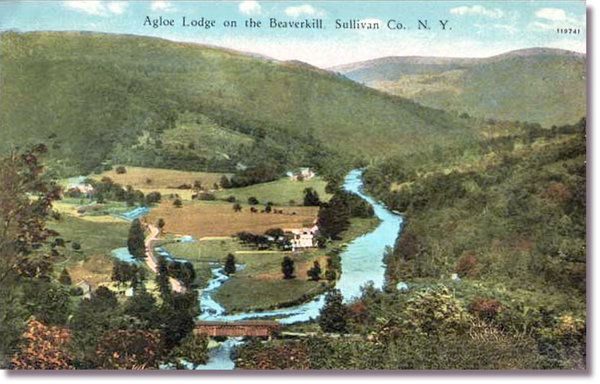
Among those countless copyright traps, Agloe achieved a rare distinction: The name stuck. As early as the 1930s, a fishing lodge named Agloe opened nearby (which later helped Rand McNally successfully claim in a lawsuit that the Agloe on its own map had not been copied from Socony’s).Google Maps only removed the town when a reporter from the New York Times asked about it. See, you don’t really have to visit a place to make a map of it… as long as you can read someone else’s map. The curious thing about Algoe is that it has been mapped so many times for so long that it has almost become real. Read about the history of Algoe, how it was named, and the fame that grew around the nonexistent town, at the New York Times.
Agloe survived on road maps by Esso and Exxon into the late 20th century and even long enough to evolve from a so-called paper town into a digital one on websites like Google, where it made its debut only last year.
It was even mentioned in a 1957 travelogue in The Times about “scenic drives through the Catskills,” which rhapsodized about “an unmarked country road that goes north through Rockland and Agloe.”

How Agloe, a speck of a hamlet in the western Catskills, wound up on maps 90 years ago remains a cartographic enigma. How it persevered is an existential riddle. In the 1930s, General Drafting Company founder Otto G. Lindberg and an assistant, Ernest Alpers, designed the town as a copyright trap.
The Still Of The Night In New Orleans
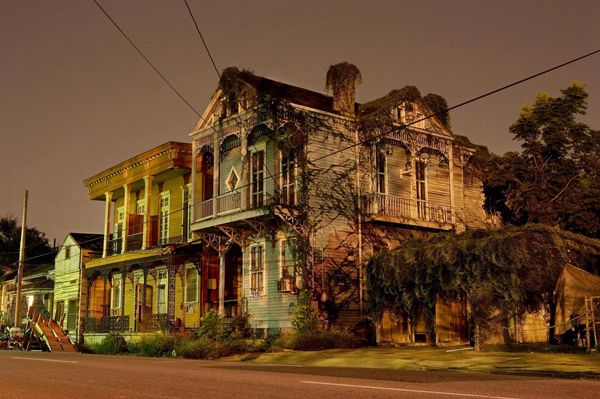

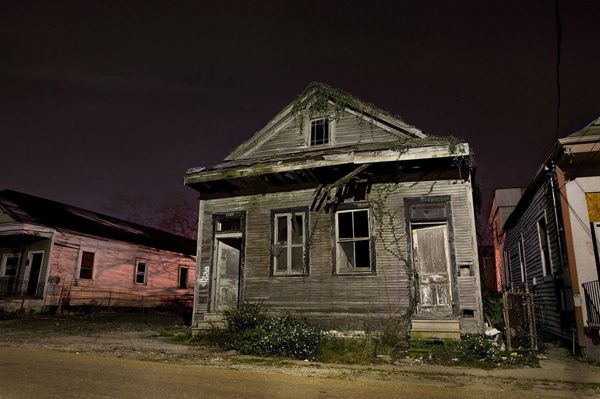
Boasting an extremely diverse range of architectural styles, from Creole cottages to shotgun houses and bungalows, New Orleans is a great place to take in the sights- especially in the still of the night.
Photographer Frank Relle rediscovered a deep love for his hometown of New Orleans after graduating college, so he decided to share his love of the Big Easy by taking long exposure nighttime photographs. They're eerie, visually compelling and full of unique charm- just like the City That Care Forgot.

How about this for a tiny home?


The Surreal Appeal Of The Falkirk Wheel

Frozen In Time
The Cyprus Buffer Zone

The demilitarized zone is restricted to the general public and no Greek or Turkish Cypriots are allowed inside. Reuters photographer Neil Hall recently visited the buffer zone, which still contains crumbling relics of times gone by - abandoned houses, businesses, and even an airport.
Archaeologists call for protection of Javanese megalithic site
Experts have called on the government to do more to protect the Gunung
Padang archaeological site in Karyamukti village in Cianjur regency,
West Java, where a prismatic structure considered to be older and larger
than the Borobudur temple in Central Java is currently being excavated.

Indonesian Institute of Sciences (LIPI) researcher Danny Natawidjaja said that even without government support, excavation and conservation work would continue.
“We’ll foot the bill ourselves until everyone comes to their senses that this is a national asset,” said Danny at a discussion held by the Center for Information and Development Studies (CIDES) in Jakarta on Wednesday.
Ali Akbar, the head of the research team, revealed that US$25 million had been raised for the funding of the Gunung Padang project in 1979, a quarter of which came from the United Nations Educational, Scientific and Cultural Organization (UNESCO).
Ali said the project required experts from a variety of fields given its complexity.
“Discoveries like this only occur every other century,” said Ali.
Ali referred to the discovery of Borobudur temple as the last time such a historical heritage site was unearthed in the country.
He also called on the government to campaign to stop efforts to sell the location as a tourist destination.
“The site should be fenced off from the foot of the hill so that it can be protected,” said Ali, who is also the manager for research and community services at the University of Indonesia’s (UI) School of Humanities.
Ali said the structure covered the entire hill, and may possibly house man-made chambers deep within.
Danny, who spearheaded an exploration of the site in 2011, said that geological methods to determine the age of the site found that the structure could be older than any other discovered in the country.
“Using carbon dating, a method for calculating the age of a mineral, we found the first layer excavated to be between 2,500 to 3,600 years old, although the structure may have been built more recently than that,” said Danny.
He also said the site could be used to prove the nonlinear progression of human population growth.
In keeping with current beliefs, Danny suggested that primitive man would not have had the ability to build something as complex as Gunung Padang, yet the site could date back to a historical period when population growth and technological development were stagnant.
He insisted that there was a missing part to the solution that was worth researching.
Architecture expert Pon Purajatmika corroborated the claim by pointing out the use of a knowledge system in the construction of the site.
“Without the help of astronomy or knowledge about the surrounding area, the site could not have been built with such precision,” Pon revealed.
Pon suggested that Gunung Padang was not only a monotheistic site because of the absence of idolatry but that it was also built in orientation to the stars and the Sun.
He likened the construction of the megalithic site to the ruins of Machu Picchu in Peru, except that Gunung Padang predated the Incan site by some 2,000 years.
“The mountain is sloped on all sides, even symmetrical,” Pon told The Jakarta Post, adding that many relics were found within a radius of 5 kilometers, suggesting that the site used to be a hub of activity.
At the site’s information center, visitors are told that the terraced site was first recorded by Dutch researcher NJ Krom in 1914 before being rediscovered by local farmers in 1979.
Scientists have agreed to categorize the prismatic structure as a stepped pyramid that has an area of 3,094 square meters consisting of five levels. It stands more than 100 meters high and is believed to be the center of a 25-hectare megalithic site.
The geological structure of the stone onsite is meticulously layered and arranged by columnar jointing, with each stone varying in size.
Since 1985, only the top layer, which was considered to be a sacred ritual arena, has been fenced off by the government for preservation.
Previously, the West Java provincial administration called on the Cianjur regency administration and the local community to help protect the megalithic site, especially from vandalism, as well as to attract more tourists.
Gunung Padang site
According to several experts from the Gunung Padang independent and
integrated research team (TTRM), the site could potentially be
Indonesia’s oldest and most important prehistoric landmark and should be
given priority in conservation efforts.
Indonesian Institute of Sciences (LIPI) researcher Danny Natawidjaja said that even without government support, excavation and conservation work would continue.
“We’ll foot the bill ourselves until everyone comes to their senses that this is a national asset,” said Danny at a discussion held by the Center for Information and Development Studies (CIDES) in Jakarta on Wednesday.
Ali Akbar, the head of the research team, revealed that US$25 million had been raised for the funding of the Gunung Padang project in 1979, a quarter of which came from the United Nations Educational, Scientific and Cultural Organization (UNESCO).
Ali said the project required experts from a variety of fields given its complexity.
“Discoveries like this only occur every other century,” said Ali.
Ali referred to the discovery of Borobudur temple as the last time such a historical heritage site was unearthed in the country.
He also called on the government to campaign to stop efforts to sell the location as a tourist destination.
“The site should be fenced off from the foot of the hill so that it can be protected,” said Ali, who is also the manager for research and community services at the University of Indonesia’s (UI) School of Humanities.
Ali said the structure covered the entire hill, and may possibly house man-made chambers deep within.
Danny, who spearheaded an exploration of the site in 2011, said that geological methods to determine the age of the site found that the structure could be older than any other discovered in the country.
“Using carbon dating, a method for calculating the age of a mineral, we found the first layer excavated to be between 2,500 to 3,600 years old, although the structure may have been built more recently than that,” said Danny.
He also said the site could be used to prove the nonlinear progression of human population growth.
In keeping with current beliefs, Danny suggested that primitive man would not have had the ability to build something as complex as Gunung Padang, yet the site could date back to a historical period when population growth and technological development were stagnant.
He insisted that there was a missing part to the solution that was worth researching.
Architecture expert Pon Purajatmika corroborated the claim by pointing out the use of a knowledge system in the construction of the site.
“Without the help of astronomy or knowledge about the surrounding area, the site could not have been built with such precision,” Pon revealed.
Pon suggested that Gunung Padang was not only a monotheistic site because of the absence of idolatry but that it was also built in orientation to the stars and the Sun.
He likened the construction of the megalithic site to the ruins of Machu Picchu in Peru, except that Gunung Padang predated the Incan site by some 2,000 years.
“The mountain is sloped on all sides, even symmetrical,” Pon told The Jakarta Post, adding that many relics were found within a radius of 5 kilometers, suggesting that the site used to be a hub of activity.
At the site’s information center, visitors are told that the terraced site was first recorded by Dutch researcher NJ Krom in 1914 before being rediscovered by local farmers in 1979.
Scientists have agreed to categorize the prismatic structure as a stepped pyramid that has an area of 3,094 square meters consisting of five levels. It stands more than 100 meters high and is believed to be the center of a 25-hectare megalithic site.
The geological structure of the stone onsite is meticulously layered and arranged by columnar jointing, with each stone varying in size.
Since 1985, only the top layer, which was considered to be a sacred ritual arena, has been fenced off by the government for preservation.
Previously, the West Java provincial administration called on the Cianjur regency administration and the local community to help protect the megalithic site, especially from vandalism, as well as to attract more tourists.
Sigiriya, An Ancient Magical Place


Hadrian's wall

The Romans buit this wall to keep the Picts from overrunning northern England - it didn't work.
The World's Best Skywalks
Do Look Down!


Hike To The Wave, Arizona

Characterized by a dazzling sandstone rock with a surreal undulating appearance, the Wave looks like a scene from another planet. The striped Navajo Sandstone dates back 190 million years ago in the Jurassic Period, formed by slow erosion of wind and rain.
Totally Parched

California is parched, with 100 percent of the Golden State
entrenched in drought conditions for the first time in 15 years,
according to the U.S. Drought Monitor (USDM).


East Antarctica Melt Could Mean 10 Foot Sea-Level Rise

The melting of a small area of East Antarctica could lead to
sea level rise for thousands of years. And halting global warming might
not stop it.
Virginia Volcanoes Linked to East Atlantic Islands

The youngest volcanoes on the East Coast share an unusual
geological link with islands on the opposite side of the Atlantic Ocean.
A Ride Around Etna
The Circumetnea Railway


Coming Tomorrow
Coming Tomorrow
- Sybil Ludington
- The Toilet That Sank The U-1206
- Did da Vinci, Create A 3-D 'Mona Lisa'?
- Ancient Native Americans Came Face To Face With Sabertooth Cats

Tuesday, May 6, 2014
The Daily Drift

Ahem ...!
Carolina Naturally is read in 198 countries around the world daily.
Now and Zen... !

Today is - Buddha Day
Don't forget to visit our sister blog: It Is What It Is
Some of our reader today have been in:
The Americas
Vicksburg,
Mascot, Latrobe, Roslyn, Sycamore, Rodeo, Tampa, San Mateo, Van Buren,
Spokane, Andrews, Slate Hill, Riverton, Elmmira, Newark, Red Wing, Pima,
Danbury and Sammamish, United States
Bogota and Medellin, Colombia
Byward
Market, Sioux Lookout, Thunder Bay, Edmonton, Toronto, Joliette,
L'ancienne-Lorette, Ottawa, Lake Louise and Downsview, Canada
Sao Paulo and Rio De Janeiro, Brazil
Montevideo, Uruguay
San Juan and Luquillo, Puerto Rico
Mexico City, Mexico
Tipitapa, Nicaragua
Europe
A Coruna, Algeciras and Badajoz, Spain
Stockholm, Sweden
Zhovtivody, Kharkiv and Kiev, Ukraine
Moscow, Vladivostok, Rostov-Na-Donu and Ryazan, Russia
Deville-Les-Rouen, Paris and Soucy, France
Dubrovnik,Croatia
Kongens Lyngby, Denmark
Dublin, Ireland
Ivrea and Padova, Italy
Anjara, Turkey
Minden and Stuttgart, Germany
Veenendaal and Amersfoort, Netherlands
Stavanger, Norway
Espoo, Finland
Sarajevo and Tuzla, Bosnia and Herzegovina
Asia
Sadiqabad, Pakistan
Shillong,
Patna, Thiruvananthpuram, New Delhi, Kolkata, Gurgaon, Goa, Bangalore,
Coimbatore, Mumbai, Gowahati and Bhubaneshwar, India
Petah Tikva, Israel
Colombo, Sri Lanka
Umm Salal'Ali, Qatar
Jakarta and Yogyakarta, Indonesia
Tehran and Tabriz, Iran
Kuala Lumpur, Malaysia
Dhaka, Bangladesh
Kathmandu, Nepal
Bangkok, Thailand
Singapore, Singapore
Africa
Al, Mansurah, Egypt
Tagiura, Libya
Calabar and Lagos, Nigeria
Johannesburg and Cape Town, South Africa
The Pacific
Sydney and Melbourne, Australia
Quezon City and Manila, Philippines
Today in History
| 1527 | German troops begin sacking Rome. Libraries are destroyed, the Pope is captured and thousands are killed. | |
| 1529 | Babur defeats the Afgan Chiefs in the Battle of Ghagra, India. | |
| 1682 | King Louis XIV moves his court to Versailles, France. | |
| 1856 | U.S. Army troops from Fort Tejon and Fort Miller prepare to ride out to protect Keyesville, California, from Yokut Indian attack. | |
| 1861 | Arkansas becomes the ninth state to secede from the Union. | |
| 1862 | Henry David Thoreau dies of tuberculosis at age 44. | |
| 1864 | In the second day of the Battle of Wilderness between Union General Ulysses S. Grant and Confederate General Robert E. Lee, Confederate Gen. James Longstreet is wounded by his own men. | |
| 1877 | Chief Crazy Horse surrenders to U.S. troops in Nebraska.Crazy Horse brought General Custer to his end. | |
| 1937 | The dirigible Hindenburg explodes in flames at Lakehurst, New Jersey. | |
| 1941 | Bob Hope gives his first USO show at California's March Field. | |
| 1942 | General Jonathan Wainwright surrenders Corregidor to the Japanese. | |
| 1944 | The Red Army besieges and captures Sevastopol in the Crimea. | |
| 1945 | Axis Sally makes her final propaganda broadcast to Allied troops. | |
| 1954 | British runner Roger Banister breaks the four minute mile. | |
| 1960 | President Dwight D. Eisenhower signs the Civil Rights Act of 1960. | |
| 1962 | The first nuclear warhead is fired from a Polaris submarine. | |
| 1994 | The Channel Tunnel linking England to France is officially opened. |

Did you know ...
That JP Morgan admits trickle down economics has completely failed
That New Jersey rejects Atheist license plates, accepts baptist ones
That the heartland institute misquotes George Carlin; gets royally busted
That the daily caller is servicing the creepy old dude demographic
About life as a McDonalds worker
That the prop 8 defense attorney reveals his daughter is gay and getting married
That China bans the Big Bang Theory and 3 other shows
About these 25 companies that spent more on lobbyists than taxes
That Obamacare is outselling playstation 4
That the repugicans would prefer a minimum wage of zero dollars per hour
That Matt Drudge deletes tweet incorrectly claiming clippers owner is a Democrat
That the majority of doctors think marijuana should be legal
That more than a fifth of America's children go hungry
That America's middle class is no longer the world's richest
These 6 studies prove everything repugicans know is wrong
That Apple's new commercial features a song about a large penis
That Indiana and Tennessee have the most meth labs
That New York City is considering a $15/hr minimum wage
That Paul Ryan wouldn't let poor people testify at a hearing on poverty
About gun rights as a cultural touchstone
About the progressive revolt in American cities
That this court reporter really, really hated his job
About how the obscenely wealthy are strangling our democracy
That NYC cops get drunk and shoot civilians
That Paul Ryan wouldn't let poor people testify at a hearing on poverty
About gun rights as a cultural touchstone
About the progressive revolt in American cities
That this court reporter really, really hated his job
That in the new Star Wars movies: who needs girls?
About the private prison industry's alarming spread across AmericaAbout how the obscenely wealthy are strangling our democracy
That NYC cops get drunk and shoot civilians
The First Protest March on Washington, D.C.

The year before the 1894 march, the economy had crashed catastrophically. Unemployment shot up to over ten percent and stayed there for half a decade. In an industrializing economy, the very idea of joblessness was new and terrifying. There was no safety net, no unemployment insurance and few charities. A week without work meant hunger.All kinds of people came from all over the country to join in the march. As they made their way to Washington, they gathered together in ever-enlarging groups that frightened the elite with threats of class warfare. Read about the march and find out what happened when they approached the Capitol, at Smithsonian.
Suddenly panhandlers were everywhere. Chicago prisons swelled with men who purposefully set out to be arrested just to have a warm place to survive the winter. The homeless were blamed for their circumstances, thrown into workhouses for “vagrancy,” punished with 30 days of hard labor for the crime of losing their job. The wealthy took little pity. The fashionable attended “Hard Times Balls,” where a sack of flour was awarded to the guest wearing the most convincing hobo costume.
Jacob Coxey, a witty Ohio businessman and perennial candidate for office, thought he had a solution. He proposed a “Good Roads Bill,” a Federal project to help the unemployed and to give the poor the work that they needed, while also helping to maintain and improve America’s infrastructure. Coxey’s idea was radically ahead of its time—four decades ahead of FDR’s New Deal programs. But Coxey had faith in his plan, declaring: “Congress takes two years to vote on anything. Twenty-millions of people are hungry and cannot wait two years to eat.”
Subscribe to:
Posts (Atom)
