

Tuesday, May 27, 2014

John Doe lawsuit judge's assistant married to Scott Walker campaign lawyer
Via the Wisconsin State Journal:
An assistant to the federal judge who ordered a halt to the state's secret investigation into possible illegal campaign coordination between Gov. Scott Walker's campaign and wingnut groups is married to a lawyer for Walker's campaign - which could be grounds for a judge to step down from a case. [...]
Walker's campaign paid Biskupic's law firm $86,000 last year, according to a recent campaign finance report. Walker's campaign is also one of the targets in the John Doe probe, according to court filings.
According to the federal Code of Conduct for Judicial Employees, employees working for federal judges should not perform any official duties in any matter in which a spouse has an interest that could be substantially affected by the outcome of the proceeding.

More Than One Million Suffer Worst Flooding In Over A Century
At
least 25 people are dead and tens of thousands more are without water
or electricity as record rainfall in the Balkan countries of Bosnia and
Serbia has led to the worst flooding in 120 years of data.
Three
months' worth of rain fell in three days last week, causing almost a
third of Bosnia to resemble a muddy lake. Those spared direct flooding
have been hit by one of around 300 landslides occurring in the last
several days. Bosnian Security Ministry spokesman Admir Malagic said
that about one million people, more than a quarter of the country's
population, inhabit the affected area.
"The torrential rain, floods and landslides are likely to cause the mines to move," writes Guy De Launey of BBC News. "Warning signs have already been washed away in a number of places. When the floods finally recede, there will be an urgent need for the deminers to move in."
"Bosnia is facing a horrible catastrophe," said Bakir Izetbegovic, the chairman of the Bosnian three-man presidency. "We are still not fully aware of actual dimensions of the catastrophe … we will have to take care of hundreds, thousands of people."Beyond the elements of natural disaster, the floods are uprooting or otherwise jeopardizing the more than 100,000 landmines left over from the regional conflict in the 1990s.
"The torrential rain, floods and landslides are likely to cause the mines to move," writes Guy De Launey of BBC News. "Warning signs have already been washed away in a number of places. When the floods finally recede, there will be an urgent need for the deminers to move in."
Walmart's poor sales don't keep top executives from getting millions in 'incentive' pay
Low sales won't keep Walmart's Bill Simon from getting incentive pay.
Workers in Walmart warehouse get $21 million wage theft settlement
Workers
in a Walmart warehouse may get $21 million in back pay, interest and
penalties as part of a wage theft settlement with contractor Schneider
Logistics. If you're thinking, "Wow, $21 million is a lot," you're
right-and there's reason to raise an eyebrow at Schneider's willingness
to pay that much as a settlement rather than taking its chances in
court.
The workers and their lawyers had fought to get Walmart
included as a defendant in the case, arguing that since the warehouse
was dedicated entirely to Walmart products and Walmart exercises
significant control over working conditions, it was, with Schneider, a
joint employer of the workers. Earlier this year, a judge agreed with
that argument, saying Walmart would have to go to trial. However:
... under the terms of the settlement, the full amount of the penalty falls to Schneider, the contractor. Walmart will pay nothing.Not only that, Walmart avoids a trial that could have found that, yes, Walmart is responsible for abuses in its warehouses. Given the size of the proposed settlement-as compared, for instance, with a $4.7 million settlement in a separate case last year-you have to wonder if Walmart put pressure on Schneider to make this case go away.
"We're obviously pleased with the proposed settlement agreement," said Kory Lundberg, a Walmart spokesman. "Schneider is the one that's solely responsible for paying the agreed upon amount."
Coming Tomorrow
Coming Tomorrow
- Craco
- Taforni
- Godafoss
- Wat Rong Khun

This giraffe is our Animal Picture, for today.
Monday, May 26, 2014
The Daily Drift

Carolina Naturally is read in 199 countries around the world daily.
Happy Memorial Day ... !

Today is - Memorial Day
Don't forget to visit our sister blog: It Is What It Is
Some of our reader today have been in:
The Americas
L'ancienne-Lorette, Ridgewood and Edmonton, Canada
Bogota and Subachoque, Colombia
Buenos Aires, Argentina
Tipitapa, Nicaragua
San Jose, Costa Rica
Europe
Nokia and Helsinki, Finland
Skanderborg, Denmark
Eschborn and Frankfurt Am Main, Germany
Stavanger, Norway
Sarajevo, Bosnia and Herzegovina
Bern, Switzerland
Treviso, Italy
Dublin, Ireland
Amsterdam, Netherlands
Ruse, Bulgaria
Athens and Marousi, Greece
Ryazan, Russia
Asia
Pune, Ganganagar, Noida, Shillong, Mumbai and Pimpri, India
La Dagotiere, Mauritius
Kuala Lumpur and Ampang, Malaysia
Colombo and Pita Kotte, Sri lanka
Jakarta and Kuta, Indonesia
Islamabad, Pakistan
Bangkok, Thailand
Africa
Port Elizabeth, South Africa
Today in History
| 17 | Germanicus of Rome celebrates his victory over the Germans. | |
| 1328 | William of Ockham forced to flee from Avignon by Pope John XXII. | |
| 1647 | A new law bans Catholic priests from the colony of Massachusetts. The penalty is banishment or death for a second offense. | |
| 1670 | Charles II and Louis XIV sign a secret treaty in Dover, England, ending hostilities between England and France. | |
| 1691 | Jacob Leiser, leader of the popular uprising in support of William and Mary's succession to the throne, is executed for treason. | |
| 1736 | British and Chickasaw forces defeat the French at the Battle of Ackia. | |
| 1831 | The Russians defeat the Poles at the Battle of Ostrolenska. | |
| 1835 | A resolution is passed in the U.S. Congress stating that Congress has no authority over state slavery laws. | |
| 1864 | The territory of Montana is organized. | |
| 1865 | The last Confederate army surrenders in Shreveport, Louisiana. | |
| 1868 | President Andrew Johnson is aquitted of all charges of impeachment. | |
| 1896 | The last czar of Russia, Nicholas II, is crowned. | |
| 1938 | The House Committee on Un-American Activities begins its work of searching for subversives in the United States. | |
| 1940 | The evacuation of Allied forces from Dunkirk begins. | |
| 1946 | A patent is filed in the United States for the H-bomb. | |
| 1958 | Union Square, San Francisco, becomes a state historical landmark. | |
| 1961 | The civil rights activist group, Freedom Ride Coordinating Committee, is established in Atlanta. | |
| 1961 | A U.S. Air Force bomber flies across the Atlantic in a record of just over three hours. | |
| 1969 | Apollo 10 returns to Earth. | |
| 1977 | The movie Star Wars debuts. |

Why Do We Love Rhymes?

Trace explains -- why our brains -- are drawn to rhymes -- evolved over time.
The Science of Misheard Song Lyrics

Your meaningful misheard lyrics are called 'mondegreens,' and their study can have real psychological significance.
How To Turn Any Interaction In Your Favor
9 Simple Conversation Hacks

Does Breaking Rules Make You Cool?

Breaking certain rules can boost a product or person's cool factor.

Could the clothes on you back halt global warming?

To assess how to make clothing people will hold onto for years, Grose, her colleagues, and students look at “emotional durability.” “We all have garments in our wardrobes that we’ve kept a long time,” Grose says. “And why is that? It’s often because it reminds you of a person like your mother or a time or an experience you had. Steven Skov Holt at our college talks about ‘sensory empathy,’ meaning that there’s something about it that appeals to the senses, whether it feels good or it’s a finish, or it grows with the user. For example, leather gathers a patina, so it gets better over time. Denim gets faded over time, and it even takes in the patterns of use that you have, like my husband’s back-left pocket has the markings of his wallet. It might be the markings of your keys, or certain whiskering because of the shape of your body. They’re very particular to you, and that develops this kind of empathy with you and your garments. So how can we design things that evolve with the person over time?”Collectors Weekly talked to Grose and several other proponents of vintage fashions about fashion and the “green” business of used clothing.
Terrible real estate agent photographs


Many mental illnesses cut life expectancy more than heavy smoking


9 Myths About Seasonal Allergies

Myths about seasonal allergies seem to spread as easily as so
many pollen grains on the wind. Here's the truth behind some of the
common misconceptions about allergies.
Gluten Sensitivity Might Not Be a Thing After All

Tara breaks down what gluten is, and why that discomfort in your stomach might just be in your head.


10 Questions Still Baffling Scientists
 Science
has done a terrific job of answering some of the world’s most
difficult questions, but certain mysteries still elude researchers. How
does gravity work? Can your pet fish really predict an earthquake? Why
do we yawn so much? Here’s what we don’t know and how close we are to
figuring it out.
Science
has done a terrific job of answering some of the world’s most
difficult questions, but certain mysteries still elude researchers. How
does gravity work? Can your pet fish really predict an earthquake? Why
do we yawn so much? Here’s what we don’t know and how close we are to
figuring it out.1. Why Do People Spontaneously Combust?
Here’s what we know: Humans really do spontaneously combust. One of the first people recorded to have gone up in smoke is a poor Italian knight who burst into flames after drinking strong wine in the mid–17th century. The cause of the mysterious fireworks befuddles scientists, but they’re certain that each instance is less spontaneous than it seems. Over centuries, 120 cases of spontaneous human combustion have been reported, but because most of the cases involve smokers, a common hypothesis is that an outside flame is involved. The theory is that a cigarette scorches the skin and breaks it deep enough to force body fat to seep rapidly from the wound into burning clothing; together they act like candle wax and a wick.It’s far more probable than the competing idea—that methane gases build up in the intestines and are sparked from inside the body by a mix of enzymes. But there’s a problem with testing both theories: Researchers can’t just walk around setting people on fire. They may have found a substitute that will answer the question, though. Pig tissue combusts in a way that’s consistent with the “wick effect,” and samples are far easier to obtain. Who knew bacon would help solve the mystery of one of Spinal Tap’s drummers?
2. Why Do We Yawn?
 Theories
about why we yawn are as common as grumpy toddlers at nap time, but
two explanations seem plausible after experimental tests. One is that
yawns help cool the brain and optimize its performance. Psychologists
at the State University of New York at Albany say it explains why we
yawn when we’re drowsy: Like the fan in a computer, the yawn kicks in
when our performance starts lagging.
Theories
about why we yawn are as common as grumpy toddlers at nap time, but
two explanations seem plausible after experimental tests. One is that
yawns help cool the brain and optimize its performance. Psychologists
at the State University of New York at Albany say it explains why we
yawn when we’re drowsy: Like the fan in a computer, the yawn kicks in
when our performance starts lagging.But if yawns are our brains’ way of kick-starting their efficiency, why is yawning contagious? The brain-cooling camp suggests that it’s a way to maintain group vigilance and safety. When a member of a pack yawns, signaling that he is not functioning at his best, the whole group may need to yawn for a collective cognitive boost.
That’s not the only theory floating around, though. Another explanation contends that contagious yawning builds and maintains empathy between yawners. A sympathetic yawn signals an appreciation and understanding of someone else’s condition and subconsciously says, “Me too, buddy.” So which story is the accurate one? Scientists aren’t ready to declare a winner yet—they need a little time to sleep on it.
3. Why Do Placebos Work?
 When
a new drug enters clinical trials, researchers need a control group
against which to compare its effects. Members of this group are given
what they’re told is the drug but is actually a pill containing no
active ingredients, a placebo. Frequently, though, the control subjects
feel the drug’s effects. Or at least they say they do. What actually
happens to placebo poppers is still unsettled. Some studies have found
objectively measured effects that are in line with a real drug’s
results. Others have found that the benefits are only subjective;
patients said they felt better after taking the placebo, regardless of
their actual improvement. This mixed bag of evidence could support any
number of explanations. There could be an actual physiological response,
Pavlovian conditioning (a patient expects to feel better after
medicating), positive feelings from patient-doctor interactions, an
unconscious desire to “do well” in a clinical trial, or even a natural
improvement in symptoms.
When
a new drug enters clinical trials, researchers need a control group
against which to compare its effects. Members of this group are given
what they’re told is the drug but is actually a pill containing no
active ingredients, a placebo. Frequently, though, the control subjects
feel the drug’s effects. Or at least they say they do. What actually
happens to placebo poppers is still unsettled. Some studies have found
objectively measured effects that are in line with a real drug’s
results. Others have found that the benefits are only subjective;
patients said they felt better after taking the placebo, regardless of
their actual improvement. This mixed bag of evidence could support any
number of explanations. There could be an actual physiological response,
Pavlovian conditioning (a patient expects to feel better after
medicating), positive feelings from patient-doctor interactions, an
unconscious desire to “do well” in a clinical trial, or even a natural
improvement in symptoms.Whatever the cause, pharmaceutical companies are keen to figure out the placebo effect given its potential to throw clinical trials into disarray. Real drugs often can’t compete against the effects of fakers, and about half get scrapped in late-stage trials. For the researchers who’ve spent nearly 10 years trying to bring their drugs to market, that’s a bitter pill to swallow.
4. What Was Life’s Last Universal Common Ancestor?
A whale and a bacterium or an octopus and an orchid don’t seem to have much in common, but deep down they’re all the same. Research reveals that most of life’s tiniest components, like proteins and nucleic acids, are nearly universal. The genetic code is written in the same way across all organisms. A small core of genome sequences is also similar across major branches of life’s family tree. All this suggests that every living thing made of cells can trace its lineage back to one source, a universal common ancestor. In
theory, this idea makes a lot of sense. Getting this ancestor to show
up for a paternity test is tougher. Scientists estimate that the last
universal common ancestor (LUCA) split into microbes and later
eukaryotes (animals, plants, and the like) around 2.9 billion years ago.
The fossil record from that era is scant, and by now, the genes that
have traveled down the family tree have been lost, swapped, or shuffled
around.
In
theory, this idea makes a lot of sense. Getting this ancestor to show
up for a paternity test is tougher. Scientists estimate that the last
universal common ancestor (LUCA) split into microbes and later
eukaryotes (animals, plants, and the like) around 2.9 billion years ago.
The fossil record from that era is scant, and by now, the genes that
have traveled down the family tree have been lost, swapped, or shuffled
around.But some features of proteins and nucleic acids encoded by these genes—such as their three-dimensional structure—have been preserved throughout time. A survey of these molecular traits offers a glimpse at what the last universal common ancestor might have looked like. Researchers have found that tiny organelles (specialized subparts of cells) as well as their associated enzymes are shared by all major branches of life, meaning that they must have been present in the last universal common ancestor. This and other evidence suggests that the LUCA was as complex as a modern cell—which doesn’t make our forebear all that visually impressive. But on the plus side, until scientists get to the bottom of this question, we can all save money on Father’s Day cards for the granddaddy of all life on Earth.
5. How Does Memory Work?
For a long time, neuroscientists thought a memory was stored in a scattered group of neurons in either the hippocampus or in the neocortex. Last year, researchers at MIT proved that theory for the first time by causing mice to remember or forget an event by activating or deactivating the associated neurons.It’s an essential piece to the puzzle, but to recall a memory on its own, the brain has to activate the correct assortment of neurons. And how exactly the brain pulls off that trick isn’t fully understood. Studies on rodents and brain imaging in people suggests that some of the same neurons that the original experience affected are involved. In other words, remembering something may not just be a matter of grabbing it from its storage space but re-forming the memory each time it’s pulled out.
6. Can Animals Really Predict Earthquakes?

It’s not out of the question that animals may sense and react to some environmental change that we don’t notice—anything from seismic waves to changes in electric or magnetic fields. However, it’s not clear that earthquakes even produce such precursors. Plus, whatever the proposed cause, it’s nearly impossible to test. If we can’t predict earthquakes, we don’t know when to observe animals, and it’s even more difficult for researchers trying to reproduce the experiment later. The few “lucky” cases where quakes happened during animal experiments provide conflicting evidence. If you’re going to rely on a cat for earthquake advice, consult one with a degree in seismology.
7. How Do Organs Know When to Stop Growing?

8. Are There Human Pheromones?
Can you actually smell someone’s fear? Or sniff out a rat? Plenty of animals communicate with chemical signals called pheromones, but whether humans are part of that club is a contentious issue. There’s some evidence of people making behavioral and physical changes in response to chemosignals, but scientists haven’t been able to figure out which chemicals trigger these responses. And despite what the labels on pheromone-infused colognes and hair gels will tell you, no compound has been identified as a human pheromone or linked to a specific response.Moreover, if people are giving off pheromones, scientists aren’t sure how others are detecting them. Many mammals and reptiles have what’s known as a vomeronasal organ that detects pheromones. While some human noses contain the tiny organ, it may not be functional; sensory neurons have little or no connection with the nervous system. So for now, the answer to this question remains “maybe.” And that uncertainty truly stinks.
9. What’s the Deal With Gravity?
 Of
the four fundamental forces of nature, gravity is the runt of the
litter. It holds the universe together, but it’s weaker than its three
siblings: electromagnetism, weak nuclear forces, and strong nuclear
forces. How much punier is it? The next step up, weak nuclear, is 10^26
(100,000,000,000,000,000,000, 000,000) times stronger. Gravity’s
relatively feeble pull makes it hard to demonstrate with small objects
in the lab.
Of
the four fundamental forces of nature, gravity is the runt of the
litter. It holds the universe together, but it’s weaker than its three
siblings: electromagnetism, weak nuclear forces, and strong nuclear
forces. How much punier is it? The next step up, weak nuclear, is 10^26
(100,000,000,000,000,000,000, 000,000) times stronger. Gravity’s
relatively feeble pull makes it hard to demonstrate with small objects
in the lab.Gravity doesn’t play well with the other forces either. Try as they might, scientists can’t use quantum theory and general relativity to explain gravity on small scales. And this incompatibility leaves us short of physicists’ grandest goal: a unified theory of everything.
Worse still, scientists can’t even figure out what gravity is made of. The other fundamental forces are all associated with particles that help carry them, but no one’s been able to detect the gravitational particle—the hypothetical graviton—even with the most super of supercolliders! And while some scientists are frustrated by its elusive nature, others know it’s just gravity’s way—the force has a reputation for bringing us down.
10. How Many Species Are There?
Taxonomists have been finding, naming, and describing species in an organized manner for more than 200 years, and they’re probably nowhere close to being finished. It’s not that they’re slacking off on the job either. In the last decade alone, scientists have reported more than 16,000 new species per year; in total, they’ve cataloged 1.2 million. It’s anybody’s guess how many are left undiscovered, though. Going out and finding every single species would take the 300,000 working taxonomists a lifetime, so they have to make educated guesses.Making these kinds of extrapolations presents serious logistical hurdles. Biodiversity hotspots often fall in developing countries, which suffer from a shortage of taxonomists. Furthermore, up to 80 percent of the planet’s life may be hiding out in hard-to-reach places under the sea.
Given these troubles, it’s no wonder there’s a wide variance in expert guesses of how many species are left undiscovered. The most recent ballpark figures place the number between five and 15 million species, which makes the odds of someone discovering a unicorn just slightly better than we’d even dared to dream.
Egyptian teen science whiz defects to US after science fair

A teenager from Egypt accused of illegally protesting the Egyptian
government defected to the US after participating in an international
high school science fair held in Los Angeles.
"Abdullah Assem, 17, decided not to board a Cairo-bound plane Sunday for fear he would be arrested upon landing," reports the LA Times. "For the last four days he has stayed with family friends in Los Angeles County while he seeks asylum in the US." He was one of 1,787 teens who took part in a six-day International Science and Engineering Fair sponsored by Intel at the Los Angeles Convention Center last week.
From Bob Pool at the LAT:
"Abdullah Assem, 17, decided not to board a Cairo-bound plane Sunday for fear he would be arrested upon landing," reports the LA Times. "For the last four days he has stayed with family friends in Los Angeles County while he seeks asylum in the US." He was one of 1,787 teens who took part in a six-day International Science and Engineering Fair sponsored by Intel at the Los Angeles Convention Center last week.
From Bob Pool at the LAT:
His project, "Eye Detection and Tracking-Based Communication System for Tetraplegia Patients," had qualified for the competition through one of the program's 450 preliminary science fairs. His research involved the use of eyeglasses and motion sensors to enable quadriplegics to use computers.There's a wonderful article about the young man at madamasr.com, "the first time Assem spoke to the press since making the life-changing decision not to return to Egypt. " Christopher Reeve writes:
Assem said that after his arrest [in Egypt], he spent the first 24 hours in state security detention in downtown Cairo’s Lazoghly. He was handcuffed, blindfolded, and assaulted. One official began to set the boy’s shirt on fire, while it was still covering his torso. Assem jumped up and down until another official doused the flames. He was made it sit in an awkward position on the floor for his interrogation.
Assem made his way from the sofa to the carpeted floor to show me the position he had to maintain. I had to imagine the blindfold and handcuffs.
Officials insulted him. “You are a kaza,” Assem retold, too modest to say the actual curses. One of Assem’s captors, the boy says, caressed his body with a knife, saying, “I can hurt you with this. Stab you here.” The knife’s blade kept moving. “Cut you here.”
Assem was called a terrorist, and told that he had stolen two tanks. The story changed slightly to two police cars. “They found it illogical to say that I stole tanks, so they changed it to cars,” Assem said. He had also been accused of carrying a weapon, perhaps his eye-tracking machine.
After his dark night in Cairo, officials from Assiut took the boy back to Upper Egypt. Still handcuffed, he was transported in the bed of a covered security vehicle, tumbling about like a ragdoll on the five-hour ride.
“I screamed. I cried,” he recalled.

Kinki University in Japan Will Change Its Name to Something Less Naughty-Sounding

The
“kinki” in Kinki University means “near the capital,” which is a
reference to its proximity to the city of Kyoto, the old capital of
Japan. You should not make any inferences about the proclivities of its
students, faculty, or staff based on how its name sounds in English.
The
school has 32,000 students, 329 of which are foreign. I don’t know how
many of them are English speakers. But the school would like to have
more of them and is worried about how its name might be perceived by prospective students:
"We aim to get more foreign students coming here, so we've decided to change our English name to ensure there is no misunderstanding," the university told English language newspaper the Japan Times.
The school isn’t changing its name in Japanese. But it will refer to itself in English as Kindai University, which is also a geographic reference:
In Japanese, the institution will continue to be known as Kinki Daigaku (daikgaku being the Japanese word for “university”). The school is also known colloquially as ‘Kindai,’ taken from the first kanji characters in Kinki and Daigaku, and the school has announced that it will be changing its official English name to Kindai University. By the start of the 2016 school year, the new name will be in place on signs around campus, school literature and stationary, and sports uniforms.
Ferrari Pickup Work Truck



Imaginary Worlds

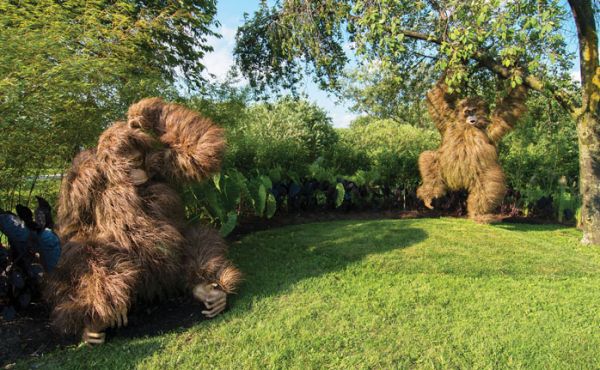
These artworks were created in Canada by International Mosaiculture of Montreal, the leaders in the art form known as mosaiculture. Just how are these amazing artworks formed? "Each sculpture is a living, sophisticated evolution of the traditional 'stuffed topiary technique," states the Garden. "Thousands of meticulously groomed annuals are planted into soil-and-sphagnum moss filled netting covering the steel forms – hidden works of artisanship themselves – to carpet the skeletons in colorful patterns. Complex irrigation systems beneath the surface of the sculptures allow the plants to grow – and the creatures to flourish – in Atlanta’s summer heat."Imaginary Worlds will be on display through October. See more pictures of the living sculptures at My Modern Met.
Towing Icebergs
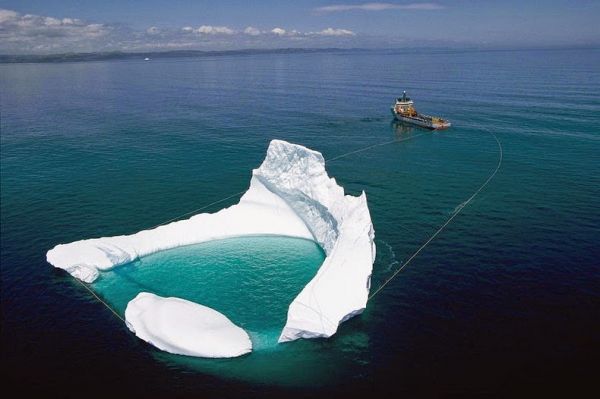
An industry was born out of the R.M.S. Titanic's collision with a 500,000-ton iceberg, which famously ripped the holes in the hull of the ship that were her downfall. After the Titanic tragedy in 1912, a group of North American and European nations established the International Ice Patrol (IIP) to prevent such incidents. The IIP utilizes data collected from satellites, radar and airplanes to furnish critical information to the maritime community regarding the location of icebergs and safe detours clear of them.
IIP information is vital to an industry of ice management contractors who are hired by oil companies to keep watch over their oil rig platforms. An estimated 20,000 to 40,000 icebergs a year — massive portions of Greenland glaciers — ride with the current into the North Atlantic, where they become potential dangers to oil installations off Newfoundland's coast. The ice management contractors keep a close eye on bergs in the general vicinity of oil rig structures. When an iceberg is identified as an immediate threat, it is then towed out of the area by the contractors, using specialized anchor handling tug supply vessels.
These contractors use towropes eight inches in diameter and up to 1/4 mile long to tow the immense icebergs. The towrope is attached to a buoy and the tug vessel circles the iceberg, while care is taken to keep a distance of 650 feet or so from the berg. Once the roping is complete, the rope is then attached to a tow cable. Between 1/2 and 3/4 of a mile of space is kept between the vessel and the iceberg to avoid a catastrophe if the iceberg flips over during the operation. If an iceberg flips during towing, it can slice through the boat, as well as cause rough seas due to the waves generated after it falls. Towing an iceberg can take up to 72 hours, as the boat needs in the neighborhood of ten hours to reach a speed of just one nautical mile (6076 feet) per hour.
Learn more and see additional pictures at Amusing Planet.

Man hired to help refurbish bathroom water-boarded after botched renovation
Two men from Stockholm in Sweden faced court on Tuesday after they
allegedly kidnapped and tortured a man hired to help renovate a
bathroom.
A young home-owner in Botkyrka, south of Stockholm, enlisted builders
to overhaul his bathroom.
His anger at what he considered an unacceptable job got the better of
him, however, leading him and an accomplice to kidnap a 31-year-old
agent working for the renovators.
The victim said he was choked until he passed out in the bathroom. When
he woke up, he said he was being waterboarded, a torture technique that
simulates drowning. The man told police he was convinced he would die.
 The home-owner then locked him up in the trunk of his own car, drove him
away and dumped him in the nearby town of Södertälje. They are now
accused of kidnapping and aggravated assault.
While the suspect offered an alternative version of events, prosecutor
Lizzie Österlund said that evidence supported the victim's tale.
"You can see the injuries where he was tied up, just like he said, and
they found blood in the house," she said.
The home-owner then locked him up in the trunk of his own car, drove him
away and dumped him in the nearby town of Södertälje. They are now
accused of kidnapping and aggravated assault.
While the suspect offered an alternative version of events, prosecutor
Lizzie Österlund said that evidence supported the victim's tale.
"You can see the injuries where he was tied up, just like he said, and
they found blood in the house," she said.
"When he was set free he immediately called the police, who found severed cable ties nearby." The two suspects said the renovation was delayed, poorly done, and that the 31-year-old pocketed a huge chunk of the builders' fees. They called the case against them "a joke". The two men have denied the kidnapping charge, but admitted an altercation had taken place, which explained the traces of blood. The case continues.
"When he was set free he immediately called the police, who found severed cable ties nearby." The two suspects said the renovation was delayed, poorly done, and that the 31-year-old pocketed a huge chunk of the builders' fees. They called the case against them "a joke". The two men have denied the kidnapping charge, but admitted an altercation had taken place, which explained the traces of blood. The case continues.
Iranian billionaire executed over $2.6B bank fraud

A
billionaire businessman at the heart of a $2.6 billion state bank scam,
the largest fraud case since the country's 1979 Islamic Revolution, was
executed Saturday, state television reported.
Authorities put
Mahafarid Amir Khosravi, also known as Amir Mansour Aria, to death at
Evin prison, just north of the capital, Tehran, the station reported.
The report said the execution came after Iran's Supreme Court upheld his
death sentence.
Khosravi's
lawyer, Gholam Ali Riahi, was quoted by news website khabaronline.ir as
saying that his client was put to death without any notice.
"I
had not been informed about execution of my client," Riahi said. "All
the assets of my client are at the disposal of the prosecutor's office."
State officials did not immediately comment on Riahi's claim.
The
fraud involved using forged documents to get credit at one of Iran's
top financial institutions, Bank Saderat, to purchase assets including
state-owned companies like major steel producer Khuzestan Steel Co.
Khosravi's
business empire included more than 35 companies from mineral water
production to a football club and meat imports from Brazil. According to
Iranian media reports, the bank fraud began in 2007.
A
total of 39 defendants were convicted in the case. Four received death
sentences, two got life sentences and the rest received sentences of up
to 25 years in prison.
The
trials raised questions about corruption at senior levels in Iran's
tightly controlled economy during the administration of former President
Mahmoud Ahmadinejad.
Mahmoud
Reza Khavari, a former head of Bank Melli, another major Iranian bank,
escaped to Canada in 2011 after he resigned over the case. He faces
charges over the case in Iran and remains on the Islamic Republic's
wanted list. Khavari previously admitted that his bank partially was
involved in the fraud, but has maintained his innocence.
Man accused of stabbing wife for wearing his socks
A man from Clarksville, Tennessee, was arrested on Friday after
allegedly attacking his wife with a "survival style" knife because she
was wearing his socks.
The wife told police that Sean Terrance Jones had been drinking, and she
was going to leave their apartment when he grabbed her by the neck and
told her to give back his socks, according to an arrest warrant.
 She said she removed the socks and went to get into a friend’s car,
but Jones followed her with a “large survival style knife” and began
beating on the windshield.
She said she opened the door to try to get him to stop, and he
threatened her, then stabbed her in the right side of her neck, behind
her ear.
She said she removed the socks and went to get into a friend’s car,
but Jones followed her with a “large survival style knife” and began
beating on the windshield.
She said she opened the door to try to get him to stop, and he
threatened her, then stabbed her in the right side of her neck, behind
her ear.
A police officer saw a small puncture wound on her neck. The victim said the knife was large, but the tip seemed to be dull. The warrant did not indicate whether she was treated for the injury. Jones, 20, was charged with aggravated assault. He was booked into Montgomery County Jail on $5,000 bond.
A police officer saw a small puncture wound on her neck. The victim said the knife was large, but the tip seemed to be dull. The warrant did not indicate whether she was treated for the injury. Jones, 20, was charged with aggravated assault. He was booked into Montgomery County Jail on $5,000 bond.
Police ask for help in order to stop plague of snot and booger graffiti
Police in Cary, North Carolina, need the public's help finding some graffiti vandals.
The graffiti tags "snot" and "booger" have appeared on more than 20
buildings across the town since January, including businesses, apartment
complexes, park property and road signage.
 Police say no gang activity is suspected, but it does cost money to clean up. Neighbours and business owners say it has to stop.
If you see vandalism, police say you should take a picture, report it to them and if it's public property, the town will have it removed.
Police say no gang activity is suspected, but it does cost money to clean up. Neighbours and business owners say it has to stop.
If you see vandalism, police say you should take a picture, report it to them and if it's public property, the town will have it removed.
Anyone with information should call the Town of Cary Police. Crime Stoppers is offering a reward of up to $2,500 for the arrest or indictment of those responsible.
Anyone with information should call the Town of Cary Police. Crime Stoppers is offering a reward of up to $2,500 for the arrest or indictment of those responsible.
Coming Tomorrow
Coming Tomorrow
- Senate repugicans throw yet another temper tantrum
- New study proves that repugicans are significantly more likely to lie than Democrats
- Workers in Walmart warehouse get $21 million wage theft settlement
- Walmart's poor sales don't keep top executives from getting millions in 'incentive' pay

This lion is our Animal Picture, for today.
Sunday, May 25, 2014
The Daily Drift

Carolina Naturally is read in 199 countries around the world daily.
That's a nerd all right ... !

Today is - Nerd Pride Day
Don't forget to visit our sister blog: It Is What It Is
Some of our reader today have been in:
The Americas
Halesite, Saginaw, Lake Havasu City, Langley, Anadarko, Saxapahaw and Waxhaw, United States
Trois-Rivieres, Vancouver, Edmonton, L'ancienne-Lorette, Victoria and Sherwood, Canada
Luquillo, Puerto Rico
Mexico City, Mexico
Chilibre, Panama
Buenos Aires, Argentina
Caracas, Venezuela
Tipitapa, Nicaragua
Sao Paulo, Brazil
Bogota, Colombia
Europe
Kiev and Zhovtivody, Ukraine
Riga, Latvia
Amsterdam, Netherlands
Ljubljana and Maribor, Slovenia
Slough, Blackwall and London, England
Madrid, Algeciras and Eixample, Spain
Reykjavik, Iceland
Sofia, Bulgaria
Tallinn, Estonia
Frankfurt Am Main and Nuremberg, Germany
Stockholm, Sweden
Dublin, Ireland
Sarajevo, Bosnia and Herzegovina
Vladivostok and Ryazan, Russia
Oslo, Norway
Treviso, Rome and Milan, Italy
Skanderborg, Denmark
Rouen and Nanterre, France
Elbag, Poland
Helsinki, Finland
Asia
Kota Kinabalu and Kuala Lumpur, Malaysia
Riyadh, Saudi Arabia
Chiang Rai, Thailand
Suratgarh, Jodhpur, Bhubaneshwar, Shillong and Mumbai, India
Tai'zz, Yemen
Tehran, Iran
Medan and Jakarta, Indonesia
Muscat, Oman
Colombo, Sri Lanka
La Dagotiere, Mauritius
Doha, Qatar
Islamabad, Pakistan
Petah Tikva, Israel
Taipei, Taiwan
Seoul, Korea
Africa
Port Elizabeth, South Africa
Kampala, Uganda
The Pacific
Quezon City, Philippines
Sydney, Australia
Today in History
| 585 BC | Thales of Greece makes the first known prediction of a solar eclipse. | |
| 1085 | Alfonso VI takes Toledo, Spain from the Muslims. | |
| 1787 | The Constitutional convention opens at Philadelphia with George Washington presiding. | |
| 1810 | Argentina declares independence from Napoleonic Spain. | |
| 1851 | Jose Justo de Urquiza of Argentina leads a rebellion against Juan Manuel de Rosas, his former ally. | |
| 1911 | Porfirio Diaz, President of Mexico, resigns his office. | |
| 1914 | The British House of Commons passes Irish Home Rule. | |
| 1925 | John Scopes is indicted for teaching Darwinian theory in school. | |
| 1935 | Jesse Owens sets six world records in less than an hour in Ann Arbor, Michigan. | |
| 1946 | Jordan gains independence from Britain. | |
| 1953 | The first atomic cannon is fired in Nevada. |


Subscribe to:
Posts (Atom)
