Candid photo of 16 year-old Lauren Bacall, 1940.
Welcome to ...
The place where the world comes together in honesty and mirth.
Windmills Tilted, Scared Cows Butchered, Lies Skewered on the Lance of Reality ... or something to that effect.
Thursday, May 29, 2014
Man's $4 Flea Market Find of Old Coca-Cola Bottle Goes to Auction
by Katie Kindelan
A New Mexico man's purchase of a $4 bottle at a flea market could turn
into a $5,000 or more pay day thanks to the bottle's ties with
Coca-Cola's past.Jim Vergo, of Albuquerque, said the aged bottle's label featuring coca leaves and the words "wine coca" caught his attention while he was shopping at a local market last fall.
"It was embossed with the name Pemberton," Vergo said in a statement released by Heritage Auctions. "I'm not a big Coca-Cola collector so it wasn't until I got home that I Googled and saw that it was Dr. Pemberton, the creator of Coca-Cola."
Vergo's flea market find was one of only three bottles known to be in existence dating back to the original roots of what the world now knows as Coca-Cola, or Coke, soft drinks.
What makes Vergo's purchase even more significant is that the bottle, which dates back to the 1880s, has 90 percent of the original label intact.
"A couple of these bottles have been known to exist but none have ever been found with a label," Noah Fleisher, Heritage's director of public relations, told ABC News. "It's the most intact and earliest incarnation of what would become Coca-Cola."
The Dallas-based Heritage Auctions is set to auction off Vergo's bottle on Saturday, May 24. It is expected to fetch at least $5,000.
"I thought, well, you know, maybe I should open it up to the whole world," Vergo, a collector of sports memorabilia, old toys and art glass, told local ABC affiliate KOAT. "You know, put it in a major auction and let somebody that's really interested or even a club could buy it."
The bottle originally held French Wine Coca, the alcoholic "nerve tonic" created by Dr. John Pemberton, the Atlanta-based druggist who created the formula for what became Coca-Cola.
"It's the oldest Coke relic there is," Fleisher told ABC News of the bottle.
The Memorial Day Massacre
The sculpture was created by Ed Blazak, a former employee of the Republic Steel company. It was originally sited on the property of Republic Steel near Burley.Ave. The sculpture, with its ten steel pipes, represent the smoke stakes of the ten steel mills within the area, now closed. They can also be Representative of the slain ten demonstrators.
What happened to the man who made canned rattlesnake?
End made a business of supplying adventurous restaurateurs and gourmets until 1944, when he died of a rattlesnake bite.
Be sure to visit Lawrence's (Roughly) Daily website!
Why Did Women Start Wearing Makeup?
by Eddie Deezen.In spite of a small microcosm of angry feminists, the "beauty industry" is a billion-dollar (trillion, maybe?) industry in America and around the world.
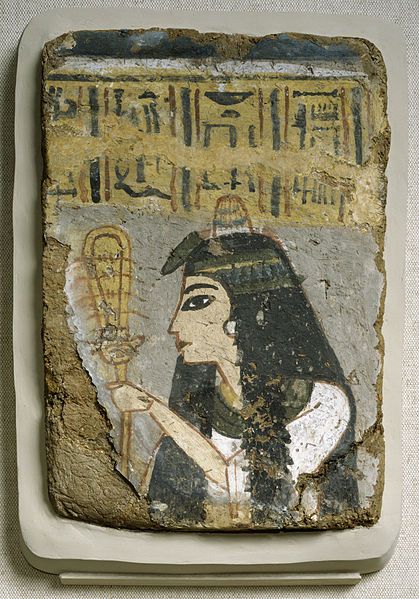
Call it vanity, if you must, but spending quality time in front of a mirror is a daily ritual millions of women can't do without, whether they're preparing for an average day at work, a big event, or a date with that special someone. It all goes back to the ancient Egyptians, who were the first women to wear makeup.
In a way, the basic motive back then was the same as it is today- just like modern day supermodels, the well-to-do women of ancient Egypt wanted to look their best and saw the careful application of face-paint as a means to that end.
But
unlike today's modern women, they weren't trying to impress that cute
guy at work or the guy at that important job interview. And the Egyptian
women weren't trying to catch the eye of the burly construction foreman
working on the pyramids or the local pharoah either. Their sights were
aimed a little higher. They were trying to impress the gods.Archeological evidence shows the Egyptian ladies were dolling themselves up as early as 4000B.C. This was mainly, or at least in good part, to please the gods, as the women felt their appearance was directly related to their spiritual worth. So the Egyptians created the first cosmetics (no word on whether they received makeovers at malls along the Nile).
They applied eye makeup called mesdement (from the ancient Egyptian word <>msdmt) a mixture of copper and lead ore, around their eyes. Green shades went on the lower eyelids; black and dark gray were applied to the lashes and upper eyelids. Dark colors were said to ward off "evil eyes".
To complete the ornate look around the eyes, they added almond shapes of dark-colored powder (later called kohl) that might have been a combination of ingredients such as burnt almonds, oxidized copper, copper ores, lead, ash, and ochre (think Johnny Depp as Captain Jack Sparrow or Keith Richards as Keith Richards). Kohl was believed to have medicinal benefits as well.
Although these earliest beauty products the ladies put on were originally intended to please the gods, it doesn't take much imagination to consider the effect these doses of makeup had on the local Egyptian men (probably similar to the first cave girl who realized the effect her short animal skin dress had on the cave men and boys she walked by).
The connection between beauty and spirituality remained for centuries, until the Romans gained power. The Romans adopted many of the Egyptians' cosmetic formulas, but their primary motive was to improve their appearance for each other (especially the Roman men). The "god factor" did not enter into it.
It brings one that most precious of all commodities: admiration. And in the end, isn't that what we all want?
Mystical Angkor Wat
Previously undetected 16th century paintings are discovered the Temple of Angkor Wat in Cambodia.
271 Years Before Pantone, An Artist Mixed And Described Every Color Imaginable In An 800-Page Book
In 1692 a Dutch artist known only as 'A. Boogert' wrote a book about
mixing watercolors. The title of the book is 'Klaer Lightende Spiegel
der Verfkonst' (Clearly Lighting Mirror of the Art of Painting). Not
only would he begin the book with a bit about the use of color in
painting, but would go on to explain how to create certain hues and
change the tone by adding one, two, or three parts of water.
Spanning nearly 800 completely handwritten and painted pages, it was probably the most comprehensive guide to paint and color of its time. According to Medieval book historian Erik Kwakkel who translated part of the introduction, the color book was intended as an educational guide. The irony being there was only a single copy that was probably seen by very few eyes.
The Abyssinian Princes Hoax of 1910
Irish practical joker Horace de Vere Cole
orchestrated his masterpiece in 1910: He dressed four friends as
Abyssinian princes and inveigled a tour of a British battleship. One of
the friends, improbably, was Virginia Woolf disguised in a false beard
and turban (far left in above photo).
The Forgotten 19th-Century Photo Technology That Romanticized America
Taschen has just published a new book called An American Odyssey: Photos
from the Detroit Photographic Co., 1888 - 1924, whose 612 pages are
crammed with hundreds of Photochroms, a Swiss-invented hybrid of
black-and-white photography and stone lithography.
Collectors Weekly interviewed one of the book's co-authors, Sabine Arqué, who explained how this technology found its way to Detroit and ending up giving most Americans their first color glimpse of places like the Grand Canyon, which had been shot decades earlier by the great American photographer William Henry Jackson.
"Pistol Pete"
Frank Eaton, “Pistol Pete”….. In the late 1860’s, 8 yr old Eaton witnessed six men kill his father. In 1875, when he was 15, he learned the whereabouts of his father’s killers. But before setting off on his mission to avenge his father’s death, he decided to visit Ft. Gibson, OK a cavalry fort, to learn more about handling a gun. He learned, and out shot everyone at the fort, earning him the nickname. Later in life, he moved to OK. Terr. and became a US Marshal.
Meet Jack Swilling
This is Jack Swilling, from South Carolina. He explored previously unknown areas while head of militia unit known as the Gila Rangers, he fought for the Confederacy and the Union (I still don’t know how he pulled that one off) and he founded Phoenix, Arizona. And all we have of him is one lousy photograph.
The Mammoth That Trampled On The History Of Mankind
Next month, scientists will meet in the town of Les Eyzies in the
Dordogne, France, to mark the 150th anniversary of the discovery of the
La Madeleine mammoth - an engraving on ivory that proves man had lived
alongside these prehistoric creatures.
The uncovering of the engraving, in 1864, was the handiwork of a joint British-French archaeological expedition and it provided the first, unambiguous evidence that human beings had once shared this planet with long-extinct animals such as the mammoth.
Russian fisherman 'snags' rare Bronze Age figurine
A Russian fisherman who expected nothing more than a haul of tench and
carp ended up catching a 4,000-year-old pagan god statue from the bottom
of a riverbed.
Archaeologists hailed the ancient find as 'unique and amazing' and 'worth its weight in gold'. The figurine has almond-shaped eyes, a large mouth with full lips, and a ferocious facial expression
Local archaeologists have hailed Siberian Nikolay Tarasov's finding as 'unique and amazing' as well as 'probably worth its weight in gold'.
Mr Tarasov was fishing on a day off from his driving job in the village of Tisul in southern Russia.
He said: 'I used a net, rather than a line, and was hauling it in when I felt the net go heavy and thought it had snagged on a rock.
'I pulled it in by getting my pal to help and was going to chuck it away. But then I stopped when I saw it was a stone with a face.
'I washed the thing in the river - and realized it was a statuette.'
The figurine has almond-shaped eyes, a large mouth with full lips, and a ferocious facial expression.
'I took it to a local museum. I needed to sit down when the experts told me that this object was carved at the very beginning of the Bronze Age.
'On the reverse side on the head the carver etched plaited hair. Below the plait there are lines looking like fish scales. The people I showed it to quite literally jumped for joy.
'I suspected it might be a couple of hundred years old, but had not considered it might by older,' he told The Siberian Times.
Marina Banschikova, director of Tisul History Museum: 'Quite likely, it shows a pagan god.
'Items from this period are very rare, the only things we have dated approximately to the same age are a stone necklace and two charms in the shapes of a bear and a bird.
'Nikolay has given us this treasure free of charge. He didn’t ask for any kind of compensation - though it is probably worth more than if it was a gold statue.
'Now we have to devote more time studying his find which is both unique and amazing.'
The area around Tisul is known to have been inhabited in ancient times.
Currently the theories are that the statuette belonged to the Okunev or Samus cultures.
Okunev culture was a Bronze Age society dated to the first half of the 2nd millennium BC in Minusinsk Hollow of southern Siberia.
To sell it and make profit however was never on the mind of Mr Tarasov, who said: 'People should see it, and learn the history of their region. It is quite clearly precious for the museums of any country.'
Archaeologists hailed the ancient find as 'unique and amazing' and 'worth its weight in gold'. The figurine has almond-shaped eyes, a large mouth with full lips, and a ferocious facial expression
Local archaeologists have hailed Siberian Nikolay Tarasov's finding as 'unique and amazing' as well as 'probably worth its weight in gold'.
Mr Tarasov was fishing on a day off from his driving job in the village of Tisul in southern Russia.
He said: 'I used a net, rather than a line, and was hauling it in when I felt the net go heavy and thought it had snagged on a rock.
'I pulled it in by getting my pal to help and was going to chuck it away. But then I stopped when I saw it was a stone with a face.
'I washed the thing in the river - and realized it was a statuette.'
The figurine has almond-shaped eyes, a large mouth with full lips, and a ferocious facial expression.
'I took it to a local museum. I needed to sit down when the experts told me that this object was carved at the very beginning of the Bronze Age.
'On the reverse side on the head the carver etched plaited hair. Below the plait there are lines looking like fish scales. The people I showed it to quite literally jumped for joy.
'I suspected it might be a couple of hundred years old, but had not considered it might by older,' he told The Siberian Times.
The figurine is 12in (30cm) long, 2in (5cm) wide and
carved from bone
The curators of the museum passed on the find to experts in the city of
Kemerovo, where they dated it at more than 4,000-years-old, and
explained it had been carved in horn which later fossilised. The
statuette is 12in (30cm) long and 2in (5cm) wide.
Marina Banschikova, director of Tisul History Museum: 'Quite likely, it shows a pagan god.
'Items from this period are very rare, the only things we have dated approximately to the same age are a stone necklace and two charms in the shapes of a bear and a bird.
'Nikolay has given us this treasure free of charge. He didn’t ask for any kind of compensation - though it is probably worth more than if it was a gold statue.
'Now we have to devote more time studying his find which is both unique and amazing.'
The area around Tisul is known to have been inhabited in ancient times.
Currently the theories are that the statuette belonged to the Okunev or Samus cultures.
Okunev culture was a Bronze Age society dated to the first half of the 2nd millennium BC in Minusinsk Hollow of southern Siberia.
To sell it and make profit however was never on the mind of Mr Tarasov, who said: 'People should see it, and learn the history of their region. It is quite clearly precious for the museums of any country.'
Amenhotep's Brother Found
The mummy of the pharaoh Amenhotep II's foster brother may finally have been located in a former Italian monastery.
The mummy, found by an expedition in the 1800s, is rediscovered in Florence, Italy.
Wari culture artifacts discovered in Ayacucho, Peru
Archaeologists working at the Wari archaeological complex in the
Vegachayoq Moqo sector have made new discoveries that promise to
illuminate the mysterious pre-Inca society.
Juan Arango Claudio, local tourism official, told Andina that “In spite of all the effort that has been expended, we only know a small percentage, that can’t be more than 10%, about the Wari, but we’re hoping that these advances will allow us more tourism flow, because these historical spaces are being evaluated.”
Specifics about the new findings are expected to be announced in coming weeks, Andina reports.
The Wari were an expansive civilization that lived in Peru from around 500 AD to 1000 AD. Their capital city, also called Wari, was located near the city of Ayacucho, in inland Peru.
Experts are interested in learning more about this little
understood civilization
Mario Cueto Cardenas from the Ayacucho Culture Board told Andina that
“Archaeologist [José Ochatoma Paravicino of the Universidad San
Cristobal de Huamanga] presented a report and is preparing an exposition
for the new Wari finds, which will allow us to explore unknown spaces,
because [at the Wari site], we’re just getting familiar with the
citadel, there are more mysteries that will allow us to better
understand their economic and cultural system.”
Juan Arango Claudio, local tourism official, told Andina that “In spite of all the effort that has been expended, we only know a small percentage, that can’t be more than 10%, about the Wari, but we’re hoping that these advances will allow us more tourism flow, because these historical spaces are being evaluated.”
Specifics about the new findings are expected to be announced in coming weeks, Andina reports.
The Wari were an expansive civilization that lived in Peru from around 500 AD to 1000 AD. Their capital city, also called Wari, was located near the city of Ayacucho, in inland Peru.
Students discover 7,000-year-old mummy in Chile
A group of students discovered a 7,000-year-old mummy during a trip to
northern Chile, local media reported Monday.
A group of Chinchorro mummies — dated between 5000 B.C. and 3000 B.C. — are on display during the exhibition "Arica, a Thousand-Year-Old Culture," on Aug. 27, 2008, in the cultural center of the La Moneda presidential palace in Santiago, Chile Claudio Santana
La Tercera newspaper reported that the find was made by chance Saturday during a visit to the Morro de Arica site by local students.
Ancient archeological artifacts have been forced toward the surface following the powerful 8.2 earthquake that rocked the region in April, reports say.
A group of Chinchorro mummies — dated between 5000 B.C. and 3000 B.C. — are on display during the exhibition "Arica, a Thousand-Year-Old Culture," on Aug. 27, 2008, in the cultural center of the La Moneda presidential palace in Santiago, Chile Claudio Santana
La Tercera newspaper reported that the find was made by chance Saturday during a visit to the Morro de Arica site by local students.
Ancient archeological artifacts have been forced toward the surface following the powerful 8.2 earthquake that rocked the region in April, reports say.
Coming Tomorrow
Coming Tomorrow
- Crocodile injured by falling accountant
- Humpback whale subspecies revealed by genetic study
- Adorable bear cub charms police in Oregon
- Ancient DNA ends Aussie claims to Kiwi origins
These sleeping Sperm whales are our Animal Picture, for today.
Wednesday, May 28, 2014
The Daily Drift
Carolina Naturally is read in 199 countries around the world daily.
Health and Fitness ... !
Today is - National Senior Health and Fitness Day
Don't forget to visit our sister blog: It Is What It Is
Some of our reader today have been in:
The Americas
Kokomo,
Florin, Kalamazoo, Killeen, Fargo, Bozeman, Livonia, Topanga, Elyria,
Pawling, Mahwah, Charlotte and Portland, United States
Saint John's L'ancienne-Lorette, Ottawa, Edmonton, Lake Louise, Nunalala and Vancouver, Canada
Mexico City and Tijuana, Mexico
Medellin, Colombia
Tipitapa, Nicaragua
Rio De Janeiro and Sao Paulo, Brazil
Europe
Moscow, Vladivostok and Ryazan, Russia
Amsterdam, Rotterdam and Limbricht, Netherlands
London and Newbury, England
Boulogne-Billancourt, Rouen, Oberhaslach, Nice and Salon-De-Provence, France
Eschborn, Kassel and Esslingen, Germany
Oslo, Norway
Malaga, Madrid, L'Olleria, Pontevedra and Granada, Spain
Frederiksberg and Copenhagen, Denmark
Bergamo, Ravenna and Ivrea, Italy
Vinnytsya and Zhovtivody, Ukraine
Dublin and Limerick, Ireland
Sarajevo, Bosnia and Herzegovina
Geneva, Switzerland
Lagos, Portugal
Zagreb, Croatia
Skierniswice, Poland
Skopje, Macedonia
Asia
Amman, Jordan
Colombo, Sri Lanka
Kolkata,
New Delhi, Shillong, Cochin, Jaipur, Madurai, Chennai, Hyderabad,
Powai, Bangalore, Ludhiana, Pune, Coimbatore and Suratgarh, India
Kuala Lumpur, Malaysia
Bangkok and Bang Rak, Thailand
Tehran, Iran
Beijing, China
Jakarta, Indonesia
Muscat, Oman
Lahore, Pakistan
Sabya, Saudi Arabia
Africa
Cape Town Johannesburg and Uitenhage, South Africa
Bulawayo, Zimbabwe
Zarzis, Tunisia
The Pacific
Sydney and Richmond, Australia
Linabuan Sur and Angeles City, Philippines
Today in History
| 585 BC | A solar eclipse interrupts a battle outside of Sardis in western Turkey between Medes and Lydians. The battle ends in a draw. | |
| 1805 | Napoleon is crowned in Milan, Italy. | |
| 1830 | Congress authorizes Indian removal from all states to the western Prairie. | |
| 1863 | The 54th Massachusetts, a regiment of African-American recruits, leaves Boston, headed for Hilton Head, South Carolina. | |
| 1859 | The French army launches a flanking attack on the Austrian army in Northern France. | |
| 1871 | The Paris commune is suppressed by troops from Versailles. | |
| 1900 | Britain annexes the Orange Free State in South Africa. | |
| 1940 | Belgium surrenders to Germany. | |
| 1953 | Melody, the first animated 3-D cartoon in Technicolor, premiers. | |
| 1961 | Amnesty International, a human rights organization, is founded. |
50 Most Amazing Summer Camps In The U.S.
A good summer camp should be a safe and magical place where girls and
boys can make friends, discover new passions and learn to be
independent. Here, they are taught values such as teamwork and
cooperation - all while surrounded by majestic lakes, mountains,
woodlands and wide-open spaces so often lacking in congested cities.More often than not, kids find out who they are and what makes them tick. Here are 50 of the most incredible summer camps in the United States.
The Monument To The Battle Of Nations
The Biggest Monument In Europe
The shadow of a new war was already casting a long shadow in 1913. Yet
it was the year when the people of the city of Leipzig in the German
state of Saxony saw the completion of their monument to a battle which
had taken place exactly a century before.The Monument to the Battle of Nations commemorated the defeat of Napoleon at the Battle of Leipzig. However, for almost a century after its inauguration, this remembrance of a battle of the past would be used by one group or another for their own ideological purposes.
China's fake Sphinx to be demolished
Residents pose for a photo
before a full-size replica of the Great Sphinx of Giza in Donggou
village in Shijiazhuang, north China's Hebei province on May 13, 2014
A replica
of Egypt's iconic Sphinx built in northern China will be dismantled
after an Egyptian ministry complained about the structure, state media
said Sunday.
A massive replica of the ancient statue was built in Hebei province, the official Xinhua news agency said.
But
Egypt's ministry of antiquities complained to the United Nations
Educational, Scientific and Cultural Organization (UNESCO) about the
Chinese imitation, it cited a source as saying.
The
report quoted an official with a cultural park on the outskirts of the
provincial capital Shijiazhuang as saying the imitation would serve only
as a temporary scene for shooting movies and television dramas.
"We
are very respectful to world cultural heritage and express our
apologies for any misunderstanding," added the official, who declined to
be named.
The replica, about 80 meters (264 feet) long and 30 meters tall, is made of steel bars and cement.
Already
notorious for copying Western goods ranging from trainers to champagne,
China is building up its replica reputation with a miniature Mount
Rushmore, an Eiffel Tower and an entire Austrian village.
In
the southwestern megacity of Chongqing, a park is scattered with
sculptures including Michelangelo's David, Rodin's Thinker and the
gigantic heads of four American presidents in a trend known as
"duplitecture".
An assemblage
of Parisian monuments including the Eiffel Tower and a fountain from
Versailles stand in the city of Hangzhou, as does a French village.
Among
the most eye-popping examples are a copy of the Austrian alpine village
and UNESCO World Heritage Site of Hallstatt in the southern province of
Guangdong, which even state media called "a bold example of China's
knock-off culture".
Thyme
Thyme
has a powerful ability to kill off bacteria and viruses and should be
taken at first signs of a cold or illness. It is a rich source of
several essential vitamins such as vitamins A, E, C, K, B-complex and
folic acid and it is also one of the best sources of calcium, iron,
manganese, selenium, and potassium. Thyme contains antiseptic,
antiviral, antibacterial, carminative, diaphoretic, and expectorant
properties which supports healing throughout the entire body. Thyme is
vital to help stimulate memory, prevent nightmares and melancholy, ease
headache and muscle tension, soothe coughs, relieve fevers, and fight
colds and infections. It also contains a compound called carvacrol which
is an excellent natural tranquilizer and has a tonic effect on the
entire nervous system. Thyme is a good source of pyridoxine which is
known to play an important role in manufacturing GABA levels in the
brain, aid in regulating sleep patterns, and benefit neurotransmitter
function in the brain. GABA is also one of the best natural defenses
against stress damage. Thyme is a great purifying herb for the digestive
tract and has been found to destroy certain intestinal hookworms and
roundworms and aid in the digestion of rich or fatty foods. Thyme has
some of the highest antioxidant levels among herbs. It is packed with
bioflavonoids such as lutein, zeaxanthin, and naringenin which have all
been shown to have powerful effects on eliminating free-radicals and
other disease producing substances from the body. Thyme oil has been
used as a local antiseptic and antimicrobial since ancient times and is
highly beneficial in supporting the immune system and for easing fatigue
and weakness after illness. Thyme oil can also help to stop hair loss
by improving blood flow to the scalp and feeding the roots of the hair.
Consider using more fresh thyme in your food by adding it to soups,
salads, guacamole, vegetables, potatoes, rice, etc... Fresh thyme also
makes a powerful and very healing tea. Steep a handful of fresh sprigs
in hot water for at least 10 minutes or it can be soaked overnight in a
pitcher of water and sipped throughout the day. Add honey or lemon, if
desired.The Lost Gardens Of Heligan
Nature's Sleeping Beauty
If you want to know if secret gardens really do exist, look no further
for England's Lost Gardens of Heligan will likely make you lose yourself
in its beauty. The Lost Gardens of Heligan in Cornwall is one of the most popular botanical gardens in the UK.The garden, originally created and owned by the Tremayne family, was once an estate that has a number of farms, quarries, woods, brickworks, a flour mill, a saw mill, a brewery, productive orchards and kitchen gardens. It was the center of the community until the First World War broke out which made the family leave the place which turned into a war department.
Bristlcone
The rest are found here
The Door to Hell
The Hellish Desert Pit That Has Been On Fire For More Than 40 Years

The ground beneath the drilling rig collapsed, leaving a large hole with a diameter of 70 meters (230 ft). To avoid poisonous gas discharge, it was decided the best solution was to burn it off. Geologists had hoped the fire would use all the fuel in a matter of days, but the gas is still burning today.
Fairy Rings
In the latest attempt to explain the cause of these circular patches, a group of researchers turned to aerial images.
The Colorado Reaches The Gulf
Aerial photos of the Colorado River pulse flow reaching the Gulf of California.
Tafoni
Nature's Rock Art
Tafoni - you may not have heard the term but chances are, if you have
visited an ocean shore, (or less likely a desert) that you have seen
them with your own eyes.Target of Weather Conspiracy Theories Powers Down
Warmest on Record
The average global temperature for April 2014 was 1.39
degrees Fahrenheit warmer than the 20th century average for the month,
which was 56.7 degrees F.
Can We Save Our Cities from Drowning?
The Antarctic ice sheet is melting, and some of the damage is
irreversible. Over the next 200 years, the ocean is expected to rise 10
feet, putting many major cities worldwide underwater. Assuming we don't
want to live in Waterworld, can we stop it?
El Nino and Climate Change
A trend in El Nino events might explain a recent slow down in
rising global temperatures -- and that trend is about to shift toward
sharper warming, say scientists.
Subscribe to:
Posts (Atom)