

Wednesday, September 10, 2014

Bank robber arrested when stolen cash fell out of his trouser leg
 A man was arrested on suspicion of robbing a bank in Merced, California,
on Saturday afternoon.
Police say Shawn Lee Canfield, 25, walked into the Chase Bank inside the
Raley's grocery store at around 1:40pm and handed the teller a card
demanding cash.
A man was arrested on suspicion of robbing a bank in Merced, California,
on Saturday afternoon.
Police say Shawn Lee Canfield, 25, walked into the Chase Bank inside the
Raley's grocery store at around 1:40pm and handed the teller a card
demanding cash.
Authorities say the teller handed over $2,748, and the suspect took off.
Officers say they were responding to the scene and caught up with
Canfield nearby as he was trying to shove money down his pants.
The teller was taken to that location and positively identified him as the suspect. As detectives walked Canfield upstairs at the station, police say money started falling out of his trouser leg, and a total of $2,414 was collected.
During police questioning, the suspect was asked to stand up and an additional $334 fell out of his trouser leg, according to authorities. Investigators say Canfield admitted to the bank robbery and said he needed the money to get to Colorado to visit his mother. Canfield was arrested and booked into the Merced County Jail for robbery and burglary.
The teller was taken to that location and positively identified him as the suspect. As detectives walked Canfield upstairs at the station, police say money started falling out of his trouser leg, and a total of $2,414 was collected.
During police questioning, the suspect was asked to stand up and an additional $334 fell out of his trouser leg, according to authorities. Investigators say Canfield admitted to the bank robbery and said he needed the money to get to Colorado to visit his mother. Canfield was arrested and booked into the Merced County Jail for robbery and burglary.
Cherries Waffles Tennis arrested for fraud at water sports stores
 Three Miami, Florida, residents were arrested on Tuesday after they
reportedly made fraudulent purchases at two Jupiter shops, police said.
A Juno Beach surf shop also called police after three people tried to
make a questionable purchase.
Three Miami, Florida, residents were arrested on Tuesday after they
reportedly made fraudulent purchases at two Jupiter shops, police said.
A Juno Beach surf shop also called police after three people tried to
make a questionable purchase.
Cherries Waffles Tennis,
19, Vincent Mitchell, 19, and Paul Miller, 22, walked into Ground Swell
Surf Shop trying to buy two Ray Ban sunglasses worth $500 and a $100
GoPro camera.
Tennis asked the clerk to punch in the credit-card number instead of swiping it. The clerk became suspicious and declined the sale, according to an arrest report. The suspects then entered Scuba Works in Jupiter and bought a $400 spear gun. They bought a GoPro camera from Kite Paddle Wake, the report said.
 The Jupiter scuba shop later confirmed the credit card was declined.
Police said they spotted the suspects as they were leaving a gas
station. Cherries Waffles Tennis told police that her aunt gave her a
credit card to use but did not know where it was when police asked.
Tennis, Mitchell and Miller were booked into the Palm Beach County Jail
on charges of fraud.
The Jupiter scuba shop later confirmed the credit card was declined.
Police said they spotted the suspects as they were leaving a gas
station. Cherries Waffles Tennis told police that her aunt gave her a
credit card to use but did not know where it was when police asked.
Tennis, Mitchell and Miller were booked into the Palm Beach County Jail
on charges of fraud.
Tennis asked the clerk to punch in the credit-card number instead of swiping it. The clerk became suspicious and declined the sale, according to an arrest report. The suspects then entered Scuba Works in Jupiter and bought a $400 spear gun. They bought a GoPro camera from Kite Paddle Wake, the report said.

How Colonial Americans Were Inspired By Asian Spices
 When we think of the diets of the founding fathers and mothers, we
imagine porridges, breads, fresh and preserved fruits and vegetables,
and gently flavored roast meats. What most people don't realize is that
the colonists had a taste for exotic fare
from all over the world and would pay dearly for delicacies from India,
China, Indonesia and other places far from the shores of North America.
When we think of the diets of the founding fathers and mothers, we
imagine porridges, breads, fresh and preserved fruits and vegetables,
and gently flavored roast meats. What most people don't realize is that
the colonists had a taste for exotic fare
from all over the world and would pay dearly for delicacies from India,
China, Indonesia and other places far from the shores of North America.
Why Are There So Many People?

Copper Age settlement discovered in Central Spain
Researchers from the Tübingen collaborative research center Resource
Cultures (SFB 1070) have uncovered the remains of a previously unknown
Copper Age settlement in the central Spanish region of Azután. Working
with colleagues from the University of Alcalá de Henares, they found
shards and stone tools over an area of around 90 hectares.

The Iberian Chalcolithic is marked by large fortified settlements in the southwest and more intensive use of natural resources than in the Neolithic period. It was believed that the central region around Toledo had been settled only sporadically at that time, as it is hemmed in by two mountains ranges, between which the River Tajo runs -- and it would have been hard to cross 4,000 years ago.
Today, the megalithic grave chamber of Azután (pictured) still hints at Chalcolithic settlement. The volume and concentration of the latest finds point towards large, long-term settlements in the region in the fourth and third centuries BC. The researchers, headed by Tübingen archaeologist Martin Bartelheim, took geomagnetic soundings and plan to compare those results with aerial photographs of the site to identify the size and structure of the settlement.
"With the new finds at Azután, we can confirm that there was intensive copper-working and settlement also in central Spain. Until now, it was thought that such activity was mostly limited to the fertile coastal regions in the south of the Iberian Peninsula," says Felicitas Schmitt, a PhD student in the Resource Cultures collaborative research center.
At nearby Aldeanueva de San Bartolomé there is another, possibly fortified settlement, which shows signs of having been an early copper processing site. Ancient millstones and weights for nets recently found around Azután point to agriculture and fishing -- and a division of labor, which marks a step along the road to the development of professional trades.
The researchers plan to trace the ancient trade routes across Spain via landscape surveys. Even today, the site is close to major roads along the river valley, and running across them are paths into the hills used by shepherds; such routes have crossed the Meseta since time immemorial.
In another study, PhD student Javier Escudero Carillo is comparing Azután with a similar Chalcolithic site on the Portuguese Algarve coast. There are clear parallels between the two regions. Felicitas Schmitt says "The two regions have similar tombs, burial rites, and objects. So we are working on the premise that rivers and shepherds' paths played an important roles served as lines of communication even then."
The Dolmen de Azután grave chamber indicates major settlement in the
Chalcolithic
Typological analysis placed the finds in the Copper Age or Chalcolithic
period -- the transitional era after the Stone Age before metallurgists
discovered that adding tin to copper produced much harder bronze,
4,000-5,000 years ago.
The Iberian Chalcolithic is marked by large fortified settlements in the southwest and more intensive use of natural resources than in the Neolithic period. It was believed that the central region around Toledo had been settled only sporadically at that time, as it is hemmed in by two mountains ranges, between which the River Tajo runs -- and it would have been hard to cross 4,000 years ago.
Today, the megalithic grave chamber of Azután (pictured) still hints at Chalcolithic settlement. The volume and concentration of the latest finds point towards large, long-term settlements in the region in the fourth and third centuries BC. The researchers, headed by Tübingen archaeologist Martin Bartelheim, took geomagnetic soundings and plan to compare those results with aerial photographs of the site to identify the size and structure of the settlement.
"With the new finds at Azután, we can confirm that there was intensive copper-working and settlement also in central Spain. Until now, it was thought that such activity was mostly limited to the fertile coastal regions in the south of the Iberian Peninsula," says Felicitas Schmitt, a PhD student in the Resource Cultures collaborative research center.
At nearby Aldeanueva de San Bartolomé there is another, possibly fortified settlement, which shows signs of having been an early copper processing site. Ancient millstones and weights for nets recently found around Azután point to agriculture and fishing -- and a division of labor, which marks a step along the road to the development of professional trades.
The researchers plan to trace the ancient trade routes across Spain via landscape surveys. Even today, the site is close to major roads along the river valley, and running across them are paths into the hills used by shepherds; such routes have crossed the Meseta since time immemorial.
In another study, PhD student Javier Escudero Carillo is comparing Azután with a similar Chalcolithic site on the Portuguese Algarve coast. There are clear parallels between the two regions. Felicitas Schmitt says "The two regions have similar tombs, burial rites, and objects. So we are working on the premise that rivers and shepherds' paths played an important roles served as lines of communication even then."
Fever mounts as stunning statues found at ancient Greek tomb

The two female
figures in long-sleeved tunics were found standing guard at the opening
to the mysterious Alexander The Great-era tomb near Amphipolis in the
Macedonia region of northern Greece.
"The
left arm of one and the right arm of the other are raised in a symbolic
gesture to refuse entry to the tomb," a statement from the culture
ministry said Saturday.
Speculation
is mounting that the tomb, which dates from Alexander's lifetime
(356-323BC), may be untouched, with its treasures intact.
Previous evacuations of Macedonian tombs have uncovered amazing troves of gold jewellery and sculptures.
A five-meter tall marble lion, currently standing on a nearby roadside,
originally topped the 500 metre-long funeral mound, which is ringed by a
marble wall.
 Two headless stone Sphinx
statues flanked the outer entrance, officials said, who said that
"removing earth from the second entrance wall revealed the excellent
marble caryatids".
Two headless stone Sphinx
statues flanked the outer entrance, officials said, who said that
"removing earth from the second entrance wall revealed the excellent
marble caryatids".
Photographs
released by the ministry show the sculptures -- which hold up a lintel
-- uncovered to mid-bust, their curly hair falling onto their shoulders.
Archaeologists
have been digging at the site, which Greek Prime Minister Antonis
Samaras called a "very important find", since mid-August.
The
ministry said the lay-out of "the second entrance with the caryatids
gives us an important clue that it is a monument of particular
importance".
Expectation had
already begun to build given the quality of the sculpted column capitals
and delicately colored floor mosaic already discovered at the site.
Theories
abound about who could be buried in the tumulus tomb, ranging from
Alexander's Bactrian wife Roxane, to his mother Olympias or one of his
generals.
Experts say the chances of Alexander himself being buried there are small, however.
After
his death at 32 in Babylon, the most celebrated conquerer of the
ancient world is believed to have been buried in Alexandria, the
Egyptian city he founded -- although no grave has ever been found there.

The Glomar Explorer: Howard Hughes' Spy Ship

The Hughes Glomar Explorer was built between 1973 and 1974, by Sun Shipbuilding and Drydock Co. for more than $350 million at the direction of Howard Hughes for use by his company, Global Marine Development Inc.
How the Voyage of the Kon-Tiki Misled the World About Navigating the Pacific
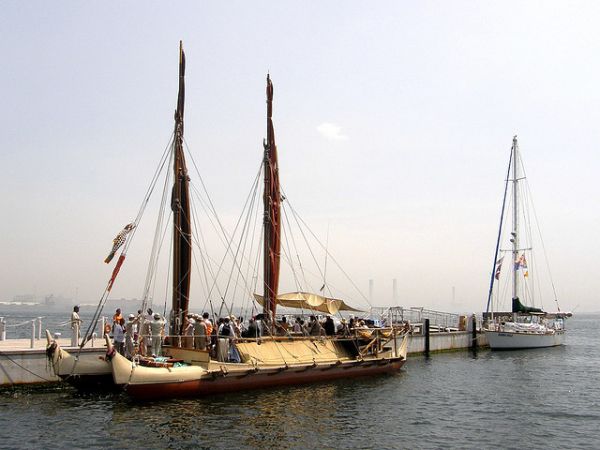
Like many of my generation, I read about Thor Heyerdahl and his raft the Kon-Tiki as a child. The voyage in 1947 was a sensation, spawning books and a movie, which seemed to prove the possibility that the Polynesian islands were settled by sailors from South America drifting on ocean currents. It was a theory that has been discussed ever since Captain Cook landed in Hawaii in 1778 and found that the language of Tahiti was understood in Hawaii. That raised the question of where the Polynesians came from and how they interconnected. Prominent European historians and navigators believed the Pacific islands must have been settled from the east, possibly even from Europe, while a Maori scholar gathered and presented evidence for the idea that the islands were settled by travelers from Asia sailing by traditional navigation techniques.
But skeptics remained, the most famous—but by no means the only—was Thor Heyerdahl. Not only did he reject the voyaging tradition, but he rejected the West-to-East migration as well. Heyerdahl argued that the Pacific had been settled by accidental drift voyaging from the Americas. His argument was based largely on the wind and current patterns in the Pacific, which flow predominantly from East to West. Where the oral tradition posed Polynesians voyaging against the wind, Heyerdahl argued it was far more likely that American Indians drifted with the wind. He made his bias particularly clear by designing his Kon Tiki raft to be unsteerable.Polynesian historians have maintained that traditional navigation led the way to Pacific exploration. In 1976, master traditional navigator Mau Piailug steered the Hawaiian canoe Hōkūleʻa (pictured) on a three-year voyage to all the Polynesian islands to prove how the ancient navigational techniques worked, and how sailors from Asia discovered and settled the islands. These techniques include intimate knowledge of the sun, stars, wind, weather, wildlife, and even the different types of ocean swells. Read how theories of ancient navigation and settlement have changed at Smithsonian. Also included is a documentary about Mau Piailug.
There is no doubt that the voyage of the Kon Tiki was a great adventure: three months on the open sea on a raft, drifting at the mercy of the winds and currents. That they did eventually reach Polynesia proved that such drift voyaging was possible. But all other evidence pointed to Southeast Asian origins: oral tradition, archaeological data, linguistic structures and the trail of human-introduced plants. Today we have strong evidence that Polynesians actually reached the Americas, not vice-versa. Nonetheless, Heyerdahl remains famous. His notion of “drift voyaging” was taken up by Andrew Sharp, whose 1963 book discredited step-by-step the possible means by which Pacific Islanders might have navigated and fixed their position at sea.
Amazing Photo: A Layer of Ice off a Leaf

SearonTrejorek smashed it on the ground after taking the photo. He should have instead heeded the advice of another redditor and sold it on eBay. That's worth at least a $100.
The Cobra Effect: law of unintended consequences, squared
 In British-ruled, cobra-infested India, a bounty was offered for
cobra-skins, so enterprising folks started breeding cobras, leading to
the program's cancellation, whereupon all those farmed cobras were
released into the wild, a net increase in cobra population. That's not the only example, either.
In British-ruled, cobra-infested India, a bounty was offered for
cobra-skins, so enterprising folks started breeding cobras, leading to
the program's cancellation, whereupon all those farmed cobras were
released into the wild, a net increase in cobra population. That's not the only example, either.
Deer Run Across Golden Gate Bridge, Cause Massive Traffic Jam
On
the evening of August fifth, a pair of deer found their way onto the
Golden Gate Bridge and proceeded to run across. Their adventure, which
started just as rush hour began, caused a huge traffic jam. The highway
patrol was called at around 5:30 p.m. Before the highway patrol could
reach the scene, they were called off, as the deer exited the bridge
around 6:00 p.m., heading north toward Marin. The animals' detour was
certainly understandable. We all need a change of scenery sometimes.





Tuesday, September 9, 2014
The Daily Drift

Carolina Naturally is read in 200 countries around the world daily.
Yep, them's weirdos, all right ... !

Today is - Wonderful Weirdos Day
Don't forget to visit our sister blog: It Is What It Is
Some of our readers today have been in:
The Americas
Sequim, Thibobaux and Goshen, United States
Montreal, Toronto, Etobicoke, Calgary, Quebec, Vancouver and Ottawa, Canada
Luquillo, Puerto Rico
Bogota, Colombia
Nagua, Dominican Republic
Rio De Janeiro and Sao Paulo, Brazil
Kingston, Jamaica
Europe
Reykjavik, Iceland
London, Lancaster, Ipswich and Worthing, England
Bielefeld, Heilbronn, Widdern, Hannover and Berlin, Germany
Mol, Belgium
Cerny, Rouen and Paris, France
Plovdiv, Bulgaria
Treviso, Ravenna, Naples, Vicenza, Genova, Padova and Bari, Italy
Budapest, Hungary
Ryazan, Moscow and Vladivostok, Russia
Madrid and Castello De La Plana, Spain
Amsterdam, Netherlands
Minsk, Belarus
Warsaw, Poland
Vinnytsya, Ukraine
Dublin and Waterford, Ireland
Riga, Latvia
Vienna, Austria
Asia
Kuching, George Town, Victoria and Selang, Malaysia
Corat, Azerbijan
Borga, Bangladesh
Vacoas, Mauritius
Abu Dhabi, United Arab Emirates
Mumbai, Kolkata, Patna, Bangalore, Jodhpur and Valodara, India
Tehran, Iran
Seoul, Korea
Hanoi, Vietnam
Karachi, Pakistan
Colombo and Kolonnawa, Sri Lanka
Bangkok, Thailand
Africa
Algiers, Algeria
Dakar, Senegal
Kampala, Uganda
The Pacific
Pasig, Philippines
Homebush and Geelong, Australia
Today in History
| 337 | Constantine's three sons, already Caesars, each take the title of Augustus. Constantine II and Constans share the west while Constantius II takes control of the east. | |
| 1087 | William the Conquerer, Duke of Normandy and King of England, dies in Rouen while conducting a war which began when the French king made fun of him for being fat. | |
| 1513 | King James IV of Scotland is defeated and killed by English at Flodden. | |
| 1585 | Pope Sixtus V deprives Henry of Navarre of his rights to the French crown. | |
| 1776 | The term "United States" is adopted by the Continental Congress to be used instead of the "United Colonies." | |
| 1786 | George Washington calls for the abolition of slavery. | |
| 1791 | French Royalists take control of Arles and barricade themselves inside the town. | |
| 1834 | Parliament passes the Municipal Corporations Act, reforming city and town governments in England. | |
| 1850 | California, in the midst of a gold rush, enters the Union as the 31st state. | |
| 1863 | The Union Army of the Cumberland passes through Chattanooga as they chase after the retreating Confederates. The Union troops will soon be repulsed at the Battle of Chickamauga. | |
| 1886 | The Berne International Copyright Convention takes place. | |
| 1911 | An airmail route opens between London and Windsor. | |
| 1915 | A German zeppelin bombs London for the first time, causing little damage. | |
| 1926 | The Radio Corporation of America creates the National Broadcasting Co. | |
| 1942 | A Japanese float plane, launched from a submarine, makes its first bombing run on a U.S. forest near Brookings, Oregon. | |
| 1943 | Allied troops land at Salerno, Italy and encounter strong resistance from German troops. | |
| 1948 | Kim Il-sung declares the establishment of the Democratic People's Republic of Korea. | |
| 1956 | Elvis Presley makes his first appearance on The Ed Sullivan Show; cameras focus on his upper torso and legs to avoid showing his pelvis gyrations, which many Americans—including Ed Sullivan—thought unfit for a family show. | |
| 1965 | US Department of Housing and Urban Development established. | |
| 1965 | Hurricane Betsy, the first hurricane to exceed $1 billion in damages (unadjusted), makes its second landfall, near New Orleans. | |
| 1969 | Canada's Official Languages Act takes effect, making French equal to English as a language within the nation's government. | |
| 1970 | U.S. Marines launch Operation Dubois Square, a 10-day search for North Vietnamese troops near DaNang. | |
| 1971 | Attica Prison Riot; the 4-day riot leaves 39 dead. | |
| 1976 | Communist Chinese leader Mao Tse-tung dies in Beijing at age 82. | |
| 1990 | Sri Lankan Army massacres 184 civilians of the Tamil minority in the Batticaloa District of Sri Lanka. | |
| 1991 | Tajikstan declares independence from USSR. | |
| 1993 | The Palestine Liberation Organization (PLO) officially recognizes Israel as a legitimate state. | |
| 2001 | Two al Qaeda assassins kill Ahmed Shah Massoud, leader of the Northern Alliance in Afghanistan. | |
| 2001 | A car bomb explodes outside the Australian embassy in Jakarta, killing 10 people. |

A vist to Sams' Club
 Yesterday I was at Sam's Club, buying a large bag of Purina dog chow for
my loyal pet, Owen , the Wonder Dog and was in the check-out line when a
woman behind me asked if I had a dog.
Yesterday I was at Sam's Club, buying a large bag of Purina dog chow for
my loyal pet, Owen , the Wonder Dog and was in the check-out line when a
woman behind me asked if I had a dog.What did she think I had an elephant?
So because I'm retired and have little to do, on impulse, I told her that no, I didn't have a dog, I was starting the Purina Diet again. I added that I probably shouldn't, because I ended up in the hospital last time, but that I'd lost 50 pounds before I awakened in an intensive care ward with tubes coming out of most of my orifices and IVs in both arms.
I told her that it was essentially a Perfect Diet and that the way that it works is, to load your pants pockets with Purina Nuggets and simply eat one or two every time you feel hungry. The food is nutritionally complete, (certified), so it works well and I was going to try it again. (I have to mention here that practically everyone in line was now enthralled with my story.)
Horrified, she asked if I ended up in intensive care, because the dog food poisoned me. I told her no, I had stopped to pee on a fire hydrant and a car hit me.
I thought the guy behind her was going to have a heart attack he was laughing so hard.
Sam's Club won't let me shop there anymore.
Better watch what you ask retired people. They have all the time in the world to think of crazy things to say.
Double Mastectomies

A new study has some surprising findings about the efficacy
of a double mastectomy compared to other forms of breast cancer
treatment. Tara breaks down the study's results.
President Obama Hammers repugicans In Congress For Having No Common Sense

On Meet The Press, President Obama called out repugicans in Congress for not having common sense. The president
pointed out that the lack of common sense has led repugicans to
obstruct everything.
Transcript:
PRESIDENT OBAMA: Well, here’s the issue. I think elections matter. I think votes matter. And given the fact that the punditry overwhelmingly felt that this was going to–
CHUCK TODD: You’re overtly pointing at me.
PRESIDENT OBAMA: That– that this was going to be a good year for Senate repugicans, because the seats that were up were in states that were tilting or significantly with– with significant repugican majorities. If we– if democrats hold the Senate, I think that should get repugicans to once again–CHUCK TODD: You think that sends a national message?PRESIDENT OBAMA: I think what it does is– is to– to send a message to repugicans that people want to get stuff done. Their– their strategy of just obstructing and saying no to every piece of legislation that might help middle class families, that might create ladders of opportunity, that that is an agenda that the American people reject.And that then gives us room, hopefully, to find some compromises. I’ve– I’ve said this before, Chuck. You know, if you asked me back in August what I want for my birthday, I’d say, “Give me a loyal opposition that has some common sense and is willing to work on some basic issues that didn’t used to be partisan issues.”It didn’t use to be that building roads, bridges, improving our airports, improving our water systems, reducing traffic, those didn’t used to be partisan issues. They have become partisan issues, because you’ve got a small portion of the repugican cabal that is fixated simply on dismantling government or making sure that we don’t get anything done around here. And that’s why elections matter.
If that approach is rejected, then you possibly have two years where we can get a whole bunch of stuff done. And the good news is that despite all that obstruction, America’s made progress. You’ve heard me speak on the stump about this, Chuck. The fact of the matter is that on almost every economic index that you can think of, America’s better off now than we were five years ago.
The president hit the nail on the head. The repugican opposition in Congress is so ideological that they lack
common sense. Rebuilding and repairing infrastructure is common sense. The repugicans claim that they want to create jobs, but companies and
businesses aren’t going to locate in areas, or countries, with poor
infrastructure.
Infrastructure is the key to economic growth and
development. The repugicans used to understand this, but today they see
every taxpayer dollar spent that isn’t a tax cut for a wealthy person or
break for a corporation as “big government.” Taking care of our
veterans and people who are less fortunate used to be common sense, but
the long-term unemployed have been waiting nearly nine months for an
extension of their benefits that isn’t coming.
It was less than a decade ago when basic programs
were agreed upon as necessary by both political parties. The repugican
mindset has completely shifted into a my way or no way approach.
Washington isn’t broken. The repugican cabal is broken. The repugican cabal has
abandoned the basic values that all Americans agreed on at one time.
If the country gives President Obama a Congress with
an ounce of common sense, things will get done before the end of his
time in office.
Fumbling Toward War: The repugican cabal’s Foreign Policy of Hate
The repugican foreign policy is a tortured and terrifying admixture of
religious dogmatism, political ideology, and corporate thirst for
profit…

“Therefore I say that it is a narrow policy to suppose that this country or that is the be marked out as the eternal ally or the perpetual enemy of England. We have no eternal allies, and we have no perpetual enemies. Our interests are eternal and perpetual, and those interests it is our duty to follow.”
– Lord Palmerston, Secretary of State for Foreign Affairs, Speech to the House of Commons, 1848
If you contrast the wise and pragmatic views of Lord Palmerstone with the rhetoric coming out of the wingnuts of the American political spectrum, you see at once the problems facing America will not be ameliorated by repugican victories in 2014 or, the gods forbid, 2016.
The repugican foreign policy, as we stand at the cusp
of the autumn of 2014, can best be described as a tortured and
terrifying admixture of religious dogmatism, political ideology, and
corporate thirst for profit, an alchemy destined to keep America at war
with somebody, somewhere, for any reason that can be conjured, in order
to keep the profits flowing.
The repugicans have not always thought this way. Chuck Hagel warned at Foreign Affairs magazine in 2004:
Initiatives to promote political reform should be based on realistic assessments of the needs and dynamics of each country, not on ideological orthodoxy. As Henry Kissinger has noted, “a foreign policy to promote democracy needs to be adapted to local or regional realities, or it will fail. In the pursuit of democracy, policy — as in other realms — is the art of the possible.
In 2005, Hagel attacked the shrub junta over the Iraq War and in 2006 said, chillingly, “There will be no victory or defeat for the United States in Iraq.” One 2006 poll showed Hagel to be more popular with Democrats than with repugicans.
It should be noted that Chuck Hagel was afterward
nominated by President Barack Obama to be his Secretary of Defense,
despite the fact that Hagel supported the wars in Iraq and Afghanistan,
and Obama did not, revealing that Obama was less wedded to ideology than
Hagel.
Tellingly, W. James Antlee III wrote at The American wingnut on July 28, 2014,
There is a reason the campaign against Chuck Hagel was so fierce and Jon Huntsman’s inability or unwillingness to appeal to wingnuts was so disappointing. With repugicans like James Baker and Brent Scowcroft aging out of government service, it’s possible that the wingnut foreign-policy establishment could become a realist-free zone.
But at the same time Antlee is condemning a rigid devotion to ideology, he is embracing christian just war theory, arguing that
“just war theory is an approach to moralizing foreign policy with a
long christian pedigree that is compatible with a strong national
defense but actually limits the resort to arms.”
If, as Antlee asserts, “wingnuts who dissent
from the reflexively hawkish status quo are presently at a
disadvantage,” then embrace of just war theory seems a strange way to
rectify the situation. History has taught us that wingnut christians can find ways to justify a unjust war, as when Rick Santorum defended the indefensible, the crusades:
The idea that the crusades and the fight of christendom against islam is somehow an aggression on our part is absolutely anti-historical. And that is what the perception is by the American left who hates christendom.
For Santorum, if you hate on the idea of just war, you hate on christendom itself, and therefore spit in the eye of god.
Or as in when the Iraq War became the latest religious crusade.
The shrub set the tone when on September 16, 2001 he called for a global “crusade” against terrorism, and the idea of a holy war
caught on. This idea of a crusade caught on, and many wingnut christians came to see it as a war against the forces of satan, as when
Lt. General William “Jerry” Boykin told a cult
in Oregon that islamic extremists hate the United States “because we’re
a christian nation, because our foundation and our roots are judeo-christians. … And the enemy is a guy named satan.”
Much as Americans rail against jihad, they are more
than willing to wage the christian equivalent, the crusade. If ISIL is
now waging jihad on Americans on behalf of a caliphate real or imagined,
it is only because they are dancing to a tune we called.
Though Donald Rumsfeld defending Boykin by saying
that the War on Terrorism was “not a war against a religion,” for repugicans, the war on terror has very much become a war against a
religion – islam. In the repugican foreign policy lexicon, the word
“muslim” is now seen as synonymous with “terrorist.”
You can see the fruits of “just war” theory in the words of Duck Dynasty’s Phil Robertson the other day:
Robertson was promoting his book when Sean Hannity asked “America’s preacher” to weigh in with his foreign policy insight on how America can best respond to radicalized muslims in ISIS. Like a good preacher, Robertson promptly whipped out his trusty christian bible and began citing scripture and verse. He read a passage from 1 John chapter 5 where he claimed god almighty divided the world into “two groups of people; the children of god, or christians, and those under the power of the evil one” he claimed was ISIS and likely all muslims. He also cited god’s words in Proverbs 8:36 that “all who hate me, love death.” The two scriptures led him to conclude that America has a simple foreign policy choice in dealing with the shrub’s spawn; “you either have to convert them, or kill them. One or the other.”
Right out of the bible. Appeal to just war will not
get us out of this mess, because it got us into this mess, and rather
than moderate a repugican foreign policy, it will inflame it.
Chuck Hagel, if the repugican cabal – which sees
war as the answer to every circumstance – does not, would seem to have
understood Field Marshal Douglas Haig’s injunction that, “Continuity of
policy is not sacrosanct against diversity of circumstance.”
Hagel identifies “Terrorism [as] a historic and existential challenge that redefines traditional notions of security”:
A wise foreign policy recognizes that U.S. leadership is determined as much by our commitment to principle as by our exercise of power. Foreign policy is the bridge between the United States and the world, and between the past, the present, and the future. The United States must grasp the forces of change, including the power of a restless and unpredictable new generation that is coming of age throughout the world. Trust and confidence in U.S. leadership and intentions are critical to shaping a vital global connection with this next generation.
According to Hagel, again in Foreign Affairs,
[A] repugican foreign policy for the twenty-first century will require more than traditional realpolitik and balance-of-power politics. The success of our policies will depend not only on the extent of our power, but also on an appreciation of its limits. History has taught us that foreign policy must not succumb to the distraction of divine mission. It must inspire our allies to share in the enterprise of making a better world. It can do so by remaining true to seven principles.
This sounds more like the Obama foreign policy than
anything even remotely possible coming from a repugican. For repugicans today, foreign policy IS a divine mission, with even our
national borders established by god. How in the world can the word
realpolitik (realistic or practical politics) ever be used in
conjunction with any reference to repugican foreign policy?
Though, for example, Minnesota repugican lawmakers criticize President Obama’s foreign policy, repugicans have not only, as The Washington Post puts it, reclaimed “their status as the party of hawks,” but more alarmingly, as MSNBC warns, “potential 2016 repugican caballers lack foreign policy experience.”
There is nothing quite so frightening to the
imagination as a bunch of warmongers who don’t know what they’re doing
controlling the most powerful military arsenal on earth. What could go
wrong? President Obama may have fumbled his way to peace, as some have
charged, but how is fumbling your way to war in any way an improvement?
Detroit's Cash-Strapped Fire Departments Use Old Soda Cans for Fire Alarms

One common method used in many firehouses throughout the city is a soda can filled with coins. Firefighters balance the can on their firehouse office printer. When a fire alert is faxed in, the paper knocks the can off the printer, making a loud noise. Then firefighters then know that it's time to check the printer and move out.
Fast-Food Workers Arrested In Fight For $15 Minimum Wage

"On Thursday, we are prepared to take arrests to show our commitment to the growing fight for $15," Terrence Wise, a Kansas City Burger King employee and a member of the fast-food workers' national organizing committee, said in a statement earlier this week.Employees at restaurant chains including McDonalds, Pizza Hut, and Burger King are walking off the job and staging sit-ins in 150 cities nationwide, from Chicago to Oakland, Pittsburg to Seattle. During the last one-day strike in May, workers protested in 150 US cities and 80 foreign cities, forcing several franchises to close for part of the day.
So far, the massive chains have been resistant to bumping up workers' wages. Nevertheless, the movement has dealt some serious setbacks to one of the biggest fast-food employers: McDonald's. The company's public image was tarnished significantly between 2013 and 2014, according to a recent study quantifying companies' reputations. McDonald's sales have fallen over the past year amid ramped up scrutiny from Congress over its poverty wages. And in July, the National Labor Relations Board ruled that McDonald's corporate can be held liable in worker lawsuits over wage-theft and working conditions. (The company had been arguing that it does not exert significant control over its franchises' employment practices.).
Deep math of the folded pizza slice

Wired's Aatish Bhatia uses the pizza-slice as a jumping-off point to explain one of the most elegant and fascinating parts of geometry, and once you read his work, you'll never be able to look at a curved surface again:
Well, the pizza slice was flat before you picked it up (in math speak, it has zero Gaussian curvature). Gauss’s remarkable theorem assures us that one direction of the slice must always remain flat — no matter how you bend it, the pizza must retain a trace of its original flatness. When the slice flops over, the flat direction (shown in red below) is pointed sideways, which isn’t helpful for eating it. But by folding the pizza slice sideways, you’re forcing it to become flat in the other direction – the one that points towards your mouth. Theorema egregium, indeed.
By curving a sheet in one direction, you force it to become stiff in the other direction. Once you recognize this idea, you start seeing it everywhere. Look closely at a blade of grass. It’s often folded along its central vein, which adds stiffness and prevents it from flopping over. Engineers frequently use curvature to add strength to structures. In the Zarzuela race track in Madrid, the Spanish structural engineer Eduardo Torroja designed an innovative concrete roof that stretches out from the stadium, covering a large area while remaining just a few inches thick. It’s the pizza trick in disguise.
Website Dedicated To Secret Menus At Fast Food Restaurants
Some fast food chains have always had secret menus,
while others have recently come around to the idea thanks to In-N-Out’s
success with their secret menu, which makes customers feel like they've
really mastered the art of eating out.
 You
used to have to search around online for posts detailing the contents
of these secret menus, but now there’s a website dedicated to these
deluxe dishes, and they're doing their best to gather every secret menu
in one place- Hack The Menu.
You
used to have to search around online for posts detailing the contents
of these secret menus, but now there’s a website dedicated to these
deluxe dishes, and they're doing their best to gather every secret menu
in one place- Hack The Menu.
They've collected 15 menus so far, for places ranging from Jamba Juice to Sonic, and they've even put together a list of healthy secret menu options, in case you're looking for some guilt free drive thru.

They've collected 15 menus so far, for places ranging from Jamba Juice to Sonic, and they've even put together a list of healthy secret menu options, in case you're looking for some guilt free drive thru.
Argument over stolen meatball led to stabbing
 A dispute between two employees of a business in Fallston, Maryland,
over a stolen meatball led to a stabbing on Thursday, the Harford County
Sheriff's Office said.
A dispute between two employees of a business in Fallston, Maryland,
over a stolen meatball led to a stabbing on Thursday, the Harford County
Sheriff's Office said.
Deputies were called to the business at around 11:10am, where they
learned there had been an altercation over one employee eating the
other's meatball from his lunch, Sheriff's Office spokesperson Cristie
Kahler said.
An argument ensued and the employee who had eaten the meatball was stabbed in the arm by the employee whose lunch he had taken the meatball from, Kahler said.
The assailant, a 31-year-old Edgewood man, fled the scene. The victim, a 36-year-old Aberdeen man, was taken to a local hospital and later discharged. Charges are pending, Kahler said.
An argument ensued and the employee who had eaten the meatball was stabbed in the arm by the employee whose lunch he had taken the meatball from, Kahler said.
The assailant, a 31-year-old Edgewood man, fled the scene. The victim, a 36-year-old Aberdeen man, was taken to a local hospital and later discharged. Charges are pending, Kahler said.
Man upset about residents parking on the street egged their cars
 Police in Clermont, Florida, arrested a man on Thursday they said egged
several vehicles in his neighborhood over the last month.
Police in Clermont, Florida, arrested a man on Thursday they said egged
several vehicles in his neighborhood over the last month.
Steven Rosa, 58, has been charged with three counts of misdemeanor criminal mischief. Police said Rosa was upset with some of the residents for parking on the street, so he threw eggs at vehicles.
One of the victims caught Rosa on Thursday morning on video passing her vehicles and throwing the eggs out of his car. The victim claims the numerous incidents caused nearly $2,000 damage to her cars.
Ticking package that caused evacuation of government building was box of clocks
 A suspicious ticking box that prompted the shutdown of a Los Angeles
County building across the street from the Hall of Justice on Friday was
discovered to be a box of clocks and other presents for retirees.
A suspicious ticking box that prompted the shutdown of a Los Angeles
County building across the street from the Hall of Justice on Friday was
discovered to be a box of clocks and other presents for retirees.
The package was left unattended on the third floor of the Hall of
Administration building, according to the Los Angeles Police Department.
An employee found the package addressed to someone in her office and
placed it on a desk.
After hearing beeping coming from the package, she notified deputies and security inside the building. Five K-9 units with explosives-detecting dogs and the LASD Arson Explosives Detail responded to the scene.
The second, third and fourth floors were evacuated until investigators were able to assess the danger. An X-ray photo revealed the box's contents: retirement award pens, pencils, watches and clocks.
After hearing beeping coming from the package, she notified deputies and security inside the building. Five K-9 units with explosives-detecting dogs and the LASD Arson Explosives Detail responded to the scene.
The second, third and fourth floors were evacuated until investigators were able to assess the danger. An X-ray photo revealed the box's contents: retirement award pens, pencils, watches and clocks.
Drunk driver hospitalized after using perfume as breath freshener
 A high-range drunk driver tried to dupe police in Queensland, Australia, by quaffing a bottle of perfume, police say. The man's attempt to beat the odds meant he didn't go directly to jail -
instead he took a detour to the hospital before being charged.
A high-range drunk driver tried to dupe police in Queensland, Australia, by quaffing a bottle of perfume, police say. The man's attempt to beat the odds meant he didn't go directly to jail -
instead he took a detour to the hospital before being charged.
Police say the man, 30, had a blood alcohol reading of 0.293 - almost six times the legal limit - when he was pulled over for speeding on the Pacific Motorway at Eight Mile Plains in Brisbane's south at about 6am on Saturday.
"It's alleged when police were speaking to him, he drank perfume as a breath freshener to attempt to mask the scent of alcohol," a police spokeswoman said. He was then taken to Queen Elizabeth II Hospital for treatment. He's since been charged with exceeding the speed limit and drink driving.
Inebriated lady yelling obscenities arrested after refusing to get off neighbor's trampoline
 A woman from Spartanburg, South Carolina, is accused of yelling obscenities while lying on a neighbor's trampoline.
When police officers asked her to leave, she refused.
Spartanburg County deputies were called to a home at about 5:45am on
Friday where neighbors complained that Debbie Robinson was disrupting
them.
The homeowner told deputies Robinson shouted expletives and knocked on her door before lying down on the trampoline, according to the sheriff's office report.
The report said Robinson continued to yell out so neighbors could hear and admitted to deputies she had been drinking. Deputies said Robinson refused to get off the trampoline and go inside her home , so she was placed under arrest and charged with public disorderly conduct.
The homeowner told deputies Robinson shouted expletives and knocked on her door before lying down on the trampoline, according to the sheriff's office report.
The report said Robinson continued to yell out so neighbors could hear and admitted to deputies she had been drinking. Deputies said Robinson refused to get off the trampoline and go inside her home , so she was placed under arrest and charged with public disorderly conduct.
Intruder held at gunpoint by homeowner offered to mow his lawn in exchange for freedom
 A Florida homeowner held a burglar at gunpoint on Wednesday morning, and
while the man waited in his house for police to arrive, the intruder
made a proposition.
In exchange for his freedom, the burglar offered to mow the man's lawn.
The incident began when Joseph Cihak woke to use the bathroom at about
4:30am.
A Florida homeowner held a burglar at gunpoint on Wednesday morning, and
while the man waited in his house for police to arrive, the intruder
made a proposition.
In exchange for his freedom, the burglar offered to mow the man's lawn.
The incident began when Joseph Cihak woke to use the bathroom at about
4:30am.
He carried his handgun with him because less than a week before, someone
had broken into his home in St. Petersburg. He and his wife made a plan
to carry a gun any time they left their bedroom at night.
On his way to the bathroom, Cihak heard a rustling noise coming from the
living room, police said. There, he found a man rifling through his
belongings. The burglar rushed Cihak, police said, and the homeowner
fired two shots.
Then the gun jammed. The burglar ran toward the kitchen, trying to find a way out, and police said Cihak ran for another gun. Cihak came back to the kitchen to find Bryan Remley, 25, lying on the floor, police said. He was uninjured. Cihak's wife, Colleen Traversa, heard her husband confront the man and called police. As they waited for police to arrive, Remley asked Cihak to let him go and promised to come back to mow the lawn, police said.
"That probably would have done it for me," joked police spokesman Mike Puetz, "but for this particular guy, he wanted to wait for the cops." Police said Remley had a 4-inch knife in a holster with him. He was charged with armed burglary and violation of probation, and he had an outstanding warrant from Seminole County on a petty theft charge.
Then the gun jammed. The burglar ran toward the kitchen, trying to find a way out, and police said Cihak ran for another gun. Cihak came back to the kitchen to find Bryan Remley, 25, lying on the floor, police said. He was uninjured. Cihak's wife, Colleen Traversa, heard her husband confront the man and called police. As they waited for police to arrive, Remley asked Cihak to let him go and promised to come back to mow the lawn, police said.
"That probably would have done it for me," joked police spokesman Mike Puetz, "but for this particular guy, he wanted to wait for the cops." Police said Remley had a 4-inch knife in a holster with him. He was charged with armed burglary and violation of probation, and he had an outstanding warrant from Seminole County on a petty theft charge.

The Days When Thousands of Cables Crowded The Skies
 Before most cables ran underground, all electrical, telephone and
telegraph wires were suspended from high poles, creating strange and
crowded streetscapes. Here are some typical views of late-19th century
Boston, New York, Stockholm, and other wire-filled cities.
Before most cables ran underground, all electrical, telephone and
telegraph wires were suspended from high poles, creating strange and
crowded streetscapes. Here are some typical views of late-19th century
Boston, New York, Stockholm, and other wire-filled cities.

40 Maps That Explain The Roman Empire
 Two thousand years ago, on August 19, 14 AD, Caesar Augustus died. He
was Rome's first emperor, having won a civil war more than 40 years
earlier that transformed the dysfunctional Roman Republic into an
empire. Under Augustus and his successors, the empire experienced 200
years of relative peace and prosperity.
Two thousand years ago, on August 19, 14 AD, Caesar Augustus died. He
was Rome's first emperor, having won a civil war more than 40 years
earlier that transformed the dysfunctional Roman Republic into an
empire. Under Augustus and his successors, the empire experienced 200
years of relative peace and prosperity.Here are 40 maps that explain the Roman Empire - its rise and fall, its culture and economy, and how it laid the foundations of the modern world.
Afghanistan is worth $1 trillion

Despite being one of the poorest nations in the world,
Afghanistan may be sitting on one of the richest troves of minerals in
the world.
Don Juan Pond
The Saltiest Body Of Water On Earth

Even though it's situated in one of the coldest region in Antarctica, Don Juan Pond is so salty that it never freezes even in temperatures as low as minus 40 degrees Celsius.
New Land Tsunami

A new volcanic island growing 600 miles south of Tokyo is
still growing, and scientists worry it could collapse and cause a
tsunami, or else explode.

Aurora: Picture Perfect

In recent weeks, the International Space Station crew have
been treated some some mind-blowing auroral displays. Here are some of
our favorite moments.
Can you hear me, now?

You know the slick "Whoosh" you hear from spacecraft zooming
through the cosmos in Hollywood Sci-Fi movies? Yeah, that just isn't
happening. Trace explains what happens to sound in the vacuum of space.
Watching the Clouds

In a recent series of images sent back from the Red Planet,
the six-wheeled rover tracked a formation of clouds drift overhead,
blown by high altitude winds.
Cattle Rustling in Russia
Completely
oblivious to the security camera pointed right at them, a group of men
in a small car take the opportunity to swipe a cow. Yeah, I said “group”
of men. There’s even one in the back seat, which I’m sure was a
pleasant experience during the getaway trip. The question remains: Is it
still called “cattle rustling” when it’s just one cow?

Subscribe to:
Posts (Atom)
