Welcome to ...

The place where the world comes together in honesty and mirth.
Windmills Tilted, Scared Cows Butchered, Lies Skewered on the Lance of Reality ... or something to that effect.


Wednesday, October 22, 2014

A Collection Of Eerie, Unexplained Photos


The internet is filled with weird stuff. That is half of the draw. It is like a Christmas gift each time you go to it, as you never quite know what you are going to get. One thing that internet has made far more accessible to most is the bevy of strange and unexplained photos out there. The problem is, with the inception of Photoshop and many other image manipulation tools, it is getting harder and harder to differentiate between what is real and what is fake. But it can still be fun to lose yourself in that, regardless of whether it is based in fact.
I found a twisted little gallery of "The Most Eerie And Unexplained Photos To Ever Exist", and though it could be assumed a couple of them are fake, many of them predate the internet. Like the above photo of the news article in the L.A Times about the "Battle for Los Angeles" that is something that actually happened (way back in 1942), when L.A was pretty sure it was being invaded by aliens.
No, not the crappy movie of the same name from a few years back. Best we just never speak of that again. But check out the gallery. "Falling body" is really creepy, too.

Cafe banned from cooking bacon following complaint from bridal store

A popular city cafe in Brisbane, Australia, has been forced to ban bacon from its menu after a neighboring tenant complained about the smell. Gramercy Coffee received a formal letter from Wintergarden center management after Winnie Bridal allegedly raised concerns that the smell of sizzling bacon wafting through air-conditioning vents was permeating their store. The bridal store, owned by Michael Yeung, sells couture dresses valued between $3000 and $10,000.
Gramercy owner Mitchell Suchowacki said his cafe had been serving bacon in breakfast bagels and on toast for nearly two years to happy customers and that the complaint he received last month was “incredibly frustrating”. “The biggest thing was the shock of not knowing anything about it and then having this massive drama arise overnight,” Mr Suchowacki said. He said Mr Yeung had been in touch with centre management previously but had never raised the issue with him personally, despite working in proximity to the cafe.
“We have no relationship with the tenant upstairs and if we had just talked about it face-to-face we could have come to an arrangement to keep both parties happy,” he said. “It’s a shame because it places us in a bad light and we never knew anything about it.” Instead, Mr Suchowacki spent weeks experimenting with cooking styles to avoid further heat from his neighbor. “It all got too much so we just cut bacon out completely and now we serve jamon, which people are happy to have,” he said.
Mr Yeung declined to comment, but a Wintergarden spokesperson confirmed the issue was raised and under Gramercy’s lease agreement cooking bacon “is not and has never been permissible”. “The cooking of bacon impacted the quiet enjoyment of another tenant in the center and therefore Gramercy were reminded of the items they were able to cook within their Edward St tenancy without an extraction fan,” the spokesperson said. Mr Suchowacki said the situation has left him unable to provide a popular breakfast ingredient.

Kraft Foods to Produce Bacon Cream Cheese


Kraft-owned Philadelphia will be adding Oscar Meyer bacon to their cream cheese, which is already stocked in some stores and will be coming soon to others. As of now, the flavor will only be distributed to American outlets. Their recent Twitter post carried the announcement, which caused the bacon lovers following their account to spread the spread news across the social media platform.I've been known to put a crispy piece of bacon on top of my bagel with cream cheese, so I'm looking forward to the concoction. In case of bacon emergency, I could still add a slice, for the luscious layered effect. The new spread is another addition to the newer flavors introduced in the line, which include brown sugar and cinnamon, honey pecan, smokey chipotle, spicy jalapeño and smoked salmon.
Kraft has already posted a recipe using the spread as an ingredient: French toast stuffed with bacon-flavored cream cheese. That recipe is here. Follow Philly's Twitter feed here.

What The World Eats

Daily diets vary considerably around the world. This chart shows what the world eats. Select different countries to see how consumption patterns have changed in the last fifty years.
Click on grams to understand the quantities of foods that are consumed per person in each country. Alternatively view the breakdown by calories to measure how the balance of food translates into bodily energy.

The Immune System


That’s a very succinct and understandable way to explain what your immune system is doing to you. If you ask me, it’s a fairly decent tradeoff for not dying of the flu or an ingrown hair. A little Benedryl should help. This is the latest comic from Tree Lobsters.

7 Terrifying Historical Figures

by Evan Andrews
They say that truth is stranger than fiction, but it might also be spookier. History is filled with accounts of barbarians, murderers and sorcerers who make the vampires and slashers of Hollywood horror movies look positively tame by comparison. In some cases, these historical terrors have even served as the blueprint for scary stories and legends still recounted to this day. From Vlad the Impaler to Jack the Ripper, meet seven of history’s creepiest figures.
1. Vlad The Impaler
Vlad The Impaler
Vlad III Dracula—better known by the gruesome moniker “Vlad the Impaler”—was a 15th-century ruler of Wallachia (now part of Romania) who became notorious for his rampant use of torture, mutilation and mass murder. Vlad’s military exploits saw him praised by many as a hero, but his unmatched cruelty and penchant for barbaric executions—often against his own people—contributed to his reputation as one of history’s most coldblooded leaders.
Vlad’s victims were supposedly killed through unspeakable means including disembowelment, beheading and even being skinned or boiled alive. Still, his preferred method was impalement, a grisly process in which the victim had a wooden stake slowly driven through their body before being left to die of exposure. After one famous military victory against the advancing Ottoman Turks, Vlad supposedly had around 20,000 men impaled on the banks of the Danube. When the second wave of invaders arrived, they are said to have immediately retreated upon seeing the grotesque “forest” of corpses. According to some accounts, Vlad enjoyed dining among the thousands of impaled bodies and would even dip his bread into the blood of his victims. This bizarre practice—along with the name “Dracula” and Vlad’s birthplace of Transylvania—would later partly inspire the vampire in Bram Stoker’s 1897 novel “Dracula.”
2. Rasputin
RasputinMuch of Grigori Rasputin’s life is shrouded in myth, but history paints the picture of a “mad monk” who steered Russia toward chaos. Rasputin began his career as a populist holy man and was known to preach a religious doctrine arguing that true salvation was only possible through indulgence in sin. His reputation as a faith healer eventually saw him summoned to the court of Czar Nicholas II, where he ingratiated himself to Czarina Alexandra Feodorovna after helping her hemophiliac son recover from an injury. By 1911 Rasputin had secured himself a place as the czarina’s closest advisor. He then began using his influence to appoint incompetent and crooked officials while also indulging in drink and perverse sexual appetites.
Rasputin had a con man’s charm and reportedly took delight in humiliating high society women by making them lick his dirty fingers after he had dipped them in soup. He was accused of raping a nun and known to consort with prostitutes by night even as he advised the czarina on state policy by day. Fearing that the wild-eyed sorcerer was leading Russia toward disaster, in 1916 a group of aristocratic conspirators poisoned him with cyanide. When the toxin failed to have its desired effect, the men reportedly shot him several times and then beat him before dumping his body into the freezing Neva River. Rasputin’s death ultimately came too late to save the royal family from public disgrace. The czar, the czarina and their five children were all murdered in 1918 during the Bolshevik Revolution.
3. H.H. Holmes
H.H. Holmes
Born Herman W. Mudgett, the notorious serial killer H.H. Holmes spent his early career as an insurance scammer before moving to Illinois in advance of the 1893 Chicago World’s Fair. It was there that Holmes built what he referred to as his “castle”—a three-story inn that he secretly turned into a macabre torture chamber. Some rooms were equipped with hidden peepholes, gas lines, trap doors and soundproofed padding, while others featured secret passages, ladders and hallways that led to dead ends. There was also a greased chute that led to the basement, where Holmes had installed a surgical table, a furnace and even a medieval rack.
Both before and during the World’s Fair, Holmes led many victims—mostly young women—to his lair only to asphyxiate them with poisoned gas and take them to his basement for horrific experiments. He then either disposed of the bodies in his furnace or skinned them and sold the skeletons to medical schools. Holmes was eventually convicted of the murders of four people, but he confessed to at least 27 more killings before being hanged in 1896. “Holmes’ Horror Castle” was later turned into a grotesque museum, but the building burned down before it could be opened.
4. Elizabeth Báthory
Elizabeth BathoryOften called the “Blood Countess,” Elizabeth Báthory was a Hungarian noblewoman who is widely considered to be history’s most deranged female serial killer. Throughout the late 16th and early 17th centuries, Báthory reportedly lured young peasants to her castle with promises of high-paying jobs as servants. Once trapped in the citadel, these victims were subject to unspeakable tortures. Some were beaten or stabbed with needles, while others were stripped naked and left to freeze in the snow. According to legend, Báthory even bathed in the blood of her virgin victims, believing it would keep her skin radiant and youthful.
Báthory allegedly massacred as many as 80 peasant girls—though the number may be as high as 600—but it was only when she turned her attention to young noblewomen that she was finally stopped. In 1611 she was bricked up inside her castle chambers with only a small opening for food. She would die four years later in 1614. Some historians have since argued that Báthory was framed by political enemies. While this claim is disputed, there is little doubt that her reputation has become thoroughly intertwined with myth and legend. Along with Vlad the Impaler, she is said to be one of the historical influences behind Bram Stoker’s novel “Dracula.”
5. Jack the Ripper
Jack the RipperIn 1888, London’s Whitechapel district was gripped by reports of a vicious serial killer stalking the city streets. The unidentified madman was known to lure prostitutes into darkened squares and side streets before slitting their throats and sadistically mutilating their bodies with a carving knife. Between August and November, five streetwalkers were found butchered in the downtrodden east end district, sparking a media frenzy and citywide manhunt. While he was originally known simply as the Whitechapel murderer, the killer soon earned a chilling new moniker: Jack the Ripper.
Without modern forensic techniques, Victorian police were at a loss in investigating the Ripper’s heinous crimes. Eyewitness testimonies were often contradictory, and after taking his final victim on November 9 the killer seemed to disappear like a ghost. The case was finally closed in 1892, but Jack the Ripper has remained an enduring source of fascination. The most popular theories suggest that the killer’s understanding of anatomy and vivisection mean he was possibly a butcher or a surgeon. Over 100 possible suspects have been proposed, and the term “Ripperology” has even been coined to describe the extensive study the case receives.
6. Gilles de Rais
Gilles de RaisGilles de Rais was a 15th-century French nobleman, soldier and companion-in-arms of Joan of Arc during the Hundred Years’ War. Rais’ military career earned him many plaudits, but his distinguished reputation and opulent lifestyle hid a horrific dark side that included charges of Satanism, rape and murder. Beginning in the 1430s, Rais reportedly began torturing and brutally killing young children, many of them peasant boys who had come to his castle to work as pages. After sexually molesting these servants, Rais would murder them by cutting their throats or breaking their necks with a club. Others were decapitated and dismembered, and Rais was even known to kiss the severed heads of some of his victims.
Rais indulged in these sadistic habits unchecked until 1440, when he attacked a priest over a land dispute. This drew the ire of the cult, which launched an investigation and soon uncovered the baron’s history of depravity. A famous trial ensued in which Rais was charged with murder and sodomy and accused of practicing alchemy and other satanic rites. He eventually confessed under torture to having murdered as many as 140 children—though some have claimed the number may be much higher—and was hanged to death and then burned in October 1440. Some historians have since suggested that Rais was the influence for the 17th-century folktale “Bluebeard,” which follows a wealthy baron who murders his young wives.
7. Tomás de Torquemada
Tomás de Torquemada
From 1483 to 1498, Tomás de Torquemada presided over the Spanish Inquisition, the notorious catholic tribunal used to try heretics and nonbelievers. In order to force their confession, these victims were subjected to gruesome punishments including strangulation or being stretched on the rack. Others were waterboarded or put through strappado, a grueling torture in which subjects were hanged by their wrists until their arms dislocated.
A Franciscan monk, Torquemada was the man responsible for reorganizing the Inquisition and expanding its scope to include crimes like blasphemy, usury and even sorcery. Torquemada also ordered the expulsion of thousands of jews, muslims and blacks, all of whom he believed would taint the spiritual purity of Spain. Those that converted to christianity were allowed to remain but risked being tortured or executed if they tried to practice their faith in secret. All told, some 2,000 people were murdered during Torquemada’s reign as Grand Inquisitor, most of them beheaded or burned at the stake.

The Great Diamond Hoax of 1872

 Most stories have the moral at the end. But we’ll put it right up front: If it seems too good to be true, it probably is.
NIGHT DEPOSIT
One evening in February 1871, George Roberts, a prominent San Francisco businessman, was working in his office when two men came to his door. One of them, Philip Arnold, had once worked for Roberts; the other was named John Slack. Arnold produced a small leather bag and explained that it contained something very valuable; as soon as the Bank of California opened in the morning, he was going to have them lock it in the vault for safekeeping.
Arnold and Slack made a show of not wanting to reveal what was in the bag, but eventually told Roberts that it contained “rough diamonds” they’d found while prospecting on a mesa somewhere in the West. They wouldn’t say where the mesa was, but they did say it was the richest mineral deposit they’d ever seen in their lives: The site was rich not only in diamonds, but also in sapphires, emeralds, rubies, and other precious stones.
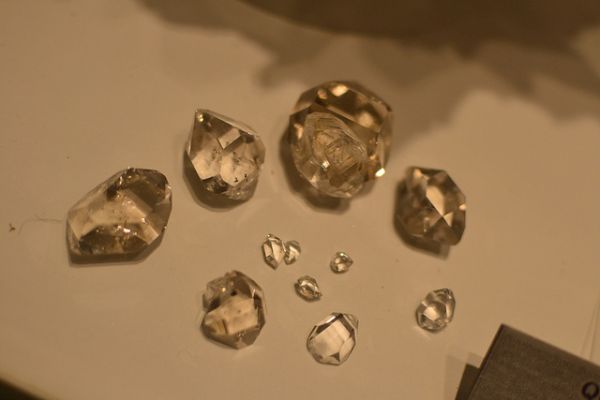
The story sounded too good to be true, but when Arnold dumped the contents of the bag onto Robert’s desk, out spilled dozens of uncut diamonds and other gems.
PAY DIRT
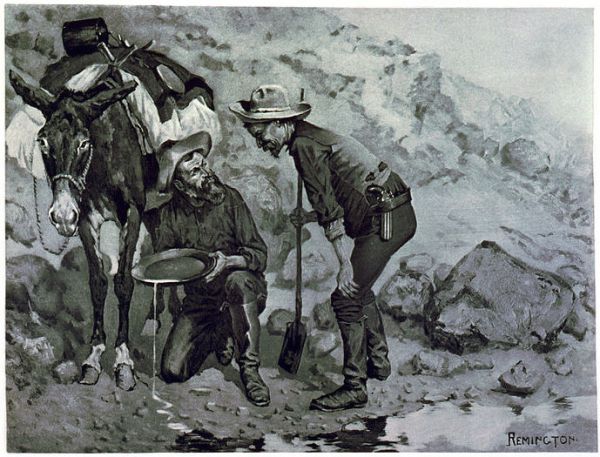
If someone were to make such a claim today, they’d probably get laughed out of the room. But things were different in 1871. Only 20 years had passed since the discovery of gold at Sutter’s Mill in California spiked the greatest gold rush in American history. Since then other huge gold deposits had been discovered in Colorado, as well as in Australia and New Zealand. A giant vein of silver had been found in the famous Comstock Lode in Nevada in 1859, and diamonds had been discovered in South Africa in 1867- just four years earlier. Gems and precious metals might be anywhere, lying just below the earth’s surface, waiting to be discovered. People who’d missed out on the earlier bonanzas were hungry for word of new discoveries, and the completion of the transcontinental railroad in 1869 opened up the West and create the expectation that more valuable strikes were just around the corner. When Arnold and Slack rolled into town with their tale of gems on a mesa and a bag of precious stones to back it up, people were ready to believe them.
OPEN SECRET
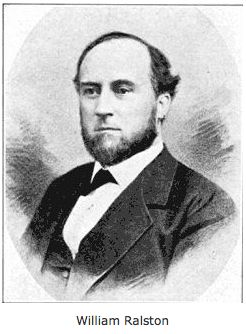
The next morning the two men went to the Bank of California and deposited their bag in the bank’s vault. They made another big show of not wanting anyone to know what was in the bag, and again they let some of the bank employees have a peek. Soon everyone in the bank knew what was in it, including the president and founder, William Ralston. He had made a fortune off the Comstock Lode, and had his eye out for the next big find. Ralston didn’t keep the men’s secret, and neither did George Roberts: Soon all of San Francisco, the city built by the Gold Rush of 1849, was buzzing with the tale of the two miners and their discovery.
Arnold and Slack left town for a few weeks, and when they returned, they claimed they’d made another trip to their diamond field. And they had another big bag of gems to prove it. Ralston knew a good thing when he saw it and immediately began lining up the cream of San Francisco’s investment community to buy the mining claim outright. While Arnold played hard to get, Slack agreed to sell his share of the diamond field for $100,000, the equivalent of several million dollars today. Slack received $50,000 up front and was promised another $50,000 when he brought more gems from the field.
Arnold and Slack left town again, and several weeks later returned with yet another bulging sack of precious stones. Ralston immediately paid Slack the remaining $50,000.
BIG TIME
Ralston didn’t know it, but he was being had. The uncut gems were real enough, but the story of the diamond field was a lie. Arnold and Slack had created a fake mining claim in Colorado by sprinkling, or “salting” it with diamonds and other gems where miners would be able to find them. It was a common trick designed to make otherwise worthless land appear valuable. What made this deception different was its scale and the caliber of people who were taken in by it. Ralston was a prominent and successful banker; he and his associates were supposed to be shrewd investors.
DUE DILIGENCE
To the investor’s credit, they did take some precautions that they thought would protect them from fraud: Before any more money changed hands, they insisted on having a sample of the stones appraised by the most respected jeweler in the United States— none other than New York City’s Charles Tiffany. If the appraisal went well, they planned to send a mining engineer out to the diamond field to verify first, that it existed, and second, that it was as rich as Arnold and Slack claimed. These precautions should have been enough, but through a combination of poor judgment and bad luck, they both failed miserably.
MAKE NO MISTAKE

In October 1871, Ralston brought a sample of the gems to New York so Tiffany could look them over. Ralston was already hard at work drumming up potential investors on the East Coast, and present at the appraisal were one U.S. Congressman and two former Civil War generals, including George McClellan, who’d run for president against Abraham Lincoln in 1864. Horace Greeley, editor of the New York Times, was also there.
Tiffany’s expertise was actually in cut and polished diamonds— he knew almost nothing about uncut stones, and neither did his assistant. But he didn’t let anyone else in the room know that. Instead, he made a solemn show of studying the gems carefully through an eyepiece, and then announced to the assembled dignitaries, “Gentlemen, these are beyond question precious stones of enormous value.”
The investors accepted the claim at face value -the appraiser, after all was Charles Tiffany. Two days later, Tiffany's assistant pegged the value of the sample at $150,000, which, if true (it wasn’t), meant the total value of all the stones found so far was $1.5 million (in today’s money, $21 million) …or more.
IN THE FIELD
Now that the gems had been verified as authentic, it was time to send an independent expert out to the diamond field to confirm that it was everything Arnold and Slack said it was. As he’d done when he brought the stones to Tiffany, Ralston went with the most qualified expert he could find. He hired a respected mining engineer named Henry Janin to do the job. Janin had inspected more than 600 mines and had never made a mistake. His first goof would prove to be a doozy.
Janin, Arnold, Slack, and three of the investors traveled by train to Wyoming, just over the border from Colorado. Then they made a four-day trek by horseback into the wilderness, crossing back into Colorado. At Arnold and Slack’s insistence, Janin and the investors rode blindfolded to keep them from learning the location of the diamond field.
The men arrived at the mesa on June 4, 1872, and began looking in a location suggested by Arnold. A few minutes was all it took: One of the investors screamed out loud and held up a raw diamond that he’d discovered digging in some loose dirt. “For more than an hour, diamonds were found in profusion,” one of the investors later wrote, “together with occasional rubies, emeralds, and sapphires. Why a few pearls weren’t thrown in for good luck I have never yet been able to tell. Probably it was an oversight.”
SEEING IS BELIEVING
Janin was completely taken in by what he saw. In his report to Ralston, he estimated that a work crew of 20 men could mine $1 million worth of gems a month. He collected a $2,500 fee for his efforts, plus an option to buy 1,000 shares in the planned mining company for $10 a share. He used the $2,500 and somehow came up with another $7,500 to buy all 1,000 shares; then he staked a mining claim on 3,000 acres of surrounding land, just in case it had precious stones, too.
One of the secrets of pulling off a scam is knowing when to get out. It was at this point that Arnold and Slack decided to make their exit. Slack had already cashed out for $100,000; Arnold now sold his stake for a reported $550,000, and both men skipped town.
EMPIRE BUILDER
As Arnold and Slack made their getaway, William Ralston was hard at work putting together a $10 million corporation called the San Francisco and New York Mining and Commercial Company. He’d already lined up 25 initial investors who contributed $80,000 apiece, and now he was preparing to raise another $8 million. New York newspaper publisher Horace Greeley had already bought into the company; so had British financier Baron Ferdinand Rothschild.
A Rothschild investing in a diamond field? The house of Rothschild was a world-renowned banking firm and experienced at spotting good investments. With Tiffany and Rothschild involved, the excitement surrounding the diamond field grew to a fever pitch. No one but Arnold and Slack knew where the mine was, but so what? When rumors began spreading that it was somewhere in Arizona Territory, fortune seekers by the hundreds began making their way there in hopes of finding strikes of their own.
LOCATION, LOCATION, LOCATION
The stage was now set for the swindle to grow much bigger, which meant that a lot more people would have lost a lot more money. That it didn’t happen was due purely to chance: when Arnold and Slack picked the location of the “diamond field,” they unknowing chose an area where a team of government geologists had been conducting surveys for five years.
The leader of the geological team was a man named Clarence King. When he learned of the diamond strike, he couldn’t believe what he was hearing. He’d been all over the territory and had already filed a report stating that there were no deposits of precious gems of any kind anywhere in the area. If the story were true, he and his team of experts had missed a significant diamond field that two untrained miners had been able to find on their own. His professional reputation was on the line: If there really was a diamond field and word of it got back to Washington, D.C. he would be exposed as incompetent and funds for the survey would be cut off.
TOO GOOD TO BE TRUE?
King arranged to meet the engineer Henry Janin over dinner to get a firsthand account of the diamond field story. As he listened to Janin describe his trip to the site, he started to smell a rat. Janin reported finding diamonds, rubies, and sapphires next to each other, and as a geologist, King knew that was impossible. The natural process by which diamonds are created are so different from those that create rubies and sapphires that they are never founding the same deposits.
Because Janin had been blindfolded on the trip to the site, he couldn’t tell King where it was. But King was so familiar with the area that after quizzing Janin, he was able to figure out which mesa he was talking about. The next day he and some members of his team set out to visit the site themselves.
ON THE SPOT
They arrived at the site a few days later. It was fairly late in the day, so they set up camp and then started exploring the area. As had been Janin’s experience, it didn’t take long for them to find raw diamonds, rubies, and other gems. By the time King was ready to turn in for the night, he’d found so many precious stones that even he had a touch of diamond fever. He went to bed wondering if the field was really genuine, and maybe even hoping a little that it was. That hope vanished early the next morning.
* Shortly after sunrise, another member of the party found a diamond that was partially cut and polished. Nature is capable of many things, but it takes a jeweler to cut and polish a diamond- the stone had been planted there by human hands.
* King noticed that wherever he found diamonds, he found other precious stones in the same place, and always in roughly the same quantities, something that does not happen in nature.
* Upon close examination, the team also noticed that the crevices in which the gems were found had fresh scratch marks, as if the gems had been shoved into place with tools.
* When precious stones were found in the earth, it was always in places that had been disturbed by foot traffic. When they went to areas that were undisturbed, they never found anything.
DIGGING DEEP
King knew that if the field was real, diamonds would also be found in the ground as well as on the surface. As a final test, he and his men went to an undisturbed area where they thought diamonds might occur naturally and dug a trench ten feet deep. Then they carefully sifted through all of the dirt that had been removed from the trench, and found not a single precious stone in any of it. There was no question about it: the find was a hoax. Arnold and Slack had planted the gems.
As soon as King got to a telegraph station, he sent word to Ralston in San Francisco that he’ been conned. Ralston was shocked and angry. He closed the company and returned the unspent capital to the original 25 investors. Then, because his reputation was on the line, he refunded the rest of their investment out of his own pocket, which cost him about $250,000. It turns out that Ralston’s bad judgment wasn’t limited to diamonds: He poured millions into the building of San Francisco’s Palace Hotel and other money-losing schemes, which contributed to the Bank of California’s collapse in 1875. His body was found floating in the San Francisco Bay the following day, though the cause of death remains a mystery.
THE HOAX EXPOSED
The Great Diamond Hoax of 1872, as it came to be known, received widespread newspaper coverage not just in America but also in Europe. As reporters in the United States and abroad researched the story, details of how the hoax had been perpetrated began to emerge.
* Arnold had once been a bookkeeper for the Diamond Drill Company of San Francisco, which used industrial-grade diamonds in the manufacture of drill bits. He apparently stole his first batch of not-so-precious gems from work, then bought cheap, uncut rubies and sapphires from other sources and added them to the mix. None of the people he duped had been able to tell industrial-grade diamonds and second-rate gems from the real thing.
* When Ralston and the other early investors paid Slack the first installment of $50,000 for his share of the mine, he and Arnold made the first of two trips to London, where they bought $28,000 worth of additional uncut stones from diamond dealers there. Most of the gems were used to salt the claim in Colorado; the few that were left over were the ones Tiffany and his assistant had foolishly valued at $150,000.
AFTERMATH
Philip Arnold and John Slack made off with $650,000, which in 1872 should have set them up for life. Neither of them fared very well, though. Arnold moved to Kentucky and bought a 500-acre farm. When the law eventually tracked him down, he paid a reported $150,000 to settle the claims against him, then used the remaining money to start his own bank. Six years after the diamond hoax, he was injured in a shootout with another banker; he died from pneumonia six months later at the age of 49.
Less is known about Slack. He apparently blew through his share of the loot and had to go back to work, first as a coffin maker in Missouri and then as a funeral director in New Mexico. When he died there in 1896 at the age of 76, he left an estate valued at only $1,600.
Uncovering and exposing the fraud gave Clarence King’s career a huge boost; in 1879 he became the first director of the U.S. Geological Survey. But he was a better geologist than he was a businessman, as he learned to his dismay in 1881 when he quit working for the government and took up ranching. He failed at that, then went on to fail at mining and banking. He died penniless in 1901 at the age of 59.
FOOL’S GOLD
So did anyone come out ahead from the experience? Apparently only Henry Janin, the mining engineer who’d vouched for the authenticity of the diamond field. He suffered a blow to his reputation when the hoax was exposed, but by then he’d already sold his $10,000 worth of shares to another investor for $40,000. Janin was never implicated in the scam; as far as anyone knows, his good fortune was just a case of dumb luck.  

Ancient petroglyph of human found on rock by Curiosity rover

Mars is one of our closest neighbors in the solar system, yet it remains a mystery. Watch this video to feed your curiosity about the red planet!
And still the strange and intriguing sightings in photos taken by the Mars Curiosity rover keep coming: This time with the image of what looks like a humanoid figure bracketed by three bold, indented parallel lines. UFO Sightings Hotspot reported Oct. 17 that the NASA's Curiosity rover had inadvertently spied a petroglyph -- or rock engraving -- among the rust-colored stones on the Red Planet.
The website noted that what looks like an etching in stone, little more than a stylized stick figure, is nearly identical to hundreds of petroglyphs engraved in columns, slabs, and rocks all over planet Earth. And of the Mars photo: "The petroglyphs engraved in the rock on Mars looks like [a] human figure and it is interesting that the same symbols are found in different parts of the planet Earth created in timelines where the people could not have possibly interacted with each other."
A video posted to YouTube (as seen above) by UFOvni2012 shows the petroglyph and compares it to several of the Earth engravings and paintings, noting its stunning similarity to terrestrial carvings from ancient Egypt and other millennia-old civilizations. Highlighting the humanoid image and its bracketing lines (one below the stick-man, two above, and all parallel), the video suggests that the petroglyph may well be part of a stone column of some sort.
So what is to be made of this latest strange Mars image? Did NASA's Mars Curiosity rover photograph a depiction of some ancient artifact, one that offers evidence that there just might be -- or might have been, since Mars seems to be rather bereft of life at present -- other beings that have -- or once had -- a bipedal, human-like form? Or is this simply just one more example of pareidolia, where time and the elements of Mars have scoured the stone to give it its current configuration -- one that looks very much like an archetypal human stick figure caught between three parallel lines. (Even the most skeptical must admit that the parallel striations on the rock are intriguing, lending a puzzling aspect to the Curiosity photo in that nature rarely exhibits parallel lines.)
The Mars petroglyph is just the latest photo image found in the Martian rock fields and mounds by Curiosity's cameras. Among others, UFO enthusiasts and keen-eyed observers have found what appears to be an ancient statue carved into the Martian hillside and a rock formation shaped like a cannon or piece of heavy artillery.
But Curiosity isn't alone in producing photos that capture remarkable images. Last week, NASA's Opportunity rover, an exploratory vehicle that has been on Mars now for a decade, photographed an image that looked every bit like an encircled Celtic or Irish cross.

The Real Face Of King Tut

With strong features cast in burnished gold, pharaoh Tutankhamun's burial mask projects an image of majestic beauty and royal power. But in the flesh, King Tut had buck teeth, a club foot and girlish hips, according to the most detailed examination ever of the ancient Egyptian pharaoh's remains.
And rather than being a boy king with a love of chariot racing, Tutankhamun relied on walking sticks to get around during his rule in the 14th century BC. A 'virtual autopsy', composed of more than 2,000 computer scans, was carried out in tandem with a genetic analysis of Tutankhamun's family.

The real Tut - Gaped buck toothed, Female hips, Club foot - in all his glory

14th century birch bark scrolls preserved in mud tell Novgorod’s story

Painting of Novgorod by Appolinary Vasnetsov. Image: Public DomainA note, from father to son in 14th century Russia was etched into the bark of a birch tree and curled into a scroll. The scroll and a dozen others like it were among the finds from this year’s digging season. These scrolls will be added to a collection of more than 1,000 birch-bark documents uncovered in the Russian city of Novgorod, after being preserved for hundreds of years in the mud.
“Send me a shirt, towel, trousers, reins, and, for my sister, send fabric,” the father, whose name was Onus, wrote to his son, Danilo, the block letters of Old Novgorod language, a precursor to Russian, neatly carved into the wood with a stylus. Onus ended with a bit of humor. “If I am alive,” he wrote, “I will pay for it.”

Longest poem of classical-era unearthed in western Turkey

The stela is an extraordinary finding that offers a treasure trove of data to historians and philologists.The stela is an extraordinary finding that offers a treasure trove of data to historians and philologists.
Excavations around the Hecatomnus Mausoleum in the western province of Muğla’s Milas district have unearthed a written stela that dates back over two millennia.
The stela is an extraordinary finding that offers very important data to historians and philologists, according to academics.
The stela, which is estimated to have been written for the ruler of its era, is in the poetry format and the longest among other similar classical-era findings.
According to information provided by the Milas Uzunyuva Project Epigraph Professor Christian Marek, the writing on the stela has a poetical language in a style called “catalectic trochaic tetrameter.”
There are 121 lines in the stela, although its upper surface has been eroded. It is estimated that the stela was erected at the end of fourth century B.C. or at the beginning of the third century B.C.

7 Prehistoric Creatures (That Are Still Around)

by David Dietle
The history of our planet is like a carnival of screams. Looking back through the fossil record, we've had everything from carnivorous swimming tanks to giant flesh eating goats. Fortunately, nature has seen fit to kill most of history's monsters with evolution and extinction events. So we're in the clear, right?
Sure, as long as you stay on land. It turns out that the "kill all monsters" message didn't travel so well underwater, and many of these prehistoric horrors are still waiting down there to eat your head and snack on your soul.
#7. Goblin Shark
Look, sharks are terrifying enough already, but at least mankind was lucky enough not to have suffered through dog's Cubist period, during which He designed, among other things, a shark with a circular saw for a face.
Goblin sharks are hideous, pink, 11-foot long servants of evil, which Wikipedia describes as having an electrosensitive, trowel-shaped, beak-like rostrum and protrusible jaws. That is science-talk for: "Oh gawd, gawd no."
They've been around since the Middle Eocene, which means they survived alongside Megalodons. For context, the Megalodon was a great white shark the size of a bus, one of the largest and most terrifying marine predators ever to exist. It did not survive. The goblin shark did.
Where Do They Live?!
The bad (worse?) news is that they have been found in most of the world's oceans, so it's possible that you're never far from one, though it can be argued that there is no such thing as being far enough away from goblin sharks. Perhaps unsurprisingly, they were originally discovered off the coast of Japan.
Since then, they've been cropping up all over the place, so it is possible that in the depths of the ocean, there has been a population explosion of monstrous terror-sharks from the past. It may be time to start investing in real-estate around Denver.
#6. Giant River stingray
Stingrays have already solidified their place in the annals of terror by doing what so many bigger and more venomous animals had failed to do in the past: kill Steve Irwin. But there is one out there that probably would have kept the Crocodile Hunter out of the water altogether.
We're sorry to inform you that that is in no way Photoshopped or modified, and is, in fact, a 16-foot long stingray. It seems Mother Nature was both lazy and malicious when she sculpted what is basically a king-sized bedsheet, and and then put a 15-inch serrated poison spike on its ass. That barb, by the way, has been known to impale body parts, sometimes skewering them completely and even penetrating bone.
The giant river stingray is an abomination faxed directly to us from the Jurassic era, 100 million years ago. See? We don't need a team of God-playing scientists to bring horrors back from the Jurassic, they are already here.
Where Do They Live?!
Thailand, New Guinea, Borneo and, surprise surprise, Australia. They live exclusively in rivers in a part of the world where rivers are uniformly murky, making these giant poisonous fish invisible as well. As if you really needed another reason to avoid the Southern Hemisphere.
#5. Frilled Shark
It's official: We as a species have no business in the ocean. You win, we're done. The frilled shark has been terrorizing the oceans for at least 95 million years, looking something like a dragon that was bitten by an eel that was also a zombie for some reason.
They usually live in the deep sea, but apparently they occasionally rise to the surface purely to remind human beings that only terror awaits us in the briny depths.
They have upwards of 300 three-pronged teeth, which one unnecessarily foreboding scientist described as "providing almost a thousand sharp hooks on which to trap struggling prey." They can also open their mouths extremely wide and can swallow something up to one and a half times their length. In case you're wondering, that means they could have swallowed Andre the Giant and the midget he was, for whatever reason, giving an ocean-bottom piggy back ride to in one horrifying gulp. Basically, they're just giant floating stomachs with a chainsaw at one end.
Where Do They Live?!
Everywhere, deep under the waves. We don't know much about them because their natural habitat is so far below the ocean and, frankly, there are enough horrors in the known world that we don't need to go out of our way in search of more.
#4. Alligator Gar
Disney's The Princess and the Frog would have us believe that bayous and swamps are home to adorable amphibians and cowardly reptiles with a love of jazz. Oh, how cute of you to believe that. Let's bring you back to reality for a moment:
As ancient as they are ugly, alligator gars have been around for 100 million years, and strike fear in the heart of anything that is afraid of large animals with hundreds of sharp teeth. Double-rows of sharp teeth, because back in ancient times you needed all the teeth you could get in order to combat all the tyrannofrogs and velociturtles that shared the swamp with you.
They also have pointed scales that are big enough to be used as arrowheads, and hard enough that they cause sparks when struck with an axe. They also have primitive lungs, so they can live for hours out of the water, which is exactly what you do not want in your oversized armored toothy demon fish.
Where Do They Live?!
All over the Southern U.S., in rivers along the Gulf Coast. Their tendency to feed on valuable game fish and your children means that fishermen kind of hate them. So much, in fact, that in the 30s in Texas, a man named Colonel J.G. Burr rigged up an "Electric Gar Destroyer" to electrocute the shit out of the swamps in order to kill them off, which just goes to show you that what nature has failed to kill off for millions of years can still be beaten by a dipshit with a ridiculous weapon.
#3. Giant Chinese Salamander
Coming in at a tie with the panda bear in the list of real animals most resembling Pokemon, giant salamanders have been plodding around for about 30 million years, which means they survived giant bears and hyenas as big as cows.
Fortunately for us, they are the one creature on this list least likely to devour you and everyone you care about, being nearly blind and feeding mainly on smaller salamanders, worms and crayfish. Although they do get aggressive around mating season, when the males fight over the holes they have dug in the mud, often killing each other in the process. We're scratching our heads over how something this stupid could survive long enough to be a living fossil.
Where Do They Live?!
China, the the land that eats monsters. We're still a little nervous about this, because on the one hand, we think they're kind of cute. On the other hand, that's probably just how they sucker you in. After all, something killed all those dinosaurs.
#2. Triops
Quick, is that the name of a prehistoric, three-eyed, hell-shrimp, or a He-Man villain? If you guessed hell-shrimp, you were correct.
Incidentally, every time we watch a horror movie about genetically engineered parasites that escape the lab, there is at least one scene where a human body bursts like a pinata and releases three hundred of these into the world:
Triops have been haunting our waterways and nightmares since the Triassic period, about 200 million years ago, meaning they sent some of the first dinosaurs screaming out of the ponds. Their eggs are damn near indestructible, and if the conditions aren't right, they can just go into suspended animation, lying dormant and unhatched for decades like the alien conspiracy from The X-Files.
Where Do They Live?!
Basically everywhere, including your living room, because you can order them online. For those of you whose idea of the perfect pet is "like sea monkeys, but evil."
#1. Lamprey
There's really no way to ease you slowly into the following analogy, so we're just going to go ahead and say it: condoms full of teeth.
If you're thinking those are tiny little worms you might find sucking on the side of your aquarium, think again. These bastards grow to about three and a half feet long, and feed by literally eating their way into the sides of fish until their guts come out the hole.
Lampreys are so old, evolutionarily speaking, that they are barely considered vertebrates, and hardly even fish. The closest thing we have to genuine Lovecraftian elder gods, Lampreys are upwards of 360-million-years old, and are basically the missing link between fish and whatever came before fish. We're guessing devils.
Where Do They Live?!
Coasts and freshwater around the world. In the great lakes, they have become a disgusting plague feeding off of other fish, mostly the delicious ones like trout. On the other hand, countries like Finland, South Korea and Sweden consider the blood-sucking spineless worm-fish a delicacy.

The Death of a Rhino

Only six of the creatures left, having been hunted by poachers in central and east Africa for their horns

Smugglers stuffed 25 cows into oil tanker

In a bid to outsmart policemen, cattle smugglers in India have been devising newer ways of transport. Police last week seized an oil tanker into which 25 cows had been stuffed.
Policemen at the Katra police station in Shahjahanpur, Uttar Pradesh, received a message on Monday that an oil tanker had jumped a road barrier and struck a jeep. The police team immediately cordoned off the area and signaled to the driver to stop. Officers said the driver and cleaner of the tanker fled on seeing them.
On inspecting the vehicle, policemen found an opening in the rear. Usually, such vehicles only have a cap on the upper portion. When policemen opened the lid on the rear of the vehicle, they found 25 cows packed inside. The cows were taken to the local veterinary hospital.
Superintendent of Police Rakesh Chandra Sahu of Shahjahanpur said: "The cattle smugglers had created an opening in the rear of the tanker through which they stuffed the cows in after injecting them with sedatives. We have lodged a report under the Prevention of Cow Slaughter Act against unidentified people. We are trying to trace the owner of the tanker."

Animal News

Tuesday, October 21, 2014

The Daily Drift

It's a generational thing ...!
 
Carolina Naturally is read in 200 countries around the world daily.   

 Don't worry wingnuts since you don't have one you don't have to celebrate ... !
Today is  - Celebration Of The Mind Day 
 
Don't forget to visit our sister blog: It Is What It Is

Some of our readers today have been in:
The Americas
Essex, Hoboken, Tukwila, Auburn, Sunrise, Vallejo, Akron, Holt, Denver, Cheltenham, Milwaukee, Portland, Newark, Hana, Baltimore and Miami, United States
Toronto, Montreal, Quebec, Saint John's, Ottawa, Oakridge and Niagara Falls, Canada
Luquillo, Puerto Rico
Boaco, Nicaragua
Lima, Peru
Rio De Janeiro, Londrina and Sao Paulo, Brazil
Buenos Aires, Argentina
Europe
Widden, Siegen, Ingolstadt and Rothe Erde, Germany
Karlin, Czech Republic
Naples, Milan, Rome,Alessandria, Treviso and Ivrea, Italy
Kongens Lyngby, Denmark
Laval and Lyon, France
Kista, Eskilstuna, Stockholm and Malmo, Sweden
Cacem, Portugal
Moscow, Ryazan, Saint Petersburg and Novgorod, Russia
Madrid and Alicante, Spain
Arendal, Norway
London, England
Belgrade, Serbia
Sarajevo and Mostar, Bosnia-Herzegovina
Sofia, Bulgaria
Dublin, Ireland
Riga, Latvia
Asia
Tehran, Ilam and Tabriz, Iran
Lakhipur, Kolkata, Delhi, Jodhpur, New Delhi, Bikaner, Saharsa, Chamba and Pune, India
Bangkok, Thailand
Colombo, Sri Lanka
Singapore, Singapore
Kuala Lumpur, Malaysia
Hanoi, Vietnam
Dhaka, Bangladesh
Lahore, Pakistan
Africa
Maseru, Lesotho
Johannesburg, South Africa
The Pacific
Homebush, Australia
Auckland, New Zealand
Dagupan, Philippines

Today in History

1096 Seljuk Turks at Chivitot slaughter thousands of German crusaders.
1529 The Pope names Henry VIII of England Defender of the Faith after defending the seven sacraments against Luther.
1600 Tokugawa Ieyasu defeats his enemies in battle and affirms his position as Japan's most powerful warlord.
1790 The Tricolor is chosen as the official flag of France.
1805 Vice Admiral and Viscount Horatio Nelson wins his greatest victory over a Franco-Spanish fleet in the Battle of Trafalgar, fought off Cape Trafalgar, Spain. Nelson is fatally wounded in the battle, but lives long enough to see victory.
1837 Under a flag of truce during peace talks, U.S. troops siege the Indian Seminole Chief Osceola in Florida.
1861 The Battle of Ball's Bluff, Va. begins, a disastrous Union defeat which sparks Congressional investigations.
1867 Many leaders of the Kiowa, Comanche and Kiowa-Apache sign a peace treaty at Medicine Lodge, Kan. Comanche Chief Quanah Parker refused to accept the treaty terms.
1872 The U.S. Naval Academy admits John H. Conyers, the first African American to be accepted.
1879 After 14 months of testing, Thomas Edison first demonstrates his electric lamp, hoping to one day compete with gaslight.
1904 Panamanians clash with U.S. Marines in Panama in a brief uprising.
1917 The first U.S. troops enter the front lines at Sommerviller under French command.
1939 As war heats up with Germany, the British war cabinet holds its first meeting in the underground war room in London.
1940 Ernest Hemingway's novel For Whom the Bell Tolls is published.
1942 Eight American and British officers land from a submarine on an Algerian beach to take measure of Vichy French to the Operation Torch landings.
1950 North Korean Premier Kim Il-Sung establishes a new capital at Sinuiju on the Yalu River opposite the Chinese City of Antung.
1959 The Guggenheim Museum, designed by Frank Lloyd Wright, opens in Manhattan.
1961 Bob Dylan records his first album in a single day at a cost of $400.
1967 The "March on the Pentagon," protesting American involvement in Vietnam , draws 50,000 protesters.
1969 Israel's Foreign Minister Moshe Dayan resigns over disagreements with Prime Minister Menachem Begin over policies related to the Palestinians.
1983 The United States sends a ten-ship task force to Grenada.
1994 North Korea and the US sign an agreement requiring North Korea to halts its nuclear weapons program and agree to international inspections.

About the Human Heart ...

Why Each Year Seems to Disappear More Quickly Than the Last

http://themindunleashed.org/wp-content/uploads/2014/10/why-eachhh.jpg
For most people, each passing month of their lives seems to feel shorter than the previous. Many of us can’t believe that stores are already starting to display Christmas products, and if you’re writing a check, you might still catch yourself writing 2013 when 2014 is nearly over.
All clocks follow the same 12 hour / 60 minute symmetry, yet studies suggest that as we get older, we don’t experience time the same way. And there are many theories that explain why it feels like time speeds up as we grow older.
Many psychologists believe that as we age, our perception of time begins to accelerate versus time actually speeding up. Studies indicate that biological changes in the human body that happen as it ages, such as reduced dopamine production in the brain, impact our internal clock. Furthermore, some believe that as we grow up, we have fewer emotional and arousing experiences – the first kiss, the first trip away from home, the first heartbreak. Such experiences are easier to remember and lead to higher time estimations.
The emotional intensity of our daily life is affected by the fact that many of us experience “Habituation Hypothesis”. Consider how often you find yourself on autopilot, moving through your daily tasks such as getting dressed or cooking dinner, or sitting in your daily commute while your mind is elsewhere. If you’ve lived in one place for a long time, or held the same job for many years, less and less feels truly new.
Our instinct is to conserve energy when we can, so when life is predictable, our minds turn to autopilot and we tune out. Our minds become efficient at carrying out tasks that have become habitual, so they are freed up to address more pressing issues. Unfortunately, many of us spend this mental energy on worrying, self-analyzing, weighing decisions, etc., which can become quite stressful. Yet, regardless where our mental focus goes, by exhibiting this type of behavior, we have a tendency to compress time, and as a result our lives seem to speed up.
There’s also what psychologists call “Forward Telescoping”, which considers how we perceive past events that have made a significant impact in our lives. We are inclined to stay connected to important past events – a birth of a child, a friend dying – to where they seem quite recent, even when many years have passed. The realization that ten years have gone by since you got married, when you feel like it’s only been five, can be quite shocking.
The quickening of our perception of time was also explained by Paul Janet’s “Proportional Theory”. It suggests that as we get older, each period of time is a smaller fraction of the whole lifetime, and this affects how we perceive each moment.
“The apparent length of an interval at a given epoch of a man’s life is proportional to the total length of the life itself. A child of 10 feels a year as 1/10 of his whole life – a man of 50 as 1/50, the whole life meanwhile apparently preserving a constant length.” ~ William James
How can we slow down time?
Look for the beauty in things. Feelings that we experience when we come across something that inspires or transforms us will expand the perception of time, because these moments are more awe-inspiring.
Enjoy the present moment. Instead of always contemplating, analyzing, making decisions, etc., make an effort to free up some of your thoughts while you’re going about you day to appreciate the minute details of each moment and your surroundings.
Limit multitasking. Many of us have busy lives and feel that multitasking is necessary. Yet consider that multitasking will occupy more of your mental resources as you keep pace with switching between tasks. You end up with have less energy to put towards the creation of new memories. In the long run, you’re likely to be less productive while you feel like there are never enough hours in a day.
Seek out new experiences. This one goes back to the impact that emotional experiences have on our perception of time. New experiences are more challenging on the mind, often engage us emotionally, and require us to focus on the present moment. Consider that it’s ok to switch up your daily routine and stop something you’re good at to begin a new chapter in life.
“Studies show that people who feel “time-rich” tend to be happier and more fulfilled than those of us who constantly feel rushed. They experience fewer headaches and upset stomachs, and regularly get better quality sleep.” ~ Ron Friedman, Ph.D. (Source)

America’s Favorite Sandwich Fillings

According to a study by the Centers for Disease Control, 49% of American will eat at least one sandwich on any given day. That’s really not so shocking; I eat one most days, if not two. And why not? A sandwich is easy to eat while working, requires no dish or utensil, and you can put just about anything in it. Most can be eaten with one hand. That’s why the sandwich was invented in the first place! What is a little surprising is the findings about what Americans put in their sandwiches.
As you can tell from the graph, lettuce is on more sandwiches than any other ingredient. That’s because it automatically goes on so many store-bought sandwiches of all kinds, and there are no other vegetables that produce as much crunch. However, if you look closer, you can see that “Cheddar or American cheese” shows up three times in the graph, depending on how it was described. If those were combined, they would be at the top. Personally, I’m surprised that peanut butter isn’t much higher on the list. You can read more about the study, and see what kind of breads we’re using on sandwiches, at FiveThirtyEight.