Welcome to ...

The place where the world comes together in honesty and mirth.
Windmills Tilted, Scared Cows Butchered, Lies Skewered on the Lance of Reality ... or something to that effect.


Wednesday, April 29, 2015

Couple unhappy about letter from HMRC saying husband was dead and may owe tax

Debbie Moore was surprised when she received a letter from the Government chasing up tax from her 'dead' husband, despite him still being alive. Now the couple are demanding an apology from HM Revenue & Customs, the department behind the correspondence. Officials had written to "the representative" of Peter Moore, sympathizing during "this difficult time". The letter then stated officials needed to ensure the 47-year-old had paid the correct amount of tax before he passed away. However Peter, of Fenton in Stoke-on-Trent, returned home while his wife was reading about his recent demise.
Debbie said: "It's really not nice getting a letter from HMRC, especially when what they're saying hasn't really happened. I was gobsmacked." Peter added: "I don't know how that kind of mistake could have been made." Mr Moore immediately phoned HMRC demanding an explanation only to be told it was 'a mistake.' He said: "I used to work away in the week so if that would have happened my wife could have really started to worry. It was addressed to the representative of Peter Wiliam John Moore, which is my full name, and it included my national insurance number so I knew it referred to me. It apologized for a recent bereavement and went on about some tax I paid before my death.
"My dad's name was Peter Moore but he died 32 years ago so I didn't think it would be anything to do with him. My wife opened the letter when I was out of the house, fortunately I came back home about five minutes after she read it so she knew it was a mistake but that might not have always been the case. I rang the tax people and the lady on the other end said she couldn't believe it." The letter states: "I am sorry to hear about your recent bereavement and recognize that this is a difficult time for you. When someone dies, I need to work out if they paid the right amount of tax before their death. In many cases, HMRC repays tax to the estate. I need to know details of the person responsible for finalizing their affairs."
Mr Moore added: "I was just really shocked, it's just all a bit strange." Mr Moore is concerned how some may respond to the letter. He added: "If a letter like this was sent to an older person or the relative of someone who was really ill it could have caused them some distress. It never should have happened." His wife Debbie had opened the letter after returning home from work. She said: "I just did what I usually did, I picked up the letters and sat down to open them. When I read it I thought it was a scam or some sort of joke. I showed it to Pete when he came in and he got straight on the phone to the tax office." A spokesman for HMRC said: "We don't talk about individual cases but when we make mistakes we aim to put them right fast and apologize."

Search for woman who stole at least seven boxes of computer components in floral dress

A woman in a floral dress walked into a Radio Shack in Weston, Florida, slipped several computer parts under her dress and walked out. The Feb. 26 theft was caught on surveillance video. It took a store employee several hours to notice that a large section of shelving was empty.
Broward Sheriff's Office spokeswoman Dani Moschella said a man acted as a lookout while the woman placed at least seven computer components under her dress. It appeared that there was a bag hidden under the fabric of her dress. "Clearly she's done this before," added Moschella. "She puts them in there quickly and she's gone."
According to Radio Shack employees the female suspect was wondering around the store until she reached one particular aisle and found the more valuable items on the shelf. "The man hands the woman a pretty sizable box containing a computer component," Moschella said. On the surveillance video, the woman is seen placing at least seven boxes inside her dress, with her male accomplice by her side.

"Detectives believe she must of had a bag or something set up," Moschella said. At one moment in the video, the woman is seen adjusting her dress to make room for the loot. Authorities say they were in and out in minutes. "The images are super clear. Anyone who knows this couple can see this video and you're gonna know who they are," Moschella said. The thieves got away with $1,140 worth of merchandise.

Four-year-old boy's Nerf gun confiscated by airport security staff

Four-year-old James Hayward had his orange and yellow toy Nerf gun confiscated by "over-zealous" security staff at East Midlands Airport. His dad Phil Hayward said the following body search was "ludicrous" and that security staff should loosen up. The £6 plastic "weapon", described as a "semi-automatic soft dart gun" by its manufacturers, was taken while the family, of Doncaster, were en route to Lanzarote in Spain. The youngster was also patted down by security staff as his toy was taken from him. But East Midlands Airport, which offered to post the "gun" back to the family's home, defended the decision to uphold security.
Mr Hayward, 44, said: "Fair enough they are thorough but it just seemed a bit ludicrous to take a plastic gun away from a four-year-old. I thought it was a bit over-zealous considering how many people were trying to get through security at the time. It came at the end of an hour and a half queuing, so we didn't cause too much fuss because we didn't want to miss our flight."
East Midlands Airport apologized for the inconvenience. A spokeswoman said: "The safety and security of our passengers is our first priority and all regulations on security are set by the government. This regulation states that no items may be permitted through security that resemble a prohibited item."

Russian women jailed for ‘inappropriate’ twerking next to war memorial

Three young women in southern Russia will serve up to 15 days in prison, on charges of hooliganism, after posting a video of themselves twerking with a WWII memorial looming in the background. Two more of the six women in the video had their punishments reduced to a fine, for health reasons.
One of the dancers was under 16, and avoided punishment, which was transferred to her mother, who was reprimanded for failing to “carry out measures to ensure the proper physical, intellectual, psychological, spiritual and moral development of the child," a court in the city of Novorossiysk ruled on Saturday. After the video first surfaced earlier this week, it was brought to the attention of the mayor of Novorossiysk, where the women reside, who was “outraged” and personally charged officials with identifying the names of the performers, who posted the video to bring new recruits to their modern dance school.
“We condemn these women. Every inch of this land is covered in blood. It is inappropriate,” said Viktoriya Dikaya, the press secretary for the city’s education department. Prosecutors in Novorossiysk said they are conducting sweeping checks at the institutions were the twerkers, who were all under 30, are enrolled, to make sure they are in compliance with “programs aimed at ensuring respect for the law among their members.” The Malaya Zemlya memorial, completed in 1982, which is seen behind the twerkers, commemorates a battle to free Novorossiysk from German occupation in 1943.

There appears to be a new-found intolerance for twerking among Russian officials, despite the dance being taught to thousands of youths throughout the country. A suggestive twerking video performed by teenagers in front of their parents in Orenburg earlier this month, led to a federal investigation for “lewdness,” with the Russia’s children’s ombudsman calling the choreographers “swine.” City officials soon officially shut the dance school that put together the routine. In one notable difference with the current case, most of the twerkers in Orenburg were underage. Parallels have been drawn with the Soviet era, when the authorities disapproved of boogie-woogie, the foxtrot and other “ideologically alien” dances.

Hit and run suspect crawled into hole and covered herself in dirt after striking 5-year-old

Police in Washougal, Washington, have arrested a woman they say hit a 5-year-old then tried to flee the scene. Police said they found 36-year-old Marsha Santoro hiding in a shallow hole where she had tried to cover herself with dirt.
At around 6pm on Friday, police said Santoro was driving when a child riding a Big Wheel rolled out of a driveway and Santoro hit the child.
Witnesses told officers Santoro attempted to drive away, but when that didn't work she got out of her Ford F-150 pickup and walked off, according to police. Police said a K-9 unit tracked Santoro to the hole that she was hiding in. When officers gave Santoro a warning, she surrendered, according to police.
Santoro was booked into Clark County Jail and faces charges for felony hit-and-run, third-degree driving with a suspended license and an unrelated misdemeanor warrant. Police said they don't think alcohol or drugs played a part in the hit-and-run. Santoro's arraignment is set for Monday at 9am.

Man crossing road injured after running into car

A middle-aged man is believed to have broken his wrist after running into the side of an almost-stationary car.
The driver of the small silver Daihatsu sedan was slowly moving in traffic along Grey St in Hamilton East, New Zealand, on Friday, when the pedestrian ran straight into the passenger side of his car.
Senior Sergeant Juliet Burgess, of the Waikato District Command Center, said the man was crossing the road through stationary traffic when he bumped into the car at about 4.15pm.
"He bounced off the side of the car, onto the ground. He said that he just didn't see it and the vehicle was traveling very slowly at the time." Other road users stopped to help the man and someone called emergency services. Ambulances treated him on site. "All we know is that he was trying to cross the road to get to the other side." There were no reports of damage to the car.

Naked man arrested for attempting to carjack motorist who offered him clothes

A man was arrested in Florida on Tuesday afternoon after he was accused of trying to steal a car while naked from a man who offered him clothes.
At 3:25pm, 32-year-old Ganzo Keith Haynes was completely naked and ambling along Southwest 40th Avenue in Gainesville when he came upon a man beside a vehicle who offered him a chance to cover up.
The man told police officers he reached into his car for some clothing and Haynes grabbed his neck and began to choke him, according to a jail booking report. Haynes told the man to get on the ground and hand over the keys to the car, according to the report. Haynes’ grip eventually forced the man down, and then he told him he no longer wanted the keys.
Haynes then ran away, and GPD officers eventually caught up with him. He told them he was naked because he had been drinking and that he grabbed the man in an attempt to get away after the man tried to unbuckle his own pants, the report states. Haynes was arrested on a charge of carjacking and booked into the Alachua County jail, where he remains awaiting a bond hearing.

Comedy penis crusader gets potholes filled in

A mystery "road artist" has been drawing pictures of penises around potholes in Bury, Greater Manchester, as a way to get the council to fix them. "They [potholes] don't get filled. They'll be there for months," says the artist who goes by the name of Wanksy. "People will drive over the same pothole and forget about it. Suddenly you draw something amusing around it, everyone sees it and it either gets reported or fixed." He says his drawings have meant the potholes get fixed more quickly, although Bury Council says they already have a plan in place to deal with the issue.
A spokesman for the council has describes Wanksy's artwork as "obscene" and urges him to stop his painting. "The actions of this individual are not only stupid but incredibly insulting to local residents," the Bury Council spokesman says. "Has this person, for just one second, considered how families with young children must feel when they are confronted with these obscene symbols as they walk to school?" But Wanksy says: "It's not an actual photograph of an anatomical part, it's a drawing, it's artwork. The naked body is a thing artists have painted for years. There are sculptures that don't wear clothes. It's artistic expressions.
"To be offended by that, you must be very prudish." The council spokesman says: ""Not only is this vandalism, but it's also counter-productive. Every penny that we have to spend cleaning off this graffiti is a penny less that we have to spend on actually repairing the potholes! People are entitled to express their grievances to the council, but offending the public and wasting their council tax is not the way to resolve the situation. We understand and accept that residents are unhappy with the number of potholes in the borough, and we have a program of scheduled works to fix them.

"We have also invested substantially in new machinery which is enabling us to carry out repairs more rapidly. Painting obscenities around potholes will not get them repaired any quicker, but simply waste valuable time and resources. We urge the perpetrator to stop defacing the roads immediately, and ask anyone who sees this sort of criminal damage being carried out to report it to the police and the council." Wanksy says he has considered the legal implications of his drawings and says he makes them with paint used by professionals when they are temporarily marking the road. "It does eventually wash off. It's not graffiti spray paint. It's gone within a week or two. It's a step up from chalk."

B.C.

http://l1.yimg.com/bt/api/res/1.2/jGP2dXk8UiYnMKAHb4X7Xw--/YXBwaWQ9eW5ld3M7Zmk9ZmlsbDtoPTE4ODtweW9mZj0wO3E9NzU7dz02MDA-/http://media.zenfs.com/en_us/News/ucomics.com/crbc150427.gif

Farmer Finds Prehistoric 'Sea Monster' On His Property

by Jacqueline Howard 
A farmer in Australia recently made a surprising discovery while tending to his land -- the gigantic fossilized jaw of a 100-million-year-old sea creature.
The creature turned out to be an extinct carnivorous marine reptile known as Kronosaurus queenslandicus.
“I was out poisoning prickly acacia and saw some objects shining in the distance," Robert Hacon, whose farm is near Neila in Queensland, said in a written statement. "At first glance I thought they were fossilized mussel shells, so I drove away. Ten minutes later my curiosity got the better of me and I turned back. I jumped out of my buggy and cast my eyes upon these enormous pieces of bone. I thought to myself ‘my gosh, what have I got!’"
kronosaurus found
Hacon uncovering the mandible (jawbone) of the Kronosaurus.
kronosaurus found
Dr. Timothy Holland, curator at the Kronosaurus Korner museum, with the fossil fragments that make the complete lower jaw of a Kronosaurus.
When Hacon realized he had found something far rarer than old mussel shells, he notified the Queensland-based Kronosaurus Korner museum.
"The scary thing is that this creature wasn’t even an adult when it died," Dr. Timothy Holland, the museum's curator, said in the statement. "It still had a lot of growing to do. If that wasn’t frightening enough, there are large indentations on each side of the mandible to accommodate enormous overhanging teeth from the upper jaw. I doubt a lot of animals would have escaped the jaws of Kronosaurus once within biting distance."
kronosaurus found
An illustration of Kronosaurus queenslandicus.
The Kronosaurus dominated Australia's great inland sea during the Lower Cretaceous period. It belonged to a group of short-necked prehistoric marine reptiles called pliosaurs. These creatures were so huge that the crocodile-like skull of a Kronosaurus could span more than two meters -- larger than the skull of T. rex -- and their curved teeth were the size of bananas.
The giant sea creature likely preyed on turtles, giant squids, and even sharks, according to Holland, and the jaws of the Kronosaurus were about twice as powerful as those of a large saltwater crocodile.
The complete fossil measures just over five feet feet in length and is seven inches deep in some places, Holland said in the statement, adding that it is "the most complete mandible of a Kronosaurus queenslandicus" ever found.
"It pretty much gives us the first really good, accurate idea of what a Kronosaurus jaw looks like," Holland told the Australian Broadcasting Corporation.
The fossil find was put on display at the Kronosaurus Korner on April 20.

Preserved Woolly Mammoth With Flowing Blood Found For First Time

Russian Scientists Claim
A preserved fully-grown woolly mammoth with flowing blood has been found for the first time, trapped in the Siberian ice, scientists have said.
Russian scientists made the discoveries during the excavation of a 50-60-year-old female animal on the Lyakhovsky Islands, in the Arctic seas of the country’s north-east.
Woolly mammoths, which look similar to elephants, are thought to have died out between 10,000 and 4,000 years ago.
Previous discoveries of well-preserved woolly mammoth remains have resulted in some scientists raising the possibility of Jurassic Park-style cloning of the animals.
‘We were really surprised to find mammoth blood and muscle tissue,’ scientist Semyon Grigoriev told the Siberian Times.
The head of the Museum of Mammoths of the Institute of Applied Ecology of the North at the North Eastern Federal University said the finding was unique.
He said: ‘It is the first time we managed to obtain mammoth blood. No-one has ever seen before how the mammoth’s blood flows’.
‘The approximate age of this animal is about 10,000 years old. It has been preserved thanks to the special conditions, due to the fact that it did not defrost and then freeze again.
‘We suppose that the mammoth fell into water or got bogged down in a swamp, could not free herself and died.
‘Due to this fact the lower part of the body, including the lower jaw, and tongue tissue, was preserved very well.
‘The upper torso and two legs, which were in the soil, were gnawed by prehistoric and modern predators and almost did not survive.’
Despite this, he hailed it as ‘the best preserved mammoth in the history of palaeontology’.

When the blood flowed from ice cavities below the belly of the animal the temperature was 10C below zero and it was placed in a test tube and sent for analysis.
‘Yet it is great luck that the blood preserved and we plan to study it carefully,’ said Mr Grigoriev.
‘For now our suspicion is that mammoth blood contains a kind of natural anti-freeze.’
Most of the scientific community is highly skeptical that any mammoth cloning project could succeed.
Genetic material still present in ancient remains would be so degraded as to make the task impracticable, experts say.
The Roslin Institute, famous for cloning Dolly the sheep, has published some thoughts on the possibilities of bringing extinct species back to life.

Animal Pictures

Tuesday, April 28, 2015

The Daily Drift

Hell Yeah, What He said  ...!
 
Carolina Naturally is read in 203 countries around the world daily.   
    
Damn, Straight  ... !
Today is  There is no special celebration today

You want the unvarnished truth?
Don't forget to visit: The Truth Be Told

Some of our readers today have been in:
The Americas
Buenos Aires, Argentina
Brasilia, Rio de Janeiro, Sao Paulo and Vinhedo, Brazil
Chelsea, Greater Sudbury, Henry Farm, Longueil, Montreal, Ottawa, Toronto and Vancouver, Canada
Santiago, Chile
Bogota, Colombia
Mexico City and Monterrey, Mexico
Boaco, Nicaragua
Lima, Peru
Lamboglia, Pajaros and San Juan, Puerto Rico
Barquisimeto, Venezuela
Europe
Andorra la Vella, Andorra
Brussels, Belgium
Sarajevo, Bosnia-Herzegovina
Glavinitsa and Sofia, Bulgaria
Broumov, Horni Pocernice, Karlin and Stare Mesto, Czech Republic
Chester, Colney, London, Manchester and Waterloo, England
Tallinn, Estonia
Helsinki, Finland
Cerny, Lyon, Roubaix, Rouen and Vigy, France
Tbilisi, Georgia
Hurth, Germany
Athens, Greece
Reykjavik, Iceland
Florence, Milan, Palermo, Pisa, Ravenna, Rome and Vicenza, Italy
Riga, Latvia
Vilnius, Lithuania
Steinsel, Luxembourg
Valletta, Malta
Amsterdam and Diemen, Netherlands
Elblag and Olsztyn, Poland
Porto, Portugal
Ivanovo, Krasnoznamensk, Saratov and Vladivostok, Russia
Barcelona, Madrid and Tarragona, Spain
Lulea, Sweden
Ankara, Turkey
Kiev, Ukraine
Asia
Yerevan, Armenia
Dhaka and Tungi, Bangladesh
Bangalore, Calicut, Chennai, New India and Shillong, India
Jakarta, Medan, Pontianak and Purwakarta, Indonesia
Petah Tikva and Tel Aviv, Israel
Kyoto, Japan
Seoul, Korea
Kota Kinabalu, Kuala Lumpur and Kuching, Malaysia
Muscat, Oman
Dera Ismail Khan, Pakistan
Riyadh, Saudi Arabia
Colombo and Kurunegala, Sri Lanka
Bangkok, Thailand
Africa
Algiers, Algeria
Gaborone, Botswana
Shubra El-Kheima, Egypt
Zinder, Niger
Cape Town and Roodeport, South Africa
Lusaka, Zambia
The Pacific
Adelaide, Grogan, Homebush, Strathfield and Sydney, Australia
Makati and Manila, Philippines
Don't forget to visit our sister blogs Here and Here.

Today in History

357 Constantius II visits Rome for the first time.
1282 Villagers in Palermo lead a revolt against French rule in Sicily.
1635 Virginia Governor John Harvey is accused of treason and removed from office.
1760 French forces besieging Quebec defeat the British in the second battle on the Plains of Abraham.
1788 Maryland becomes the seventh state to ratify the constitution.
1789 The crew of the HMS Bounty mutinies against Captain William Bligh.
1818 President James Monroe proclaims naval disarmament on the Great Lakes and Lake Champlain.
1856 Yokut Indians repel an attack on their land by 100 would-be Indian fighters in California.
1902 Revolution breaks out in the Dominican Republic.
1910 The first night air flight is performed by Claude Grahame-White in England.
1916 British declare martial law throughout Ireland.
1919 Les Irvin makes the first jump with an Army Air Corps parachute.
1920 Azerbaijan joins the Soviet Union.
1930 The first organized night baseball game is played in Independence, Kansas.
1932 A yellow fever vaccine for humans is announced.
1945 Benito Mussolini is killed by Italian partisans.
1946 The Allies indict Tojo on 55 counts of war crimes
1947 Norwegian anthropologist Thor Heyerdahl and five others set out in a balsa wood craft known as Kon Tiki to prove that Peruvian Indians could have settled in Polynesia.
1953 French troops evacuate northern Laos.
1965 The U.S. Army and Marines invade the Dominican Republic.
1967 Muhammad Ali refuses induction into the U.S. Army and is stripped of boxing title.
1969 Charles de Gaulle resigns as president of France.

Woman Builds Tiny 186-Square-Foot House to Avoid High Cost of Housing


Isabella Mori, 50, is a resident of Vancouver, Canada, and she found the price of housing in her home town overwhelming. Unsurprising, since Vancouver has the second most unaffordable housing in the world. Her solution? Build her own home at a cost of only CAD $39,000 (USD $30,995).The attractive, light-filled dwelling, which Mori calls "Thousand Crow," is equipped with well-planned features such as a fan to vent the cat litter box and a number of built-in, space-saving storage solutions.
See many more interesting pictures of Thousand Crow at Isabella Mori's Imgur post.

Brain’s Source of Power

0945498580_brain plug_4307_485x353Study Sheds New Light on Brain’s Source of Power

New research published today in the journal Nature Communications represents a potentially fundamental shift in our understanding of how nerve cells in the brain generate the energy needed to function. The […]

Non Sequitur

http://l3.yimg.com/bt/api/res/1.2/JkbjuJSdzMERC90vWPo5Kg--/YXBwaWQ9eW5ld3M7Zmk9ZmlsbDtoPTE5NTtweW9mZj0wO3E9NzU7dz02MDA-/http://media.zenfs.com/en_us/News/ucomics.com/nq150425.gif

Kansas kid corrects anti-drug teacher, cops raid his house

The 11-year-old son of medical marijuana advocate Shona Banda spoke out in his Kansas classroom to correct his teacher's misinformation about pot; then the state of Kansas raided his house and took him away from his mother.
After her son spoke out about medical marijuana, he was detained, and police launched a raid on Shona Banda’s home. “Well, they had that drug education class at school that was just conducted by the counselors… They pulled my son out of school at about 1:40 in the afternoon and interrogated him. Police showed up at my house at 3… I let them know that they weren’t allowed in my home without a warrant… I didn’t believe you could get a warrant off of something a child says in school.” Banda continued, “We waited from 3 o’clock until 6 o’clock. They got a warrant at 6 o’clock at night and executed a warrant into my home. My husband and I are separated, and neither parent was contacted by authorities before [our son] was taken and questioned.”
“They subsequently conducted a raid and then called me when the raid was over letting me know that there was a list of items they took on my kitchen table, I was allowed to go home, and [an officer] gave me his word I would not be arrested in person or at work and that charges would be given to me in a postcard in the mail. I have not been charged with anything at this point, but I have a hard time believing that it’s OK for them to interrogate my child without parental consent for hours,” said Banda. A report by The Human Solution International notes that officers found 2 ounces of cannabis and an ounce of cannabis oil during the raid.
Banda then described the actions that the State of Kansas began to take in an effort to take her son from her, “On the 24th, he was taken into custody. That was on a Tuesday. He was taken out of town Tuesday, Wednesday, and Thursday. Friday we had a temporary hearing… and temporary custody was granted to my ex. Now the only reason why temporary custody was granted to my ex is because the judge said something to the effect that the amount of cannabis found in my home was going to possibly be felony charges and it was pointless letting the child return home to his mother.” She believes that the state is trying to take her son away and said, “The state is trying to deem it to where [Shona's ex-husband] is not fit and I’m not fit and they’re trying to take custody of our child.”

Firefighters rescued man who got stuck in wall of his home while attempting to evade police

Steven Shuler, 44, from Monrovia, Indiana, tried to hide from police but ended up getting stuck between the walls of his home. On Monday, officers with the Morgan County Sheriff’s Office went to Shuler’s home to serve him an arrest warrant. When officers pulled up, they saw a woman coming out of the home.

Burglar tried to make getaway on wheelchair he had stolen from victim

A 54-year-old man allegedly broke into a man’s apartment in Hillcrest, San Diego, early on Thursday and rode off on a stolen electric wheelchair, but was arrested nearby after being bitten by a police dog, authorities said.
Stanley McQuery allegedly confronted 79-year-old William Ballard at his apartment shortly after 3:30am, pushed him out of his wheelchair and took his phone, San Diego police Officer Frank Cali said.
Ballard, who has only one leg, suffered minor injuries. McQuery then attempted to ride the electric wheelchair to freedom, but police officers caught up to him a couple blocks away, Cali said.
He then ditched the wheelchair and tried to run off, but was bitten by a police dog and taken into custody. Locked up in the San Diego Central Jail in lieu of $105,000 bail, McQuery has been charged with two felonies (robbery and burglary) and several misdemeanors, including elder abuse.
There's a news video here.

Man who stole entire cooler full of ice cream as store clerk slept arrested

Police in Florida apprehended a man on Wednesday suspected of stealing a Good Humor ice cream cooler from a gas station in Oakland Park, Broward County.
Dennis Norman, 25, who moments before the robbery looked up to extend his middle finger at surveying cameras, was arrested and charged with grand theft. Surveillance footage shows a “swaying and spitting” Norman walking into the store on April 2 at 4:09am through the rear parking lot.
After minutes of browsing around, Norman noticed the gas station attendant, Beauvais Guisman, sleeping behind the counter. Norman then cautiously pushed the ice cream cooler away from the register and from a sleeping Guisman, who was just inches away behind a window.

Approximately 15 minutes later, Norman pushed the cooler, valued at $2,500, through the store’s doors. Police believe that Norman fled the same way he entered the store, on foot. Details leading to Norman’s final arrest are not available but police say they had reason to believe that he was a member of a nearby gym and lived in the area.

Chinese Government Cracking Down on Funeral Strippers


The Chinese Ministry of Culture announced Thursday that the government and police will join forces to stop the popular practice of hiring strippers for funerals to entice more mourners to attend. After pictures circulated online of a funeral in the city of Handan in which a dancer took off her bra with children in the audience, the Ministry of Culture denounced the behavior as obscene and warned that a crackdown would follow. To flex their muscle on the issue, they revealed that after the Handan funeral, the people responsible for hiring the dancers were fined 70,000 yuan (approximately $11,300 USD).The Chinese believe that one measure of the deceased is the number of people who show up at their funeral. As a result, large, flashy funeral processions that look more like parades with music, bands and dancers (as in the screen shot above) are common. Hiring exotic dancers and strippers for funerals is also popular in Taiwan, which is where the video footage below was shot by National Geographic.
Video Link
Read more on the topic at the Wall Street Journal.

Redesigning the World's Most Remote Human Settlement


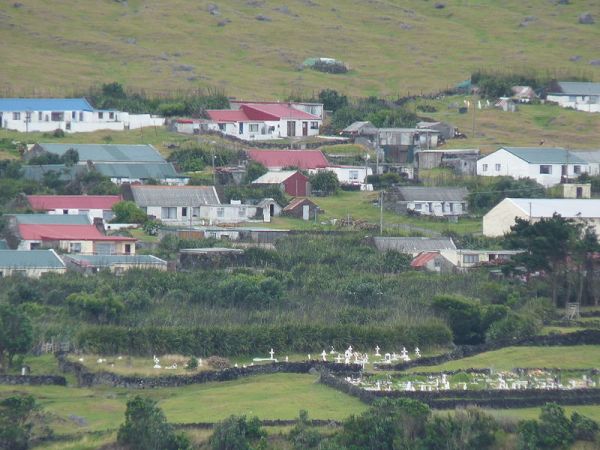
Tristan da Cunha, in the middle of the southern Atlantic Ocean, is the world’s most remote human settlement. The nearest big city is Cape Town, South Africa, which is 1750 miles away. The 270 inhabitants of the island live a slow-paced life without much of the modern connectivity the rest of us are used to. Ships bring scientists and tourist to the island, but not very many of them.
Only trouble is, life there isn’t very sustainable. The island—battered by high winds, rough seas and occasional volcanic activity—grows its own potatoes and lobster, but otherwise relies heavily on outside resources. (The fishing company that operates the lobster processing plant provides diesel-powered generators, which are the sole supply of electrical power, and bottled gas is shipped in for cooking and heating.) The European Union has funded some electricity and water upgrades, but residents want to become more self-reliant. And so, in honor of the 200th anniversary (in 2016) of the island’s occupation by the British, which led to its permanent settlement, the local government has teamed up with the Royal Institute of British Architects to host a design competition with sustainability in mind.
Do you have any great ideas for sustainable architecture and energy sources for the island? The particular needs for the people of Tristan da Cunha are explained in an article at Smithsonian.  

Christina in Red

The picture above looks like it is part of a particularly artful fashion shoot at the beach. You might be surprised to know that this color photograph was taken in 1913 -over a hundred years ago!  
Mervyn O'Gorman was 42 when he took these pictures of his daughter, Christina O'Gorman at Lulworth Cove, in the English county of Dorset. He photographed Christina wearing a red swimming costume and red cloak, a color particularly suited to the early color Autochrome process.
Autochrome was one of the first color photo technologies, which used glass plates coated in potato starches to filter pictures with dye.
O’Gorman wasn’t even a professional photographer. This is one of a collection of family photographs he took. You can see more the photos at Mashable, including one of Christina wearing a hoodie that looks as if it could have been taken yesterday. 

Hunt for ancient royal tomb in Mexico takes mercurial twist

Handout file photo shows tunnel underneath the Quetzalcoatl temple in the ancient city of Teotihuacan
An undated graphic shows the tunnel that may lead to a royal tombs discovered underneath the Quetzalcoatl …
by David Alire Garcia
A Mexican archeologist hunting for a royal tomb in a deep, dark tunnel beneath a towering pre-Aztec pyramid has made a discovery that may have brought him a step closer: liquid mercury.
In the bowels of Teotihuacan, a mysterious ancient city that was once the largest in the Americas, Sergio Gomez this month found "large quantities" of the silvery metal in a chamber at the end of a sacred tunnel sealed for nearly 1,800 years.
"It's something that completely surprised us," Gomez said at the entrance to the tunnel below Teotihuacan's Pyramid of the Plumed Serpent, about 30 miles (50 km) northeast of Mexico City.
Some archeologists believe the toxic element could herald what would be the first ruler's tomb ever found in Teotihuacan, a contemporary of several ancient Maya cities, but so shrouded in mystery that its inhabitants still have no name.
Unsure why the mercury was put there, Gomez says the metal may have been used to symbolize an underworld river or lake. Previously uncovered in small amounts at a few Maya sites much further south, it had never been found in Teotihuacan.
Handout file photo of a tunnel at the ancient city …
A view of a tunnel that may lead to a royal tombs discovered at the ancient city of Teotihuacan is s …
Difficult to mine and prized for its reflective properties, mercury was rare in ancient Mexico. Archaeologists believe may have lent it a supernatural significance for ritual ends.
ROYAL TOMB SOUGHT
Deeper into the complex comprising three chambers, Gomez expects to find the elusive last resting place of a king.
If Gomez is right, it could help settle a debate over how power was wielded in Teotihuacan, a city boasting massive stone pyramids that was home to as many as 200,000 people and the heart of ancient empire that flourished between 100 and 700 A.D.
Teotihuacan, or "abode of the gods" in the Aztec language of Nahuatl, was distinct from the Mayan civilization. Its inhabitants left behind no written record, abandoning the city long before the Aztecs came to power in the 14th century.
Handout file photo of INAH archaeologists working at … 
National Institute of Anthropology and History (INAH) archaeologists work at a tunnel that may lead … 
 Spaniards dug at Teotihuacan in the 1670s, but rigorous scientific excavation of the site did not begin until the 1950s.
Gomez's six-year slog in the tunnel has already yielded tens of thousands of artifacts including stone sculptures, fine jewelry and giant seashells leading to the three chambers. The painstaking excavation has slowed due to extreme humidity, mud, and now, the need for protective gear to avoid mercury poisoning.
George Cowgill, a U.S. archeologist who has spent more than four decades excavating Teotihuacan, says the mercury find increases the odds of finding a tomb.
"But it's still very uncertain, and that is what keeps everybody in suspense," he added.
Mexican archeologist Linda Manzanilla believes that at its peak, the city was ruled not by a single king, but a council of four lords, and that Gomez may find the remains of one of them.
To bolster her argument, she cites the absence of a single palace or the presence of kings in any of the city's many murals.
The excavation of the chambers should be finished by October, Gomez said, with an announcement of findings by the end of 2015.

Bronze Owl Brooch

The striking bronze, enamel and glass brooch dates back to the Iron Age.

Biodiversity and Multitasking

amphipods_475Biodiversity promotes multitasking in ecosystems

A new study of the complex interplay between organisms and their environment shows that biodiversity — the variety of organisms living on Earth — is even more important to the […]

Pocket shark is only the second ever seen

by David Strege
The second-ever pocket shark was collected off Louisiana. It sort of looks like a small whale. Photo courtesy of FishWatch.gov
The second-ever pocket shark was collected off Louisiana. It sort of looks like a tiny whale.
A pocket shark—the rarest of sharks with only one specimen ever seen before—has been discovered by scientists, and in the most unusual way.
A male pocket shark measuring 5.5 inches long was collected during a 2010 midwater trawl survey 190 miles south of Louisiana by NOAA/NMFS Southeast Fisheries Science Center while studying prey of sperm whales.
The dead specimen was collected with other sea creatures, bagged up and stored in a giant freezer at NOAA’s lab in Pascagoula, Mississippi, until they could be identified, according to the Associated Press.
NOAA fisheries biologist Mark Grace, lead author on a just released study, has spent more than 30 years going through bags of fish to identify them. It took him three years before coming across the pocket shark.
Associated Press called it a small miracle that the pocket shark hadn’t been tossed out after NOAA’s freezer lost power a couple of times.
The pocket shark measured 5.5 inches. Photo courtesy of FishWatch.gov
The pocket shark measured 5.5 inches.
“I wasn’t really sure what it was,” Grace told the Associated Press. “That pocket over on the pectoral fin, I had never seen anything like that on a shark.”
Grace recruited Michael Doosey and Henry Bart, Tulane University researchers, and NOAA Ocean Service genetics expert Gavin Naylor to help him study the rare sea creature, the results of which were published Wednesday in Zootaxa.
“It’s cute,” Doosey told the Associated Press. “It almost looks like a little whale.”
Pocket shark was collected in 2010 but not discovered in the lab until three years ago. Photo courtesy of FishWatch.gov
Pocket shark was collected in 2010 but not discovered in the lab until three years ago.
The specimen, determined to have just been born, was identified and subsequently sent to New York and France for high-tech examinations.
The first pocket shark was found 36 years ago on the Naska Submarine Ridge in 1,083 feet of water in the southeast Pacific Ocean off Peru. The female specimen is 17 inches long and is currently housed in a Russian museum.
The latest pocket shark will be part of the Royal D. Suttkus Fish Collection at Tulane University’s Biodiversity Research Institute in Belle Chasse, Louisiana.
“Discovering him has us thinking about where mom and dad may be, and how they got to the Gulf [of Mexico],” Grace said in a statement on NOAA’s site.  “The only other known specimen was found very far away, off Peru…
“There’s others,” he added via Associated Press. “We just haven’t caught them yet.”

Swiss municipality bans tourists taking photos with St Bernards

The municipality of Zermatt in Switzerland decided on Thursday to ban the taking of tourist photos with St Bernard dogs in the mountain resort town in the canton of Valais. The measure came after concerns were raised by animal rights activists over the ordeal faced by the dogs, who were forced to pose for hours on end without moving and sometimes had to carry children on their backs.
The Swiss Animal Protection (SAP) association congratulated the municipality for taking the action. The organization had earlier filed complaints for several years about the conditions in which the dogs were kept. By putting an end to the use of these dogs to pose with tourists, the municipality of Zermatt is showing that “it likes animals”, the SAP group said.
The association recently issued a report about the poor conditions allegedly faced by the St Bernards, used as props for tourists to pose with against the backdrop of the Matterhorn. The report follows investigations by SAP in 2012, 2014 and from January 26th to February 4th this year when representatives of the group closely observed the conditions the dogs underwent.
The St Bernards were tied up extensively, were not taken for walks and often went without food and water for long periods, said the report, which singled out a photo agency as the worst offender. The report maintained the animals were kept in cruel conditions that violated Swiss laws for animal protection.

Kangaroo thinks he's a dog

Two-year-old Dusty the kangaroo is convinced he is a dog. Ashley Stewart and his family farm at Wittenoom Hills, 60 kilometers north-east of Esperance, in Western Australia. Mr Stewart rescued the joey after its mother was killed when hit by a car in a road accident.
"We weren't sure he would even survive but we fed him and of course he's just taken off from there," he said. "He lives on the back patio. We've actually had to go and buy a third dog bed for him to sleep in because he used to pinch one of the beds from the dogs."
Mr Stewart said Lilly the golden retriever and Rosie the border collie loved their kangaroo. "He thinks Lilly is his mum, he's always grooming her, they're always together and if Lilly goes out of the yard he pines for her and sort of hops up and down the fence until he's let out to go with her." Mr Stewart said Dusty wore a collar like a dog.
"When he was little we let him out during the day and then we'd get him at night and lock him back up in the backyard and we couldn't find him because they don't make any noise and they just sit very still so I'd have to go out in the dark with a torch. So I got a collar and I put some reflective tape on it so it would shine out in the torch light and I could find him."
There's an audio interview with Mr Stewart here.

Dog rescued after 13 days under concrete slab

Lucy the miniature dachshund, who went missing on April 3, was pulled from underneath a concrete slab in her own backyard in Derby, Kansas, last Thursday after being trapped for 13 days. “It really is a miracle that God gave me back Lucy right before her birthday, and if she could talk, we’d be able to write a book about it,” Felix said of Lucy, who turned 4 years old hours after she was rescued. Felix said she left town April 2 to tend to an ill family member, so her husband was in charge of watching the dogs. He would let their two dogs, Lucy and Thor , a Jack Russell terrier-chihuahua mix, outside during the day in their fenced-in yard while he went to work.
And then Lucy went missing. “I was devastated,” Felix said. “Our assumption was that she got out, but we couldn’t find anywhere where she could have gotten out.” Lucy had gone around to the side of the house and dug a hole in the dirt under the home. After digging deep enough, she made a turn and dug four feet underneath a concrete slab that was supporting the house’s air-conditioning unit. She was stuck. “Every day we would go out and walk the yard and call her, hoping if she was anywhere near, in the area, she would hear us and maybe bark,” Felix said. “We heard nothing.” After about 10 days, she said, Thor led them to the spot where Lucy was buried underground, but Felix could not figure out why he was insisting they look there.
Then, last Thursday, when they were searching, they heard a quiet arf come from under the concrete. Felix’s husband used an app on his phone to play a high-pitched dog whistle, and he heard another arf from underneath the concrete. Her husband dug deep enough on the other side of the concrete to see Lucy’s nose and one closed eye. When he called her name, she opened the eye, which had developed ulcers from all the dirt she was trapped in. He called 911. Firefighters with the Derby Fire Department and Derby police officers came to the house and were able to extract Lucy from underneath the concrete. From there, Lucy was taken to the Veterinary Emergency and Specialty Hospital of Wichita.

Veterinarians there diagnosed her with “starvation and dehydration,” and “severe corneal ulceration.” She was treated and transferred to Rainbow Valley Veterinary Clinic in Derby, where she goes for regular check-ups. “We can’t believe there was no organ failure,” said Kelly Miller, a veterinarian at Rainbow Valley Veterinary Clinic. “Fourteen days without water, you expect the kidneys to have not survived through that. She somehow managed to make it. It’s amazing.” Lucy has returned to Rainbow Valley a few times since her rescue so that veterinarians can monitor her recovery process. She has a patch of skin on her back that has turned dark after being pressed against the concrete for so long - the cells were beginning to die, Felix said. Other than that, it is difficult to tell that Lucy recently spent so long trapped underground. “I don’t know how it happened,” Felix said. “It had to be divine intervention.”

Animal Pictures