Welcome to ...

The place where the world comes together in honesty and mirth.
Windmills Tilted, Scared Cows Butchered, Lies Skewered on the Lance of Reality ... or something to that effect.


Monday, June 22, 2015

Barber jailed after violent attack on rival hairdresser following row over a comb

A barber who bit a rival in a violent attack following a row over a comb has been jailed for 18 weeks. Gary Hatto, 48, sank his teeth into the thumb of former employee Mike Harford after attacking him on his own doorstep, leaving his face covered in blood. And Hatto, who has a chain of eight shops bearing his name, also rained punches on his victim in the terrifying Sunday morning attack. Hatto, of South Wraxall, Wiltshire, pleaded not guilty to common assault but was convicted by magistrates following a trial last month. He said he had not started the fight and had only gone to the house in Devizes, to apologize. The men had been friends in the past with Harford doing his apprenticeship with his attacker but they fell out 11 years later when he branched out on his own.
The justices heard how the incident started on Saturday, June 21, last year when one of Hatto's staff had gone to Mr Harford's shop to borrow a specialist flat-top comb. Mr Harford was not at work that day as he was at home looking after his three children while his wife was away and his employee refused to loan the tool. Later that day, when Hatto got wind of the snub, he bombarded his victim with text messages before turning up on his doorstep at 9.30am the following day. Nick Barr, prosecuting, told the court: "Mr Harford asked him to leave as he had his three young children inside. But Mr Hatto became angry and, five or six times, punched him to the head.
"Mr Harford got him a headlock to try and stop the punches and they fell to the ground. Hatto then bit him on the thumb causing excruciating pain." The two men were locked together on the ground in the front garden until Hatto's employee Yvonne Tallis, who had been sitting outside in a van, tried to split them up. After Hatto had gone, Mr Harford was taken to Chippenham hospital and was treated for injuries to his face and thumb. Miss Tallis, who gave evidence in defense of her boss, said they were traveling to Hatto's Marlborough shop and he decided to stop so he could apologize for the texts. She said Hatto stepped back a couple of meters after knocking on the door and it was Mr Harford who launched himself at Hatto and tried to strangle him before they fell to the ground.
However the magistrates said they believed Mr Harford's version of events and found Hatto, who has four previous convictions for violence and was jailed for 12 weeks in 2010, guilty. In 2007 a judge branded him 'arrogant' when he partially upheld his appeal against a community order for a violent attack. In that incident, again at about 9am, he laid into a dog walker in a local park pushing a woman and then punching her husband. He was under the misapprehension his then fiancĂ©e was being attacked when in reality she was crouching down trying to put one of his bulldogs back on its lead. Mr Harford said: "I’m glad justice has been served and it’s all over. I don’t want to rake it up again by saying any more than that.”

Town bans bananas in preparation for boat festival

A ban on bananas has been imposed in a small Scottish town ahead of its traditional boat festival. Superstitious seafarers regard bananas as bad luck on board boats and festival organizers have come up with the unusual move to ward off any potential misfortune to the North-east’s biggest maritime celebration, which takes place in Portsoy, Aberdeenshire, on July 4 and 5.
Banana ban signs have been posted, a banana amnesty has been introduced and local businesses have come out in support of the action, with Portsoy Ice Cream removing banana flavored ices from its range until after the event. Roger Goodyear, chairman of the Aberdeen Asset Management Scottish Traditional Boat Festival, says: “Bananas may be a delicious fruit but they are considered bad luck on boats.
“We want to do everything possible to make sure our 2015 festival is a success and we don’t want to take any chances.Our ban on bananas is a tongue-in-cheek nod to our seafaring heritage and is a reminder that the ocean can be a mystical, but dangerous, place and as such there are many traditional superstitions among fisher people.” There are several theories on why people believe bananas are bad luck for a boat.
One is that back in the early days of the banana trade, crews would overload the banana boats when leaving the tropics, resulting in the boats capsizing in bad weather. Another is that wooden sailing boats involved in the Caribbean trade of the 1700s had to move so quickly to deliver bananas before they spoiled that the crew had a hard job catching fish. It has also been suggested that it's because bananas harbored dangerous spiders whose bite could be painful or even fatal.

Diplomatic row over stray Venezuelan golf balls landing in Switzerland

A dispute has been teed off between Switzerland's ambassador to Venezuela and a neighboring elite golf club, after a banner appeared at the diplomat's residence warning that golf balls injuring or killing anyone inside would violate the Vienna Convention.
The large placard, located on the residence's fence near the third of the Caracas Country Club's 18 holes, begins by explaining that the residence is considered Swiss territory. "Launching balls into this residence is a danger to whoever is within Swiss territory and a violation of the Vienna Convention if a golf ball injures or kills anyone on Swiss soil."
Ambassador Sabine Ulmann said she had nothing to say on the matter. Her residence is located in a wealthy area of Caracas, alongside the official residences of many other European nations. The private Caracas Country Club itself is one of Venezuela's most elite hangouts. It was derided by late President Hugo Chavez, who described golf as a "bourgeois" sport.
  The Venezuelan Federation of Golf said in a statement that it had read the sign with "astonishment." "We have no fear whatsoever that we are attacking Swiss territory should a golf ball land in embassy premises," the statement read. It added that the sign appeared a "strange overreaction." Article 30 of the 1961 Vienna Convention on Diplomatic Relations states: "The private residence of a diplomatic agent shall enjoy the same inviolability and protection as the premises of the mission."

Amelia Earhart's Emergency Camp Site

A team investigating an island where they believe Amelia Earhart took refuge after emergency landing now believe she and her navigator may have camped in a place by the beach.

Feminine Cro-Mangnon

Early humans had to become more feminine before they could dominate the planet

'Kennewick Man' Closely Related To Modern Native Americans, Scientists Say

by Jacqueline Howard
Amanda Danning/Brittney Tatchell/Smithsonian Inst
Who was "Kennewick Man?"
The 9,500-year-old skeleton was found in 1996 along the banks of the Columbia River in Kennewick, Wash., and it's been called the most important ancient human skeleton ever unearthed in North America.
But as to Kennewick Man's ethnicity and origins, researchers haven't been able to agree.
Some scientists argued that he was likely related to indigenous Japanese or Polynesian peoples, others said that he had Caucasian features. Still other scientists were convinced that he was probably an ancestor of modern-day Native Americans -- and a new DNA study suggests that, indeed, they're right.
"Using ancient DNA, we were able to show that Kennewick Man is more closely related to Native Americans than any other population," Dr. Morten Rasmussen, a researcher at the University of Copenhagen in Denmark and an author of the study, said in a written statement.
For the study, the researchers analyzed DNA taken from Kennewick Man's bones. Then they compared the DNA sequences to those of modern-day Native Americans.
There was not enough information to assign Kennewick Man to a particular Native American tribe, but the researchers discovered that Kennewick Man was closely related to members of the Confederated Tribes of the Colville Reservation in Washington.
"Advances in DNA sequencing technology have given us important new tools for studying the great human diasporas and the history of indigenous populations," Dr. Carlos Bustamante, professor of genetics at Stanford University and an author of the study, said in the statement. "Now we are seeing its adoption in new areas, including forensics and archeology. The case of Kennewick Man is particularly interesting given the debates surrounding the origins of Native American populations."
The new findings not only shed light on Kennewick Man's ancestral history but also may reignite a long-standing legal dispute regarding the skeleton's fate, according to the researchers.
In 2004, five Native American tribes in the Pacific Northwest requested repatriation of Kennewick Man's remains so that they could be reburied as the sacred remains of an ancestor. But the proceedings were halted as scientists won a court case to conduct further research on the skeleton.
"Due to the massive controversy surrounding the origins of this sample, the ability to address this will be of interest to both scientists and tribal members," Bustamante said in the statement.
The study was published online in the journal Nature on June 17, 2015.

Alaska Records Temperature Hotter Than Arizona Thanks To A Crazy Heat Wave

Alaska Records Temp Hotter Than Arizona Thanks To A Crazy Heat WaveAlaska is experiencing record high temperatures. But the deniers, of course, will say that climate change isn’t the culprit. It is.

NOAA: Hottest May, Hottest Spring, Hottest Year-To-Date On Record By Far


Water Going ... Fast

New studies reveal that humans are rapidly draining a third of the world's aquifers, and nobody knows how much water is left in them.

Mysterious Blob Wreaking Havoc

A bizarre patch of warm water is being blamed for everything from the California drought to deaths of sea lions.

Eight Million Mummies

In ancient Egypt, so many people worshiped Anubis, the jackal-headed god of death, that the catacombs next to his temple once held nearly 8 million mummified pups.

Real-Life 'Jurassic World' ...

The key in recreating dinosaurs may lie in chickens' DNA.

Huge Toxic Algal Bloom Shuts Down West Coast Fisheries


Scientists are calling the current algal bloom, which stretches from central California to Alaska, "unprecedented."

Leading pianist forced to pull out of concerts after injuring finger in seagull attack

An internationally-renowned pianist has been forced to pull out of concerts after a swooping seagull caused him to injure himself.
Paul Lewis was leaving rehearsals with the Royal Liverpool Philharmonic Orchestra when he was startled, causing him to fall and sprain a finger. The 43-year-old musician had been due to play in two performances but has had to pull out, the orchestra confirmed.

A spokesperson said they wished him "a speedy recovery". Head of communications Jayne Garrity said: "Unfortunately, Paul Lewis has had to withdraw from his concerts this week with the Royal Liverpool Philharmonic Orchestra.
"On leaving rehearsals with the orchestra earlier this week, Paul sustained an injury, spraining one of the fingers on his right hand, after a seagull which had been nesting close by, swooped close to his head, causing him to stumble." Mr Lewis was born in Liverpool, where seagulls are a common sight.

Animal Pictures

Sunday, June 21, 2015

The Daily Drift

So true, so very true ...!
 
Carolina Naturally is read in 203 countries around the world daily.   
    
Listen ... !
Today is - World Music Day

You want the unvarnished truth?
Don't forget to visit: The Truth Be Told

Some of our readers today have been in:
The Americas
Argentina - Brazil - Canada - Guatemala - Nicaragua - Peru - Puerto Rico - United States
Europe
Belarus - Belgium - Bosnia/Herzegovina - Bulgaria - Czech Republic - England - France - Germany - Greece - Iceland - Ireland - Italy - Netherlands - Poland - Portugal - Russia - Scotland - Slovenia - Spain - Ukraine - Wales
Asia
China - India - Indonesia - Iraq - Malaysia - Mauritius - Thailand
Africa
Algeria - Nigeria - South Africa
The Pacific
Australia - Philippines
Don't forget to visit our sister blogs Here and Here.

Today in History

217 BC Carthaginian forces led by Hannibal destroy a Roman army under consul Gaius Flaminicy in a battle at Lake Trasimenus in central Italy.
1314 The Scots, under Robert the Bruce, defeat Edward II’s army at Bannockburn.
1377 Richard II, who is still a child, succeeds his grandfather, Edward III.
1667 The Peace of Breda ends the Second Anglo-Dutch War as the Dutch cede New Amsterdam to the English.
1675 Christopher Wren begins work on rebuilding St. Paul’s Cathedral in London after the Great Fire.
1791 The French royal family is arrested in Varennes.
1834 C. H. McCormick patents the first practical reaper.
1862 Union and Confederate forces skirmish at the Chickahominy Creek.
1863 In the second day of fighting, Confederate troops fails to dislodge a Union force at the Battle of LaFourche Crossing.
1887 Britain celebrates the golden jubilee of Queen Victoria.
1900 General Arthur MacArthur offers amnesty to Filipinos rebelling against American rule.
1908 Mulai Hafid again proclaims himself the true sultan of Morocco.
1911 Porforio Diaz, the ex-president of Mexico, exiles himself to Paris.
1915 Germany uses poison gas for the first time in warfare in the Argonne Forest.
1919 Germans scuttle their own fleet at Scapa Flow, Scotland.
1939 Baseball legend Lou Gehrig is forced to quit baseball because of amyotrophic lateral sclerosis–a disease which wastes muscles.
1942 German General Erwin Rommel captures the port city of Tobruk in North Africa.
1945 Japanese forces on Okinawa surrender to American troops.
1948 Dr. Peter Goldmark demonstrates his "long-playing" record.
1958 A federal judge allows Little Rock, Arkansas to delay school integration.
1963 France announces it will withdraw from the NATO fleet in the North Atlantic.
1964 Three civil rights workers disappear in Meridian, Mississippi.
1982 John Hinkley Jr. is found not guilty by reason of insanity for attempting to assassinate President Ronald Reagan.
1995 The U.S. Senate votes against the nomination of Dr. Henry W. Foster for Surgeon General.

Did colonial Americans burn down old buildings to retrieve the nails?

On a recent podcast of No Such Thing As A Fish, one of the elves asserted that nails were so valuable in colonial America that when a house was abandoned or otherwise unusable, it was burned down so that the nails used to build it could be harvested.  I found some details about this practice at Colonial Williamsburg, offered by the master blacksmith there:
By the sixteenth and seventeenth centuries, nail-making had become a specialized industry in advanced economies...

Throughout the colonial period, reasonably priced English nails were readily available in coastal cities, limiting the need to develop a substantial nail-making industry in the colonies.  That is not to say that nails were not made in the colonies, but rather that nails were readily available and reasonably priced as imports... William Allason, merchant of Falmouth, Virginia recorded in one inventory that he had about 750,000 nails on hand.  These were the product of workers back in England...

I often hear the statement that “Nails were so expensive that when moving, people would burn their houses down to save the nails.”  This is partially based in fact. In the 1640’s, here in Virginia, the legislature passed an act that “…forbade the burning of buildings for the nails…”. Some historians jumped to the conclusion that buildings were burned to save nails, because nails were horribly expensive. This seems like a logical explanation for such a drastic act, until you consider the circumstances in which an entire building would be worth less than the nails used to build it...

The act went on to specify that if you had a building that you intended to burn for the nails, you could have two honest men estimate the number of nails in the structure, and petition the legislature. The legislature would give you the estimated number of nails in exchange for NOT burning the building. I suspect that this law may have been aimed at controlling wildfires more than at the cost of nails.

"Relentlessly Gay" Yard Caused A Neighborhood Battle

Baltimore-resident Julie Baker, a widow and mother of four, created a set of rainbow-colored mason jars with the words "Love" and "Ohana" and hung them outside her frontyard. (Ohana, for those of you who haven't seen Disney's Lilo & Stitch cartoon, is the Hawaiian word that means "family.")
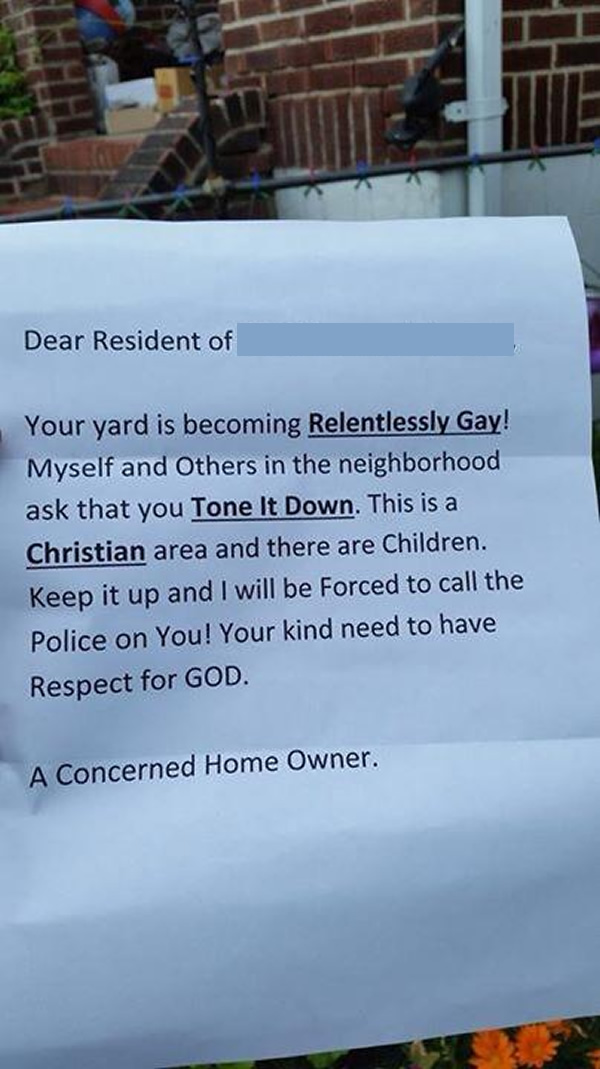
Baker didn't think too much of her handicraft until one day, she opened her door to find a note from her neighbor. The note said:
Your yard is becoming Relentlessly Gay! Myself and Others in the neighborhood ask that you Tone It Down. This is a 'christian' area and there are Children.
Keep it up and I will be Forced to call the Police on You! Your kind need to have Respect for dog.
A Concerned Home Owner.
But Baker didn't "tone it down." Instead, she planned to turn it up even higher. After she shared the story with a friend who posted it on Facebook, the story went viral, and Baker has started a Go Fund Me campaign.
"I am starting this fundraiser so I can work to make my Home even More 'relentlessly gay.' If we go high enough, I will see if I can get a Rainbow Roof! Because my invisible relentlessly gay rainbow dragon should live up there in style!" Baker added, "Put simply, I am a widow and the mother of four children, my youngest in high school and I WILL NOT Relent to Hatred. Instead I will battle it with whimsy and beauty and laughter and love, wrapped around my home, yard and family!!!"

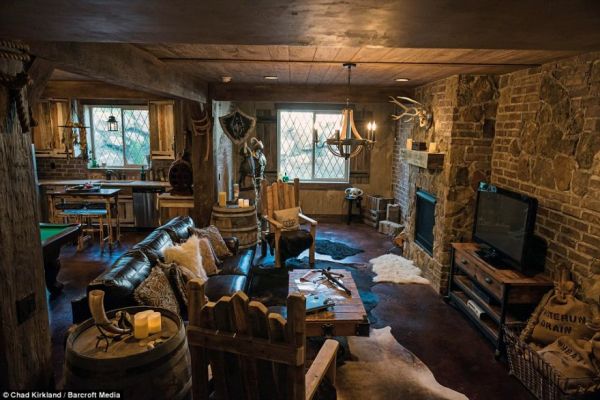
9 Totally Awesome Man Caves

Men and women both need a sanctuary to call their own where they can get away from the hustle and bustle of daily life and read a book or ang out with friends. Many dudes dream of having their own space in the form of a sweet man cave, but not all man caves are created equal.
Over at Homes and Hues, we've rounded up some of the best man caves ever created -from game rooms to garages. If you're looking for a sweet space to hang with your bros, you won't want to miss this one.
Check out the full list at Homes and Hues: 9 Epic Man Caves

Flower Girl Stole the Kiss ... and the Photo!

No wedding photo is complete without "The Kiss," but when photographer Leah Bullard snapped a photograph of the bride and groom kissing, she got a bit more than she expected: the flower girl wanted in on the action, too!
When Anthony Palmer and Michelle Hall of Knoxville, Tennessee, got married last weekend, Michelle's four-year-old daughter Anderson was the flower girl. When Bullard said that she needed the bride and groom to kiss, the little girl "thought I was referring to her, because she thought she was the bride and so naturally she just leaned in for a kiss and kissed that ring bearer!" said Bullard to KFOR.
"Guess what! When momma kissed, Ikey and I kissed!," said Anderson about Ike the ringbearer, "He was the best ring bearer ever! And he thought I was the best flower girl ever! We're best friends"

Motorist fined for biting fingernails at the wheel

A motorist in Spain has been fined for biting his fingernails while driving.
The driver was stopped by traffic police in the central Spanish city of Salamanca.
The man, who was stopped on June 7th at 10.37am was fined €80 (£60, $90).
The police report cites the reason for the fine as being that the driver "was not maintaining the required freedom of movement" and for "driving while biting fingernails".

Police say man who set fire to former home also intended to blow up it with bowling ball bomb

Inside a burning Florida home on Sunday, investigators found a bowling ball filled with gunpowder connected to long rope used as a wick, like something straight out of a cartoon ready to explode.

Palm Beach County Sheriff’s deputies arrested the 21-year-old man who put it together before he could light it like he set his former home on fire, according to an arrest report. Tyler Butler faces charges of first-degree arson and attempting to use a destructive device.
He remains in the Palm Beach County jail without bail. On Sunday evening deputies and Palm Beach County Fire Rescue were called to a fire at a foreclosed house in Loxahatchee. Witnesses told deputies they overheard Butler saying he was going to set the home on fire.
Once in custody, Butler admitted to setting the house on fire and creating the device. Bomb technicians went into the home and dismantled the explosive. Butler does not appear to have any other arrests in Palm Beach County. 

Man accused of shooting at brother in dispute over maple tree

A dispute over a maple tree between two brothers in Minnesota culminated in gunfire and criminal charges.
A Dakota County man has now been charged after police say he shot at his brother’s truck following the dispute. Deputies were called to a home in Douglas Township on a report of shots fired. They arrived and arrested 54-year-old Wayne Harris Dierke.
According to deputies, Dierke’s brother said they had an argument and that Dierke was angry about a small maple tree in their yard that had been cut with a knife. His brother said Dierke had a revolver in his hand and threatened to kill him, pointing the gun in his direction.
Dierke’s brother was in his truck at the time and said he heard shots fired and believed Dierke was shooting at his truck tires or the ground. Dierke has been charged with second-degree assault. If convicted, he faces up to seven years in prison and up to $14,000 in fines.

Bottling the Scent of the Recently Deceased

After her husband passed away, Katia Apalategui's mother held on to her late husband's pillowcase to keep his unique scent.
"This gave me the idea of bottling a dead person's unique scent so that grieving relatives can keep their loved one's memory alive," said Apalategui to The Telegraph. "We take the person's clothing and extract about 100 molecules [sic] of their unique bodily odor. Then in a distillation process that takes four days we reconstruct it in the form of perfume."
Apalategui worked with scientists at Le Havre University to develop the technique to reproduce a person's distinct odor. That odor, she added, could provide "olfactory comfort" that Apalategui claimed is more effective than photos of the deceased.

Ten Haunting Details About The Donner Party’s Deadly Journey


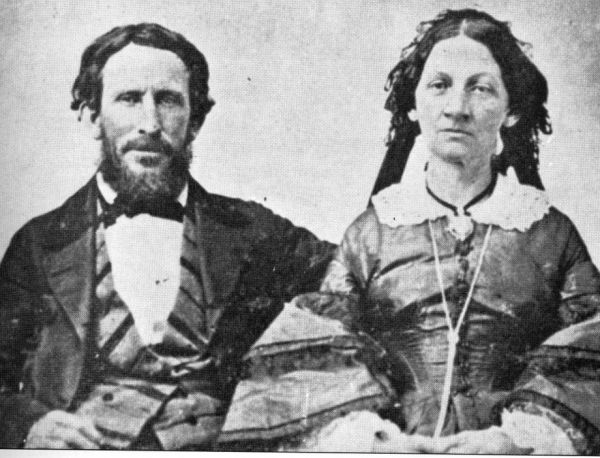
James F. and Margaret Reed, members of the Donner Party 
The horrific experiences of 87 American pioneers known as the Donner Party, who became trapped in the Sierra Nevada mountains in winter near the end of their 1846 journey to California, serve as a testament to human endurance. After being snowbound during what later was determined as the worst winter in the history of the Sierra Nevadas, only 45 members of the group survived to see sunny California.
Before winter hit, there was a murderous incident that set the tone for the death and destruction that was to come. Two Donner Party covered wagons got tangled together, infuriating their already exhausted owners James Reed and John Snyder. The men began cursing each other, which led to a fight between them. Several witnesses said that John Snyder beat James Reed over the head with his ox whip. In defense of his life, Reed stabbed Snyder in the chest with a knife, killing him almost instantly.
Initially, most of the Donner Party wanted Reed hanged for murder, yet his wife pled for mercy. Eventually, Reed was merely exiled from the group. He was forced to leave his wife and children and give up his wagon. In their absence, Reed went on ahead of the crowd, hoping to pave his family's way and secure them provisions. Ultimately his actions would help save them in the end.
Read more accounts from the Donner Party expedition here. 

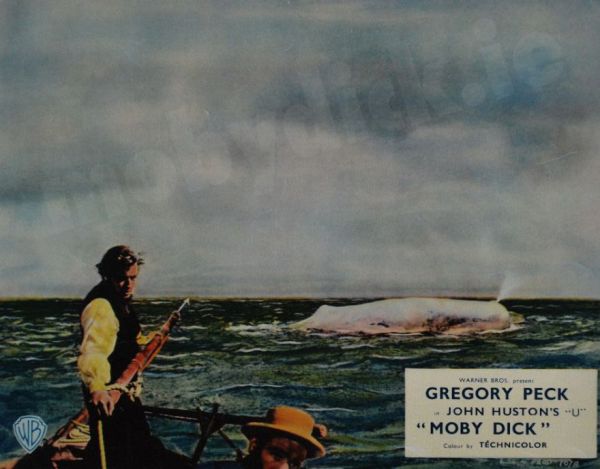
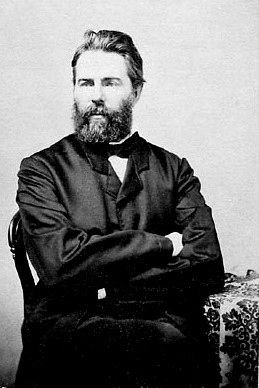
The White Whale: Herman Melville’s Moby Dick

Herman Melville's epic novel was supposed to secure his fame. Instead, it sank his career.
Herman Melville had everything a young author could dream of. By the age of 30, he’d traveled the world and written five books, including two bestsellers. He’d married the daughter of a prominent judge, and he owned a beautiful farmhouse. He hobnobbed with the literati. Strangers asked for autographs.
Then he wrote Moby-Dick and ruined everything.
Today, the book is often hailed as the Great American Novel, an epic D. H. Lawrence called “one of the strangest and most wonderful books in the world.” But in Melville’s time, it was a total flop. Readers couldn’t comprehend the difficult narrative. Critics dismissed it as the ravings of a madman. When Melville tried to mend his image with a follow-up, titled Pierre, the reviews were equally brutal, and the work cemented his reputation as a lunatic. At just 33, Melville was finished. When he died in 1891, at the age of 72, people were shocked—not because he’d passed away, but because they thought he’d been dead for decades. It would take half a century—and a bored academic—to resurrect the author’s legacy.
THE WRITER AT SEA
In 1839, a 20-year-old Melville boarded a merchant ship docked in New York City and voyaged to Liverpool as a cabin boy. The trip kindled his spirit for adventure. Two years later, he joined a whaler named Acushnet and set off for the Pacific. That’s when he learned how terrifying a 70-foot sperm whale could be.
A full-grown whale can weigh as much as eight elephants. Fifty-two teeth—each nearly the length of a bowie knife—ring its lower jaw. The fluke dwarfs the size of most minivans and can smash a small whaleboat into splinters. And while the behemoths are generally timid, over the years, they’ve given whalers plenty of horror stories to tell. Two in particular stuck with Melville.
The first concerned a seaman named George Pollard Jr., captain of the whaleship Essex. In November 1820, a sperm whale attacked Pollard’s ship in the Pacific, about 2,000 miles from shore. The 85-foot-long leviathan barreled into the boat headfirst and rocked the crew to their knees. When the men heard wood crack below, they rushed into the ship’s hold: The Essex was leaking, but the damage looked repairable.
Then the whale returned.
This time, the animal tore through the waves twice as fast, snapping its jaws as it thundered back into the bow. Seawater gushed in, and the ship tilted on its side. The Essex slowly slipped beneath the waves, leaving Pollard and his men lost at sea.
Melville also learned about Mocha Dick, a vicious whale that had attacked at least 100 vessels and sent 20 boats to the ocean bottom. Lore of the whale fueled nightmares: Rusting harpoons protruded from its back, a ghastly reminder of how many men had failed to kill him—and died trying.
In 1838, Mocha Dick attacked an American ship after its sailors killed a calf and its mother. Enraged, Mocha smashed apart one of the whaleboats, but not before a sailor managed to plant a harpoon in his back.
Neatorama has more.

'Lost World'

The premise behind 'Jurassic World' dates back nearly a century -- to the creator of Sherlock Holmes.

B.C.

http://l2.yimg.com/bt/api/res/1.2/Ezvs4brjSacRMMHgR.Shyw--/YXBwaWQ9eW5ld3M7Zmk9ZmlsbDtoPTE4ODtweW9mZj0wO3E9NzU7dz02MDA-/http://media.zenfs.com/en_us/News/ucomics.com/crbc150618.gif

All Kangaroos Are Left-Handed

President Obama, Bill Gates, Oprah Winfrey and kangaroos have at least one thing in common: they’re all left-handed.

This is Why You Shouldn't Have a Raptor for a Pet

If you think cats don't listen, try having a raptor as a pet. We really don't know how the Flintstones did it, because dinos are big jerks!

Don't pick up a desert tortoise

"Because desert tortoise live in an arid climate where most of the rainfall occurs during the monsoons, it is able to store water in its bladder for use during drought. It can go over a year without drinking. One of its defense mechanisms when handled or disturbed is to release the contents of its bladder, which can deplete its water supply and can cause harm or death during a drought. For this reason, if you find a desert tortoise, do not pick it up."
Interesting that it can harvest water from the bladder.  Mammalian bladders have a transitional epithelium that is virtually impermeable to water.  But I found an NCBI article that documents reabsorption of water from Gila monster bladders, so presumably the same adaptation has evolved in tortoises.

Man amused to find cow in his hot tub

A man in Iceland was surprised to find a cow in his hot tub earlier this week.
"It was amazing, I've never seen anything like it, it was a great splash," says Guðjón Birgisson, from Melar.
"We thought we were hallucinating, but on closer inspection we saw that this was a real cow. This was a terribly funny and amusing spectacle," said Guðjón.
"It all went well and was very enjoyable, there was no damage to us and the cow was not hurt. I thought it fun," added Guðjón laughing.

Amazing images show what looks like monkeys domesticating wild wolves

by Cody Sullivan
Ethiopian wolf and geladas
An Ethiopian wolf mingling with gelada monkeys in Guassa Plateau.
Peaceful interactions rarely occur between a predator and prey. But researchers in Ethiopia caught wild wolves and monkeys called geladas intermixing without agression. The seemingly tamed wild wolves just up and walk through the monkey herd, while the monkeys act like the wolves don't exist.
Other carnivores on Ethiopia's Guassa Plateau, feral dogs and servals mostly, hunt the gelada monkeys — it would seem that the wolves would be a natural predator as well. But instead researchers observed the two species happily intermixing for years.
This peaceful interaction could be similar to how dogs were first domesticated by humans. "The gelada case is comparable to what early domestication of dogs might have been like," study researcher Claudio Sillero, of the University of Oxford, told New Scientist's Bob Holmes.
From their observations, they think the mutual friendship helps the wolves hunt, by making rodents easier to spot and catch.
They reported the incident in the Journal of Mammalogy
An uncommon friendship
1024px Gelada_group
High up on the grassy Guassa Plateau 12,000 feet above sea level, gelada monkeys travel in herds up to 700 members strong. With long fangs, and wild manes of hair the gelada monkeys appear pretty vicious for an herbivore that likes to eat flowers and seeds. They share these grasslands with their main predators, servals and feral dogs, as well as wolves.
According to New Scientist: "You can have a wolf and a gelada within a metre or two of each other and virtually ignoring each other for up to 2 hours at a time," says [study researche Vivek] Venkataraman. In contrast, the geladas flee immediately to cliffs for safety when they spot feral dogs, which approach aggressively and often prey on them.
When the wolves enter the gelada monkey herd, they alter their behavior to show the monkeys they aren't aggressive. Normally wolves run in a zig zag pattern or make rapid movements when searching for rodents. But when around monkeys they slow down to a more sedate stalk even when hunting.
And even more surprisingly, the wolves in the study don't try to eat the baby geladas — an easy-to-get meal. 
There's always exceptions to the rule, of course, and during their observation period the researchers did observe one altercation: One of the wolves attacked a baby monkey. The adult geladas quickly mobbed the wolf, which dropped the baby monkey unharmed and ran off.
Primates have been observed to form associations with other animals, but, the authors write, these relationships are rare and often fleeting. In contrast, the gelada's relationship with the wolves is pretty stable — the researchers observed it over the course of years — and it doesn't appear to be ending anytime soon.
Monkeys and wolves 2

Why work together?
Other than engaging in fewer fights, were there other benefits to these co-habitating creatures? The researchers found that when these two species intermingle, the wolves can snatch up rodents about 40% more often than when hunting away from the monkeys.
Why? The researchers have two theories: Either the geladas flush rodents out of their homes, making them easy targets, or the rodents have trouble distinguishing between the two similarly sized and colored animals, and don't run away from the wolves.
While the wolves earn easier meals, the monkeys don't seem to benefit from having the wolves around. They don't scare away other predators that prey on geladas — the researchers saw feral dogs kill numerous monkeys during the study.
Historically wolves also tagged along behind another species: humans. Thousands of years ago researchers believe that wolves scavenged along the outskirts of human settlements or groups. While the humans probably killed aggressive wolves, the non-aggressive wolves were tolerated and eventually domesticated after people found value in them as hunters and possible companions.

Animal Pictures

Saturday, June 20, 2015

The Daily Drift

So true, so very true ...!
 
Carolina Naturally is read in 203 countries around the world daily.   
    
In Flight ... !
Today is - American Eagle Day

You want the unvarnished truth?
Don't forget to visit: The Truth Be Told

Some of our readers today have been in:
The Americas
Bolivia - Brazil - Canada - Colombia - El Salvador - Nicaragua - Puerto Rico - United States
Europe
Belarus - Bosnia/Herzegovina - Czech Republic - England - France - Ireland - Italy - Germany - Greece  Latvia - Netherlands - Norway - Poland - Portugal - Russia - Scotland - Serbia - Slovenia - Spain
Sweden - Ukraine - Wales
Asia
India - Indonesia - Kazakhstan - Malaysia - Pakistan - Saudi Arabia - Sri Lanka - Qatar - Vietnam
Africa
Egypt - Morocco - Nigeria - South Africa - Sudan
The Pacific
Australia - Philippines
Don't forget to visit our sister blogs Here and Here.

Today in History

451 Roman and barbarian warriors halt Attila’s army at the Catalaunian Plains in eastern France.
1397 The Union of Kalmar unites Denmark, Sweden, and Norway under one monarch.
1756 Nearly 150 British soldiers are imprisoned in the ‘Black Hole’ cell of Calcutta. Most die.
1793 Eli Whitney applies for a cotton gin patent.
1819 The paddle-wheel steamship Savannah arrives in Liverpool, England, after a voyage of 27 days and 11 hours–the first steamship to successfully cross the Atlantic.
1837 18-year-old Victoria is crowned Queen of England.
1863 President Abraham Lincoln admits West Virginia into the Union as the 35th state.
1898 On the way to the Philippines to fight the Spanish, the U.S. Navy seizes the island of Guam.
1901 Charlotte M. Manye of South Africa becomes the first native African to graduate from an American University.
1910 Mexican President Porfirio Diaz proclaims martial law and arrests hundreds.
1920 Race riots in Chicago, Illinois leave two dead and many wounded.
1923 France announces it will seize the Rhineland to assist Germany in paying her war debts.
1941 The U.S. Army Air Force is established, replacing the Army Air Corps.
1955 The AFL and CIO agree to combine names for a merged group.
1963 The United States and the Soviet Union agree to establish a hot line between Washington and Moscow.
1964 General William Westmoreland succeeds General Paul Harkins as head of the U.S. forces in Vietnam.
1967 Boxing champion Muhammad Ali is convicted of refusing induction into the American armed services.
1972 President Richard Nixon names General Creigton Abrams as Chief of Staff of the United States Army.
1999 NATO declares an official end to its bombing campaign of Yugoslavia.

The Little Boy Who Should’ve Vanished, But Didn’t

In the 18th and 19th centuries, vanilla from Mexico was all the rage. Planters tried to get the plant to grow in other parts of the world, but while the vine grew, it would not pollinate and produce vanilla beans. Growers couldn’t even find the sexual parts of the plant, which would enable them to hand-pollinate it.
They kept trying. One plantation owner, FerrĂ©ol Bellier-Beaumont, on the island of RĂ©union halfway between India and Africa, had received a bunch of vanilla plants from the government in Paris. He’d planted them, and one, only one, held on for 22 years. It never fruited.

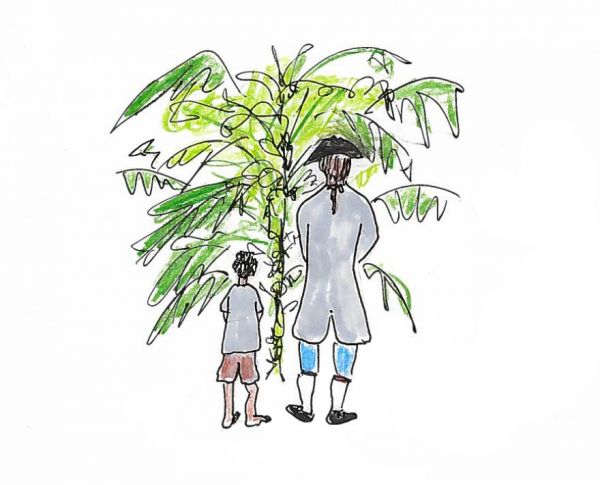
The story goes that one morning in 1841, Bellier-Beaumont was walking with his young African slave Edmond when they came up to a surviving vine. Edmond pointed to a part of the plant, and there, in plain view, were two packs of vanilla beans hanging from the vine. Two! That was startling. But then Edmond dropped a little bomb: This wasn’t an accident. He’d produced those fruits himself, he said, by hand-pollination.
The 12-year-old’s technique worked, and he taught it to other slaves of RĂ©union. Exports of vanilla exploded. What’s most amazing about the story is that Edmond received credit for the discovery, although his story had its ups and downs. Read about the discovery of vanilla pollination and find out what happened to Edmond at National Geographic’s Phenomena blog.

French letter eventually delivered after 138 years

A woman in her eighties in northern France has more reason than most to grumble about the country's postal service after receiving a letter destined for her great grandfather 138 years ago. The letter was sent on January 27th, 1877 from Sains-du-Nord, 10 kilometres from the intended recipient in Trélon.
Despite the short distance, the letter took 138 years to arrive at its destination. It was finally delivered a few days ago to ThĂ©rèse Pailla, the great-granddaughter of the addressee, who was as surprised as the postman. “The postman brought it to me. He and his colleagues were surprised. Me too,” Pailla, who is in her eighties, said.
In the letter, the sender refers to an order of yarn from a spinning mill that once owned by Pailla’s great-grandfather, who died in 1897. It is as yet unclear whether the belated arrival was due to a postal error or if the letter was recently found and re-posted. France’s postal service La Poste has said it will investigate.
In a statement, the regional post service described the late delivery as a “very exceptional” case, pointing out that it wasn’t necessarily the same postal service as today. “It can sometimes happen that a letter gets lost when a locker is dusted, tidied or moved. A letter can fall accidentally and is found years later. But, generally, it’s quite rare.”