At least 30 people were sickened after
eating at a luncheon hosted by Bethesda United methodist cult in
Weatherford, and state authorities are investigating the cause and its
link to the meal
Welcome to ...
The place where the world comes together in honesty and mirth.
Windmills Tilted, Scared Cows Butchered, Lies Skewered on the Lance of Reality ... or something to that effect.
Friday, October 16, 2015
Jersey Devil
The Jersey Devil's diverse features are strong evidence that it cannot exist as a real animal.
Orphaned baby possum has adopted stuffed kangaroo as surrogate mother

A baby brushtail possum in Australia has adopted a plush toy kangaroo,
even sleeping with it every night, after being orphaned in the wild.
The possum joey is being given around-the-clock care by Taronga Zoo vet
nurse Felicity Evans who has nicknamed the orphan “Bettina”.
Bettina was taken to the Taronga Zoo Wildlife Hospital after being found
wandering alone and suffering from dehydration. She is one of two
possum joeys Ms Evans is helping to care for.
Since coming into Ms Evans’s care the possum joey has built up an
attachment to a fluffy new friend, a plush kangaroo toy, which she holds onto tightly while she eats and sleeps each night. Ms Evans said the attachment to the toy may be to compensate for Bettina’s not having a mother. “At this age she would naturally still be with her mother, so the soft toy gives her something to snuggle for comfort,” she said. “It’s not as fluffy and woolly as an adult brushtail possum, but she clings to it using her claws and teeth as she would do with mum in the wild.”
Thursday, October 15, 2015
The Daily Drift
Welcome to the Thursday Edition of Carolina Naturally.
Carolina Naturally is read in 205 countries around the world daily.
Today is - International Day of Rural Women
You want the unvarnished truth?
Don't forget to visit: The Truth Be Told
Some of our readers today have been in:
The Americas
Argentina - Bolivia - Brazil - Canada - Ecuador - Mexico - Nicaragua - Puerto Rico - United States
Europe
Belgium - Bosnia/Herzegovina - Bulgaria - Cyprus - England - France - Germany - Hungary
Ireland - Italy - Latvia - Lithuania - Poland - Portugal - Netherlands - Norway - Romania
Russia - Scotland - Serbia - Slovenia - Spain - Ukraine - Wales
Asia
India - Iran - Mauritius - Sri Lanka
Africa
Algeria - Zambia
The Pacific
AustraliaToday in History
| 1529 | Ottoman armies under Suleiman end their siege of Vienna and head back to Belgrade. | |
| 1582 | The Gregorian (or New World) calendar is adopted in Italy, France, Spain, and Portugal; and the preceding ten days are lost to history. | |
| 1783 | Francois Pilatre de Rozier makes the first manned flight in a hot air balloon. The first flight was let out to 82 feet, but over the next few days the altitude increased up to 6,500 feet. | |
| 1813 | During the land defeat of the British on the Thames River in Canada, the Indian chief Tecumseh, now a brigadier general with the British Army (War of 1812), is killed. | |
| 1863 | For the second time, the Confederate submarine H L Hunley sinks during a practice dive in Charleston Harbor, this time drowning its inventor along with seven crew members. | |
| 1878 | Thomas A. Edison founds the Edison Electric Light Co. | |
| 1880 | Victorio, feared leader of the Minbreno Apache, is killed by Mexican troops in northwestern Chihuahua, Mexico. | |
| 1892 | An attempt to rob two banks in Coffeyville, Kan., ends in disaster for the Dalton gang as four of the five outlaws are killed and Emmet Dalton is seriously wounded. | |
| 1894 | Captain Alfred Dreyfus, a Jewish army officer, is arrested for betraying military secrets to Germany. | |
| 1914 | Congress passes the Clayton Anti-Trust Act, which labor leader Samuel Gompers calls "labor’s charter of freedom." The act exempts unions from anti-trust laws; strikes, picketing and boycotting become legal; corporate interlocking directorates become illegal, as does setting prices which would effect a monopoly. | |
| 1924 | German ZR-3 flies 5000 miles, the furthest Zeppelin flight to date. | |
| 1941 | Odessa, a Russian port on the Black Sea which has been surrounded by German troops for several weeks, is evacuated by Russian troops. | |
| 1945 | Vichy French Premier Pierre Laval is executed by a firing squad for his wartime collaboration with the Germans. | |
| 1950 | President Harry Truman meets with General Douglas MacArthur at Wake Island to discuss U.N. progress in the Korean War. | |
| 1964 | Nikita Khrushchev is replaced by Leonid Brezhnev as leader of the Soviet Union. | |
| 1966 | Huey P. Newton and Bobby Seale establish the Black Panther Party, an African-American revolutionary socialist political group, in the US. | |
| 1969 | Rallies for The Moratorium to End the War in Vietnam draw over 2 million demonstrators across the US, a quarter million of them in the nation’s capital. | |
| 1987 | The Great Storm of 1987 strikes the UK and Europe during the night of Oct 15-16, killing over 20 people and causing widespread damage. | |
| 1989 | Canadian hockey player Wayne Gretzky makes his 1,851st goal, breaking the all-time scoring record in the National Hockey League. | |
| 1990 | Mikhail Gorbachev, leader of the USSR, receives Nobel Peace Prize for his work in making his country more open and reducing Cold War tensions. | |
| 1997 | Andy Green of the UK becomes the first person to break the sound barrier in the Earth’s atmosphere, driving the ThrustSSC supersonic car to a record 763 mph (1,228 km/h). | |
| 2003 | China launches its first manned space mission, Shenzhou I. | |
| 2007 | New Zealand police arrest 17 people believed to be part of a paramilitary training camp. | |
| 2008 | Dow Jones Industrial Average plummets 733.08 points, the second-largest percentage drop in the Dow’s history. | |
| 2011 | Protests break out in countries around the globe, under the slogan "United for Global Democracy." |
People Who Wore the Perfect Shirts for Their Celebrity Encounters
T-shirts that reference film, television and other bits of popular culture are everywhere. On occasion, many of us walk around wearing an image of a celebrity or media presentation that we're enthusiastic about.
The people in these photos happened to have just the right shirt on at the right time. Whether they were at a convention in which the celebrity at hand was expected or they happened upon the star in a completely random encounter, these celebrity sightings give new meaning to the phrase "dress for success."
See a collection of these encounters with famous people on Imgur.
Woman Uses Medieval Combat Skills and Ninja Sword to Beat up Home Invader

She immediately began punching him, landing about 10 blows and sending him reeling back into a corner of the room. Then she reached into a nightstand drawer for her gun. But, in the confusion of the encounter, she couldn't find it.
So Dolley reached for her backup weapon: a ninja sword. With her ninjato, she held the intruder at sword-point until police arrived to arrest him.
Dolley described her training to the Indianapolis Star:
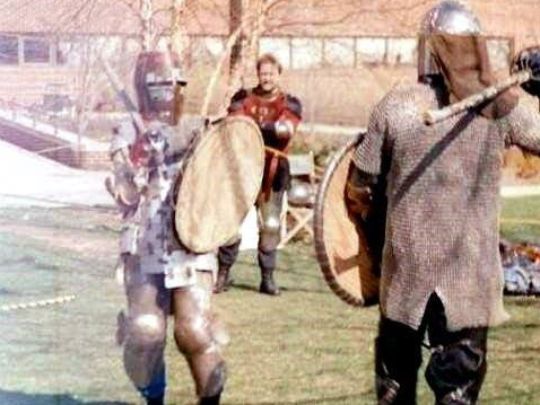
Dolley would don armor and engage in unchoreographed fights using rattan swords, which are safer than steel. She fought against men who stood taller than 6 feet and had 20 years experience.
In the beginning, her opponents could guess her moves because she was afraid she was going to hurt someone, she said, so an early lesson was to move confidently and aggressively after someone.
Now Dolley is using those lessons to help in roller derby, where she's a new recruit known as Foul Morguean with Naptown Roller Girls.
The lessons helped during Thursday’s break-in too, she said.
“I definitely don’t need to work on my aggression, I guess,” Dolley said.
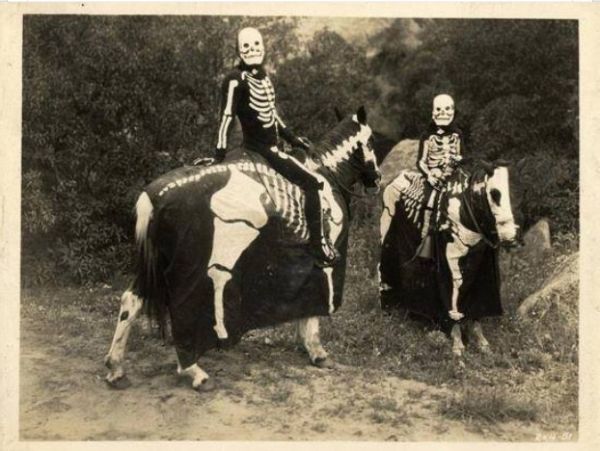
Vintage Halloween Photos

Gruesome Halloween Display Has Neighborhood Kids Running Scared
When it comes to decorating
for Halloween there's a fine line between suitably scary and downright
disturbing, and sometimes we Halloweenies have to reel in our morbid
imaginations a bit so we don't scare off all the trick-or-treaters.
But, as the Barrett household in Parma, Ohio discovered, you should use even more discretion when you live a block away from an elementary school or prepare to incur parental wrath.

Kids
and parents alike feel that the decorations, which include an impaled
body, a body wrapped in plastic hanging from a tree and a figure
crucified upside down, are too disturbingly realistic to have up around
children.
The decorations seem perfect
for a haunted house or an area with fewer kids, but a display that
gruesome is guaranteed to keep kids from trick-or-treating at their
house of horrors, and where's the fun in that?!
Mel Brooks’ High-Quality Low Comedy

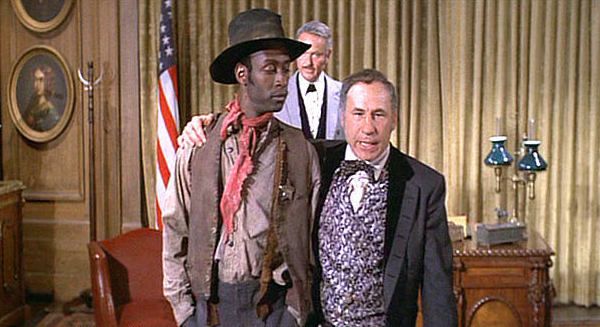
Brooks would push this kind of taboo-breaking even further in Blazing Saddles (1974), a comedy that still feels daring for its bomb-throwing at some of America’s touchiest subjects.Brooks' genius can be hard to parse for those who weren’t there in the context of the times, but the A.V. Club deconstructs his filmography with some recommendations for a newbie to enjoy. And for older fans, it’s an excuse to watch Young Frankenstein again.
Saddles is Brooks’ first movie spoof, but rather than sending up a specific film, as he would do later, he takes aim at the underlying themes of the Western genre. Watch a classic oater and you’ll likely encounter a lot of cringe-worthy racism and scenes of white men mowing down non-white characters on their path to manifest destiny. In a fairly radical move for a Western, let alone a comic one, Saddles makes the cowboys and government the enemy because of their racism. And Brooks makes it clear that his critique doesn’t just apply to the Old West, but to modern society as well. (Richard Pryor was a co-writer.)
Which Languages Will Thrive in the Future?
Will English still be a dominant language 100 years from now?
We take a look at what the landscape of language might look like in
future generations.
Do We All Hallucinate?
Even healthy people hallucinate, reports a new study. We think we see things based on our prior experiences.
In females, childhood head injury could lead to alcohol abuse later in life
Food Chain Collapse Predicted in World's Oceans
Rising carbon dioxide emissions could cause a collapse in the marine food chain from the top down.
Earth's Frozen Center Formed a Billion Years Ago
Bacteria Is Literally Everywhere
In us, on us, and everywhere around us is something that's
guaranteed to make you squirm just thinking about it: bacteria. In fact,
we each trail our own personal microbial cloud of it wherever we go.
Genes linked with malaria’s virulence shared by apes, humans
Birds and T-rex share common past
Animal News
The reddish-brown creature is about the size of a squirrel
and has been named for businessman and philanthropist Andy Sabin.
A hamadryas baboon at an English zoo puts a premium on personal grooming.
Ants in Australia's semi-arid areas routinely carry seeds half their size over distances of 50 meters.
Wednesday, October 14, 2015
The Daily Drift
Welcome to the Wednesday Edition of Carolina Naturally.
~ Brain and Marsha James
Our latest comment:
We really enjoy reading this blog.
Carolina Naturally is read in 205 countries around the world daily.
Today is - Stop Bullying Day
You want the unvarnished truth?
Don't forget to visit: The Truth Be Told
Some of our readers today have been in:
The Americas
Argentina - Bolivia - Brazil - Canada - Chile - Colombia - Jamaica - Mexico - Nicaragua
Puerto Rico - United States - Venezuela
Europe
Bosnia/Herzegovina
- Bulgaria - Czech Republic - England - Finland - France - Germany -
Hungary Ireland - Italy - Latvia - Netherlands - Poland - Portugal -
Romania - Russia - Scotland - Serbia Slovenia - Spain - Sweden -
Switzerland - Turkey - Ukraine - Wales
Asia
Bangladesh - India - Indonesia - Iran - Jordan - Mauritius - Saudi Arabia - Thailand
Africa
Madagascar - South Africa - Tanzania
The Pacific
Australia - PhilippinesToday in History
| 1066 | William of Normandy defeats King Harold in the Battle of Hastings. | |
| 1651 | Laws are passed in Massachusetts forbidding the poor to adopt excessive styles of dress. | |
| 1705 | The English Navy captures Barcelona in Spain. | |
| 1773 | Britain’s East India Company tea ships’ cargo is burned at Annapolis, Md. | |
| 1806 | Napoleon Bonaparte crushes the Prussian army at Jena, Germany. | |
| 1832 | Blackfeet Indians attack American Fur Company trappers near Montana’s Jefferson River, killing one. | |
| 1884 | Transparent paper-strip photographic film is patented by George Eastman. | |
| 1912 | Former U.S. President Theodore Roosevelt is shot and wounded in assassination attempt in Milwaukee. He was saved by the papers in his breast pocket and, though wounded, insisted on finishing his speech. | |
| 1917 | Mata Hari, a Paris dancer, is executed by the French after being convicted of passing military secrets to the Germans. | |
| 1930 | Singer Ethel Merman stuns the audience when she holds a high C for sixteen bars while singing "I Got Rhythm" during her Broadway debut in Gershwin’s Girl Crazy. | |
| 1933 | The Geneva disarmament conference breaks up as Germany proclaims withdrawal from the disarmament initiative, as well as from the League of Nations, effective October 23. This begins German policy of independent action in foreign affairs. | |
| 1944 | German Field Marshal Rommel, suspected of complicity in the July 20th plot against Hitler, is visited at home by two of Hitler’s staff and given the choice of public trial or suicide by poison. He chooses suicide and it is announced that he died of wounds. | |
| 1947 | Test pilot Chuck Yeager breaks the sound barrier aboard a Bell X-1 rocket plane. | |
| 1950 | Chinese Communist Forces begin to infiltrate the North Korean Army. | |
| 1962 | Cuban Missile Crisis begins; USAF U-2 reconnaissance pilot photographs Cubans installing Soviet-made missiles capable of carrying nuclear warheads. | |
| 1964 | Rev. Martin Luther King is awarded the Nobel Peace Prize for advocating a policy of non-violence. | |
| 1966 | Montreal, Quebec, Canada, opens its underground Montreal Metro rapid-transit system. | |
| 1968 | US Defense Department announces 24,000 soldiers and Marines will be sent back to Vietnam for involuntary second tours of duty. | |
| 1968 | Jim Hines, USA, breaks the "ten-second barrier" in the 100-meter sprint at the Olympics in Mexico City; his time was 9.95. | |
| 1969 | The British 50-pence coin enters the UK’s currency, the first step toward covering to a decimal system, which was planned for 1971. | |
| 1983 | Prime Minister of Grenada Maurice Bishop overthrown and later executed by a military coup. | |
| 1994 | Nobel Peace Prize awarded to Palestinian leader Yasser Arafat, Israel’s Prime Minister Yitzhak Rabin and Israeli Foreign Minister Shimon Peres for establishing the Oslo Accords and preparing for Palestinian Self Government. | |
| 1998 | Eric Robert Rudolph charged with the 1996 bombing during the Summer Olympics in Atlanta, Georgia; It was one of several bombing incidents Rudolph carried out to protest legalized abortion in the US. | |
| 2012 | Felix Baumgartner breaks the world record for highest manned balloon flight, highest parachute jump, and greatest free-fall velocity, parachuting from an altitude of approximately 24 miles (39km). |
Meet The Awesome Cop Who Is Showing The World What Policing Is Really About
Why can’t more cops follow this amazing man’s example?
Read more
Read more
‘Bunny Ranch’ Brothel Owner Steps Up To Help His Employees With Student Loan Debt
This Tiny Country Is Going 100 Percent Organic
by Natasha Geiling
Rice fields in Bhutan.
In 2011, the tiny mountain nation of Bhutan announced a lofty
goal: make the country’s agricultural system 100 percent organic by the
year 2020. If it succeeded, it would be the first country in the world
to achieve the feat. Bhutan — nestled in the Himalayas between India and China — only has about 700,000 people living within its borders, and most are farmers. It’s a majority Buddhist kingdom, and its culture reflects several key When we say happiness, it’s not just happiness of humans. It’s happiness of the soil, happiness of the animals, happiness of all sentient beings In many ways, Bhutan’s size and Buddhist culture makes it the perfect testing ground for transitioning to a completely organic agricultural system. But would such a shift ever be possible for a larger country, like the United States?“For a country like Bhutan, there are some things that are a lot easier, because they are a smaller country,” Kristine Nichols, chief scientist at the Rodale Institute, a nonprofit that supports research into organic farming, said. “When you’re looking at a country like the U.S., if we were to go 100 percent organic, more than likely it isn’t going to be an instantaneous process. It’s going to be a transition process.”
Sowing the seeds of organic agriculture in Bhutan
Bhutan is currently still in the middle of that transition process,
though the small country had a few things already working in its favor
even before 2011. Bhutan is the only country in the world that rejects
gross domestic product (GDP) as a measure of progress. Since 1971, the
country has instead relied on a measurement known as gross domestic
happiness — a benchmark that seeks to quantify the happiness and health
of the entire country.“When we say happiness, it’s not just happiness of humans. It’s happiness of the soil, happiness of the animals, happiness of all sentient beings,” Appachanda Thimmaiah, Bhutan’s agricultural adviser from 2008 to 2013 and associate professor of sustainable living at Maharishi University of Management in Iowa, said. “Organic farming was very much part of the gross national happiness. You cannot think about applying chemical fertilizers and pesticides and say that your country is happy.”
That’s a cultural philosophy, Thimmaiah said, that he doesn’t see present in the United States.
“Here, we use the word ‘dirt’ for the ‘soil,’ from a very young age,” he said. “That gets ingrained in the mind, and as the child grows up, the child thinks soil is dirty, so what’s the problem in applying pesticide?”
Beginning in 2008, Thimmaiah worked with the Bhutanese government to help the country begin its transition to 100 percent organic agriculture, a partnership that culminated in the development of a National Organic Policy. A crucial part of implementing Bhutan’s NOP, Thimmaiah said, was expanding the educational resources for farmers — beginning with something as simple as redefining the idea of “organic agriculture.”
“I used a term called low-cost agriculture; I didn’t use the word organic agriculture,” Thimmaiah said. “I told them that our main purpose should be to reduce the cost of production.”
For Bhutan, with its mountainous topography, Thimmaiah was confident that organic agriculture, when done correctly, would be more cost-effective than the transportation costs associated with shipping chemical fertilizer throughout the country. Thimmaiah also worked to help farmers understand organic agriculture as being complementary to the local resources — and even waste products — of Bhutan.
…other countries can also emulate these things That meant everything from teaching farmers how to produce their own pollinated heirloom seeds to reusing animal waste for manure. Many Bhutanese farmers, for instance, used to keep their livestock outside, tied to trees or in pastures. Thimmaiah encouraged them to build sheds with concrete floors that could help collect the livestock’s waste and urine, which could then be used to help fertilize the crops.“I think this was really key — demonstration of simple, low cost techniques that utilized the local, available resources,” he said. “If it’s about buying inputs, organic farming cannot be successful. The most important thing in organic farming is to see that all the inputs that are required are produced in the farm itself by the farmers by utilizing the locally available resources.”
Thimmaiah says that Bhutan possesses both the political will and farmer interest to succeed in its goal of transitioning to 100 percent organic agriculture by 2020, but notes that there are some existing hurdles, as the country’s population continues to shift from rural to increasingly urban. And even if the country manages to transition, it still will likely rely heavily on imported food — right now, less than 4 percent of Bhutan’s land is under cultivation, though its agricultural productivity has increased 3 percent since beginning its organic push, according to Reuters.
To Thimmaiah, it’s crucial that the government be involved in the transition and support farmers as they make the move from conventional to organic.
“It’s a responsibility of the country to help them, to regard the good work by the farmers,” he said, adding that “other countries can also emulate these things.”
What would it mean for the United States to go 100 percent organic?
If the United States wanted to transition to 100 percent organic
agriculture, Nichols explained, the first steps wouldn’t be much
different from the path taken in Bhutan.“From a government standpoint as well as a private industry standpoint, there needs to be support for these transitioning farmers,” Nichols said. “Without support, it can be difficult for many farmers to survive that transition process.”
In general, organic agriculture is a system that relies on cover crops and crop rotation to ensure soil health, and stresses the reduction of external and off-farm inputs. Organic farming, as a rule, eschews genetically modified crops, and some kinds of organic farming rely more on crop diversity to combat weeds and pests than pesticides and herbicides. But there are different levels to organic agriculture — not all organic practices completely reject pesticides, for instance. Some organic farms do use pesticides, they just use ones that are derived from natural, not synthetic, sources (and sometimes, those pesticides can be more harmful than chemical ones). And organic farming doesn’t necessarily mean small-scale farming — there is still industrial organic farming, and at least one study has suggested that large-scale organic farming is more carbon-intensive than conventional farming.
Nichols explained that, at least initially, farmers transitioning from conventional to organic agriculture often see their yields decrease, though she notes that several studies have shown marginal decreases in yields over the long-term. It’s worth noting that those studies, however, tend to compare best organic farming practices — like crop rotation and crop diversity — to a type of conventional agriculture that fails to use those practices. When conventional agriculture employs those conservation practices, the Genetic Literacy Project notes, the gap between conventional yields and organic yields widens.
It’s also important to note, however, that much of the grain — especially corn and soy — grown in the United States via conventional farming isn’t intended for human consumption. The vast majority of U.S. domestic corn is used for ethanol fuel or animal feed, leaving a relatively small sliver of the total production for food.
Nichols also notes a lack of infrastructure support for farmers hoping to transition from conventional to organic agriculture — most grain elevators, for instance, are set up to process non-organic grains, meaning that farmers that grow organic could be forced to transport their product long distances for processing, a cost that could negate the economic premium that organic products tend to collect at market. Another hurdle for farmers — at least as long as organic is still the minority production method — is obtaining an organic certification, which can be prohibitively expensive for some small operations.
I tell people, being an organic farmer is a lot more like raising kids than making cars “There’s a lot of infrastructure things that would need to go into a large country like the United States becoming 100 percent organic,” Nichols said. “In a smaller country, where you’re closer to population centers, what you’re producing can be more directly marketed.”John Ikerd, professor emeritus of Agricultural & Applied Economics University of Missouri Columbia, also notes that food prices would potentially increase if the United States were to switch to a 100 percent organic agricultural system — but he argues that the increase would not be insurmountable for the consumer.
“The studies that have been done on this indicate if we shifted to a sustainable system, we’d probably increase retail food prices by eight to twelve percent,” Ikerd said. But, he continued, using the majority of corn produced for either ethanol or livestock feed also raises food prices. “We’ve seen retail food prices go up more than that as a consequence of the corn ethanol program,” Ikerd explained. “When we take 40 percent of the U.S. corn crop and burn it in our cars, that takes all of that land out of producing food for either livestock or people.”
In the long term, Ikerd argues, organic agriculture is less costly than conventional agriculture, because the current price of conventional agriculture doesn’t include any of its detrimental effects on the environment, like dead zones and algal blooms from fertilizer runoff or carbon emissions from soil degradation.
“What makes these industrial operations more economically competitive is that they’re not paying the full environmental and social cost of what they’re doing,” Ikerd said. “When you shift to an agriculture that does not impose any of those costs on the environment or the people that work on that system, you’re going to have increased costs in the short term. In the long term, we’ll find that the organic system is less costly.”
In the end, Ikerd, Nelson, and Thimmaiah all agree that for the United States to switch to 100 percent organic agriculture, it would require a massive overhaul of our priorities, at a federal, industrial, and consumer level.
“The main thing is the mindset,” Ikerd said. “It’s a different way of thinking about what agriculture is. I tell people, being an organic farmer is a lot more like raising kids than making cars.”
Sponge Bikini Cleans the Ocean as You Swim

This material has multi-model porosity (micro/mezzo/macro porous) that allows it to be a light yet strong absorber with its undulating texture (visible through Electron Microscope). Absorbing everything but water, the material is a powerful tool for water and contaminant separation. The super-porous nature allows the Sponge to absorb in high capacity, up to 25 times of its own weight depending on the density of the substance absorbed. The Sponge does not release the absorbed materials unless it is heated in high temperatures (1,000 degrees Celsius) to re-obtain its original liquid form. This property allows the Sponge to be recyclable as the liquid form is ready to be reshaped having been separated from its contaminants.
Watch what happens when Westboro baptist cult are confronted by high school protesters
Watch as a crowd of high school students gloriously jeer and taunt the Westboro Baptist hate mongers into a full retreat.
LBGTQ Nation shares the story:
When members of the Westboro baptist cult showed up at a high school campus in Kansas City, Missouri to protest the recent election of a trans girl as homecoming queen, a group of high school students were not pleased. As members of the hate group congregated outside Oak Park High School, waving their usual “Dog Hates Fags” signs, they quickly faced a group of counter-protesters, carrying signs that read “Westboro baptist cult need jesus” and chanting “Long live the queen!”
When the hate group saw the mob of students heading their way, they realized they outnumbered and immediately ran to the safety of their minivan. As they skidded away hastily, students cheered.
Why are some 'christians' so hung up on same-sex marriage?
Use FoxType to Be More Polite

FoxType offers an interactive tool that it purports will assess the politeness of text. It will make suggestions for how you could rephrase your words so as to create a better impression.
The Worst Car In The World

Read more about this test drive at Jalopnik.
The Hoffmann was made in Germany right after the war by one M. Hoffmann, a man no one seems to know much about. I’m not entirely sold on the idea he was a human at all, actually. Whatever he was, he had real skill — the car is actually beautifully built, with lots of difficult metalwork and fabrication evident throughout.The good news about the Hoffman is that there was only one built. Read more about the Hoffman here.
Dallas Cowboys Gunman shoots man in head
The man who shot another man in the head
after a Dallas Cowboys football game was reportedly egged on by the
crowd of people watching the fight.
Waffle House Murderer Evades Justice
Fox News Blames Jews for Dying During the Holocaust
What is Happening to America?
Ablow wrote the following, which is posted at FoxNews.com:
If Jews in Germany had more actively resisted the Nazi party or the Nazi regime and had diagnosed it as a malignant and deadly cancer from the start, there would, indeed, have been a chance for the people of that country and the world to be moved to action by their bold refusal to be enslaved.It is beyond offensive for Fox News to publish any type of suggestion that the Jews are to blame for the massacre of 6,000,000 Jews by the Nazi regime. Moreover, it fails to address the fact that the Nazis also killed approximately 5,000,000 non-Jews. Were these other 5,000,000 people simply cowards and weak who contributed to their own death? Fox News also fails to recognize that approximately half of those killed were women and children.
Yes, that would have required immeasurable courage. Yes, that would have required unspeakable losses. But is that not the lesson of the Old Testament? Does not Abraham bind his son Issac to an altar, willing to sacrifice his son’s life to God’s Word—to the truth? Must not we all be ready to sacrifice ourselves to stand in the way of evil?
Granted, I was not there. Granted, hindsight is 20/20. But it turns out it was a bad idea for any Jew to have turned over a gun. It was a bad idea for any Jew to have boarded a train. It was a bad idea for any Jew to have passed through a gate into a camp. It was a bad idea for any Jew to do any work at any such camp. It was a bad idea for any Jew to not attempt to crush the skull or scratch out the eyes of any Nazi who turned his back for one moment. And every bullet that would have been fired into a Nazi coming to a doorway to confiscate a gun from a Jew would have been a sacred bullet.
Finally, as always, Fox News fails to perform any research. There was Jewish armed resistance during the Nazi regime. It proved futile, as those resisting were trying to battle one of the most powerful military machines in history, which successfully conquered numerous countries.
As stated in WikiPedia:
Between April and May 1943, Jewish men and women of the Warsaw Ghetto took up arms and rebelled against the Nazis after it became clear that the Germans were deporting remaining Ghetto inhabitants to the Treblinka extermination camp. Warsaw Jews of the Jewish Combat Organization and the Jewish Military Union fought the Germans with a handful of small arms and Molotov cocktails, as Polish resistance attacked from the outside in support. After fierce fighting, vastly superior German forces pacified the Warsaw Ghetto and either murdered or deported all of the remaining inhabitants to the Nazi killing centers. The Germans claimed that they lost 18 dead and 85 wounded, though this figure has been disputed, with resistance leader Marek Edelman estimating 300 German casualties. Some 13,000 Jews were killed, and 56,885 were deported to concentration camps. There were many other major and minor ghetto uprisings, however most were not successful. Some of the ghetto uprisings include the Białystok Ghetto Uprising and the Częstochowa Ghetto Uprising.To read the entire offensive article by Fox News, (if you can stonach the sputum, that is), click Why Carson is right about Jews, the Holocaust and guns.
**********10
Ten Bizarre Tales Surrounding Adolf Hitler
Eva Braun and Adolf Hitler with their dogs
After
Adolf Hitler lost in his bid for the 1932 German presidential election,
his team of supporters decided that he was badly in need of a public
relations makeover. Heinrich Hoffman, Hitler's photographer, had his job
cut out for him, but he was up for the challenge. The result of his
work was the 1932 book The Hitler Nobody Knows.Hoffman's book purported that the Hitler nobody knew wasn't an antisemetic egomaniacal lunatic, but a man who was the embodiment of “STRENGTH and GOODNESS”; a “NON-DRINKER, NON-SMOKER, and VEGETARIAN.” Photos of Hitler as a baby, as an adult frolicking with baby deer and dogs, and showing him as a busy, hardworking and competent politician were featured. The book worked like a charm. It became incredibly popular, selling 400,000 copies in 1942. American magazines also lent a hand in Hitler's public relations campaign. Vogue and New York Times magazines ran flattering puff pieces about Hitler that contained tours of his home and painted a picture of him as a simple, kindly gentleman. It wasn't until the war that people learned the truth about the Hitler nobody knew.
The Tragic Story of Mt. Everest’s Most Famous Dead Body

A quiet middle child with five siblings, Paljor was known in the village for his polite, compassionate manner. He had a big heart and natural kindness. Though good-looking, even as a teen Paljor never had a girlfriend – he was simply too shy. He once told his brother that he was more interested in dedicating his life to something bigger than himself than in getting married.The article at BBC Future follows Paljor on his quest to summit Everest, and the story of what went wrong on the mountain almost twenty years ago. Part two of the series deals with what happened to Paljor’s body and the other 200 or so corpses still on Mt. Everest.
As the eldest son, Paljor no doubt felt pressured to provide for his family, which was struggling to make ends meet at their modest farm. So after completing 10th grade, he quit school and tried out for the Indo-Tibetan Border Police (ITBP), whose sprawling campus was located in nearby Leh, Ladakh’s dusty capital. Formed in 1962 in response to increasing hostilities from China, the men who serve in that armed force specialise in high altitude landscapes – a necessity given that India’s border with its domineering neighbour stretches across the Himalayas. To Paljor and his family’s delight, he made the cut.
10 Graveside Traditions at Famous Tombs

We’ve brought you reports for years on the Poe Toaster, the mysterious person who visits Edgar Allan Poe’s grave on his birthday with roses a toast of cognac. Or at least we did until 2009, when he made his last visit. Poe’s is far from the only gravesite in which people carry on strange traditions. Take, for example, the grave of Victor Noir, a French author who was shot by Napoleon’s great-nephew.
Poor Victor Noir's grave at Père Lachaise is home to one of the more lascivious cemetery traditions. Noir was a journalist who died in an 1870 duel, and later became a hero to Napoleon III's opponents. But his life story seemingly has little to do with the tradition invented by a tour guide in the 1970s, who said that rubbing the lump in the trousers on Noir's memorial would bring luck in love. Tourists were also told to kiss Noir's lips, and leave flowers in his hat. Decades of tourists have done the same, even though in 2004, the city briefly erected a fence around the statue and a sign prohibiting "indecent rubbing."That barrier was removed by popular demand. Read about nine other gravesites and the odd traditions for those who visit, at mental_floss.
Why Elephants Don't Get Cancer

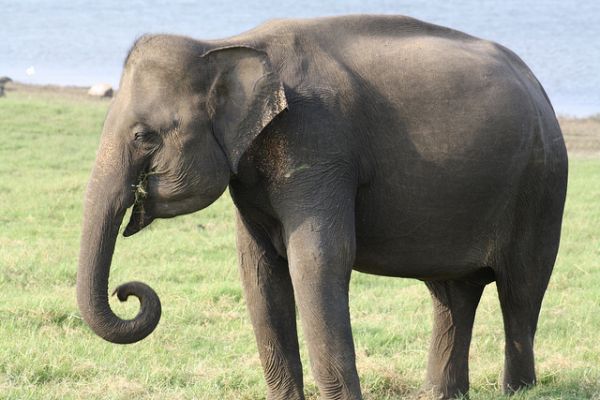
The cells of older and larger animals divide more times than those of smaller and younger animals. So, hypothetically, large animals that live a long time should be at greater risk for developing cancer. Ewen Callaway describes in Scientific American the paradox developed by epidemiologist Richard Peto:
Peto noted that, in general, there is little relationship between cancer rates and the body size or age of animals. That is surprising: the cells of large-bodied or older animals should have divided many more times than those of smaller or younger ones, so should possess more random mutations predisposing them to cancer. Peto speculated that there might be an intrinsic biological mechanism that protects cells from cancer as they age and expand.It is very rare for the notably large and long-lived elephants to have cancer. Why? Two scientific papers that were recently and independently published explain that elephants have multiple copies of a cancer-fighting gene:
Elephants have 20 copies of a gene called p53 (or, more properly, TP53), in their genome, where humans and other mammals have only one. The gene is known as a tumor suppressor, and it snaps to action when cells suffer DNA damage, churning out copies of its associated p53 protein and either repairing the damage or killing off the cell.
Subscribe to:
Posts (Atom)