Average Americans have put away only $20,000 of the $300,000 they expect to need.
Also: Welcome to ...
The place where the world comes together in honesty and mirth.
Windmills Tilted, Scared Cows Butchered, Lies Skewered on the Lance of Reality ... or something to that effect.
Thursday, December 9, 2010
On The Job
Some companies are on the attack against the “Ferris Bueller” phenomenon.
Also: Look for job growth in these fields, due to trends in tech, health care, and education.
Also: Real estate winners, losers
Despite one of the worst recessions in history, some real estate markets held onto their gains.
Also: Billionaire's art island
A Russian steel magnate may convert a deserted island into a home for his vast collection.
Also: Six forgotten vacation spots
One famous spring-break beach town is now a luxury family-friendly destination.
Also: Weird Science
Scientists have rediscovered a bizarre insect in Kenya, collecting the first Terrible Hairy Fly specimen since 1948.
Researchers say a curled-up brown fossil dredged up off the Dutch coast is an ancient piece of hyena dung, the first found in the North Sea dating back to the Late Pleistocene era, 12,000-100,000 years ago.
NASA’s 3D Tour of the Known Universe
Fifteen Alien Vegetables Found on Earth
The salak fruit, native to Indonesia, has an outer skin resembling that of a snake. The pulp inside divides into three edible lobes. Agriculture Guide has pictures of this fruit and fourteen other odd-looking fruits and vegetables.
Paris hit by huge snowfall
The largest storm in decades blankets the city, closing the Eiffel Tower and stranding commuters.
Also: Dazzling sky shows ahead
Don't miss a chance to catch a massive meteor shower and a sight that won't be repeated until 2014.
Also: Laser beams endanger planes
The FAA warns of a startling increase in reports of beams pointed at cockpits from the ground.
Also: Ship slammed by massive waves
An Antarctic vessel slams into treacherous waters measuring three stories high.
Also: Backlash over NASA discovery
The breakthrough that captivated the world sparks a backlash from some experts.
Also: New organism ravages Titanic
Scientists say a strange bacteria strain is one thing eating away at the historic ship's wreckage.
Also: Frog and Toad Bladders Hunt and Remove Foreign Objects
At Wired, Dave Mosher writes:
They enlisted five green tree frogs and five cane toads, implanting small inert beads in each the same way they implanted the radio transmitters. Each tree frog expelled its bead within 23 days. One cane toad also gave its bead the boot, and the beads in the other four toads had migrated to their bladders.
To unravel the secrets of the process, the zoologists implanted beads in 31 more cane toads, toxic amphibians native to South America but introduced to northeastern Australia in 1935 to control beetle infestations. (Since then, Shine says, the toads have become invasive and poisoned populations of large predators such as pythons. As a result, ecologists now closely track their numbers and behavior.)
Toads dissected on sequential days revealed that the bladder grew a thin offshoot of cells to surround the bead, which later developed into mature, bladder-like tissue and merged with the organ’s main cavity. From there, they “floated freely in the urine” and were peed out if near the bladder’s opening.
Ten Weirdest New Animals of 2010
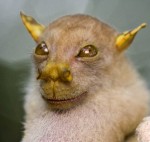
National Geographic posts many lists in December rounding up up the top ten of subjects you won’t find anywhere else. The Ten Weirdest New Animals of 2010 has quite a few we’ve posted about, but seeing them all in one gallery is almost startling. Yes, the tiny purple octopus is there, and the snub-nosed monkey, and this friendly-looking bat.
This tube-nosed fruit bat—which became a Web sensation as “Yoda bat”—is just one of the roughly 200 species encountered during two scientific expeditions to Papua New Guinea in 2009, scientists announced in October.
Though seen on previous expeditions, the bat has yet to be formally documented as a new species, or even named. Like other fruit bats, though, it disperses seeds from the fruit in its diet, perhaps making the flying mammal crucial to its tropical rain forest ecosystem.
Subscribe to:
Posts (Atom)