Welcome to ...

The place where the world comes together in honesty and mirth.
Windmills Tilted, Scared Cows Butchered, Lies Skewered on the Lance of Reality ... or something to that effect.


Friday, August 30, 2013

The Birth of the Bleep

Curses!
The Verge has an extensive article on the rise of broadcast censorship. Despite the devotion to freedom of speech, broadcasters have always been terrified of audience response, and did what they could to avoid offending anyone. The first incidence of broadcast censorship occurred in 1921, when Vaudeville performer Olga Petrova visited one of the earliest radio stations. Petrova was known to be opinionated, and a friend of birth control advocate Margaret sanger.
One night in 1921, Petrova, then engaged at a Newark theater, went to the local radio station WJZ to perform. The Great War had just ended, during the course of which the government had forbidden the use of private radio equipment. After the armistice the Navy tried to retain monopoly control of radio, but Congress put a stop to their power grab. Wartime restrictions were lifted, but the pioneers of broadcasting such as those at WJZ were mindful of potential government interference, and Petrova had a reputation as a firebrand. She disarmed her hosts by announcing that she would be performing her own versions of Mother Goose rhymes, and then proceeded to read the following:
There was an old woman who lived in a shoe, She had so many children because she didn’t know what to do.
The 1873 Comstock laws, which banned the distribution of “obscene” materials, including information about contraception, were still in force; Petrova had, arguably, kind of broken the law.
"The means for censoring broadcast content came years before the emergence of the first national broadcast network"

“The staff was terrified,” Barnouw relates. “They were certain there would be trouble from Washington. Westinghouse [then owner of WJZ] executives were already nervous about possibilities of this sort, and had wondered what to do if a 'red' got on the air. An emergency switch was provided for the engineer in the shack.” Thus, he could switch to that “phonograph beside him — on his own judgment or on a signal from the studio.”
Petrova marveled at how broadcasters had to take control over the possibility of offending, as if listeners at home could not control their own radios. That was just the beginning of a system that evolved to protect the delicate sensibilities of the general public. More

Ziggy

http://media.zenfs.com/en_us/News/ucomics.com/zi130829.gif

Can a Messy Desk Make You More Creative?


One of my favorite adages is "An uncluttered desk is the sign of an uncluttered mind." It appears to be true that a messy desk fosters creativity. Kathleen Vohs of the University of Minnesota cites three experiments in which a neat or messy setting influenced a person's thinking process. In one experiment, 48 subjects were placed in either a neat or a messy room, and told to come up with creative uses for ping pong balls.
Two assistants rated each idea on a one-to-three scale (from not at all creative to very creative). After adding the scores, the researchers found that those who worked in the messy room were more creative overall, and came up with more highly creative ideas, than those who performed the same task in the neat room. On average, those working in the pristine environment came up with as many suggestions as those in the messy one; their ideas just weren’t as innovative.

“Being creative is aided by breaking away from tradition, order and convention,” Vohs and her colleagues conclude, “and a disorderly environment seems to help people do just that.”
An interesting observation here is that the subjects did not select whether their experimental environment was neat or messy, so a person's natural messiness or creativity did not come into play. And a neat desk has its advantages, too. Vohs tells us of other experiments in which people working in a neater environment tended to be more generous and to select more nutritious foods afterward. More

The US Built and Operated Aircraft Carriers on the Great Lakes during World War II


During World War II, the US converted two sidewheel steamships into aircraft carriers and operated them entirely on the Great Lakes. But their mission wasn't to guard America's freshwater border with Canada. The USS Sable and the USS Wolverine (pictured above) were training vessels for pilots.
I learned about these carriers through a post written by Glenn Reynolds. He comments:
You know, Nick McCall and I were going to write a novel about a U-boat in the Great Lakes, being chased by, among other things, these very carriers, but we couldn’t come up with a good way to get it there. 
That would be a fine alternate history challenge!

How to Treat College Freshmen in 1495

Ask the Past is a delightful blog that conveys medieval advice to modern readers. For example, would you like to haze college freshmen? According to a Leipzig University statute promulgated in 1495, it is forbidden:
Statute Forbidding Any One to Annoy or Unduly Injure the Freshmen. Each and every one attached to this university is forbidden to offend with insult, torment, harass, drench with water or urine, throw on or defile with dust or any filth, mock by whistling, cry at them with a terrifying voice, or dare to molest in any way whatsoever physically or severely, any, who are called freshmen, in the market, streets, courts, colleges and living houses, or any place whatsoever, and particularly in the present college, when they have entered in order to matriculate or are leaving after matriculation.
Behave yourselves.

In Peru, drones help map archaeological treasures

Luis Jaime Castillo, a Peruvian archaeologist with Lima’s Catholic University and an incoming deputy culture minister, flies a drone over the archaeological site of Cerro Chepen in Trujillo August 3, 2013. Reuters / Mariana Bazo
In Peru, Archaeologists are using drones to "help set boundaries to protect sites, watch over them and monitor threats, and create a digital repository of ruins that can help build awareness and aid in the reconstruction of any damage done," according to this Reuters item. The Peruvian government "plans to buy several drones to use at different sites, and [says] the technology will help the ministry comply with a new, business-friendly law that has tightened the deadline for determining whether land slated for development might contain cultural artifacts."
"Commercial drones made by the Swiss company senseFly and the U.S. firms Aurora Flight Sciences and Helicopter World have all flown Peruvian skies." Read the full article over at Skift.

Awesome Pictures

Honey The Magical, Immortal Superfood

Honey is awesome, and we're not talkin' just the taste. It can do things no other food can do! Anthony dishes on this magical golden treat.

Mustard Spiced Ancient European Cuisine

Ancient northern Europeans spiced their venison, seafood and other dishes with tangy mustard seeds

Higher temperatures ...

Hgher food prices.
Higher the flares of tempers.
Oh, yeah. there are "good times" ahead.
The earth’s rising temperature also affects crop yields indirectly via the melting of mountain glaciers. As the larger glaciers shrink and the smaller ones disappear, the ice melt that sustains rivers, and the irrigation systems dependent on them, will diminish. the continuing loss of mountain glaciers and the resulting reduced meltwater runoff could create unprecedented water shortages and political instability in some of the world’s more densely populated countries. - More

Earth News

Nearly 70 percent of the groundwater stored in parts of the United States' High Plains Aquifer, could be used up within 50 years.
Calls for an active 2013 Atlantic hurricane season, with six to nine hurricanes, have been met with silence by Mother Nature so far.

Astronomical News

New results from NASA's Cassini spacecraft show Titan has an icy shell far more rigid and thicker than previously believed.
About 250 light-years away in the constellation Capricornus lies a star that looks awfully familiar.

Funny Pictures

Ocean Worm Wriggles Back Into View after 140 Years

A deep-sea worm last seen in 1873 has again been found living at the bottom of the ocean.
used up within 50 years.

Octopus limbs have a mind of their own

A couple of years ago, I recorded a talk on octopus neurobiology. One of the freakiest things you'll learn, if you watch it, is that an octopus' "brain" isn't really a centralized thing the way ours is. The processing capacity is distributed throughout the animal's body. At io9 today, Annalee Newitz writes about a new study that backs up that idea, demonstrating that disembodied octopus arms react to threats in ways a severed human hand never could.

It's A Pig's World

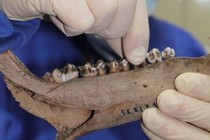
European hunter-gatherers owned pigs as early as 4600BC
European hunter-gatherers acquired domesticated pigs from nearby farmers as early as 4600BC, according to new evidence. European hunter-gatherers acquired domesticated pigs from nearby farmers as early as 4600BC, according to
Read more... 
Stone Age hunter-gatherers in Europe may have acquired pigs from settled farmers as long as 7,000 years ago.

Animal News

Like mobsters assassinating witnesses and informants, elephant and rhino poachers poison the carcasses of their quarry to kill vultures and thwart law enforcement efforts. 
A deep-sea squid pretends to be a small animal, by use of a hand puppet-like lure, fooling prey to approach ever closer before the squid attacks.
If you could clone a mammoth, would it be able to mate with an Asian elephant? And would it survive?
Rare and endangered animals may be legally hunted in parts of Africa, so long as the hunter is willing and able to pay the hefty price.

Animal Pictures

Thursday, August 29, 2013

The Daily Drift


Find your Peace ...!
 
Carolina Naturally is read in 192 countries around the world daily.

Herbs taste better! ...

Today is More Herbs, Less Salt Day  
 

Don't forget to visit our sister blog: It Is What It Is

Some of our readers today have been in:
Faisalabad and Islamabad, Pakistan
Rio De Janeiro, Curitiba and Sao Paulo, Brazil
Mississauga, Toronto, Fredericton, Thunder Bay, Templeton, Halifax, Longueuil and Saint John's, Canada
Merida, Mexico City and Ecatepec, Mexico
Dublin, Ireland
Ruse, Bulgaria
Terni, Rome, Milan, Padova and Florence, Italy
Grenoble, Rouen, Laval, Tencin, Roubaix and Longjumeau, France
Iasi, Bucharest and Cernavoda, Romania
Jakarta, Medan and Pontianak, Indonesia
Sandsli, and Oslo, Norway
Karur, Delhi, Pune, Hyderabad, New Delhi and Chennai, India
Dhaka, Bangladesh
Johannesburg, South Africa
Shah Alam and Kuala Lumpur, Malaysia
Ryazin, Russia
Riga, Latvia
Bangkok, Pathum Thani and Phasi Charoen, Thailand
Cebu City and Manila, Philippines
Santiago, Chile
Lima, Peru
Zhovti Vody and Kiev, Ukraine
Auckland, New Zealand
Brussels and Mechelen, Belgium
San Juan, Puerto Rico
Riyadh, Saudi Arabia
Bogota, Colombia
Madrid and Almeria, Spain
Bochum, Berlin and Nuremberg, Germany
London, England
Randers and Niva, Denmark
Lisbon, Portugal
Buenos Aires, Argentina
Graz, Austria
Sanaa, Yemen
Homebush, Australia
Tehran, Iran
Tallinn, Estonia
Nicosia, Cyprus
Douala, Cameroon

Today in History

70 The Temple of Jerusalem burns after a nine-month Roman siege.
1526 Ottoman Suleiman the Magnificent crushes a Hungarian army under Lewis II at the Battle of Mohacs.
1533 In Peru, the Inca chief Atahualpa is executed by orders of Francisco Pizarro, although the chief had already paid his ransom.
1776 General George Washington retreats during the night from Long Island to New York City.
1793 Slavery is abolished in Santo Domingo.
1862 Union General John Pope's army is defeated by a smaller Confederate force at the Second Battle of Bull Run.
1882 Australia defeats England in cricket for the first time. The following day a obituary appears in the Sporting Times addressed to the British team.
1942 The American Red Cross announces that Japan has refused to allow safe conduct for the passage of ships with supplies for American prisoners of war.
1945 U.S. airborne troops are landed in transport planes at Atsugi airfield, southwest of Tokyo, beginning the occupation of Japan.
1949 USSR explodes its first atomic bomb, "First Lightning."
1950 International Olympic Committee votes to allow West Germany and Japan to compete in 1952 games.
1952 In the largest bombing raid of the Korean War, 1,403 planes of the Far East Air Force bomb Pyongyang, North Korea.
1957 US Congress passes Civil Rights Act of 1957 after Strom Thurmond (Sen-D-SC) ends 24-hour filibuster, the longest in Senate history, against the bill.
1960 US U-2 spy plane spots SAM (surface-to-air) missile launch pads in Cuba.
1964 Mickey Mantle ties Babe Ruth's career strikeout record (1,330).
1965 Astronauts L. Gordon Cooper Jr. and Charles "Pete" Conrad Jr complete 120 Earth orbits in Gemini 5, marking the first time the US set an international duration record for a manned space mission.
1966 The Beatles give their last public concert (Candlestick Park, San Francisco).
1968 Democrats nominate Hubert H Humphrey for president at their Chicago convention.
1977 Lou Brock (St Louis Cardinals) breaks Ty Cobb's 49-year-old career stolen bases record at 893.
1986 Morocco's King Hassan II signs unity treaty with Libya's Muammar Gadhafi, strengthening political and economic ties and creating a mutual defense pact.
1991 USSR's parliament suspends Communist Party activities in the wake of a failed coup.
1992 Thousands of Germans demonstrate against a wave of racist attacks aimed at immigrants.
1995 NATO launches Operation Deliberate Force against Bosnian Serb forces.
2003 A terrorist bomb kills Ayatollah Sayed Mohammed Baqir al-Hakim, the Shia Muslim leader in Iraq, and nearly 100 worshipers as they leave a mosque in Najaf where the ayatollah had called for Iraqi unity.
2005 Rains from Hurricane Katrina cause a levee breech at the Industrial Canal in New Orleans, causing severe flooding.
2012 The Egyptian Army's Operation Eagle results in the deaths of 11 suspected terrorists and the arrest of another 23.