
Saturday, April 16, 2016
Fox News Will NEVER Be Able To Say ‘Fair And Balanced’ Again After What Hannity Just Did


Georgia woman says she had to let school principal paddle her son or go to jail

Math teacher goes bonkers after student reports him for watching porn in class

Dear Abby blames girl’s rape on communication breakdown in bewildering advice column gone wrong


You Don't Win Friends with Salad
We are proud to bring you a guest post from Ernie Smith, the editor of Tedium, a twice-weekly newsletter that hunts for the end of the long tail. In another life, he ran ShortFormBlog.

Salad Bar Origins
 Five other key points in salad bar history
In the 1950s, a restaurant called The Cliffs in Springfield, Illinois made its claim to being the originators of the “famous salad bar.” This postcard in the Illinois Digital Archive also makes the case. The Cliffs (which had air conditioning!) came around nearly two decades before Steak & Ale.
Chuck’s Steak House in Waikiki, first founded in 1959 is another of the claimants of having the first salad bar. The chain is still around today, somehow.
In 1971, the Chicago-based restaurant R.J. Grunts launched with a massive salad bar, complete with 40 different items. The restaurant, which ultimately begat a conglomerate called Lettuce Entertain You, was a key part of the salad bar becoming a trend in the 1970s.
The decision by Wendy’s to go all-in on salad bars in 1979 started a trend of salad bars at fast-food outlets, and Wendy’s was out front for much of that period—at one point extending the concept to a Superbar buffet. But Wendy’s eventually pulled out of the concept entirely in 2006—long after its competitors did the same.
In the early 1990s, the salad bar concept began to evolve in big cities, so that many smaller restaurants began to try it on for size. This is around the time that the salad bar concept moved away from all-you-can-eat to the scale-based format, which is also used in grocery stores. “Salad bars have become the cafeterias of the 90′s—cheap, convenient and with something for everyone,” The New York Times wrote about them in 1994.
 Pay by the pound: How Whole Foods ruined a good thing
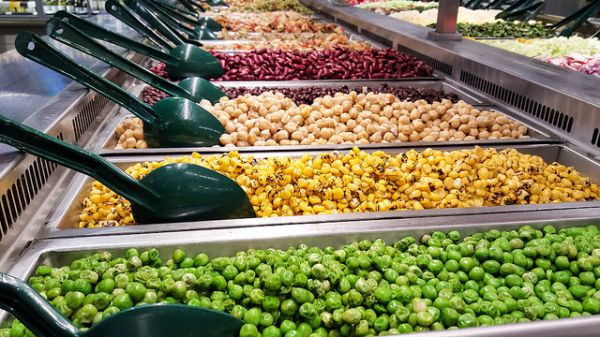
It’s arguable that the biggest problem Whole Foods has with the public is its scales. Its hot and cold salad bars, which would likely be considered a buffet if it didn’t charge by the ounce, probably do more than anything else to give the chain its reputation as “Whole Paycheck.”
Last year, the company found itself the target of some embarrassing headlines in New York City, which were caused in part due to “scales not being calibrated correctly.” The company responded with a blog post and video titled ”Addressing Weight and Pricing: A Message to Our Customers,” which featured two contrite-looking co-CEOs. It’s long been a big problem for the grocer, but it’s been much more of one for consumers, who end up paying extra cash for those rubber-band-wrapped boxes.
(The company eventually settled with the city for $500,000, which is bad, but not nearly as bad as the $800,000 Whole Foods paid out the year before over similar claims in California.)
But let’s assume the scales are calibrated correctly. The food’s pretty good, but there’s sure a lot of couscous, and heavy dressing in the mix. And at the hot bar, they sure are nudging you toward the mashed potatoes, the mac and cheese, and the red beans and rice, aren’t they?
That’s no accident, of course. Those salad bars are designed to be immensely profitable for Whole Foods, which most assuredly does not pay $8.99 per pound for all those ingredients.
Salad bars have in recent years become more aggressive at charging by weight, and they put out ingredients that are specifically designed to add weight, like croutons and dressings. (Many salad-bar strategy guides specifically recommend you buy the heavy ingredients separately and add them to your salad after the fact.)
But Whole Foods has taken this maximize-weight approach to a different level by putting particularly heavy things out there as options. The fried chicken and casserole prey on your worst nourishment tendencies, those moments of impulse that you would otherwise avoid at all costs. And for those who want to eat something more exotic—ooh, johnnycakes!—they have you covered, too.
They’re tricking you into getting more than you actually want, and by the time you’ve realized you’ve put $20 of stuff into a biodegradable bowl, it’s too late. It’s not like you’re gonna put that gravy-covered lump of mashed potato back, are you?
Whole Foods knows that this strategy is brilliant and effective, but it can in fact be defeated. In a 2011 New York Times Magazine piece, statistical genius Nate Silver recommended that people buy goods at the salad bar that cost as much or more elsewhere in the store. Instead of romaine lettuce, get in on the mesclun; get some blue cheese instead of the ranch; and get loads of exotic toppings, which often cost as much or more in the store than the salad you’re getting.
The scales may not be calibrated properly, but there’s still room for you to tip them in your favor.
 The Sneeze Guard
Is It Worth It?
So going back to the start of the piece, it’s worth asking—did those health inspectors who tried to put the kibosh on the school salad bars have a point? Even with the sneeze guards?
Last year, a South Carolina television station worked with a laboratory to test how safe a selection of salad bar food was. They overnighted the ingredients—a mix of raw and prepared food—to a Seattle-area lab, which did a variety of tests on the final result.
They found that while the food did not test positive for any of the tell signs of food poisoning—E. coli, listeria and salmonella—but much of the raw food did show signs of large numbers of microbes and coliform, some above the level of what was considered safe. But at the same time, IEH Laboratories CEO Dr. Mansour Samadpour tried to make clear that food isn’t meant to be sterile, and that coliform levels can seem unnaturally high.
Still, though, it’s a reminder that sneeze guards can only do so much.
The
salad bar is something that many restauranteurs claim to have
invented, but we know for sure that just one guy invented the sneeze
guard.
In January, a major lobbying group for the school
lunch industry won a victory that involved salad bars. The School
Nutrition Association, feeling the pressure because of what it called
arduous nutrition rules, fought for (and won) a slightly more reasonable policy,
including rules that specifically allowed schools to continue to offer
salad bars to those super-grubby, messy kids. Some local health
inspectors tried to veto the salad bars, claiming they created health
hazards. But the updated law Congress came up with clarified that salad
bars are safe. Today’s issue ponders why salad bars have become so
common and whether the scale is trying to rip us off.Salad Bar Origins
“You know, I looked at what was the problem with restaurants. You’d go in, the waiter would come up to the table, maybe he wouldn’t, and then he’d take an order, and disappear for a while. You’d fill up on bread. I said I want to let the customer see what he’s getting. And that includes a salad.”— Norman Brinker, a groundbreaking restauranteur during the 1960s and 1970s, discussing his claimed invention of the salad bar concept for his Steak & Ale restaurant chain. Whether he did or not is a point of dispute, but he most certainly had the most success with it. (He also played a key role in the expansion of two other chains that you’re probably more familiar with, Chili’s and Bennigan’s.) Brinker, who gained status as a business guru before his death, was a master at building a more casual approach to dining—hiring cheery college students instead of snooty waiters and creating a vibe that encouraged repeat visits. And to think, it all started with the salad bar.
In the 1950s, a restaurant called The Cliffs in Springfield, Illinois made its claim to being the originators of the “famous salad bar.” This postcard in the Illinois Digital Archive also makes the case. The Cliffs (which had air conditioning!) came around nearly two decades before Steak & Ale.
Chuck’s Steak House in Waikiki, first founded in 1959 is another of the claimants of having the first salad bar. The chain is still around today, somehow.
In 1971, the Chicago-based restaurant R.J. Grunts launched with a massive salad bar, complete with 40 different items. The restaurant, which ultimately begat a conglomerate called Lettuce Entertain You, was a key part of the salad bar becoming a trend in the 1970s.
The decision by Wendy’s to go all-in on salad bars in 1979 started a trend of salad bars at fast-food outlets, and Wendy’s was out front for much of that period—at one point extending the concept to a Superbar buffet. But Wendy’s eventually pulled out of the concept entirely in 2006—long after its competitors did the same.
In the early 1990s, the salad bar concept began to evolve in big cities, so that many smaller restaurants began to try it on for size. This is around the time that the salad bar concept moved away from all-you-can-eat to the scale-based format, which is also used in grocery stores. “Salad bars have become the cafeterias of the 90′s—cheap, convenient and with something for everyone,” The New York Times wrote about them in 1994.
It’s arguable that the biggest problem Whole Foods has with the public is its scales. Its hot and cold salad bars, which would likely be considered a buffet if it didn’t charge by the ounce, probably do more than anything else to give the chain its reputation as “Whole Paycheck.”
Last year, the company found itself the target of some embarrassing headlines in New York City, which were caused in part due to “scales not being calibrated correctly.” The company responded with a blog post and video titled ”Addressing Weight and Pricing: A Message to Our Customers,” which featured two contrite-looking co-CEOs. It’s long been a big problem for the grocer, but it’s been much more of one for consumers, who end up paying extra cash for those rubber-band-wrapped boxes.
(The company eventually settled with the city for $500,000, which is bad, but not nearly as bad as the $800,000 Whole Foods paid out the year before over similar claims in California.)
But let’s assume the scales are calibrated correctly. The food’s pretty good, but there’s sure a lot of couscous, and heavy dressing in the mix. And at the hot bar, they sure are nudging you toward the mashed potatoes, the mac and cheese, and the red beans and rice, aren’t they?
That’s no accident, of course. Those salad bars are designed to be immensely profitable for Whole Foods, which most assuredly does not pay $8.99 per pound for all those ingredients.
Salad bars have in recent years become more aggressive at charging by weight, and they put out ingredients that are specifically designed to add weight, like croutons and dressings. (Many salad-bar strategy guides specifically recommend you buy the heavy ingredients separately and add them to your salad after the fact.)
But Whole Foods has taken this maximize-weight approach to a different level by putting particularly heavy things out there as options. The fried chicken and casserole prey on your worst nourishment tendencies, those moments of impulse that you would otherwise avoid at all costs. And for those who want to eat something more exotic—ooh, johnnycakes!—they have you covered, too.
They’re tricking you into getting more than you actually want, and by the time you’ve realized you’ve put $20 of stuff into a biodegradable bowl, it’s too late. It’s not like you’re gonna put that gravy-covered lump of mashed potato back, are you?
Whole Foods knows that this strategy is brilliant and effective, but it can in fact be defeated. In a 2011 New York Times Magazine piece, statistical genius Nate Silver recommended that people buy goods at the salad bar that cost as much or more elsewhere in the store. Instead of romaine lettuce, get in on the mesclun; get some blue cheese instead of the ranch; and get loads of exotic toppings, which often cost as much or more in the store than the salad you’re getting.
The scales may not be calibrated properly, but there’s still room for you to tip them in your favor.
“Being the germaphobe that he was, he couldn’t stand people going down the Smorgasbords smelling things and having their noses too close to the food. He said to his engineers, ‘We have to devise something—I don’t want these people sneezing on the food.’”— Barbara Kelley, the daughter of sneeze guard inventor Johnny Garneau, discussing the importance of the invention. The plate of glass separating your bacteria from the food that’s just sitting out came about out of a desire for Garneau to innovate at his Pennsylvania smorgasbord business. His timing was opportune—just a few years after filing for a patent on the sneeze guard, the federal government took steps to require that every salad bar had one.
Is It Worth It?
So going back to the start of the piece, it’s worth asking—did those health inspectors who tried to put the kibosh on the school salad bars have a point? Even with the sneeze guards?
Last year, a South Carolina television station worked with a laboratory to test how safe a selection of salad bar food was. They overnighted the ingredients—a mix of raw and prepared food—to a Seattle-area lab, which did a variety of tests on the final result.
They found that while the food did not test positive for any of the tell signs of food poisoning—E. coli, listeria and salmonella—but much of the raw food did show signs of large numbers of microbes and coliform, some above the level of what was considered safe. But at the same time, IEH Laboratories CEO Dr. Mansour Samadpour tried to make clear that food isn’t meant to be sterile, and that coliform levels can seem unnaturally high.
Still, though, it’s a reminder that sneeze guards can only do so much.

Mystery of Nazca, Peru's Puquios: Purpose of Ancient Holes Finally Solved By Satellites
by Anna Swartz
For
years, spiral-shaped holes, called puquios, that dot the dry landscape
in Nazca, Peru have confused archaeologists. But now, using satellite
images, a team of researchers has finally solved the mystery of the
holes once and for all, reports the BBC.

To design such a system would have meant that the ancient Nazca people who built them had extensive knowledge about the geography of the area, Lasaponara said. The irrigation tunnels may also be connected to the Nazca lines, giant geoglyphs of animals, people and shapes carved into the Nazca desert, Lasaponara told the BBC.

Giant Rock Sphere Linked to Mysterious Civilization?

A man known as Bosnia's Indiana Jones claims he found a 1,500-year-old giant sphere made by an ancient civilization.
Spreading seeds by human migration

Greenland's Melt Season Started Nearly Two Months Early

Plants Force Partners to Act Fairly

Plants reward fungi that provide more nutrients -- and starve those that don't.
Loch Ness monster found thanks to underwater robot
 A 30ft (9m) model of the Loch Ness Monster built in 1969 for a Sherlock
Holmes movie has been found almost 50 years after it sank in the loch.
The beast was created for the Billy Wilder-directed The Private Life of
Sherlock Holmes, starring Sir Robert Stephens and Sir Christopher Lee.

 It has been seen for the first time in images captured by an underwater robot.
Loch Ness expert Adrian Shine said the shape, measurements and location pointed to the object being the prop.
The robot, operated by Norwegian company Kongsberg Maritime, is being used to investigate what lies in the depths of Loch Ness.
VisitScotland and Mr Shine's The Loch Ness Project, which gathers scientific information on the loch's ecology and the potential for a monster, is supporting the survey. Mr Shine said: "We have found a monster, but not the one many people might have expected. The model was built with a neck and two humps and taken alongside a pier for filming of portions of the film in 1969. The director did not want the humps and asked that they be removed, despite warnings I suspect from the rest of the production that this would affect its buoyancy.
 "And the inevitable happened. The model sank."
Mr Shine added: "We can confidently say that this is the model because
of where it was found, the shape - there is the neck and no humps - and
from the measurements."
The model was floated out to a place in the loch where only a few months
earlier claims of sighting of Nessie had been made.
The Private Life of Sherlock Holmes was made in the US and UK in 1969
and released in cinemas in 1970.

17-year Cicadas Set to Invade the Northeast

Next month, billions of cicadas will begin to emerge from the ground as their internal clocks hit the 17-year mark.
Why Bearcats Smell Like Buttery Popcorn

Without cooking or eating anything unusual, a shaggy
endangered animal has managed to produce the same smell of hot buttered
popcorn.
‘Trickle of food’ helped deep sea creatures survive asteroid strike that wiped out dinosaurs


Subscribe to:
Posts (Atom)
