Welcome to ...

The place where the world comes together in honesty and mirth.
Windmills Tilted, Scared Cows Butchered, Lies Skewered on the Lance of Reality ... or something to that effect.


Wednesday, September 25, 2013

In a Time of Rising Liberalism, religio-wingnuts Cling to Hope of religious revival

Americastan 
At a time when wingnut christianity seems to have hit an all-time low in America, agitator Billy Graham is thinking that not only is it time for a religious revival, but as Troy Anderson revealed over at Wingnut Daily, “In nearly a dozen interviews with WND, prominent national faith leaders, pollsters and others said they are witnessing what appear to be early signs of a spiritual awakening.” Um…yeah…about that:
  • Just 7 percent of Americans are evangelicals, though up to 25 percent may belong to evangelical denominations;
  • 43 percent of children raised as evangelicals stop going to cult rituals when they become adults
  • Pew Forum revealed in 2011 that “U.S. evangelical leaders are especially downbeat about the prospects for evangelical christianity in their society; 82% say evangelicals are losing influence in the United States today.”
  • A year later (2012) Pew Forum revealed that Nones were on the rise, that “One-fifth of the U.S. public – and a third of adults under 30 – are religiously unaffiliated today, the highest percentages ever in Pew Research Center polling.”
  • “In the last five years alone, the unaffiliated have increased from just over 15% to just under 20% of all U.S. adults,” Pew Forum reported in 2012.
  • 13 million Americans (6 percent of the population) said in 2012 that they are atheists or agnostics, reported Pew Forum.
  • 33 million people (14 percent of the population) said in 2012 that they “have no particular religious affiliation,” reported Pew Forum.
  • 20 percent of Americans in 2013 do not consider themselves part of any particular cult, according to Sociologists from the University of California, Berkeley, and Duke University reported HuffPo.
  • “[T]hree out of every five young christians (59%) disconnect either permanently or for an extended period of time from cult life after age 15,” reports Barna Group.
Why are people losing their religion?
  • Apparently, kids and young adults are tired of all the hating. According to the Barna Group: “One-quarter of 18- to 29-year-olds said “christians demonize everything outside of the cult” (23% indicated this “completely” or “mostly” describes their experience).
  • Young adults have a problem with the cult’s anti-science attitudes: “christians are too confident they know all the answers” (35%). Three out of ten young adults with a christian background feel that “cults are out of step with the scientific world we live in” (29%).
  • And then there is the exclusive nature of wingnut christianity: “One-fifth of young adults with a christian background said “cult is like a country club, only for insiders” (22%).” What’s funny is that this “insiders group” insists that whether we join or not, we have to obey their rules.
Bob Russell wrote earlier this year about proper responses to a survey that showed, “Among millennials (those under 34 years of age) only 17% could be classified as religious wingnuts, 23 % as liberals and 22% nonreligious.”
As Russell observed, “America’s religious views are becoming more liberal.”
He asked, what should we do?
The answer for some is to hope for the end times, like Billy Graham:
In an exclusive interview with WND exploring the reasons behind My Hope America, Graham explained he believes the world is coming to the “end of the age, not the end of the world or the earth but the end of the age – the period that god has set aside for this particular time.”
“There’s a great deal to say in the bible about the signs we’re to watch for and when these signs all converge at one place we can be sure that we’re close to the end of the age,” Graham said. “And those signs in my judgment are converging now for the first time since jesus made those predictions.”
So, apparently, does wishful thinking:
Banning Liebscher, director of jesus culture, an international christian indoctrination youth cult based out of Bethel cult in Redding, Calif., said he’s now seeing what he believes are the initial signs of a spiritual awakening among a segment of today’s youth, too.
“It may be in seed form,” Liebscher said. “It may not be a full, mature awakening, but it’s happening. In every city we go to, there are thousands of young people who come out whose hearts are awakened to the love of jesus and the power of god. I would say absolutely an awakening is happening.”
Oh if I had a dollar for every time christians thought jesus was coming back.I could have retired centuries ago. The years 1000 and 2000 are far from the only “certain” dates in history. These folks have been waiting with baited breath for 2,000 years, even though jesus said the event would take place in his own life-time and Paul of Tarsus said the same thing.
This obsession with the end-times is a real head-scratcher. Here we have a perfectly good planet (a little damaged, sure) and lives here on this world – right now – but these people can think of nothing else but some ephemeral existence that can’t be proven to exist.
I’m not pooh-poohing afterlifes – Heathenism (Ásatrú) has its own belief in the afterlife – but it seems from the data – and the evidence of my own eyes – that young people are more interested in the real world than in heaven or in a “kingdom of god” on earth.
These people are tired of the negativity and the exclusion. They are tired of the culture wars that demonize their friends and family. They are tired of hate. They want to live their lives. They want to enjoy it.
Is it any wonder that religious people are more depressed than other folks? Ask any former fundamentalist and they will tell you. I was raised a Lutheran and that was my experience too. I felt a cloud had lifted from over my head when I left the cult. The doom and gloom, the sin and the guilt over every little thought is soul-devouring.
People don’t want their souls devoured. People want to live their lives. They want to actually enjoy them with friends and family they are instructed to demonize.
It is no surprise, given all of the above, that fundamentalists feel the U.S. is ripe for a religious revival.
That doesn’t mean it’s going to happen.

Rabid Dog Ted Cruz Urges The repugican cabal to Defund the Military in Order to Stop Obamacare

The depth of repugican madness was revealed when  Ted Cruz suggested shutting down the military if President Obama and Democrats fail to acquiesce and kill the ACA.…

This repugican Says Illegal Immigrants Have Killed More People than Multiple 9/11s

Steve King's vicious racism and xenophobia is a far greater threat to our nation's safety and security than are the immigrants he is so fond of attacking.… steve-king

The Serfs Are Rebelling As Ronald Reagan Statue Gets Torched in California

reagan-statue-burned
Arsonists set fire to a life size Ronald Reagan statue at a California sports park. Interestingly, only the Reagan statue was damaged.
According to The Press-Enterprise:
The life-size statue of Ronald Reagan, at his namesake sports park in Temecula, was damaged by vandals in an apparent arson fire, authorities said Friday, Sept. 20.
The bronze likeness of the 40th president was blackened by the blaze.
“It’s an insult to the president as well as to the community,” said Perry Peters, founder of the nonprofit Friends of Ronald Reagan Sports Park, which donated the statue to the city.
A park worker discovered the damage about 7 a.m., said Sgt. Terry Jones of the Riverside County Sheriff’s Department. Jones said there was unrecognizable burned debris near the base of the statue. Inscribed granite tiles from the decorative wall behind it had fallen to the ground, apparently due to the heat from the fire. The landscaping and lighting were also damaged.
Jones said they don’t know who started the blaze or why.
I would guess that the person/people who started the blaze is/are not big fans of Ronald Reagan. Sports parks are magnets for vandals. It doesn’t matter whether you live in a small town or a big city. If you have a community sports park, baseball fields, football fields, or basketball courts vandals will target them. Arson is a crime, and whoever did this deserves to be prosecuted, but the real oddity here is that the statue of Reagan was targeted.
Maybe this was a symbolic political attack on the repugican founding father of trickle down income inequality? Could it be that the attack on the statue was motivated by politics? It is delicious irony that after House repugicans voted to deny healthcare to tens of millions of Americans and cut off food assistance for an additional 3.8 million people, Ronnie goes up in flames. People aren’t stupid. They see what the repugican cabal is doing.
Many of those who are among the have nots in repugican cabal’s two Americas have had enough.
Ronald Reagan has taken on a god like status within the repugican cabal since his death, and repugicans have honored his legacy by adopting an ideological cruelty that the former president could not have imagined. The fire could have been the work of apolitical firebugs, but the karma is unmistakable.
The repugicans are pushing people too far, and pretty soon they aren’t going to take it anymore.

The Average American Family Pays $6,000 a Year in Subsidies to Big Business

2013.9.23.BF.Buchheit
That's over and above our payments to the big companies for energy and food and housing and health care and all our tech devices. It's $6,000 that no family would have to pay if we truly lived in a competitive but well-regulated free-market economy.

The $6,000 figure is an average, which means that low-income families are paying less. But it also means that families (households) making over $72,000 are paying more than $6,000 to the corporations.

1. $870 for Direct Subsidies and Grants to Companies

The Cato Institute estimates that the U.S. federal government spends $100 billion a year on corporate welfare. That's an average of $870 for each one of America's 115 million families. Cato notes that this includes "cash payments to farmers and research funds to high-tech companies, as well as indirect subsidies, such as funding for overseas promotion of specific U.S. products and industries...It does not include tax preferences or trade restrictions."

It does include payments to 374 individuals on the plush Upper East Side of New York City, and others who own farms, including Bruce Springsteen, Bon Jovi, and Ted Turner. Wealthy heir Mark Rockefeller received $342,000 to NOT farm, to allow his Idaho land to return to its natural state.

It also includes fossil fuel subsidies, which could be anywhere from $10 billion to $41 billion per year for research and development. Yet this may be substantially underestimated. The IMF reports U.S. fossil fuel subsidies of $502 billion, which would be almost $4,400 per U.S. family by taking into account "the effects of energy consumption on global warming [and] on public health through the adverse effects on local pollution." According to Grist, even this is an underestimate.

2. $696 for Business Incentives at the State, County, and City Levels

The subsidies mentioned above are federal subsidies. A New York Times investigation found that states, counties and cities give up over $80 billion each year to companies, with beneficiaries coming from "virtually every corner of the corporate world, encompassing oil and coal conglomerates, technology and entertainment companies, banks and big-box retail chains."

$80 billion a year is $696 for every U.S. family. But the Times notes that "The cost of the awards is certainly far higher."

3. $722 for Interest Rate Subsidies for Banks

According to the Huffington Post, the "U.S. Government Essentially Gives The Banks 3 Cents Of Every Tax Dollar." They cite research that calculates a nearly 1 percent benefit to banks when they borrow, through bonds and customer deposits and other liabilities. This amounts to a taxpayer subsidy of $83 billion, or about $722 from every American family.

The wealthiest five banks -- JPMorgan, Bank of America Corp., Citigroup Inc., Wells Fargo & Co. and Goldman Sachs -- account for three-quarters of the total subsidy. The Huffington Post article notes that without the taxpayer subsidy, those banks would not make a profit. In other words, "the profits they report are essentially transfers from taxpayers to their shareholders."

4. $350 for Retirement Fund Bank Fees

This was a tough one to calculate. Demos reports that over a lifetime, bank fees can "cost a median-income two-earner family nearly $155,000 and consume nearly one-third of their investment returns." Fees are well over one percent a year.

However, the Economic Policy Institute notes that the average middle-quintile retirement account is $34,981. A conservative one percent annual management fee translates to about $350 per family. This, again, is an average; many families have no retirement account. But many families pay much more than 1% in annual fees.

5. $1,268 for Overpriced Medications

According to Dean Baker, "government granted patent monopolies raise the price of prescription drugs by close to $270 billion a year compared to the free market price." This represents an astonishing annual cost of over $2,000 to an average American family.

OECD figures on pharmaceutical expenditures reveal that Americans spend almost twice the OECD average on drugs, an additional $460 per capita. This translates to $1,268 per household.


6. $870 for Corporate Tax Subsidies

We've heard a lot about tax avoidance and tax breaks for the super-rich. With regard to corporations alone, the Tax Foundation has concluded that their "special tax provisions" cost taxpayers over $100 billion per year, or $870 per family. Corporate benefits include items such as Graduated Corporate Income, Inventory Property Sales, Research and Experimentation Tax Credit, Accelerated Depreciation, and Deferred taxes.

Once again, it may be even worse. Citizens for Tax Justice cite a Government Accountability Office report that calculated a loss to the Treasury of $181 billion from corporate tax expenditures. That would be almost $1,600 per family.


7. $1,231 for Revenue Losses from Corporate Tax Havens

U.S. PIRG recently reported that the average 2012 taxpayer paid an extra $1,026 in taxes to make up for the revenue lost from offshore tax havens by corporations and wealthy individuals. With 138 million taxpayers (1.2 per household), that comes to $1,231 per household.


Much More Than an Insult

Overall, American families are paying an annual $6,000 subsidy to corporations that have doubled their profits and cut their taxes in half in ten years while cutting 2.9 million jobs in the U.S. and adding almost as many jobs overseas.

This is more than an insult. It's a devastating attack on the livelihoods of tens of millions of American families. And Congress just lets it happen.

Senator Bernie Sanders: 'Do You Want to Know Why People Are Angry?'

A middle-class American family made less last year than in 1989, according to a new Census Bureau report released on Tuesday. Meanwhile, Forbes magazine this week reported that the 400 wealthiest Americans doubled what they were worth a decade ago and “finally gained back all that they lost” in the 2008 economic collapse.

“You want to know why the American people are angry and disgusted and frustrated?” Senator Bernie Sanders (I-VT)asked in a Senate floor speech on Wednesday. “That's why,” he thundered.
The Census Bureau also reported that:
- The typical middle class family has seen its income go down by more than $5,000 since 1999 after adjusting for inflation.
- Average male workers made $283 less last year than they did 44 years ago.
- Average female workers earned $1,775 less last year than they did in 2007.
- A record breaking 46.5 million Americans lived in poverty last year.
- 16 million children in America (21.8% of all kids in America) lived in poverty last year.
- A higher percentage of American kids lived in poverty last year than in 1965.
- A higher percentage of African Americans lived in poverty last year than 15 years ago.
- 9.1% of seniors lived in poverty last year, higher than in 2009.
- More American seniors were living in poverty last year than in 1972.
- 48 million Americans are uninsured, 3 million more than in 2008.

This repugican Whose Family Received Millions in Farm Subsidies Mocks People on Food Stamps

Often the words “hypocritical” and “Republican” go hand and hand.  After all, these are the people who talk often about “small government” while massively growing government, and claim to be “fiscally conservative” yet seem to always drastically grow our national debt when they control the White House.
So when Kansas Republican Representative Tim Huelskamp mocked people who receive food stamps while his family received millions of dollars in government farm subsidies, I wasn’t shocked.
Rep. Huelskamp had some choice — and tasteless — words for those who rely on food stamps to help feed their families:
“Go pick up trash in a road ditch–you got to do something.  There are 3.5-4 million American adults who are able-bodied, have no dependence and what do we require them to do to get a free check for food?  Nothing.”

And I Quote

Emerging economies urged to go green

Emerging economies urged to go greenStock exchange, Kuala Lumpur (Image: BBC)

To move up the world's financial rankings, emerging economies need to invest in green energy, education and research, says a US expert in economic growth.

It's the Climate, Stupid

iceSlowdown 'central' to climate report

A 15-year slowdown in temperature increases is said to be at the heart of a key report on climate change being discussed at a conference in Sweden.

Rajendra PachauriHuman role in warming 'more certain'
Scientists are more certain than ever that greenhouse emissions from human activities are heating the planet, the UN's climate panel chief says.

Universal Flu Vaccine Closer to Reality

Researchers say that targeting T-cells may be the key to developing a vaccine that would protect against all types of flu.

Why it's risky to be a bad-ass

At Matter, physical therapy professor Eric Robertson writes about a very rare condition called rhabdomyolysis — it's what happens when chronically overworked muscle cells rupture and overload your kidneys with massive amounts of protein. The results are painful, reasonably disgusting, and potentially deadly. Rhabdomyolysis used to be something you only had to worry about if you were, say, part of an elite military squad or a professional athlete. But as more average folks have gotten into elite physical training regimens through programs like CrossFit, the profile of people damaged by rhabdomyolysis is changing. Training like a bad-ass can bring along some of the physical risks of being a bad-ass.

The voices in your head are culturally specific

I'm utterly fascinated by the way culture affects the outcomes of mental illness — whether that's in terms of prevalence of specific disorders, how we interpret and treat those disorders, or even how seemingly innate symptoms express themselves in wildly different ways. Case in point: The voices that schizophrenics hear. In the US, those voices seem to talk a lot about violence — what a person should to do themselves, or to others. In Chennai, India, on the other hand, schizophrenic patients report that voices most commonly command them to do household chores. The disturbing content comes in the form of sexual comments or directions to drink from the toilet.

First evidence that fears can be reduced during sleep


A fear memory was reduced in people by exposing them to the memory over and over again while they slept. It’s the first time that emotional memory has been manipulated

Binge-eating linked to lifelong impairments

Binge-eating disorder, designated only months ago by the American Psychiatric Association as a diagnosis in its Diagnostic and Statistical Manual of Mental Disorders, is associated with substantial lifelong impairments comparable

Believe it or not

http://media.zenfs.com/en_us/News/ucomics.com/rp130923.gif

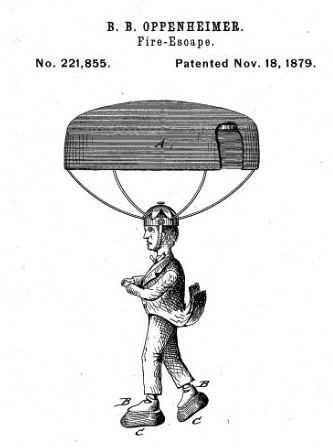
Patent for a Fire Escape Parachute

Strangely, this clever invention by Benjamin Oppenheimer never became popular. It looks like an excellent way to escape a burning building. The system consists of a parachute strapped to the head and padded shoes to ease the impact with the ground. What could possibly go wrong?

The Lost World Of The London Coffeehouse

In contrast to today's rather mundane spawn of coffeehouse chains, the London of the 17th and 18th century was home to an eclectic and thriving coffee drinking scene.

London's coffee craze began in 1652 when Pasqua Rosée, the Greek servant of a coffee-loving British Levant merchant, opened London's first coffeehouse (or rather, coffee shack) against the stone wall of St Michael's churchyard in a labyrinth of alleys off Cornhill.

Designs For Great Architectural Landmarks That Were Never Built

If you're writing an alternate history, these would be the buildings you'd want to include. They're the discarded designs for famous landmarks. Imagine if the Lincoln Memorial were a pyramid! It almost was... (picture above) and these other buildings were almost dramatically different too.

The Art Of The Romanian Haystack

At this time of year the fields of the Romanian countryside are full of new haystacks. Over the centuries this particular method of haystack building has become more refined to the point where the haystacks of Romania have their own unique characteristics. Haystacks like this are found nowhere else on earth.

Astronomical News

The moon is quite a bit younger than scientists had previously believed.
Enjoy some of the most inspiring, beautiful and down-right stunning photos from our adventures in space this past week.
Space is a rough place. It's freezing, there's no air, and the weather is terrible! Trace explains what that 'weather' in space is doing to our satellites.
About 5 billion years from now, our sun will look like the glowing remains of sun-like star in the constellation Cygnus.

Bizarre and Delightful Animals In Vintage Photos

Find more of them at io9.

Protective dog rushed to stop crawling baby from getting too close to the sea

A Cocker Spaniel-type dog proved to be a baby's best friend on a Turkish beach last week.
As the baby's mother threw a ball for the dog at a beach at Kabak Koyu on Turkey's south-western coast, her attention was distracted from her child who began to crawl towards the sea.

As the baby got close to the water, the dog instinctively realised the danger and ran to the child, lying between it and the waves, preventing it from entering the water, before the mother rushed over to rescue her child.

Animal Pictures

Tuesday, September 24, 2013

The Daily Drift


The Brain: genius or insane ...

Carolina Naturally is read in 193 countries around the world daily.
 
 Register to vote so we can cast the wingnuts out ... !

Today is National Voter Registration Day  
 

Don't forget to visit our sister blog: It Is What It Is

Some of our readers today have been in:
The Americas
Bogota, Colombia
Buenos Aires, Argentina
Curitiba, Sao Paulo, Indaiatuba and Rio De Janeiro, Brazil
Moosonee, Montreal, Mississauga, Sioux Lookout, Ottawa and Byward Market, Canada
San Juan, Puerto Rico
Mexico City and Culiacan, Mexico
Ciudad Guayana, Venezuela
Santiago, Chile
Kingston, Jamaica
Lima, Peru
Managua, Nicaragua
Europe
Ivrea, Rome, Lucca, Padova and Bari, Italy
Siemianowice, Gdynia and Sieradz, Poland
Ankara, Turkey
Skopje, Macedonia
Reykjavik, Iceland
Dortmund, Berlin, Aalen and Rothe Erde, Germany
Bergen and Oslo, Norway
Laval, Loyat and Rouen, France
Zhovti Vody and Kiev, Ukraine
Nottingham and Woking, England
Roskilde, Denmark
Ryazin and Vladivostok, Russia
Buse and Sofia, Bulgaria
Madrid, Spain
Nokia, Finland
Stockholm, Sweden
Korce, Albania
Dublin, Ireland
Groningen, Netherlands
Asia
Shanghai, China
Bangalore, Thiruvananthapuram, Kottayam, Jodhpur, Hyderabad, New Delhi, Pondicherry, Sillong, Pitampura, Chennai and Pune, India
Islamabad, Hyderabad and Lahore, Pakistan
Male, Maldives
Sanaa, Yeman
Hong Kong, Hong Kong
Jakarta, Indonesia
Bangkok, Thailand
Colombo, Sri Lanka
Kathmandu, Nepal
Rangoon, Burma
Bandar Eman Khameyni and Tehran, Iran
Manama, Bahrain
Kuching, Malaysia
Dhaka, Bangladesh
Africa
Cape Town and Johannesburg, South Africa
Al Jizah, Egypt
Al Hammamat, Tunis, Tunisia
Pacific
Manila, Philippines
Brisbane, Australia

Today in History

1788 After having been dissolved, the French Parliament of Paris reassembles in triumph.
1789 Congress passes the Judiciary Act of 1789, establishing a strong federal court system with the powers it needs to ensure the supremacy of the Constitution and federal law. The new Supreme Court will have a chief justice and five associate justices.
1842 Branwell Bronte, the brother of the Bronte sisters and the model for Hindley Earnshaw in Emily's novel Wuthering Heights, dies of tuberculosis. Emily and Anne die the same year.
1862 President Abraham Lincoln suspends the writ of habeas corpus against anyone suspected of being a Southern sympathizer.
1904 Sixty-two die and 120 are injured in head-on train collision in Tennessee.
1914 In the Alsace-Lorraine area between France and Germany, the German Army captures St. Mihiel.
1915 Bulgaria mobilizes troops on the Serbian border.
1929 The first flight using only instruments is completed by U.S. Army pilot James Doolittle.
1930 Noel Coward's comedy Private Lives opens in London starring Gertrude Lawrence and Coward himself.
1947 The World Women's Party meets for the first time since World War II.
1956 The first transatlantic telephone cable system begins operation.
1957 President Dwight D. Eisenhower sends federal troops into Little Rock, Arkansas, to protect nine black students entering its newly integrated high school.
1960 The Enterprise, the first nuclear powered aircraft carrier, is launched.
1962 The University of Mississippi agrees to admit James Meredith as the first black university student, sparking more rioting.
1969 The "Chicago Eight," charged with conspiracy and crossing state lines with the intent to incite a riot, go on trial for their part in the mayhem during the 1968 Democratic Party National Convention in the "Windy City."
1970 The Soviet Luna 16 lands, completing the first unmanned round trip to the moon.
1979 CompuServe (CIS) offers one of the first online services to consumers; it will dominate among Internet service providers for consumers through the mid-1990s.
1993 Sihanouk is reinstalled as king of Cambodia.
1996 Comprehensive Nuclear-Test-Ban Treaty signed by representatives of 71 nations at the UN; at present, five key nations have signed but not ratified it and three others have not signed.
2005 Hurricane Rita, the 4th-most intense Atlantic hurricane ever recorded, comes ashore in Texas causing extensive damage there and in Louisiana, which had devastated by Hurricane Katrina less than a month earlier.
2009 LRAD (Long Range Acoustic Device) "sonic cannon," a non-lethal device that utilizes intense sound, is used in the United States for the first time, to disperse protestor at the G20 summit in Pittsburgh, Penn.

Non Sequitur

http://media.zenfs.com/en_us/News/ucomics.com/nq130923.gif

DragonCon cosplayers who dressed up as Marriott carpet get a cease-and-desist for their fabric offering

There's widespread consensus that the best cosplayers at this year's Dragoncon were the people who dressed up in bodysuits patterned after the notoriously bizarre institutional carpet at the Atlanta Marriott hotel, one of the event's venues. But when one of the cosplayers offered to supply carpet-camo to other attendees, Couristan Inc (the company that designed the carpet) sent them a legal threat.
Of all the things to get a Cease and Desist over, of ALL the replicas I've made over the years, I've received one from Couristan Inc., designers if the Marriott Marquis Atlanta hotel carpet. Spoonflower has pulled the design, as is their right, so sorry everyone who wanted some fabric of their own!
The absurdity is palpable.

Did you know ...

About the Koch brothers' secret bank

That navy sexual assault reports rise 50%

That wal-mart workers plan massive strikes for black Friday 2013

WTF is this thing?? Nobody knows ...

Taliban abduction left her 'even braver'

In this Tuesday, Sept. 17, 2013 photo, Afghan lawmaker Fariba Ahmadi Kakar speaks during an interview with the Associated Press in Kabul, Afghanistan. Since July, several prominent women have been attacked in Afghanistan. Among them: two police officers who were killed in the south, an Indian author living in eastern Afghanistan who was killed years after her memoir about 1990s life under Taliban rule became a Bollywood film; and a senator who was wounded in an ambush. These and other attacks on female leaders in recent years have generally been blamed on the Taliban, though the Afghan militant group, mindful of cultural sensitivities, usually does not admit to targeting women. (AP Photo/Rahmat Gul)
The Taliban kidnappers moved her to at least 13 homes, made her sleep on the ground, and kept asking where she'd been, what she'd done and whom she knew. Every few days, she would be given a chance to call her family.
Still, the militants would push her only so far — they knew they needed to keep their bargaining chip in good shape.
Fariba Ahmadi Kakar's four-week ordeal ended this month after the Afghan government gave in to her captors' demands to free some prisoners. In an interview with The Associated Press, the 39-year-old Afghan lawmaker gave a rare account of what it's like for a woman to be held captive by the Islamist insurgents.
"I wasn't tortured. I wasn't under constant stress. But I wasn't free," Kakar said.
She's also lucky to be alive.
Since July, several prominent women have been attacked in Afghanistan. Among them: two police officers who were killed in the south, an Indian author living in eastern Afghanistan who was killed years after her memoir about 1990s life under Taliban rule became a Bollywood film; and a senator who was wounded in an ambush.
These and other attacks on female leaders in recent years have generally been blamed on the Taliban, though the Afghan militant group, mindful of cultural sensitivities, usually does not admit to targeting women. The assaults have added to growing fears that what few gains Afghan women have made since the U.S. toppled the Taliban government in 2001 could be erased once American-led foreign troops finish withdrawing next year.
Being a woman in the public eye is a special challenge in Afghanistan, where tribal and conservative Islamic mores have long subjected women across the social spectrum to violence and discrimination.
The spotlight can be a shield, making men think twice about mistreating a woman and perhaps even guaranteeing that she'll be assigned a bodyguard. At the same time, it can make a woman a more attractive target for insurgents hoping to spread fear and weaken confidence in the Afghan government.
Kakar is one of 69 female lawmakers in the 249-seat lower house of parliament, and she's never been naive about the danger she and other prominent Afghan women face. Still, her initial encounter with her kidnappers was so swift and shocking it's still something of a blur today.
Kakar, her four children, her bodyguard and her driver were traveling from southern Kandahar province to Kabul, the Afghan capital, when a handful of armed militants on motorbikes appeared ahead of them on the outskirts of Ghazni city. The gunmen made the driver turn off the highway onto a bumpy, dirt road that led to a small village.
The militants put the group in the home of an Afghan Taliban family, separating the men from the women and saying little. Kakar, though, quickly began pleading with the captors to free her three daughters and son, ages 2 to 20.
She tried to calm her children but did not downplay what was happening. "I told them, 'This is the situation in this country. I will try to make sure you are safe,'" she said.
The Taliban fighters let her call her family. Within a couple of days her children were released to her mother and brother. Kakar, though, was shifted from place to place and kept separate from her driver and bodyguard.
Just days before the kidnapping, a fellow female legislator was wounded in an ambush by suspected Taliban gunmen not far from where Kakar was seized. Sen. Rouh Gul Khairzad's young daughter was killed, as was a bodyguard, while other family members also were wounded.
The militants who kidnapped Kakar had a different goal: They wanted the government to release some prisoners, and Kakar was their leverage.
In recounting her ordeal, Kakar wavered from calm to anger to wariness, and wouldn't always delve into details. At times she looked faint, but then she'd break into a sudden grin. When asked what she did all day in the various homes in which she was held captive, she smirked and said, "Nothing!"
She had only a vague idea of what was happening between her captors and authorities seeking to free her.
Kakar had a couple of female minders, whom she called "the doctor's mother" and "Zolaikha," but she wouldn't go into specifics about them. She said, however, that most of the women she encountered would tell her, "We have no power or authority to talk to you."
The men, like many Taliban, were hard-line Muslims who tried to avoid interacting with women outside their families. They would tell her their commanders were dealing with the details of her case.
Now and then, Kakar would be interrogated by the militants — usually three or four of them, and they didn't hide their faces. They'd ask her questions about her travels, her political activities and if she had met President Hamid Karzai. Nonetheless, they always treated her with "full respect," she said, even cutting short the questioning if they saw she was getting tired.
Kakar leads a privileged life compared to most Afghans, and she was deeply troubled by the poverty and ignorance around her. There were no beds to sleep on, the food was often "inedible," and there was no sense of any government presence. When she needed medicine, she'd give the militants some of her own money so they could buy it for her.
"The people in these villages don't even know what vaccines are," said Kakar, a former development worker whose constituency is in Kandahar city.
In early September, the captors told Kakar it would be just days before she'd be free. That same week, militants dragged Indian author Sushmita Banerjee out of the home she shared with her Afghan husband in eastern Afghanistan and fatally shot her. Banerjee's 1990s tale of life under the Taliban was the basis for the 2003 movie "Escape from Taliban."
Kakar was freed Sept. 7. Her bodyguard and driver were released separately. But there are conflicting accounts about whom the government freed in exchange.
Zholina Faizi, secretary of the Ghazni provincial council and one of the few in the government willing to discuss the matter, told the AP that seven male insurgents and one woman were released.
But the Taliban, in a statement announcing Kakar's release, said the prisoners were "four innocent women and two children." The militants also emphasized they had treated Kakar "in a very Islamic and humane way."
Kakar said government officials told her four women and 10 children from Taliban families were let go, including babies born in prison. She said she was told the women's husbands made them transport explosive materials, but that the women were unaware what it was they were carrying and were taken into custody.
The ordeal has left Kakar even more determined to pursue her political activism, especially in light of next year's presidential election, which she says will be a "lie" when so many Afghans lack access to government services or basic information.
"I am even braver than before," she said. "I will defend Afghanistan, especially the women, until the last drop of my blood."
As Kakar spoke, the news was rapidly spreading that suspected Taliban gunmen in southern Helmand province had shot and killed one of Afghanistan's top policewomen, some two months after a fellow female officer was slain.

While Persecuting Everyone Else, the religio-wingnuts Cry Persecution

Matt-Barber 
It is interesting that at the same time House repugicans are supporting a “Marriage and Religious Freedom Act” that would allow them to persecute same-sex couples on the basis of religion, Liberty Counsel’s Matt Barber turns truth on its head when he claims that the Obama administration holds a “pagan worldview” and that that the administration is discriminating against christians – particularly those same evangelicals who are backing legislation that would persecute everyone who does not share those evangelical religious beliefs. Acceding to Barber, the Obama administration is the “modern-day equivalent” of ancient Rome, where each citizen is made to worship Caesar with progressivism.
Is there perhaps just a little bit of hypocrisy involved here?
“It’s the same thing; it’s pagan sexual morality. It’s a Pagan view of the world that is a secularist view of the world that is inherently hostile toward not just any religion but particularly christianity.”
Factually, this is absurd, and there are a few points I wish to make:
  1. Obama is a christian and his policies prove it. If he were a Pagan he would hardly have continued and even expanded upon the shrub’s faith based initiatives. And in keeping it, had he been Pagan, he would certainly have added at least a few Pagans to it rather than giving it a monotheistic leadership panel. No, not much evidence of Paganism in the Obama administration.
  2. Barber’s claims about ancient Rome are even more laughable, since Rome did not discriminate against christians outside of perhaps 7 to 10 years in a three century span. As Thomas Jefferson observed, “had not the Roman government permitted free inquiry christianity could never have been introduced.”
  3. And Roman citizens were not made to worship Caesar.
  4. Paganism is not secularist and never has been. Paganism is not hostile toward religion. It cannot be and remain Paganism. Nor was Paganism historically hostile to christianity, despite all the attempts of historical christianity to pretend to be persecuted – a pretense that continues today.
    This attempt to make everything outside of itself Paganism is a pathetic demonization of the Other as old as christianity itself.
  5. Sacrifices were to the genius – guardian spirit – of Caesar, not to Caesar himself. And they were not coerced. For the Romans, sacrificing to the genius of Caesar was much like the Pledge of Allegiance is today for Americans – an expression of loyalty. Yet in another example of hypocrisy, while denouncing Roman devotion to Caesar, these evangelicals want to coerce Americans to worship their god through the old “under god” line they got added to the Pledge of Allegiance in 1954.
Apparently, Barber believes that since christianity has always – until the Enlightenment – coerced worship of jesus, that every other religion must also have coerced its believers.
I’m sorry, Mr. Barber, but if that is the only way you can GET believers, then maybe there is something wrong with your religion.
So-called christians like Barber are busily trying even now to coerce worship of jesus by legislating his beliefs in violation of the U.S. Constitution. While crying persecution and defending freedom of religion, these religio-winuts are denying freedom of religion to millions of Americans, demanding that their own beliefs be legislated into law and the rest of us forced to go along with them, giving up our own freedom to have different beliefs of our own.
This is like repugicans saying liberals are both Nazis and Communists, or Communists and islamists. It’s nonsensical and seemingly meaningful only to a repugican mind.
But without lies and distortion and hypocrisy and invented history, what would the religio-wingnutst have?
Not much at all.

The truth be told


This Is How Private Prison Companies Make Millions Even When Crime Rates Fall

 
We are living in boom times for the private prison industry. The Corrections Corporation of America (CCA), the nation's largest owner of private prisons, has seen its revenue climb by more than 500 percent in the last two decades. And CCA wants to get much, much bigger: Last year, the company made an offer to 48 governors to buy and operate their state-funded prisons. But what made CCA's pitch to those governors so audacious and shocking was that it included a so-called occupancy requirement, a clause demanding the state keep those newly privatized prisons at least 90 percent full at all times, regardless of whether crime was rising or falling.
Occupancy requirements, as it turns out, are common practice within the private prison industry. A new report by In the Public Interest, an anti-privatization group, reviewed 62 contracts for private prisons operating around the country at the local and state level. In the Public Interest found that 41 of those contracts included occupancy requirements mandating that local or state government keep those facilities between 80 and 100 percent full. In other words, whether crime is rising or falling, the state must keep those beds full. (The report was funded by grants from the Open Society Institute and Public Welfare, according to a spokesman.)
All the big private prison companies—CCA, GEO Group, and the Management and Training Corporation—try to include occupancy requirements in their contracts, according to the report. States with the highest occupancy requirements include Arizona (three prison contracts with 100 percent occupancy guarantees), Oklahoma (three contracts with 98 percent occupancy guarantees), and Virginia (one contract with a 95 percent occupancy guarantee). At the same time, private prison companies have supported and helped write "three-strike" and "truth-in-sentencing" laws that drive up prison populations. Their livelihoods depend on towns, cities, and states sending more people to prison and keeping them there.
You might be wondering: What happens when crime drops and prison populations dwindle in states that agreed to keep their private prisons 80 percent or 90 percent full? Consider Colorado. The state's crime rate has sunk by a third in the past decade, and since 2009, five state-run prisons have shuttered because they weren't needed. Many more prison beds remain empty in other state facilities. Yet the state chose not to fill those beds because Democratic Gov. John Hickenlooper and CCA cut a deal to instead send 3,330 prisoners to CCA's three Colorado prisons. Colorado taxpayers foot the bill for leaving those state-run prisons underused. In March, Christie Donner, executive director of the Colorado Criminal Justice Reform Coalition, estimated that the state wasted at least $2 million in taxpayer money using CCA's prisons instead of its own.
That's just one example of how private prison companies keep the dollars rolling in, whether crime is rising or waning. Not surprisingly, In the Public Interest's report calls on local and state governments to refuse to include occupancy requirements and even ban such requirements with new legislation. "With governmental priorities pulling public funds in so many different directions, it makes no financial sense for taxpayers to fund empty prison beds," the report says.

Will An Inverted Jenny Turn The Stamp World Upside Down Again?

Sunday, September 22, 2013, the William H. Gross Stamp Gallery at the Smithsonian National Postal Museum opened to the public. The gallery has been in the works since the fall of 2009, when Gross, who made his billions as the founder of the Pimco Total Return bond fund, donated $8 million to the National Postal Museum.

Among the 20,000-plus items on display is a block of four 24-cent Inverted Jenny stamps, so named because the blue intaglio vignette of a Curtiss JN-4-H biplane in the 1918 stamp was printed upside down in relation to its carmine-colored frame.

Pilot Makes Emergency Landing on Downtown Chicago Street

He Used Traffic Signal to Time His Descent
John Pedersen's single engine plane suffered damage while he flew it this morning. He couldn't make it the O'Hare or Midway Airports. So he landed in downtown Chicago on Lake Shore Drive. Pedersen did his best to avoid hitting cars:
Pedersen. who said he had been flying for five years, had decided the drive was his best landing spot. If timed correctly, he figured, he could bring down the plane while traffic was stopped at a red light.
"You pick a landing spot that's not going to jeopardize anybody else," he said.
When the light on East Balbo Avenue turned red, he brought the plane down in the northbound lanes, its nose facing north.
It was a tricky landing, but he stuck it, Chicago Fire Department spokesman Larry Langford said admiringly.
Two cars actually hit the airplane after it landed – and then, mysteriously, sped off, Pedersen said. One can only imagine what their drivers were thinking.

Daily Comic Relief

http://media.zenfs.com/en_us/News/ucomics.com/dp130923.gif

Blotevoetenpad

Blotevoetenpad is Dutch for Barefoot Path. It's situated in Belgium in a place called Zutendaal. When walking the blotevoetenpad you can sense with your feet the special incentives of wood, stone, tree clippings, grass, loam and water on a controlled route that is only accessible barefoot.

You can sense hot and cold, moist and dry, feel pleasant, excited and stimulated on a route of almost 2 km in Lieteberg. There are water hazards, sand hills, and steep slopes. There's also a wooden watchtower, a maze, and a suspension bridge.

Chinese-Style Giant Camping Festival

Forget about quiet, unspoiled countryside or venturing out into the wild-unknown - this is camping Chinese style! Over 15,000 people from around the world transform a hillside near Mount Wugongshan in China's Jiangxi province into a kaleidoscope of coloured tents for the 2013 International Camping Festival.

Jiangxi Province, located in the eastern part of the country, is considered by many to be home to China's most beautiful countryside due to its natural ecology, as well as its long history and tradition.

A Standing Version of the Seesaw

(Photo: Winfield Parks/National Geographic)
This photo from 1964 shows an unusual and awesome seesaw in Tokyo. One child pulls down and the other flies into the air.
Okay, I understand why most kids were never allowed to play on these risky toys. But now that I'm legally an adult, can I have one? Please?
More

What Did Barney Rubble Do For A Living?

In 1960, the first ever prime-time animated TV series took to the air, The Flintstones. Fred Flintstone was a blustery, quick-tempered, loud-mouthed, blowhard. Fred's best friend and next door neighbor was the affable and always loyal Barney Rubble.

Fred Flintstone is a bronto-crane operator at the Slate Rock and Gravel Company. But Barney's occupation is, for the most part of the series, unknown, though later series depict him working in the same quarry as Fred. But what exactly did Barney Rubble do for a living?

Why Didn't People Smile in Old Photographs?


Why are people in Nineteenth Century photos usually grimacing? This newlywed couple looks like they've just been sentenced to hard labor. American author Mark Twain explains their expression:
A photograph is a most important document, and there is nothing more damning to go down to posterity than a silly, foolish smile caught and fixed forever.
Twain wasn't alone. He supported a traditional though fading belief that smiling made you look stupid. The Atlantic cites scholar Nicholas Jeeves:
Twain wasn’t the only believer in the idiocy of the style. Look back at painted portraiture — the tradition photography inherited — and you’ll rarely see a grinning subject. This is, in fact, Jeeves’s subject. “By the 17th century in Europe,“ he writes, “it was a well-established fact that the only people who smiled broadly, in life and in art, were the poor, the lewd, the drunk, the innocent, and the entertainment.”
Indeed, not only were smiles of the middling sortthey breached propriety. In 1703, one French writer lamented “people who raise their upper lip so high… that their teeth are almost entirely visible.” Not only was this discourteous, he asked: Why do it at all? After all, “nature gave us lips to conceal them.”
Portraits represented an ideal. It’s easy to mock them — they were the profile pictures of the aristocracy, in a sort of way — but they were crucial, tied to mortality, a method of preserving a person’s visage and affect. Jeeves puts it well: “The ambition [with portraiture] was not to capture a moment, but a moral certainty.” Subjects never looked exactly like their picture, yet their portraits were how they appeared. Portraits had permanenceYou did not want to commit a permanent faux pas
More

Ziggy

http://media.zenfs.com/en_us/News/ucomics.com/zi130923.gif

The Origins Of The Periodic Table

The periodic table is a tabular arrangement of the chemical elements, organized on the basis of their atomic numbers, electron configurations, and recurring chemical properties.

As early as 330 BCE, Aristotle created a four-element table: earth, air, fire, and water. But it wasn't until the late 1700s that Antoine Lavoisier, a French nobleman and chemist, wrote the first list of 33 elements. He classified them as metals and nonmetals, though we now know that some were compounds or mixtures.