Welcome to ...

The place where the world comes together in honesty and mirth.
Windmills Tilted, Scared Cows Butchered, Lies Skewered on the Lance of Reality ... or something to that effect.


Tuesday, March 11, 2014

The Think Tank That Controls America

The Rand Corporation

If you think the Internet came out of Silicon Valley, that NASA planned the first satellite to orbit Earth, or that IBM created the modern computer—think again. Each one of these breakthroughs was conceived at RAND, a shadowy think tank in Santa Monica, California.

The Intimidation Factor

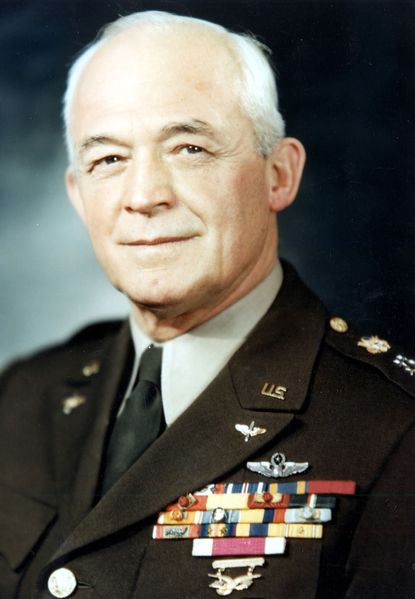
Rand rose out of the ashes of World War II. After witnessing the success of the Manhattan Project—the $2 billion initiative that created the first atomic bomb—a five-star Air Force general named Henry “Hap” Arnold (pictured) concluded that America needed a team of great minds to keep the country’s technology ahead of the rest of the world. In 1946, he gathered together a small group of scientists and $10 million in funding and started RAND (which stands for Research and Development). He even convinced a family friend, aircraft magnate Donald Douglas, to house the project at his factory in Santa Monica.

After a few short months, RAND got the attention of academics, politicians, and military strategists alike by issuing a prophetic study called “Preliminary Design of an Experimental World-Circling Spaceship.” At the time, rocket science was still in its infancy, so RAND’s call for an orbiting space station was revolutionary. Not only did the think tank specify the kind of fuel the spaceship would need and how quickly it could be built, but it also outlined how the station could predict the weather, transform long-distance communication, and, most importantly, intimidate our rivals abroad. If America could put a satellite into space, what else was she capable of?

Although President Truman passed on the space station, the military fell in love with RAND. Through Hap’s connections, the Air Force quickly became the think tank’s main contractor, and RAND began consulting on everything from propeller turbines to missile defense. Before long, the organization was so flush with contracts that it had to hire hundreds of additional researchers to keep up. In recruitment ads, RAND bragged about its intellectual genealogy, tracing a direct line from its president, Frank Collbohm, to Isaac Newton. Whether or not that claim was true, the institute secured a reputation as the place to dream up new ways to wage wars and keep enemies at bay.

By the 1960s, America’s rivals were paying attention. The Soviet newspaper Pravda nicknamed RAND “the academy of science and death and destruction.” American outfits preferred to call them the “wizards of Armageddon.”

War Games

The Soviets had good reason to worry about RAND. In 1957, the Air Force hired the think tank to create spy satellites. Within two years, it developed CORONA—a covert system that aimed to send camera-carrying satellites into orbit on the backs of missiles. While the idea was genius, the design was flawed. It took 13 failed attempts before the system finally got off the ground in 1959. Once it did, however, the results were spectacular. The CORONA satellite returned with 161 lbs. of film about the Soviet Union, more footage than spy planes had recovered in the previous four years combined. For the following decade, CORONA became the backbone of American intelligence on the Soviet Union. Researchers watched troops march along the Russian border with China and spied on cities they’d never seen before. They could even count the fruit in Soviet orchards and analyze their crops.

By the early 1960s, RAND had established itself as a fixture of U.S. policy. Branching out from straight rocket science, the think tank had become the center of the nation’s nuclear strategy. One high-profile RAND genius, John Williams, developed game theory to predict how the cagey Soviet Union might act during conflict. The theory was a perfect fit for RAND, an organization that continually sought to impose objective reality on an irrational world.

Another genius, mathematician Albert Wohlstetter, came up with the fail-safe concept, which saved the world from nuclear conflagration several times. The idea called for a series of checkpoints for bombers armed with nuclear weapons. If a bomber pilot failed to receive confirmation at any checkpoint, he would abandon the mission and turn the plane around. Once, in 1979, a mistake by a telephone operator led to a transmission that the United States was under nuclear attack from Moscow. Ten fighters from three separate bases took to the air armed with nuclear missiles. But in the end, because of Wohlstetter’s fail-safe system, none of them deployed their weapons.

Through the years, RAND’s sphere of influence became more visible. In the 1960s, Secretary of Defense Robert McNamara hired scores of its young researchers—dubbed the “Whiz Kids”—to reorganize the Pentagon. But perhaps the thing that most solidified RAND’s reputation in the public’s imagination was the release of the Stanley Kubrick film Dr. Strangelove or: How I Learned to Stop Worrying and Love the Bomb in 1964. The movie’s title character, a deranged Nazi scientist, was modeled after RAND’s eccentric Herman Kahn. A military strategist, Kahn famously argued that America could easily survive an all-out conflict with the Soviet Union if people took refuge in shelters and rationed food. Although the radiation would cause hundreds of thousands of genetic defects, Kahn insisted the American people would endure. Kahn’s apocalyptic scenarios didn’t end there. He also dreamed up the Doomsday Machine, a device that could destroy all life on Earth, which Kubrick used in Dr. Strangelove. In fact, Kubrick borrowed so many of Kahn’s sayings and ideas that the scientist began demanding royalties. Kahn was so persistent that Kubrick finally had to tell him, “That’s not how things are done, Herman.”

Spinning a World Wide Web

While RAND has played a major role in keeping America safe from military attacks and nuclear catastrophes, the think tank has also left its mark on the communications industry. RAND is directly responsible for packet switching, the technology that made the Internet possible. It all started in the 1960s, when the military asked RAND researchers to solve a hypothetical question: If the Soviet Union destroyed all of our communication systems with a nuclear bomb, how could we fight back?
A young engineer named Paul Baran provided an elegant solution by likening the nation’s telephone wires to the brain’s central nervous system. Baran proposed sending messages via phone lines and changing words into numbers to avoid noise and distortion. Baran also decided that any content relayed should be divided into “packets,” or discrete bundles of data. As a result, messages were separated during transmission, and would then automatically reconfigure themselves once they reached their destination. More importantly, if direct communications were destroyed, the packets could reroute themselves through phone lines anywhere in the world.

Baran tried to convince AT&T to install the system, but the phone giant refused to create something that could become its worst competitor. Instead, the creation of a worldwide packet-switching system was left to the Pentagon, which devised ARPANET, the predecessor to the Internet.

Healthy Choices

During the 1960s, RAND also expanded its lines of investigation into education, welfare reform, and criminal justice. By the time Richard Nixon took office in 1969, the think tank was an established, independent source for social policy research. So, when the issue of medical insurance sparked a great national debate, Nixon tapped RAND for ideas. At the time, there was little data on the effectiveness of free health care versus coverage plans with co-pays and deductibles. In particular, Nixon wanted to know if free health care made people healthier. To find the answer, RAND’s Health Division spent 10 years acting as the insurance company for more than 5,000 people around the country.

In the end, RAND’s research found that people who paid for health care were just as healthy as people who got it for free. With free health care, people went in for more regular medical screenings, but their other habits—exercise, diet, smoking—were worse. The message was not lost on the insurance industry, nor on the federal government. In 1982, when the study was released, only 30 percent of medical plans had deductibles. Five years later, more than 90 percent did.

Thinking Ahead
Health care was just the beginning of RAND’s expansion into the social sciences. Although 50 percent of RAND’s current $223 million budget still comes from federal funding, much of that goes toward non-defense work. The think tank currently employs close to 1,000 researchers, who spend their time analyzing everything from renewable energy and obesity to hurricanes and the Israeli-Palestinian conflict. Globalization has also opened up the organization’s opportunities. In addition to its five centers that handle social and economic policy issues, as well as the five centers that focus on international affairs, RAND has an affiliate organization in Europe, and a prominent voice in Middle Eastern policy. Most notably, the RAND Qatar Policy Institute is working on reconfiguring the emirate’s entire educational system.

Of course, RAND hasn’t exactly abandoned its bread-and-butter services. The organization touts three federally funded research and development centers that concentrate on national security. After all, RAND did establish the discipline of studying terrorism in the 1970s, long before the United Nations even had a working definition for the word. Today, the RAND Terrorism Chronology Database, which has catalogued all acts of terrorism from 1968 to the present, has become an invaluable tool for the military and the government. It makes sense that in these times, our new president will pay attention to the think tank, too. Barack Obama has taken a keen interest in its study on post-traumatic stress disorder in soldiers returning from Iraq. In other words, RAND already has his ear.

The Who’s Who of Rand

John Nash – RAND was the motherland of game theory during the 1950s and 1960s, and among its most prominent players was John Nash—the soulful subject of the book and movie A Beautiful Mind. Nash came up with what is now called the Nash equilibrium, which is used to determine the stability of competition.

Thomas Schelling – Schelling was an economist who came to RAND shortly after Nash’s frenzied departure. His game theory concocted a worldview of aggression and counter-aggression that was heavily influential during the Vietnam War.

Kenneth Arrow – One of the most influential RAND employees, Arrow posited that greed is good, and that what he termed “consumer sovereignty” should rule society. Some critics have blamed Arrow’s Theorem for providing the theoretical foundation for the free market frenzy of the past 30 years, including the current housing market meltdown.

Albert Wohlstetter – The most prominent member of RAND’s so-called Nuclear Boys Club. A brilliant theoretical mathematician and an unparalleled nuclear strategist, he worked at RAND on and off from 1951 to his death 46 years later. He originated the Second Strike nuclear doctrine (make sure you have enough backup nukes to wipe out any attackers) and the Fail Safe principle (drop the big one on your target only after confirmation in flight from headquarters).

Daniel Ellsberg – An endlessly loquacious mathematical genius, strategic thinker, and unlikely peacenik. Disgusted with official lies about America’s involvement in Southeast Asia, he leaked the Pentagon Papers, which set in motion the end of the Vietnam War.

What Type of Companies Own Your State's Politicians?

What kind of companies top the list of political campaign contributions in your state's last election cycle? Mother Jones took the data from Follow The Money, a nonpartisan and nonprofit organization that compiles a database of verifiable campaign finance contributions across the 50 states for the 2012 election, and came up with the map above.
The data is admittedly incomplete: Mother Jones limited their search to the top business in each state and excluded contributions from unions, law firms, nonprofits, and PACs.
It's not surprising that gambling dominated the political contributions in Nevada, but I was surprised to find that it also dominated in Rhode Island. I'm also surprised to find that finance companies dominated the political contributions in only 4 states - why did I think it would've been in more places?
Real Estate companies pay the highest corporate campaign contributions in 14 states, health-related companies in 13, and energy companies in 12. Tech and telecom dominated in 3 whereas manufacturing in only two.
See which type of company dominated your state's politics over at Mother Jones.

McCrony says he can put distance between himself and former employer Duke Energy

And that is just his latest lie ... 
Thom Tillis, Pat McCrory, Dan FOrest
From left, Thom Tillis, Pat McCrony, and Dan Forest

Pat McCrony worked at Duke Energy for 29 years.
That’s what his resume says.
Other than a few short sentences about his areas of work, his biography says nothing else about his career.
Duke Energy officials aren’t talking.
Well-connected state and local leaders aren’t saying.
Charlotte City Council members aren’t sure.
And McCrony hasn’t said.
Until now.
Few have delved into McCrony’s history at the utility. And until recently, it didn’t matter.
But a month ago, a Duke Energy coal ash pond dumped tens of thousands of tons of toxic gray sludge into the Dan River.
Now, critics are saying that McCrony will go soft on Duke Energy because of his years there. That his career was a mystery for a reason. That he is more loyal to the company than to the people of North Carolina, even six years after resigning.
McCrory said he couldn’t be easy on Duke Energy because he knows too much about how management works there — and how it has failed to prevent one of the state’s worst environmental disasters.
“My expertise is not in coal. I never worked in that area,” McCrony said. “But I know infrastructure and I know management and I know engineering. Somewhere along the way there has been a breakdown in ensuring that site was properly maintained.”
On Friday, McCrony gave the News & Record his first in-depth interview about his career — and how it shaped his philosophy — since the spill.
McCrony had another reason for breaking his silence: He wanted to put an end to his image as a corporate fat cat with nothing but cushy jobs during his years at Duke Energy.
Without any details of what McCrony did for 29 years, critics are finding all kinds of ways to fill in the blanks.
“I’m sure a lot of people would like to know what Pat did when he was at Duke,” Charlotte Mayor Pro Tem Michael D. Barnes said.
McCrony’s official biography reads like the classic American success story.
McCrony graduates from Catawba College.
He is hired into a “rigorous management training program” at then-Duke Power.
“Through that opportunity, he learned the energy business from the ground up, digging trenches, climbing electric utility poles and more,” according to the bio.
As McCrony fills in the blanks, he portrays his time there as years of rich experiences, relationships and education.
When he graduated in 1978, the economy was in shambles. He interviewed for a couple of management-training jobs and chose Duke Power. The company assigned him to Charlotte where, he said, he hit the streets with linemen his first week on the job.
“I was riding in a construction truck — two guys on both sides of me, chewing tobacco,” he said. “The guys riding with me taught the college boy some things he didn’t know. Putting on rubber gloves and actually putting your hands on hot wires was a good learning experience.”
After that work, the company offered McCrony a management position in South Carolina. He didn’t want to move because he desired a different career path. He wanted to use his teaching degree to train workers and executives.
He moved into the utility’s design engineering department because the group needed a corporate trainer.
But his stint as a trainer was short.
“I learned so much about engineering,” he said, “they transferred me to the engineering office where I became the engineer recruiter for the entire company, where I hired nuclear and electrical and mechanical engineers.”
McCrony said that, as a young man in his 20s, he became a specialist at interviewing.
He traveled to every top engineering school in the country.
“I was interviewing 15 people a day, so I learned a lot about interviewing skills, and I wrote a training manual about it. I’ve used those skills today on my Cabinet. I’m a very tough interview,” McCrony said.
McCrony became the manager of the company’s recruiting program for engineers during the “boom years” of the 1980s, as he called it.
He was responsible for recruiting hundreds of engineers a year to work across the Duke Power system in several states.
“That’s the good news,” McCrony said. “The bad news is in 1988 they eliminated my job and had layoffs.”
He said he was planning to get married in a few months, “and I found out that my job had been eliminated, which was a turning point in my life. It still sticks with me today — never to take a job for granted.”
But three weeks later, the company hired him back, offering him a promotion as training director for the entire company.
“I had a pretty large staff. It was almost like being principal of a high school. I had training facilities across the state that I was responsible for.”
Throughout the 1980s McCrony’s jobs had taught him to be a salesman.
Soon, he would begin to sell his merits as a candidate.
McCrony sought — and won — a seat on the Charlotte City Council in 1989 at 32 years old.
Working on the council and as a training manager at Duke Power didn’t faze McCrony, he said, because he has always worked two jobs.
“I’ve always had jobs where I would typically go 12 or 14 hours a day,” he said.
After several promotions at Duke Power — and moving up to mayor pro tem on the council — McCrony decided to make a run for mayor and was elected in 1995.
McCrony had to cut back his work at Duke Power.
Critics felt that the company, the city’s largest taxpayer, kept him on board so it could influence government.
McCrony and his supporters admit that it’s impossible to put in the time for a corporate career and a major political office.
John Lassiter, McCrony’s 2012 campaign manager and a confidante as interim chairman of the state Economic Development Partnership, said of McCrony: “When he first went into public life, he was working a traditional schedule, which means he was balancing his 40-hour week. When he became mayor, Duke realized he would have to give more time, and they allowed for that.”
McCrony said he had to get permission from the company before he ran for political office.
But as mayor, he said, he couldn’t make the schedule work.
“I had to step back and put a hold on my career,” McCrony said.
As he came to know Charlotte and its business community, Duke Energy enlisted McCrony as a consultant on economic development.
John Autry, who is serving his first term on the Charlotte City Council, said he and others never believed that McCrony had much to do at Duke when he was mayor.
“As a citizen, we always considered the Duke employment as a ‘sugar daddy job,’ ”Autry said.
But McCrony bristles at the thought that he didn’t put in his time at the utility.
“I started with Duke. I didn’t get the job when I became mayor,” he said. “I wasn’t placed in that job. I worked hard. Duke had a motto of citizenship and service.”
At least once, however, McCrony was accused of putting the company over duty when, in 1994, the then-mayor pro tem voted to condemn two pieces of land for a new Charlotte water line.
What he did not disclose, an N.C. Supreme Court justice said in a written opinion, was that McCrony knew the land abutted Duke Energy property.
And the city would be free to buy power from Duke Energy if it could gain control of the land.
The properties’ owners sued the city, and the Supreme Court eventually found in favor of the city.
But Justice I. Beverly Lake Jr. wrote a dissenting opinion that took aim at McCrony.
In the opinion, Lake said McCrony exchanged emails with Duke Energy officials and discussed condemning the land for the project.
McCrony then voted in favor of the condemnation at a meeting he chaired, Lake wrote.
McCrony has repeatedly said that if he had known at the time that Duke Energy was involved, he would not have voted on the issue.
As mayor, McCrony defends his record as mayor and his career at Duke Energy.
“It was very transparent. I never hid from it,” he said. “With Duke I was working with industrial customers mostly outside the Charlotte area rather than industrial customers inside the city.”
Barnes, the Charlotte mayor pro tem, wonders if McCrony’s role at Duke made him reluctant to promote green energy.
“As I recall, when Pat was here, when the council tried to work on green energy and green issues. I sense sometimes he had concerns about the council’s efforts and I wasn’t sure whether that was related to Duke or other issues," Barnes said.
But there’s evidence that McCrony promoted environmental efforts.
In 2001, he helped create a program with the U.S. Environmental Protection Agency designed to draw regions together to promote clean air and water.
The group published a complex report in 2006 outlining its goals for a region of cities surrounding Charlotte in North Carolina and South Carolina.
But it’s hard to find any reports that show the effort was a success.
By 2008, McCrony resigned from Duke Energy to run for governor, which he said was one of the hardest decisions of his life.
After he lost that election, he went to work for his brother at McCrony & Co., a sales training company.
He also worked as a consultant for lawyers at the Moore & Van Allen firm in Charlotte until his election in 2012.
“A lot of the lawyers were good at legal work, but they weren’t real good at strategy,” he said.
At the end of the interview, McCrony took stock of his past relationship with Duke Energy and the coal ash crisis.
He said Duke taught him what to do — and that’ll be the right thing.
“The one thing regarding the spill which is disappointing is that there was a lack of oversight of understanding what was beneath the coal ash, what was beneath the pond and the lack of a plan,” he said.
According to public records, engineering inspectors have had concerns over the drainage pipes under the company’s Dan River ash basin as far back as 1996. Their warnings went unheeded, leading to the Feb. 2 coal ash spill, the third worst in U.S. history.
“That’s a serious, serious breakdown within that company that must be addressed. And I’ve demanded an answer in a short period of time,” McCrony said.
He is emphatic that he can put distance between himself and his former employer.
“I can separate. I can clearly separate. I’m the first governor to support a lawsuit against Duke Energy.
“I make the assumption my past friends respect that responsibility.”

The Story Behind the SAT Overhaul

You may have heard the news that the Scholastic Aptitude Test (SAT) is getting an overhaul. The essay portion that was added in 2005 will be made optional, and the rest of the test is going back to the old 1600-point scale. Questions will be replaced to bring them more in line with what students are being taught in the classroom, to try to level the playing field that has been upset in recent years by students who can afford test tutoring. Why? Because students, parents, teachers, and even colleges don’t like it. It’s stressful, interferes with regular classwork, and doesn’t even predict college success.

A growing number of colleges and universities, frustrated by the minimal change to the SAT when it was revised in 2005 and motivated by a report issued in 2008 by the National Association for College Admission Counseling (Nacac), began to eliminate the SAT and its competitor, the A.C.T., as admission requirements, following the lead of several small, liberal-arts colleges that did so years before. The authors of the Nacac report cited a University of California study, which characterized the SAT as a “relatively poor predictor of student performance” and questioned the tendency of colleges to rely on the SAT as “one of the most important admission tools.” (Many of the schools that dropped test requirements saw spikes in their applications, at least in the first year.)

Around the time the report came out — and following the publication of “The Power of Privilege,” by the Wake Forest University sociology professor Joseph A. Soares, an account of the way standardized tests contributed to discriminatory admissions policies at Yale — Wake Forest became the first highly rated institution (it regularly appears as a Top 30 university on the U.S. News & World Report college rankings) to announce a test-optional admissions policy. Follow-up studies at Wake Forest showed that the average high-school G.P.A. of incoming freshmen increased after the school stopped using standardized-test scores as a factor. Seventy-nine percent of its 2012 incoming class was in the top 10 percent of their high-school classes. Before going test-optional, that figure was in the low 60s. In addition, the school became less homogeneous. “The test highly correlates with family income,” says Soares, who also edited a book that, in part, examines the effects of making the SAT optional at the University of Georgia, Johns Hopkins University and Wake Forest. “High-school grades do not.” He continued, “We have a lot more social, racial and lifestyle diversity. You see it on campus. Wake Forest was a little too much like a J. Crew catalog before we went test-optional.”
The new test will not be introduced until the spring of 2016 -too late for all my children. Only time will tell if the changes are an improvement. The New York Times has the story of how the SAT became something other than what it was intended to be, and how the changes for 2016 came about.

Questions From the National Science Quiz


The National Science Foundation recently released results of their science test that showed Americans sadly lacking in basic science knowledge. We cringed at the fact that one in four Americans did not know that the Earth revolves around the sun. So how hard is the test? When I saw the opportunity to sample it, I thought, “How fun!” But there are only ten questions, and to our readers they would be so extremely simple you would all get ten out of ten right.
However, under each answer, we find out how the average Americans polled scored on each, which is sobering. More than half the respondents did not know what lasers are made of. The answers also have some neat explanations in the form of videos. And the comments are what you’d expect -half argue about two questions on religious grounds, and the other half are pedantic science nerds who argue about the exact wording of a question. See those questions at PolicyMic.

What happens when you opt your kids out of standardized tests?

Lisa T. McElroy is a law professor who's spending a year at the University of Denver with her two kids, one in high school and one in middle school. She learned that she could opt her kids out of the standardized tests the school administered. So she did. What followed was a total educational freakout, as the principal, vice-principal and administration alternately cajoled and guilted her over her kids' non-participation in pedagogically suspect, meaningless, destructive high-stakes testing.
McElroy's story is a snapshot of an educational system in the process of implosion, driven by the ridiculous idea that schools are factories whose product is educated kids, and whose employees must be made "accountable" by measuring anything we can put a number on -- attendance and test-scores -- at the expense of actual educational outcomes.
Despite the fact that the best-performing educational systems in the world don't treat teachers as assembly line workers and kids as standardized injection molds to be squirted full of learning, the west continues to pursue this approach, scapegoating teachers' unions and pitting parents against them when the real enemy is the doomed idea that schools are a specialized kind of industrial plant -- and the project of selling off public schools to privatized educational corporations that collect public funds to educate kids, but only to the extent that this can be done without undermining their shareholders' interests.
When I answered that I very much appreciated her call but was going to stick by my decision, she offered several reasons why my daughter should take the test. First, taking TCAP (Transitional Colorado Assessment Program, the relatively new set of state standardized tests) would help my daughter on the ACT. Huh. Given that she’s only in seventh grade, I wasn’t buying that one. The principal then said that the test would show us how our daughter was doing academically. But we get a report card every six weeks, and we can follow her progress in real time through an online school portal that lists her grade on every assignment, so we’re all set in that regard. One more try. The test results, she said, reward teachers by showing them that they are doing a good job. My reaction: And seeing their students’ progress doesn’t?
But when the lawyer in me started pushing back, pointing out to the principal that none of her arguments was especially convincing, I got nowhere. Including off the phone. The principal kept going on. And on. And on. My daughter really should take it. She was the only child in the entire school who was opting out. She might feel weird, being different from all the other kids.

Survivor of Mengele's twin studies recounts her experiences on Reddit

We missed this Ask Me Anything when it was live back in February, but it's definitely worth going back and reading. It features Eva Mozes Kor, who was chosen at age 10, along with her twin sister, for experiments performed by Josef Mengele at Auschwitz. Really an amazing AMA.

First clinical LSD trial in 40 years shows positive results in easing anxiety of dying patients

In Safety and Efficacy of Lysergic Acid Diethylamide-Assisted Psychotherapy for Anxiety Associated With Life-threatening Diseases, a new paper published in The Journal of Nervous and Mental Disease, a Swiss psychiatrist named Peter Gasser and his colleagues report on the first controlled trial of LSD in forty years. Gasser used LSD therapeutically to treat 12 people nearing the end of their lives, and concluded that their anxiety "went down and stayed down."
Many psychopharmacologists believe that psychedelics such as LSD have therapeutic benefits that could be realized if the strictures on them were loosened. David Nutt, the former UK government drugs czar, called the ban on psychedelics in therapeutic settings "the worst case of scientific censorship since the catholic cult banned the works of Copernicus and Galileo". He devotes a whole chapter to psychedelics in his brilliant book on drug policy, Drugs Without the Hot Air. If you only read one book about drug policy, read that one.
Gasser's trial is positioned as a major move in the struggle to end the damage the War on Some Drugs has wrought on legitimate medicine. It used a randomized double-blind protocol to dose some dying patients (most with terminal cancer) with LSD as part of an anxiety-reduction strategy. The results were dramatic and positive. In a NYT story, some Gasser's patients relate their experiences with the therapy.

A doctor who treats sick scientists ...

Wherever they may be — If a paleontologist breaks her leg three days' travel from the nearest hospital, what happens? One thing she might do is call Matt Lewin — a doctor who specializes in treating scientists who get sick or injured in the field. He's the subject of a profile in the latest issue of Discover magazine. Sadly, the full story is only available in print, but it's a fascinating topic and a job we'd never really given much thought to before, so we wanted to share it.

For Your Health


Patients are more likely to raise a health problem with […]

University of Florida scientists believe they have pinpointed the exact compounds […]

Medical Journal Article on Sword Swallowing


The researchers were precise in their methodology:
We excluded cases in which injury was related to swallowing items other than swords, such as . . . jack hammers.
As well they should!
Brian Witcombe, a physician, and Dan Meyer, an executive in a professional organization for sword swallowers, published an article in a 2006 issue of the British Medical Journal. It evaluated the health risks of sheathing a sword inside the human esophagus. They surveyed 46 sword swallowers and determined that performers increase the likelihood of injury by “adding embellishments to their performance.”
Who engages in this performing art? Amy Kraft of The Week attended a meeting of sword swallowers. It was one of many held simultaneously at Ripley’s Believe It or Not locations around the United States. She writes that sword swallowing originated in India about 4,000 years ago. It requires careful and rigorous training:
To get there, you must first learn to suppress the gag reflex in the back of your throat, which sword swallowers work on for years. Then you have to flip back your epiglottis and relax several other involuntary muscles in the esophagus, which winds past major organs, including the heart. Finally, to get the sword into the stomach you have to relax the lower sphincter muscle and repress the stomach's retch reflex.

Peeing In The Pool Can Be Hazardous To Your Health

We’ve all heard of people doing it, we’ve all done it on the sly once or twice in our life, and we’ve all heard the urban legends about the colorful chemical that identifies the culprit.
I’m talking, of course, about peeing in the pool, and up until now it has been seen as a harmless, albeit gross, thing to do when you’re swimming those summer days away and don’t want to get out just to empty your bladder.
But scientists have discovered something that will ruin your summer- peeing in the pool can be hazardous to your health. According to scientist from China Agricultural University and Purdue University “compounds in urine mix with chlorine to form chemicals that have been linked to respiratory effects in swimmers”, so the next time you take a dip try to hold it until you get out- for your health.

Ziggy

http://media.zenfs.com/en_us/News/ucomics.com/zi140310.gif

San Marino

Tiny State, Big Baggage

by Walter Mayr
San Marino: Tiny State, Big Baggage
The trial of a former head of state has brought unwanted media attention on the often overlooked San Marino, the world's oldest Republic. The nation, which is already reeling from the financial crisis, is not amused. More

IKEA is Learning About Americans

IKEA conducted a survey of Americans to find out about their homes and lifestyles. Fast Company looked through it and found some interesting results, which they expanded on. Here's a sample.
1. Only 1% [of those surveyed] want their home to reflect how successful they have been.
Analysis: This may seem surprising, but in fact Americans often choose to lie to surveys to make themselves appear more humble.

2. 62% of respondents say they control the remote over their significant other, children, friends, or others. However, 74% of men are more likely to say they control the remote than women at 52%.
Analysis: Americans are warlike creatures who must wrest control of an item called a control.
Number one is kind of believable. I understand the theory of conspicuous consumption as well as the next person, but where I live, if your house looks nicer than your cousin’s house, that cousin will be over all the time asking to borrow money. Number two adds up to way over 100%, but that can be explained by the American habit of having a TV for every person in the house. You don’t have to argue over the channel if you’re in separate rooms.

If you want to see the entire IKEA report, you’ll find that here. I noticed that 27% percent of Americans use technology in their kitchens. The other 73% either don’t realize what technology means, or else they never go into the kitchen.

Man kidnapped his mother because she didn't want to move with him to Miami

A man from Richmond, Virginia arrested in South Carolina says he kidnapped his mother because she didn't want to move with him to Miami.
Regelio Lopez, 20, is accused of kidnapping his mother and stuffing her in the trunk of his Cadillac. A dashboard camera video released on Wednesday shows South Carolina troopers pulling over the Cadillac on February 25.

The troopers order Lopez to get on the ground, then open the trunk where a woman is found inside. Troopers had been looking for the Cadillac in connection with the Richmond kidnapping.

In the video, Lopez tells officers he was heading to live in Miami and says he put her in the trunk because she didn't want to go with him. "What made you do that?" a trooper is heard asking. "I was alone," Lopez responds. Lopez is now back in Richmond where he faces a kidnapping charge.

Man with meth arrested three times in three days

A man who police say drove his pickup into a building in Roseburg, Oregon early on Sunday morning has been arrested again. And again.

Roseburg police arrested Michael John Querubin, 48, of Roseburg, after police said he was driving under the influence of a controlled substance when he drove his pickup into the building. Police charged Querubin with driving under the influence of a controlled substance, reckless driving and unlawful possession of meth. Querubin was cited and released from the Douglas County Jail.
 
At about 1:40am on Tuesday, Sheriff's deputies arrested Querubin in the 4800 block of NE Stephens, charging him with unlawful possession of meth. He was again cited and released from the Douglas County Jail. According to the Sheriff's office, Querubin was arrested for the second time on Tuesday shortly before 10:30pm in the 3400 block of Cleveland Hill Road.

Deputies charged Querubin with driving under the influence of a controlled substance and unlawful possession of meth. Querubin was lodged in the Douglas County Jail. Sheriff's deputy Dwes Hutson says the arresting officer in each case has discretion on whether to cite and release a suspect to appear in court, or to lodge them in the jail.

Reluctant whistle-blower finally breathes sigh of relief

A Chinese man who swallowed a plastic whistle when he was 9-years-old and made shrill whistle sounds after falling asleep at night for 15 years has finally been able to breathe a sigh of relief.

Liu Yougang, 23, successfully had an operation to take the whistle out at West China Hospital, Chengdu, Sichuan Province on Monday. Liu swallowed the whistle in 1999 but the doctor did not find it in his body.
Liu said that he always found it difficult to breathe in the past 15 years. He also coughed continuously all year round. Zhu Hui, a doctor from the bronchoscope room at West China Hospital examined Liu on February 21 and discovered a foreign object wrapped in granulation tissue in his right lower lobe bronchus.

After half an hour of surgery, the whistle was successfully removed. Zhu said, "The whistle had been embedded in my body for many years and had been broken down gradually." Liu can now speak and eat normally and was recently discharged from hospital.

Man who chased $20 bill down storm drain became stuck underground for two days

A twenty-dollar bill dropped into a storm drain led to a Lawton, Oklahoma man being stuck in the city's underground water drainage system for two days. The man told police that he dropped the money into a storm water drain. He said that he had no choice but to go in after the lost money. But once underground, he lost his way, leaving him with little to do but hope someone would hear his calls for help.

Daily Comic Relief

http://media.zenfs.com/en_us/News/ucomics.com/dp140310.gif

Luxury Ice Fishing Shacks


The sturdier fishermen of the Upper Midwest of the United States are fond of venturing out to iced-over lakes. Fishing requires time and patience. Ice fishing requires both while enduring cold temperatures. That’s why many drag shacks onto the ice, where they can enjoy essential amenities, such as beer and heaters.
But now these ice fishermen can enjoy shacks far superior to crude wooden structures. Ice Castle Fish Houses, a company in Montevideo, Minnesota, builds veritable ice fishing mansions.
They come with full kitchens, showers, satellite television and beds. There are even air conditioners, which could really come in handy down here in Texas.
When it’s time to actually fish, just pull up a comfortable chair, open a plug in the floor and drop down a line.

Arachnophobia

A teenager who got trapped behind a wardrobe, before being confronted with a spider, called 999 and had to be freed by three firefighters. Reece Thomas, an A-level pupil at Brighton Aldridge Community Academy, decided to rearrange his bedroom on Tuesday afternoon.
He has told how his wardrobe got stuck as he moved it and he became firmly wedged. Then the teenager, who is petrified of spiders, spotted an arachnid and, seeing no other option, called Sussex Police on 999. They alerted firefighters to Reece's plight and a crew went to the home he shares with his parents, Paul and Sarah Goodwin, in Moulsecoomb, Brighton, and freed him.
The 17-year-old, who is studying for qualifications in sports, maths, leadership and IT, said he was physically uninjured but was panicking. He said: “I felt quite claustrophobic and did not like it. I am very embarrassed.” He added: “I was just moving my furniture when I got stuck. I moved it one inch and it must have slipped and got stuck by the bed because next thing I knew I could not move.

“My parents said I should have called them first.” He added: “I want to say thank-you to the firefighters, who did not look very impressed when they came to help me. But there was a spider and I really don't like spiders.” His mother added: “I couldn't believe it when he told me. He is getting stick from people saying he is looking for Narnia.” Sussex Police and East Sussex Fire and Rescue both confirmed they were aware of the incident. A police spokesman said they received the call but the job was more suitable for the fire service.

Poisoned dog saved by bottle of vodka

When Charlie the Maltese terrier was just hours away from death last weekend, vets saved his life with a bottle of vodka.
 
The curious canine was rushed to the Animal Accident & Emergency hospital, having licked some coolant in his owner Jacinta Rosewarne’s garage at Melton, west of Melbourne, Australia.
Vets realised Charlie had ethylene glycol poisoning, which can cause kidney failure within hours and, left untreated, leads to death. So they grabbed a bottle of vodka and started feeding it to Charlie through a tube down his nose and then intravenously.

“He was definitely drunk,” Ms Rosewarne said. “He was stumbling around, I’d go to pat him and he’d push me away like a normal drunk person, he was vomiting a little, whining like a drunk. I thought it was hilarious ... It was distressing but funny at the same time.” Charlie had 700ml of vodka in two days, a miracle treatment which saved his life but left him with an almighty hangover.

Animal Pictures


Monday, March 10, 2014

The Daily Drift

That's what makes this blog so revolutionary ...

Carolina Naturally is read in 195 countries around the world daily.   

 The expert napper hard at work... !
Today is - Napping Day


Don't forget to visit our sister blog: It Is What It Is

Some of our readers today have been in:
The Americas
Tipitapa, Nicaragua
Memphis, Bend, Bedford, Baltimore, Bourbon, Champaign, Chesapeake and Dedham, United States
Quito, Ecuador
Santo Domingo, Dominican Republic
San Jose, Costa Rica
Britannia, Templeton, Thunder Bay, Vancouver, Surrey, Junction Triangle, Sioux Lookout, Montreal, Guelph and Saint John's, Canada
Lima, Peru
Campinas and Rio De Janeiro, Brazil
Buenos Aires and Villa Maria, Argentina
Bogota and Medellin, Colombia
Montevideo, Uruguay
Mexico City, Mexico
The Bottom, Sint Eustatius and Saba
Europe
Reykjavik, Iceland
Boulogne-Billancourt, France
Lublin, Krakow and Warsaw, Poland
Kiev and Zhovti Vody, Ukraine
Luxembourg, Luxembourg
Nicosia, Cyprus
Madrid, Barcelona and Eixample, Spain
Leeds, Nottingham and London, England
Blagoevgrad, Bulgaria
Tallinn, Estonia
Svyetlahorsk and Minsk, Belarus
Milan, Ravenna and Ivrea, Italy
Riga, Latvia
Oslo, Bergen, Grimstad and Stavanger, Norway
Ryazan and Moscow, Russia
Heviz, Hungary
Sulzbach, Dresden and Chemintz, Germany
Ankara and Istanbul, Turkey
Kista, Sweden
Ostrava, Czech Republic
Dublin and Limerick, Ireland
Sarajevo, Bosnia and Herzegovina
Ruma, Serbia
Lisbon, Portugal
Asia 
Haridwar, Patna, Kolkata, Thiruvananthapuram, Pune, Mumbai, New Delhi and Goa, India
Jagirsidsermo, Kupang and Jakarta, Indonesia
Raub, Kuala Lumpur, Nilas, Balakong and Kota Kinabalu, Malaysia
Taipei, Taiwan
Shenyang, China
Colombo, Ja Ela and Kandy, Sri Lanka
Amman, Jordan
Baghdad, Iraq
Nakhon Pathom, Thailand
Muscat, Oman
Haifa and Petah Tikva,  Israel
Tehran, Iran
Rafah, Gaza
Dubai, United Arab Emirates
Hong Kong, Hong Kong
Osaka, Japan
Lahore, Pakistan
Seoul, Korea
Rangoon, Burma
Doha, Qatar
Africa 
Ifo, Nigeria
Cairo and Al Jizah, Egypt
Johannesburg, South Africa
Gaborone, Botswana
Mbarara, Uganda
Pacific
Surrey Hills and Sydney, Australia

Today in History

515 BC The building of the great Jewish temple in Jerusalem is completed.
241 BC The Roman fleet sinks 50 Carthaginian ships in the Battle of Aegusa.
49 BC Julius Caesar crosses the Rubicon and invades Italy.
1656 In the colony of Virginia, suffrage is extended to all free men regardless of their religion.
1776 "Common Sense" by Thomas Paine is published.
1785 Thomas Jefferson is appointed minister to France.
1806 The Dutch in Cape Town, South Africa surrender to the British.
1814 Napoleon Bonaparte is defeated by an allied army at the Battle of Laon, France.
1848 The treaty of Guadeloupe-Hidalgo is signed which ends the United States' war with Mexico.
1876 Alexander Graham Bell makes the first telephone call to Thomas Watson saying "Watson, come here. I need you."
1893 New Mexico State University cancels its first graduation ceremony, because the only graduate was robbed and killed the night before.
1902 The Boers of South Africa score their last victory over the British, capturing British General Methuen and 200 men.
1910 Slavery is abolished in China.
1924 The U.S. Supreme Court upholds a New York state law forbidding late-night work for women.
1927 Prussia lifts its Nazi ban, Adolf Hitler is allowed to speak in public.
1933 Nevada becomes the first U.S. state to regulate drugs.
1941 Vichy France threatens to use its navy unless Britain allows food to reach France.
1943 Adolf Hitler calls Field Marshall Erwin Rommel back from Tunisia in North Africa.
1944 The Irish refuse to oust all Axis envoys and deny the accusation of spying on Allied troops.
1945 American B-29 bombers attack Tokyo, killing 100,000.
1947 The Big Four meet in Moscow to discuss the future of Germany.
1948 Author Zelda Fitzgerald (wife of F. Scott) dies in a fire at Highland Hospital.
1953 North Korean gunners at Wonsan fire on the USS Missouri, the ship responds by firing 998 rounds at the enemy position.
1954 President Dwight Eisenhower calls Senator Joseph McCarthy a peril to the Republican Party.
1966 The North Vietnamese capture a Green Beret camp at Ashau Valley.
1969 James Earl Ray pleads guilty to the murder of Dr. Martin Luther King and is sentenced to 99 years in jail.
1971 The Senate approves a Constitutional amendment to lower the voting age to 18.
1975 The North Vietnamese Army attacks the South Vietnamese town of Ban Me Thout, the offensive will end with total victory in Vietnam.
1980 Iran's leader, Ayatollah Khomeini, lends his support to the militants holding the American hostages in Tehran.
1982 The United States bans Libyan oil imports, because of the continued support of terrorism.
1987 The Vatican condemns surrogate parenting as well as test-tube and artificial insemination.

Non Sequitur

http://l.yimg.com/bt/api/res/1.2/kTe9.xv27Paz1V9kSxZqxw--/YXBwaWQ9eW5ld3M7Zmk9Zml0O2g9MTIwMDtxPTc1O3c9MzAy/http://media.zenfs.com/en_us/News/ucomics.com/nq140309.jpg

Did you know ...

That this tea party candidate mocks gunshot victims on facebook

Is Lysistrata the answer to the repugican cabal?

That "post-racial America" is a dangerous lie

About this gun fail

The repugican Lie Dies as the Obama Economy Hits 48 Straight Months of Job Growth

For the shrub's entire 8 years, job growth was just 1.1 million. Yet under Obama, the private sector has had 48 straight months of job growth, with businesses adding 8.7 million …
obama sotu
We hear a lot about this fictional liberal land under President Obama, where job creation was killed by Obamacare and liberal ideas have destroyed the country. Reality, of course, is quite different. In fact, reality is almost the exact opposite. For the shrub’s entire 8 years, job growth was just 1.1 million. Yet under Obama, the private sector has had 48 straight months of job growth, with businesses adding 8.7 million jobs. Today’s job numbers are a good example of the disconnect. “Nonfarm payroll employment rose by 175,000 in February, and the unemployment rate, at 6.7 percent, changed little,” per Erica L. Groshen, the Commissioner of the Bureau of Labor Statistics.
Jason Furman, Chairman of the Council of Economic Advisers, put these numbers in perspective in a statement in which he explained that February was the 48th straight month of private sector job growth, “February 2014 was the 48th straight month of private-sector job growth, with businesses adding 8.7 million jobs over that time.”
This matters because we hear a lot from Republicans about how Obama is killing jobs. However, Rick Newman pointed out in January of 2013 for US News that in shrub’s first term, he created zero job growth, even before the shrub recession. “When the shrub began his first term in January 2001, total nonfarm employment was 132.47 million. When his second term began four years later, it was 132.45 million, or effectively zero job growth.”
So, even though we know math is not a repugican cabal forte, I am hoping we can all agree that zero is smaller than any number above zero. Newman continued the math, “From February 2001 to February 2005, the economy created 164,000 jobs, for a 0.1 percent gain during shrub’s first term. From February 2009 through December 2012, the economy created nearly 1.2 million jobs, a 0.9 percent improvement.”
The repugicans built that zero to .1 percent gain job growth. In shrub’s entire 8 year term, total job growth was just 1.1 million. Obama created more jobs in his first term than the shrub did in his entire 2 terms. Although we have to hand public sector job growth to the shrub. Yes, the Big Government repubgicans don’t like to talk about reality much. They killed public sector jobs under Obama, in an attempt to make his job numbers look bad and cripple government, but ironically, this is only making Obama the Private Sector Job Growth President.
While things are far from great, repugicans really shouldn’t be pointing fingers and tittering about job numbers that are much better than their cabal created.
Job numbers are typically impacted by bad weather but the job growth rate still picked up. Jason Furman explained, “Despite a major snowstorm that hit the East Coast during the reference week for the labor market surveys, the rate of job growth picked up from the December and January pace.”
But as always with this one-party attempt to recover from the Great Recession of 2008, things are not rosy. We have a long way to go. Furman continued, “Nevertheless, the unemployment rate remains elevated, and for too many Americans, wages have been slow to rise.”
What to do about this… We could do a) Nothing (the repugican Plan) except kill emergency unemployment benefit extension or b) Consider the President’s budget which includes job training and other job stimulating policies.
Furman elaborated, “This week, the President put out a budget that can make progress on these issues by investing in education, job training, and innovation, by expanding tax credits for working Americans, and by extending the emergency unemployment benefits that has expired for 2 million Americans. And while the President encourages Congress to act on his proposals, he will also continue to take action on his own wherever possible to support job growth and expand economic opportunity.”
The repugicans already said they would not consider the President’s budget, so Obama is already working with governors in a regional effort to raise the minimum wage. The repugicans in Congress not only don’t want to raise the minimum wage, but are now making noise about killing it all together. They just threw 2 million off of emergency unemployment benefits in addition to blocking a bill for veterans benefits as well.
When it comes to which party we can trust with the economy and with jobs, contrary to conventional wisdom, it is the Democratic Party that paid for programs as they went, balanced the budget, got a surplus, added more jobs, and stayed a steady course instead of the rickety repugican rise and crash style of totally unregulated industry. This is not to claim that things are great. We have a lot of work to do, especially for the middle and working classes. But Democrats will have to do that work alone, as repugicans have made it clear that they will do nothing but obstruct any efforts to make things better.

North Carolina Cites 5 Duke Energy Plants Lacking Permits

North Carolina regulators have cited five more Duke Energy power plants for lacking required storm water permits after a massive spill at one of the company's coal ash dumps coated 70 miles of the Dan River in toxic sludge..The state Department of Environment and Natural Resources announced Monday that Charlotte-based Duke Energy had been issued formal notices of violation for not having the needed permits, which are required to legally discharge rainwater draining from its plants into public waterways.
.
Two other violations were issued Friday against the Dan River Steam Station in Eden, site of the Feb. 2 spill. The company could face hundreds of thousands of dollars in fines for the violations.

Fake Arrests of Ohio Ministers Designed to Sell christian persecution Myth

FakeArrests
Because there is no actual footage of christians being persecuted in this country – you know, because no christians are actually BEING persecuted in this country – a group of Ohio ministers had to stage some arrests, employing actual cops to help them.
Hint: Groups that actually get arrested don’t have to stage arrests – they can show actual footage. Guess which group that doesn’t include: christians.
Here is the far more gratuitous full version, complete with suggestive blood graphics, set to the song “Bad Boys” – you know, “Whatcha gonna do when they come for you?”
In all, three ministers – the Rev. Melford Elliott, pastor at Greater Bethel baptist cult; the Rev. Robert Golson, pastor at Prince of Peace baptist cult; and the Rev. Vincent Peterson, pastor at Providence baptist cult – were “arrested” at their cults, in front of their covens (Pope Francis will no doubt be relieved that none of his flock participated in this foolishness).
All of this was, reports the Akron Beacon Journal, “to make people more aware of what it takes for pastors to defend the christian delusion beyond preaching on Sundays.” Yes, because American pastors are regularly subject to arrest by the government while preaching to their sheep. Occupational hazard, I’m afraid. Seriously, they are more likely to be shot by fellow wingnuts armed to the teeth by repugican lawmakers and fired up by Faux News.
A video of the “arrests” posted on the Internet made a big splash and forced Summit County Sheriff Steve Barry to explain that “the arrests were simulated as a prelude to an upcoming production at the Akron Civic Theatre.” The video, it turns out, was meant to be a marketing tool (it was a production of Larry James, who is general manager of Cleveland-based KAZ Radio Television Network).
Barry said, in defense of his actions (two of his deputies were actually on duty and being paid),
“I feel we have an obligation to the community as part of our community policing and community relations. It took nothing away from their assignments and it was a good way to continue building relationships.”
Yes, because paid public employees should participate in activities that present christianity as a persecuted religion. In fact, the Beacon Journal points out, “most parishioners were unaware that the arrests were fake.” Apologies? None from the sheriff. And Edra Frazier, marketing coordinator for production said only in defense of letting viewers think the pastors were actually being arrested, “We do, however, need to do a more adequate job of tagging the posts with production information.”
Right. That’s all they did wrong.
As the Friendly Atheist wrote at Patheos yesterday, “Putting on a stage play is one thing. But that cult officials are reduced to staging arrests by bad-guy cops (who clearly represent the long arm of government) is the best illustration yet of how absolutely deranged the christian persecution narrative has become.”
Deranged is a good word for it. Wingnut christianity has never been busier persecuting everything outside itself – women, the LGBT community, muslims, ethnic minorities, Atheists, Secularists, Pagans and other religious minorities. We have filled the virtual pages with post after post, tracking their activities across America. The scope of their hostility is truly staggering.
They want to outlaw everything they say their bible doesn’t approve of, they want to legalize their persecution of people they say their bible doesn’t approve of, they want to withdraw First Amendment protections from other religions, insisting they apply only to christianity (no matter what the First Amendment actually says).
At CPAC – the Conservative(Wingnut) Political Action Conference – this year, Media Matters reports that,
... (wingnut) columnist Ken Blackwell, who also holds leadership positions at the National Rifle Association (NRA) and (anti)Family Research Council (FRC), used health care reform to compare the Obama administration to a “totalitarian” or “authoritarian” regime and conspiratorially claimed that Obamacare was designed to “destroy the family” and “silence the cult.”
They claim your having health insurance is a persecution of their religion. They want to forcibly take it away from you in the name of their god. And yet, as they force your children to die for want of medication they won’t let you have, they claim themselves to be the true victims of persecution.
As the Southern Poverty Law Center (SPLC) points out, Behind the ‘Religious Freedom’ Attacks on Gay Rights Lurks a Broad Attack on Civil Rights.
Yes, they are deranged. But no less dangerous for it. This video, and the activities of these pastors and these deputies, illustrate the depths to which they will sink in order to perpetrate their persecution myth on America.

Man suing Las Vegas casino for letting him gamble while really drunk

The Downtown Grand in Las Vegas has been open for just a few months, but it is already facing a lawsuit.
Mark Johnston says the resort cheated him out of $500,000, which he lost gambling during Super Bowl weekend. Johnston, who says he had too much to drink before wagering that money, says the resort should not have let him gamble.

Gaming regulations stipulate a casino can be disciplined for allowing a visibly drunk person to gamble. Johnston says while he doesn't expect any sympathy from others, he still feels wronged.

“I feel like they picked my pockets,” he said. “I feel like they took a drunk guy . . . like a drunk guy walking down the street, and you reach in his pockets and grab all his money.” The Downtown Grand does not comment on pending litigation. Johnston says the Gaming Control Board is investigating.

What the Internet really looks like

The information age is powered by thin fiber-optic cables buried in the sea bed, spreading between continents to connect the most remote corners of the planet.

These great arteries account for practically all of our international web traffic, and each one has been logged by Washington research firm Telegeography in its interactive Submarine Cable Map 2014.

How Language Shapes How We Think

In a fascinating article for NPR, Alan Yu writes:
Lera Boroditsky once did a simple experiment: She asked people to close their eyes and point southeast. A room of distinguished professors in the U.S. pointed in almost every possible direction, whereas 5-year-old Australian aboriginal girls always got it right.
They weren't the only ones. Linguist John McWorter explains how using cardinal directions seems to indicate greater intelligence in spatial manipulation:
As an example, he refers to modern speakers of a Mayan language, who also use directions that roughly correspond to compass points, rather than left or right. Researchers asked people, most of whom only knew this language, to do tasks like memorizing how a ball moved through a maze, which would have been easier had they thought about it in terms of left and right, rather than compass points. The participants were just as good at these tasks and sometimes better, leading the experimenters to conclude they were not constrained by their language.
Some linguists think that language can constrain or liberate our thinking, opening or closing mental possibilities. For example, the Russian-American novelist Vladimir Nabokov wrote his first autobiography in English. When a publisher asked him to translate it into Russian, Nabokov started to do so. But he promptly found himself writing a different book. Yu quotes linguist Aneta Pavlenko:
"When Nabokov started translating it into Russian, he recalled a lot of things that he did not remember when he was writing it in English, and so in essence it became a somewhat different book," Pavlenko says. "It came out in Russian and he felt that in order to represent his childhood properly to his American readership, he had to produce a new version. So the version of Nabokov's autobiography we know now is actually a third attempt, where he had to recall more things in Russian and then re-translate them from Russian back into English."
This reminds me of studying Koine Greek, which has a grammatical concept called "aspect." Nothing really corresponds with it in English. The experience made me wonder what invisible mental barriers were in my mind simply because of language.


In one ear and out the other

Remember that sound bite you heard on the radio this […]

Music: It's Not For Everyone

Many people crave music, but others take little interest -- and now science backs them up.

Want Better Sleep?


A randomized placebo-controlled study by the University of Oxford suggests […]

Ziggy

http://l1.yimg.com/bt/api/res/1.2/zJeMbbAS0s9VA5Huox53gw--/YXBwaWQ9eW5ld3M7Zmk9Zml0O2g9NDIyO3E9NzU7dz02MDA-/http://media.zenfs.com/en_us/News/ucomics.com/zi140309.jpg

Black Angel

The Lost Star Wars Movie

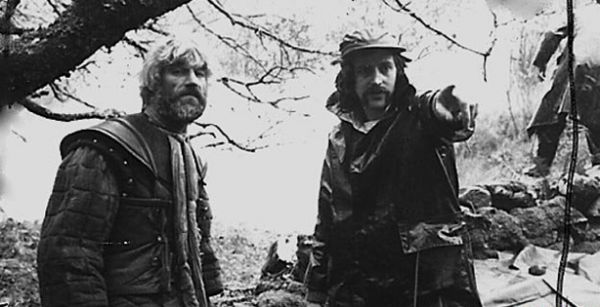
In 1979, George Lucas was looking for a good short film to show in theaters before The Empire Strikes Back, which was released in 1980. Roger Christian, the set decorator on the first Star Wars film, was commissioned to make a 25-minute film for Lucas. It was Christian’s first attempt at directing a film, and he only had a £25,000 ($50,000) grant to do it with. The result was Black Angel, a medieval fantasy about a knight who must rescue a mysterious woman. Christian and his tiny crew shot the film in Scotland.
But back in London, Christian's editor informed him that there wasn't enough footage to meet the 25-minute contract. To lengthen the film, they decided on a new option at the time, called step-printing, which produced a slow-motion effect during fight sequences by printing one frame repeatedly.

"It looked amazing," Christian says. Lucas was apparently so impressed with the fight sequences that the technique was then edited into The Empire Strikes Back during a scene with Luke Skywalker and Darth Vader in a cave. "He liked that look." Black Angel's stunning Arthurian appearance would also go on to influence fantasy movies in the 1980s like Excalibur and Legend.
Black Angel was shown before The Empire Strikes Back in Europe and Australia, but not in America. Then the film was completely lost for thirty years! A negative was recovered under mysterious circumstances in 2011, and the complete restored short film will be available for sale soon. Read the story of Black Angel, and see a clip, at Esquire.

Photographs Of Greenwich Village From The 20s And 30s

People are wary of cameras being pointed at them nowadays, and folks become extra paranoid when they’re up to no good and don’t want someone capturing photographic evidence of their misdeeds.
But the 1920s and 1930s were a simpler time, and photos were seen as a benign medium, considered flattering if people wanted to take your picture even if you were hanging around a speakeasy or dive bar.
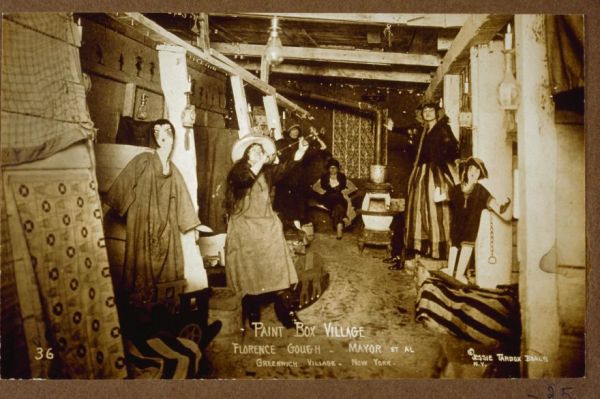
The photographs taken by Jessie Tarbox Beals, the first published female photojournalist in America, give us a window into Greenwich Village's past, with the seedy standing alongside the historical, and 29 of her photos which have become part of Harvard's Schlesinger Library are now on Flickr for your viewing pleasure.

Have some money to invest?

Perhaps I can interest you in buying a piece of the Brooklyn Bridge!
In the early 1900s, a con man named George Parker used a line like that on unsuspecting tourists and immigrants. Using forged documents, Parker pretended he owned the bridge and told people that as co-owners, they could make money by controlling access to the bridge. Parker was so convincing that the police often found his victims setting up toll booths on the portions of the bridge they thought they owned. Parker was eventually caught and sent to Sing Sing prison for life.
Robert Hendy-Freegard met a similar fate. The British con man pretended he worked at the British intelligence agency MI-5. He'd convince people they were in danger, send them into hiding, and then steal from them. He was jailed for life in 2005, but the sentence was later reduced to 9 years on appeal.
Other con men – or con women – have gotten away cleanly.
Sara Al-Amoudi is the alias of a mysterious London scam artist posing as a wealthy Middle Easterner. She convinced 2 real estate developers to give her London flats worth around 14 million pounds, by promising to invest millions in their other real estate projects, which she never did. Last month, a British court ruled Al-Amoudi could keep the apartments.
Other scams are more anonymous.
Ever gotten an e-mail from a wealthy Nigerian who says he’s trying to escape his corrupt country? He offers millions in rewards…if you give him some money now. The scam actually goes back to the French Revolution, when con men sent letters pretending to be French nobles who needed help relocating their fortunes.
And if you fall for that scam now that you've been warned, then perhaps I can sell you a piece of the Empire State Building.

Nine Kings


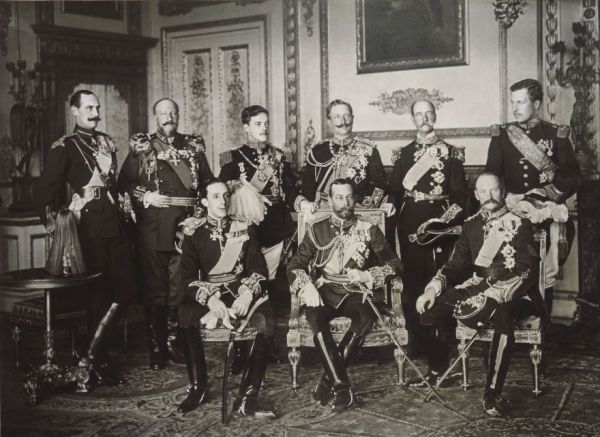
Looking through a collection of historical images at reddit, this one jumped out from the list (which is heavy on World War II photos). These are the nine monarchs of Europe who attended the funeral of the United Kingdom’s King Edward VII on May 20, 1910. They are:
Standing, from left to right: King Haakon VII of Norway, Tsar Ferdinand of Bulgaria, King Manuel II of Portugal, Kaiser Wilhelm II of the German Empire, King George I of Greece and King Albert I of Belgium. Seated, from left to right: King Alfonso XIII of Spain, King-Emperor George V of the United Kingdom and King Frederick VIII of Denmark.
They were all related to Edward VII; George V was his son and the rest were in-laws or cousins. The funeral was also attended by scores of queens, princes, princesses, and other royalty. U.S. president Theodore Roosevelt was there representing the United States. See the photo full-size.

Random Photos

An Excursion Into The Depths

The Diving Bell And The Exoskeleton

Deep diving is one of the most preposterous activities in which humans engage. Put it this way: diving below a few hundred feet into the ocean pushes the human body farther outside its natural limits and tolerances than walking in space. An Excursion Into The Depths.

Finally A Fence With Camouflage

Granted, you probably won't want to install one where there are a lot of deer running around at full speed and you wouldn't want one in front of your house both because it's hardly durable and because keeping it spotless is a nightmarish task, but even so, it's a clever idea that is certain to catch they eye even as it blends in.
See more cool pictures of the fence at Homes and Hues: Forget White Picket Fences, This One Reflects Its Surroundings