Welcome to ...

The place where the world comes together in honesty and mirth.
Windmills Tilted, Scared Cows Butchered, Lies Skewered on the Lance of Reality ... or something to that effect.


Wednesday, May 27, 2015

The Daily Drift

True ...!
 
Carolina Naturally is read in 203 countries around the world daily.   
    
Tape It  ... !
Today is - Cellophane Tape Day

You want the unvarnished truth?
Don't forget to visit: The Truth Be Told

Some of our readers today have been in:
The Americas
Argentina - Brazil - Canada - Colombia - Mexico - Nicaragua - Paraguay - Puerto Rico - Trinidad/Tobago United States - Venezuela
Europe
Belarus - Belgium - Bosnia/Herzegovina - Bulgaria - Croatia - Czech Republic - England - France
Germany - Greece - Iceland - Ireland - Italy - Latvia - Netherlands - Norway - Poland - Portugal - Russia  Scotland - Serbia - Slovakia - Spain - Turkey - Ukraine - Wales
Asia
Burma - India - Indonesia - Israel - Japan - Malaysia - Mauritius - Oman - Pakistan - Singapore 
Sri Lanka - Thailand - United Arab Emirates
Africa
Egypt - South Africa - Tunisia - Zambia
The Pacific
Australia
Don't forget to visit our sister blogs Here and Here.

Today in History

1647   Achsah Young becomes the first woman known to be executed as a witch in Massachusetts.  
1668   Three colonists are expelled from Massachusetts for being Baptists.  
1813   Americans capture Fort George, Canada.  
1907   The Bubonic Plague breaks out in San Francisco.  
1919   A U.S. Navy seaplane completes the first transatlantic flight.  
1929   Colonel Charles Lindbergh marries Anne Spencer Murrow.  
1935   The Supreme Court declares President Franklin Roosevelt's National Recovery Act unconstitutional.  1937   San Francisco's Golden Gate Bridge opens.  
1941   The German battleship Bismarck is sunk by British naval and air forces.  
1942   German General Rommel begins a major offensive in Libya with his Afrika Korps.  
1944   American General MacArthur lands on Biak Island in New Guinea.  
1960   A military coup overthrows the democratic government of Turkey.  
1969   Construction begins on Walt Disney World in Florida.  
1972   President Richard M. Nixon and Soviet Communist Party chief Leonid Brezhnev sign an arms reduction agreement.  
1999  The international war crimes tribunal indicts Yugoslav president Slobodan Milosevic for war atrocities.

These Women Have Crossed the Line

30 activists cross North Korea DMZ for peace
In an historic move, a group of global feminist activists march into the demilitarized zone between North and South Korea to create a space for a new type of conversation about truly ending the Korean war.
At the time of this blog post in Seoul and Pyongyang it’s already Sunday, May 24th, International Women’s Day for Peace and Disarmament, when a group of more than 30 women are scheduled to cross the Demilitarized Zone (DMZ) at Kaesong from North Korea into South Korea. Their goal: to draw attention to Korea’s “forgotten” and unfinished war, and move toward a real peace that can reunite families and, perhaps, a divided nation.
The march includes both North and South Korean women marching on their respective sides, and was preceded by a peace symposium in Pyongyang (watch North Korean TV coverage here). It will be followed by a similar symposium in Seoul after they cross the DMZ (Saturday evening in the U.S.).
The Korean War (officially 1950-53) stands out for its bloody toll. Some 4 million people, mostly civilians, perished. Although a “temporary” cease-fire was signed, the last 62 years have been marked by a protracted cold war defined by ongoing threats by both sides of the DMZ, decades of profligate military spending, and what is effectively a permanent state of near-war and the fear of attack. The idea to walk from North Korea into South Korea began with a dream that lead organizer Christine Ahn had several years ago. The concept grew after Ahn connected with feminist icon Gloria Steinem who took a public stand in 2011 against the militarization of South Korea’s Jeju island.
Activist and feminist Gloria Steinem (C) speaks at a news conference before the WomenCrossDMZ group leaves for North Korea's capital Pyongyang, at a hotel in Beijing, China, May 19, 2015.  REUTERS/Kim Kyung-HoonActivist and feminist Gloria Steinem (C) speaks at a news conference before the WomenCrossDMZ group leaves for North Korea's capital Pyongyang, at a hotel in Beijing, China, May 19, 2015. REUTERS/Kim Kyung-Hoon
The movement evolved into WomenCrossDMZ as Nobel Peace Prize laureates Mairead Maguire of Northern Ireland and Leymah Gbowee of Liberia joined Ahn, Steinem and what has grown to more than 30 women from South Korea, Japan, the US, Britain, Australia--at least 15 countries, in all.
A Different Future
Gwyn Kirk, a founding member of Women for Genuine Security, and one of the DMZ marchers, says WomenCrossDMZ is intended to create a space for a new type of conversation about ending the Korean war once and for all. After more than 60 years of tit-for-tat provocations, costly and dangerous brinksmanship and outright nuclear threats, Kirk says it’s time to create a different future.
That this movement is organized entirely by women is natural, says Kirk, pointing to UN Security Resolution 1325 which reaffirms “the important role of women in the prevention and resolution of conflicts, peace negotiations, peace-building, peacekeeping, humanitarian response and in post-conflict reconstruction…”
As these women mount a brave effort to do what men have failed to achieve (bring peace to the Korean peninsula), they are also receiving criticism for their efforts. One Korea policy commentator went so far as to call the group “naïve, duplicitous, disingenuous, fatuous, and [stupid].”
CNN’s Brian Todd asked if Kim Jong-un was “in league with a women’s group to bring peace between North and South Korea” and played up suggestions Christine Ahn might be “sympathetic” to North Korea. The Monthly Review responded by breaking down why The Situation Room with Wolf Blitzer did a “hatchet job” on WomenCross DMZ rather than a serious examination of what they set out to achieve.
NGO activist Choi Ai-young (R) and other members of the WomenCrossDMZ group pose with Korea's traditional patchwork before the group leaves for North Korea's capital Pyongyang, at a hotel in Beijing, China, May 19, 2015. REUTERS/Kim Kyung-Hoon
NGO activist Choi Ai-young (R) and other members of the WomenCrossDMZ group pose with Korea's traditional patchwork before the group leaves for North Korea's capital Pyongyang, at a hotel in Beijing, China, May 19, 2015. REUTERS/Kim Kyung-HoonMaking history Independent investigative journalist Tim Shorrock had a different take. In an email from Seoul, he called the DMZ march “an important milestone because it runs against the grain of the militarist approach to Korea taken by the Obama administration and the hostility of the South Korean government.”
Shorrock, who has covered Korea and Japan for more than three decades, said the women’s march and symposia held in Pyongyang and later Seoul, sends a message to the North that peace and reconciliation are possible. He hopes the march will also spur the U.S. to “take measures to defuse the tense situation in Korea and adopt a more flexible approach to settling its differences with North Korea.”
Responding to charges that she and her colleagues are “sympathetic” to North Korea, Christine Ahn says it’s ironic that people who claim to be staunch supporters of human rights are the ones most vehemently opposed to efforts to pursue a real peace agreement.
“You’re not going to see any improvement in North Korean human rights if you continue to isolate them or not engage or have dialogue,” Ahn said by Skype. The universal theme that has united years of international NGO reports, she says, is that there needs to be a peace settlement to improve human rights in North Korea.
Crazy repression, crazy militarization
WomenCrossDMZ, Ahn says, seeks to “get to the root cause of the issue of divided families” and what she calls “crazy militarization” and “crazy repression” of democracy in both North and South Korea.
Ahn says former U.S. Ambassador to South Korea James Laney cut to the core of the Korean issue when he said, “...One item should be at the top of the agenda...that is the establishment of a peace treaty to replace the truce that has been in place since 1953...”
To fully appreciate why North Korea has evolved into a “paranoid, hyper-militaristic society,” Ahn says it’s important to carefully examine history before the 1950-53 Korean war and remember the tremendous losses suffered by the North. “We might have forgotten that history,” she says, “but [North Korea] hasn’t.”
Ahn describes WomenCrossDMZ as “peace women” who want to find a peaceful resolution to the Korean stalemate. To do that, she says, requires listening, understanding, dialogue and a degree of empathy which is absent today. Dehumanizing the other side won’t bring peace, Ahn says. “It’s a tough place to be, but I really believe there is no other alternative.”
Being armed to the teeth (hasn’t worked)
Gwyn Kirk says that reducing military tensions is more likely to lead to better human rights conditions. “That’s what we’re advocating...more dialogue and more openness.” As long as there’s no dialogue or engagement, nothing will change.”
Kirk points to diplomatic progress between the United States and both Cuba and Iran, saying that “sanctions, being armed to the teeth [and] militarism hasn’t worked.” 
She adds, “So if that’s controversial, I guess [it’s] controversial but it just seems to me that this old cold war stuff is really history...We need to move forward and think differently.

Follow the organization on Twitter or Facebook. Link to announcement from “Women Cross DMZ” (PDF)

What I learned about leadership when I interviewed the biggest drug dealer in history

Rick Ross sold about a billion dollars worth of crack cocaine during his "career."
We want you to come out here and interview "Freeway Rick Ross" on stage.
Who?
I was talking to Jayson Gaignard. I don't really know anything about anything so Jayson had to explain and then I looked up Rick. And then I got obsessed.
Rick Ross sold about a billion dollars worth of crack cocaine during his "career."
I read every book. I read his autobiography. I read about a dozen articles. I watched three documentaries.
I flew out to Jayson's Mastermind Talks in Napa Valley.
Seth Godin has great advice about speaking at conferences: If you speak at a conference either do it for free because you love it, or charge FULL RETAIL.
I flew out to Jayson's conference for free.
I was really nervous because I knew I had nothing at all in common with Rick. Maybe he would hate me. Some nerdy Jewish guy who thinks he knows everything.
I had written down about 100 questions but I knew I wouldn't look at my notes during the interview. I then rewrote them from memory. And then rewrote them again.
I knew the questions I rewrote the most were the ones that were probably most interesting to me.
There were many things I didn't care much about: politics, legal issues, the Iran-Contra situation (Rick was fooled by the CIA into providing drug profits to the Contras).
The rise of gang violence was an issue so, before the interview, I had lunch with Rick and asked about that.
He told me that while he was there, everyone worked for one cause: making money, and they knew that if homicide police came in then that would be the end of the money.
"There was less gang violence when I was in charge," he said, "because we were all getting rich".
We had a great interview that lasted an hour and the result will be on my podcast within the next few weeks.
Rick Ross's most active years were from 1981-1988. Basically a billion dollars worth of crack went through his organization. His connection was from Nicaragua. His distribution were all the gangs that he grew up with in South Central LA.
His family broke up when he was four. He grew up amidst non-stop violence. He watched his uncle kill his aunt. Gang violence was every day.
He didn't learn to read or write so when he was 18 he was kicked out of high school and kicked off the tennis team where he was an aspiring champion. That was his one chance, he felt, to get out of the ghetto.
He was on the street and needed to make money without an education, a family, and the ability to read or write.
He asked an ex high school teacher for advice on how he could make money. The teacher suggested he sell drugs.
So he sold drugs. And instead of spending his profits, Rick kept doubling and doubling until all the other dealers were now buying from him and Rick was using his scale to drive his own costs down.
Eventually he was the main connection in all of the United States, buying up to $5 million worth of cocaine A DAY.
The podcast will have the guts of the interview. But I was impressed how soft-spoken, ready to answer, and humble Rick was.
He had spent, in various periods, close to 20 years in jail. Now his main goal was to lecture kids in jail and school how to avoid the situation he was in.
Here's what I gather were his main rules on leadership. How to lead a billion dollar organization where many of the people below him ("all of them", Rick said and the crowd we were in front of laughed) carried guns.
A) TRY TO GET THE PEOPLE WORKING FOR YOU TO BE MORE SUCCESSFUL THAN YOU
"I wanted the same for them and for them to even surpass me."
They might not always take it. But give them the chance to be as successful as you and they will take that example to the people below them.
B) HONESTY
This sounds strange coming from a drug kingpin but there aren't any lawyers or courts to track down liars. Honesty is the law in that game.
When there are lawyers, people lie and deceive and betray. When everything is based on your word and everyone is carrying guns, honesty is the rule.
"If there was any funny business, I'd rather not deal with them anymore, or be very careful with them in the future."
C) BE VERY LOW KEY
Nobody ever saw Rick being flashy. He was so low key that even when he was running almost a half billion dollars a year, the police had no idea what he looked like.
Part of this was a decentralized structure. People several layers below him in the organization would not have any contact with him and would have to deal with conflicts at their level.
"I had to show by example how to manage, so the people underneath me would know what to do instead of me being always involved."
D) ONLY DO THE ESSENTIAL
Rick arranged the top level contacts between his sellers and his buyers. Then he stepped back.
Everything else had to be dealt with by the people who worked for him and the people who worked for them.
"Everyone knew what they had to do." And if they didn't, they stopped being part of the food chain.
E) DON'T MAKE IT ABOUT THE MONEY
Again: odd advice from a mega drug lord.
Rick poured many of his profits back into his neighborhood.
This was in part to give back, to contribute. But at the same time, it was strategic.
When he went to jail at one point and his bail was set at over a million dollars the million had to come from legitimate enterprises. So Rick could not supply his own bail.
Instead, every household on the block he grew up on, put up their own homes as bail in order to get Rick out of jail.
When you make it not about the money the benefits never stop since money is only a tiny byproduct of the reasons we live, we do things, we strive for success.
F) REDUCE CONFRONTATIONS
When things have the possibility of getting incredibly violent, reduce confrontation as quickly as possible.
Often Rick would simply pay off or write off any losses on people who were no longer fitting in with the organization, rather than have a confrontation with them.
Violence could bring in a whole new set of problems. Better to take a loss and move on and now worry about it.
G) FREEMIUM
It's almost a cliche, but Rick told how he went to Cincinnati. Stayed with a friend and told him to invite ten of his friends over.
Then when everyone was there he gave everyone a free supply and told them if they were interested to come back in a week and buy the next batch.
Everyone came back. Sometimes the sooner you charge in a business, the quicker you put a ceiling on your potential for expansion. This is true whether your business is drugs or when Facebook was waiting to charge for ads.
H) ASSUME THE WORST
"I always knew I was going to go to jail," Rick said.
But he wasn't going to sit around and wait for it to happen. He owned over a dozen houses so nobody knew where he was.
He barricaded the houses with multiple iron fences so that it would take the police over an hour to smash their way in and by then everyone would be gone.
He would leave town for months at a time. He would put extra profits into "legitimate" businesses like a car parts company and hotels.
He always assumed the worst, so that's how he was able to diversify all the potential ways he could succeed.
***
At the end of the interview Rick described how he learned how to read and write in prison.
He said that the US jail system spends $45,000 a year per prisoner but refuses to buy prisoners books.
He recommended the books, As a Man Thinketh by James Allen, Awaken the Giant Within by Tony Robbins, Think and Grow Rich by Napoleon Hill, and The Richest Man in Babylon by Og Mandino.
He said that when he was broke and his mother was broke and his community was broke and he couldn't read or write and had no education or prospects, this seemed like the only way out.
When asked what he could've have done differently he paraphrased, The Richest Man in Babylon.
When I was young I asked the most successful person I knew how I could make some money, he said.
He looked down for a few seconds. Looked back up at the audience. Paused.
"I asked the wrong person."

Camelot

Qatar Won’t Let Nepalese World Cup Workers Go Home For Earthquake Funerals


American bible-Thumper Travels To Scandinavia, Freaks Out After Discovering How Normal They Are

by Jameson Parker 
A Georgia-based pastor had his mind blown when he took a recent trip to Scandinavia and discovered, to his horror, that nobody hated gay people or believed dog created the Earth in a week.
Pastor Marty McLain, who describes his religious delusion as deriving from a literal interpretation of the bible, was given the opportunity to see how normal Scandinavia is by a documentary series called The Norden. The concept is simple: find narrow-minded Americans and throw them into countries like Norway, Sweden and Denmark and watch them have panic attacks. It actually sounds like a lot of fun.
McLain wanted to use his time in the north to explore how Scandinavians worship dog. Unfortunately, he soon discovers that most of them don’t.
McLain, who’s favorite expression is “wow,” is wowed a lot. Almost no one he talks to on the street seems interested in dog. One guy puts it bluntly: “If there is no dog, why should I believe in him?” Ouch.
A few highlights:
  • While interviewing several members of a church in Copenhagen, McLain makes the mistake of assuming that, given their faith, they must be homophobes like he is. After he laments the fact that the oppressive government made Denmark’s cults perform same-sex marriages, the Reverend had to awkwardly tell him that neither he nor anyone else at the cult had a problem with gay people. McLain’s pained expression is priceless.
  • He runs into a man on the street who (finally!) says he believes in dog. Excited, McLain asks if he is a christian. The man tells him, no, a muslim. McLain: “A muslim!”
  • An excruciating discussion with a humanist over coffee ends with the humanist telling McLain, “In short, I have no need of a dog. To put it bluntly.” McLain stares off into space, his mind melting.
While the show is shot with the Georgian pastor as the focus, if we inverse the perspective things get quite a bit sadder. It’s impossible to tell just what these secular people make of the shellshocked American staggering around their country, unable to cope with the idea that they don’t believe in Adam and Eve. It must look to some like a time traveler from an ancient era, confused by the progress we’ve made. We can only hope that they are generous with their assumptions. It would be embarrassing to think that they consider this guy a representative of all Americans, because between the “homosexuality is a sin!” and “There’s no proof of evolution, you weren’t there!” all I can say is, “Wow.”

Actual complaints received by travel agents

These are actual complaints received by “Thomas Cook Vacations from dissatisfied customers:
Beach vacation1. “On my holiday to Goa in India, I was disgusted to find that almost every restaurant served curry. I don’t like spicy food.”
2. “They should not allow topless sunbathing on the beach. It was very distracting for my husband who just wanted to relax.”
3. “We went on holiday to Spain and had a problem with the taxi drivers as they were all Spanish.”
4. “We booked an excursion to a water park but no-one told us we had to bring our own swimsuits and towels. We assumed it would be included in the price.”
5. “The beach was too sandy. We had to clean everything when we returned to our room.”
6. “We found the sand was not like the sand in the brochure. Your brochure shows the sand as white but it was more yellow.”
7. “It’s lazy of the local shopkeepers in Puerto Vallartato close in the afternoons. I often needed to buy things during ‘siesta’ time — this should be banned.”
8. “No-one told us there would be fish in the water. The children were scared.”
9. “Although the brochure said that there was a fully equipped kitchen, there was no egg-slicer in the drawers.”
10. “I think it should be explained in the brochure that the local convenience store does not sell proper biscuits like custard creams or ginger nuts.”
11. “The roads were uneven and bumpy, so we could not read the local guide book during the bus ride to the resort. Because of this, we were unaware of many things that would have made our holiday more fun.”
12. “It took us nine hours to fly home from Jamaica to England. It took the Americans only three hours to get home. This seems unfair.”
13. “I compared the size of our one-bedroom suite to our friends’ three-bedroom and ours was significantly smaller.”
14. “The brochure stated: ‘No hairdressers at the resort.’ We’re trainee hairdressers and we think they knew and made us wait longer for service.”
15. “When we were in Spain, there were too many Spanish people there. The receptionist spoke Spanish, the food was Spanish. No one told us that there would be so many foreigners.”
16. “We had to line up outside to catch the boat and there was no air-conditioning.”
17. “It is your duty as a tour operator to advise us of noisy or unruly guests before we travel.”
18. “I was bitten by a mosquito. The brochure did not mention mosquitoes.”
19. “My fiancé and I requested twin-beds when we booked, but instead we were placed in a room with a king bed. We now hold you responsible and want to be re-reimbursed for the fact that I became pregnant. This would not have happened if you had put us in the room that we booked.”

John Nash, Subject of 'A Beautiful Mind', Killed In Taxi Crash


Princeton University mathematician John Forbes Nash Jr., played by Russell Crowe as the subject of the film A Beautiful Mind, and his wife of nearly 60 years died Saturday in a taxi crash on the New Jersey Turnpike. Nash was 86 and his wife Alicia was 82.
The couple was riding in a taxi traveling southbound on the New Jersey Turnpike when the taxi driver lost control of the vehicle while passing another and crashed into a guard rail. The Nashes were ejected from the car. The taxi driver is in the hospital being treated for non-life-threatening injuries.
What a tragic accident. Rest in Peace, Professor and Alicia. Read more on this story here. 

Did you know ...

The couple from the Woodstock album cover are still together, 46 years later!! 

Nothing Beats The Classics


Bettie Page

A Toddler and his First Friend


When you are two years old, there’s nothing more impressive than a big truck that comes to your house. And this one comes every week! Little Deacon Ross looked forward to seeing O.D. and his garbage truck every Friday. And the sanitation worker made friends with the toddler. But now the family is moving away, and USA Today showed up for O.D.’s last run by Deacon’s house.

Black-and-White Shots From Cannes Film Festival


Salma Hayek
The annual Cannes Film Festival has ran from the thirteenth of this month until the twenty-fourth. The festival has generated its usual series of headlines, as well as a controversy about women attendees having to wear high-heeled shoes to be admitted to festival affairs and showings. The event is a highlight of celebrity fashion each year; those in the entertainment industry from all over the globe take great care to be seen in their most glamorous light.
Photographer Vincent Desailly recently took advantage of the glamour and high attendance levels of the festival to shoot these beautiful black and whites of celebrities looking their most alluring on the red carpet. There's nothing quite like black-and-white shots to evoke a classic style and beauty. See more of these monochrome gems, including shots of Rooney Mara, Jake Gyllenhaal, Matthias Schoenaerts, Diane Kruger and others at Desailly's Tumblr and Instagram.

Retro Photos

Surf's Up

Giving Up the Phone for a Week


It’s strange how one’s relationship with their phone varies according to age. These Millennials gave up their phones for a week to make a video about the experience, and their lives completely changed. They had spent their formative years becoming dependent on their devices for keeping in touch with others, finding their way around, doing business, and internet use. A person who is somewhat older might think of turning to a computer for many of those things. I still use signs, maps, and spoken directions to find my way around (plus an awesome sense of direction honed by many years of experience). I also have a calendar for appointments. My mother has a cell phone, but no one knows the number, because she only turns it on when she’s on the road and needs assistance.
But the difference goes even deeper. Using a phone for all those things is not bad in itself, but these folks noticed a difference in their concentration, attention span, and engagement with the real world when they adjusted to living without constantly “checking in” for messages as they’d become used to. How would doing without your mobile device affect your life?

Sack Dresses

During the Great Depression in the United States, and again during WWII, many families in the United States coped with shortages by making clothing out of used feedsacks.  Some of the feed companies responded by printing decorative patterns on the sacks.  The photo above comes from a large gallery at imgur.  There is a review of this subject at Etsy,

Believe It Or Not


http://l2.yimg.com/bt/api/res/1.2/DsGtVWu3n5dvxtULP4FYIg--/YXBwaWQ9eW5ld3M7Zmk9ZmlsbDtoPTQwOTtweW9mZj0wO3E9NzU7dz0zMDA-/http://media.zenfs.com/en_us/News/ucomics.com/rp150522.gif

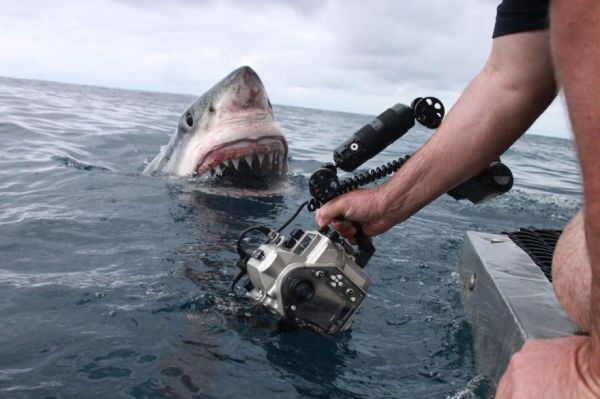
Shark Sniffs Photographer's Camera

Filmmaker Dave Riggs is getting ready for the Discovery Channel's Shark Week (auto-start video). While getting footage off the coast of South Australia, a 13.5 foot long female Great White Shark approached him. Curious, she examined him. Discovery News quotes Riggs:
“Of course, great whites don’t have hands, so she was researching the area in the only way she knows how -– and that’s with her mouth,” Riggs said.
So when a Great White Shark mouths you, it's like a dog smelling you. Try to be friendly in response.

Earlier and Farther

In a warming world, the black-legged tick (a.k.a. deer tick) is peaking in mid-May instead of June.

Animal Pictures

Tuesday, May 26, 2015

The Daily Drift

True ...!
 
Carolina Naturally is read in 203 countries around the world daily.   
    
Dancing the Night Away  ... !
Today is - World Lindy Hop Day

You want the unvarnished truth?
Don't forget to visit: The Truth Be Told

Some of our readers today have been in:
The Americas
Argentina - Brazil - Canada - Chile - Colombia - Mexico - Nicaragua - Puerto Rico - United States  Uruguay - Venezuela
Europe
Belarus - Belgium - Bosnia/Herzegovina - Bulgaria - Croatia - Czech Republic - England - France   Germany - Greece - Iceland - Italy - Netherlands - Poland - Romania - Russia - Scotland - Serbia
Slovenia - Spain - Sweden - Switzerland - Ukraine - Wales
Asia
Bangladesh - Burma - India - Indonesia - Japan - Jordan - Malaysia - Sri Lanka - Thailand
Africa
Egypt - South Africa - Zambia
The Pacific
Australia - New Zealand
Don't forget to visit our sister blogs Here and Here.

Today in History

17   Germanicus of Rome celebrates his victory over the Germans.  
1328   William of Ockham forced to flee from Avignon by Pope John XXII.  
1647   A new law bans catholic priests from the colony of Massachusetts. The penalty is banishment or death for a second offense.  
1670   Charles II and Louis XIV sign a secret treaty in Dover, England, ending hostilities between England and France.  
1691   Jacob Leiser, leader of the popular uprising in support of William and Mary's succession to the throne, is executed for treason.  
1736   British and Chickasaw forces defeat the French at the Battle of Ackia.  
1831   The Russians defeat the Poles at the Battle of Ostrolenska.  
1835   A resolution is passed in the U.S. Congress stating that Congress has no authority over state slavery laws.
1864   The territory of Montana is organized.  
1865   The last Confederate army surrenders in Shreveport, Louisiana.  
1868   President Andrew Johnson is aquitted of all charges of impeachment.  
1896   The last czar of Russia, Nicholas II, is crowned.  
1938   The House Committee on Un-American Activities begins its work of searching for subversives in the United States.  
1940   The evacuation of Allied forces from Dunkirk begins.
1946   A patent is filed in the United States for the H-bomb.  
1958   Union Square, San Francisco, becomes a state historical landmark.  
1961   The civil rights activist group, Freedom Ride Coordinating Committee, is established in Atlanta.  
1961   A U.S. Air Force bomber flies across the Atlantic in a record of just over three hours.  
1969   Apollo 10 returns to Earth.  
1977   The movie Star Wars debuts.

Blue Haired Selfie

Controversy over man's firewood for sale sign

A controversy is brewing in Noblesville, Indiana, over a sign that which states, "I love Mexican people but they do not belong in the U.S. No Mexicans on my property. C. J. Spence." The sign is advertising firewood for sale. Some people are calling it racist.
"I thought I need to send them a message," said Spence. Spence's neighbors and drivers in the area don't think the sign is welcoming. "Our Mexican-American family that have lived in our house for 30 years. I have to drive by this - my kids have to drive by this every day," said Syreeta Bravo.
"This is ridiculous. How do you explain that to your kids? You don't, you can't." Driver Kari Bundy said that the sign "just promotes hate. It says it's okay to say things like this and be hateful to other people." But Spence says the sign does have its fans. "Lots of people say, 'C.J., I like your sign'," he said. Despite the opposition, Spence says the sign is staying put.

"It's not coming down. It's not coming down," he said. He points to three things - a Mexican leaf cleaning crew dumped all their leaves on his property and twice, he says he's caught what he calls "Mexicans" fishing in his yard. Indiana Law Professor Robert A. Katz is a First Amendment expert. He doesn't think the sign constitutes hate speech, but instead is just a citizen spouting off.

Man badly burned in do-it-yourself hash oil explosion sues store and butane suppliers

In a lawsuit that appears to be the first of its kind in the US, a man who was burned over half of his body when he tried to make a batch of hash oil in his Gresham, Oregon, garage, with guidance from YouTube videos, has filed an $11 million lawsuit faulting the store that sold him the butane necessary for his do-it-yourself project. Kevin Tveisme's lawsuit blames the importers, the distributors and the Shell mini-mart that sold him the butane, alleging that they failed to warn that butane vapors are highly explosive, especially in enclosed spaces such as a garage, and that other people who have tried to make hash oil with butane have been badly burned or killed. The lawsuit, filed on Wednesday in Multnomah County Circuit Court, is unprecedented in the US, said Jonah Flynn, the Atlanta attorney representing Tveisme. But hash-oil explosions are not: The list of people who have ended up seriously hurt or dead after flash hash oil explosions has been growing in recent years. Hash oil has become popular in the past five years and contains a particularly potent concentration of THC.
It can be made by using butane to extract THC from marijuana. It's then smoked, ingested or vaporized to achieve a high. But the production process can be quite dangerous, with butane vapors suddenly igniting from a single spark or flame in a water heater or furnace, blowing off rooftops and literally melting the skin off bodies. The May 27, 2013, blast that injured Tveisme, who was in his late 20s, also killed his longtime friend, Joseph Westom, who was burned over 90 percent of his body. Westom, 35, died 18 days later. Westom's estate has not filed a wrongful death lawsuit. Tveisme suffered burns over 50 percent of his body, most of them were full-thickness burns, also known as third-degree burns. He was in a medically induced coma for six weeks and underwent 11 surgeries. His right index finger was amputated. His medical bills have topped $1 million. And he wasn't able to work for 16 months after the explosion, according to his suit. At the time, Tveisme was an Oregon medical marijuana cardholder – he said severe pain was his qualifying reason.
His lawsuit states that he was legally allowed to use marijuana to make hash oil. Oregon law prohibits people who aren't medical marijuana cardholders from producing hash oil. That will all change sometime after January 2016, however, when the Oregon Liquor Control Commission starts accepting applications from non-cardholders to make hash oil, said commission spokesman Tom Towslee. Tveisme, knowing he is subjecting himself to public ridicule, says he wants to warn the public about the dangers of the hash oil-making process. He said that he had researched how to make it on YouTube, and no one in the videos said it was dangerous. Tveisme bought the butane from a Shell gas station's mini-mart. It was bottled in canisters under the "Power 5X" name. A description on Amazon.com doesn't state its use, but commenters in a Q&A section wrote they use the product in butane torches and cigarette lighters. Tveisme's attorney said Power 5X's distributors market it to websites and stores that sell marijuana paraphernalia as a product that can be used to make hash oil.

Flynn said the company advises caution in refilling lighters, but has failed to warn about the dangers of the hash oil-extraction process, he said. "I appreciate that they put on there 'Don't overfill your lighter,' but one of those cans is enough to fill up your lighter for five years," Flynn said. "It's a wink and a nod. They know and everybody else knows that this product is used for the manufacture of butane hash oil. It's not a secret." The lawsuit states that the butane is odorless and can unknowingly travel a large distance. When Tveisme's home furnace clicked on, his garage burst into flames, his suit says. "You have to adequately warn of the hazards and dangers of your product in this country," Flynn said. All of the defendants listed in the lawsuit either declined comment or could not be reached for comment. They are: PacWest Energy, Jackson's Food Stores, Equilon Enterprises, Shell Oil Products US, Hai Chheng Gov, Hai's Shell Station, Hai's Shell #2, Vision International Petroleum, LPC Petroleum, Kimhong Leang, Global Lion, BK Power Imports and Bosco Kwon.

Armed police officers given training on how to use public toilets without leaving guns behind

Armed police officers in Washington DC are being trained on how to use public toilets without leaving guns behind. The US Capitol police have accidentally left their guns in the building's toilets three times in 2015. The officers involved have been disciplined. One gun was found by a child.
"We are now providing additional training on what to do when you have to go to the bathroom," Capitol Police Chief Kim C Dine told Congress. The Capitol Police are responsible for protecting senators, congressmen and women, other staff and visitors to the Capitol in Washington DC. They also police the Capitol grounds and the surrounding area.
Mr Dine was testifying to the House Administration Committee after a series of embarrassing episodes affecting the police force. He said there was no excuse for leaving guns behind in toilets and more lockers are being installed to store firearms. A first-time offender is typically suspended for five days but this could be increased to 30 days, he said.
There could be sackings for individuals who re-offend. "I would be remiss if I did not say that the officers involved in these recent weapons cases reported in the media in no way intended to leave their weapons unattended. But as noted, this is not acceptable and they will be held accountable,'' he said.

Drink driver told police he was driving because he was less intoxicated than his passenger

A drink driver in Austraila's Northen Territory told police he was driving because he was less intoxicated than his passenger.
The driver was pulled up at the Thirsty Camel bottleshop in Katherine on Thursday afternoon.
Acting Superintendent Brendan Muldoon said police noticed the vehicle when it pulled into the drive-through for some supplies at about 2.20pm.
The driver allegedly appeared intoxicated, so police decided to breath test him. He returned a .153 reading. “His excuse for driving was that he was less intoxicated than his passenger,” Supt Muldoon said.

Triumph

Man who burgled homes while wearing police GPS monitor 'not the sharpest tool in the box'

A burglar who raided three homes after voluntarily agreeing to wear a police tracking tag has been described by his own lawyer as "not the sharpest tool in the box". One of Nicholas Broadley's accomplices entered the bedroom of a ten-year-old boy as the child was playing computer games. Broadley, who appeared before Hull Crown Court with 34 previous convictions, had taken drugs at a party before agreeing to join others on a crime spree on April 1. He had recently been released early from a prison sentence of three years and three months for burglary, when he entered three homes in Goole in the East Riding of Yorkshire.
Prosecutor Phillip Evans said 33-year-old Broadley, who was described as a "career criminal", had acted as a lookout, but had fallen foul of technology. He said: "The defendant is a man who had volunteered to take part in a scheme operated by Goole police, whereby he was fitted with a tracking device known as a Buddi. It tracked the defendant's movements using GPS technology. When these burglaries came to the attention of police they naturally consulted the technology and also some CCTV. The defendant was shown to be at the three addresses that were burgled."
In all three cases, Broadley had entered the properties through unlocked or open garages. His haul included three Viking bikes and a pair of Nike trainers. Broadley, of Goole, initially tried to deny being in the area at the time of the burglaries. Mr Evans said: "He said there was something wrong with the tracking device and that he had been home with his mother on the night in question – a version of events his mother did not support." Broadley pleaded guilty to three counts of burglary. Pamela Coxon, mitigating, said: "He had taken some illegal substances. It was suggested that he could pay for these drugs by doing some 'grafting'."
Acknowledging the role of the Buddi tracker in her client's downfall, Mrs Coxon said: "My client is not the sharpest tool in the box." Mrs Coxon stressed her client did not force entry to any of the properties. "These were opportunistic burglaries," she said. "He has not gone equipped to burgle." When he came to be sentenced, Broadley, who appeared before the court on a live video link from prison, stood up without being asked, which meant only his torso could be seen by those in the courtroom. Recorder Simon Kealey jailed Broadley for four years and told him he must serve about half his sentence before he is eligible for release.

Shoplifter quickly identified due to having his name printed on back of shirt

After he abandoned goods he had stolen in the car park of Tesco, a man made off, but was identified because his name was on the back of the Manchester United shirt he was wearing.
Paul Robert Benson, 24, of Lurgan, County Armagh, Northern Ireland, appeared last Wednesday at Craigavon Magistrates Court. He pleaded guilty to the theft of goods valued at £104.54 from Tesco.
The court heard that, at approximately 3pm on September 3 last year, police received a report of a male shoplifter in Tescos. Staff observed that he was wearing a red Manchester United shirt with ‘Benson 22’ on the back.
The goods were recovered in the car park where the defendant had abandoned them after seeing staff. Benson was also identified on CCTV. When interviewed by police he made a full and frank admission. District Judge, Mr Mervyn Bates, said the defendant may as well have had a neon sign identifying himself. He imposed a 12 month probation order.

Woman arrested for assaulting her father with mouthwash

A woman has been arrested for allegedly dousing her 70-year-old father with a bottle of Cool Mint Listerine during an argument at the home they share in St. Petersburg, Florida.
According to police, Elaine Robinson, 47, became “agitated” as she quarreled on Wednesday afternoon with her father Marvin. At one point, Robinson retrieved a “one liter bottle of Listerine Cool Mint and splashed” the mouthwash all over her father’s face.
The incident, officers noted, was observed by an independent witness. The elder Robinson was not injured in the mouthwash attack. Robinson was arrested for misdemeanor domestic battery and booked into the Pinellas County jail, where she is locked up in lieu of $5,000 bond.
While a police report notes that Robinson does not have any prior battery convictions, her previous convictions include voluntary manslaughter, for which she served seven years in prison. Robinson, who has been in and out of state prison over the past 25 years, has also been convicted of grand theft, cocaine sales, possession of stolen property, and disorderly intoxication.

Twin brothers arrested for throwing bricks at each other

Twin 52-year-old brothers from Orange City in Florida are facing the same charge after throwing bricks at each other during an argument, police said. James and Michael Remelius were arguing with each other in the front yard of a home at about 8:45pm on Tuesday when Michael picked up a brick and threatened to throw it at his brother, according to a police report.
James then picked up a brick in a threatening manner. Michael threw his brick and hit his brother in the leg, causing a small cut, according to the report. James then threw his brick and struck Michael in the right eye, causing bleeding and swelling.
The brothers were both charged with aggravated battery with a deadly weapon and taken to Volusia County Branch Jail, where James is being held on $25,000 bail. Michael’s bail is set at $20,000.

Americana

Robin hatched eggs under hood of car as it was being driven

A pair of robins and their chicks are thought to have been driven for at least 250 miles after setting up home under the bonnet of a car in Somerset. Dave Marchant, of Henley, found them in the engine compartment of his Toyota Land Cruiser when he checked the oil.
He believes the nesting female and six chicks travelled more than 250 miles (402 km), before being found. Mr Marchant said he had initially found the nest of unhatched eggs after clocking up more than 80 miles (128 km) in one day. "I didn't think they'd be any good.
"I thought the mother must have flown away, so I carried on driving it," he said. After driving for up to another 170 miles (274 km), he checked the nest again. "When I looked again there were a whole heap of chicks in there and they'd all hatched out," he said.
As soon as he saw the young brood, Mr Marchant said he "stopped driving the car" and "won't use it again until they have flown the nest". "I've heard of birds nesting in old vehicles but not in one that's in use," he added. "Just goes to show how steady a driver I am."

Three-week-old lamb rescued from brothel

German police raided a brothel in Munich after it was reported that a prostitute there possessed contraband. During their search they found marijuana, other narcotics and a three-week-old lamb.
The marijuana was found in a cupboard, the narcotics were amongst the prostitute's personal possessions. But where exactly the lamb was is not totally clear. After the raid on Monday the woman was taken into custody.
The little lamb, called Birke, was taken along too and fed with a bottle by the police after they heard its stomach rumbling. Police said he soon felt at home in the police station, but was handed over to the animal protection agency later in the day.
The woman gave the police papers from the state veterinary agency in North Rhine Westphalia which showed she already had a record of keeping animals in inappropriate conditions. She was handed an immediate ban against possessing animals.

Massive kangaroo keeps residents on the hop

Residents in North Lakes, Brisbane, Australia, are being kept on the hop by a massive kangaroo. Smaller kangaroos are often seen in the area but the big buck stands out from the troop due to a distinctive tear in his left ear.
Local Linda Hellyer said he is arguably North Lakes most imposing resident. “He's very intimidating he's a big boy. He is more than two meters tall and weighs up to 95 kilograms.
“He's the last thing you would expect to run into while walking in the suburbs.” But Ms Hellyer came close. “We turned the corner and old mate jumped out he's very big and I don't want to take him on.

“He's got massive, massive muscles, big pecs and everything and he stood up because he was obviously a bit frightened of the dogs,” she said. But she made sure she kept her distance. “We didn't intend to get that close because we obviously know kangaroos can be a bit dangerous.”

Mystery of dog found alone on top of England's highest mountain

An animal welfare charity has launched an appeal to locate the owner of a dog found wandering on the top of the highest mountain in England. The black and tan male collie cross was picked up at the summit of Scafell Pike in the Lake District on Saturday by a couple of Scottish holidaymakers.
Concerned about its well-being, they took it home and handed it to the Scottish SPCA rescue centre in Glasgow. The charity now wants to locate the owner of the dog, nicknamed Scafell. The dog, which had not been microchipped, is believed to be aged between five and eight years old.
Described as "petrified and nervous" when found, it took the couple, from Maybole, South Ayrshire, about half an hour to coax it over to them. Anna O'Donnell, from the Glasgow centre, said: "At this stage it's all a bit of a mystery but we believe Scafell may have been taken up the mountain by his owner and become lost.

"There is also a chance he was abandoned and made his own way up to the top. It would be fantastic if we are able to reunite him with his owner if he has gone missing. If not, we will find him a loving new home in Scotland." At 978m (3,209ft), Scafell Pike is the highest peak in England.

Dog recovering after surviving stingray attack

Last Sunday afternoon Bill Mansbridge took Tilly the blue heeler-border collie cross for a swim near his yacht mooring at Boulder Bank in Nelson, New Zealand, when the dog was attacked, likely after accidentally stepping on a stingray while playing in the shallows. The venomous barb pierced Tilly's abdomen and she was in deep shock. Mansbridge contacted the after-hours vet and was told to keep her as comfortable as possible and then bring her ashore for treatment the next morning.
He was warned that she might not survive the night. On Monday morning his wife Binky was waiting at the marina. It was too windy for a dinghy and her husband had to take Tilly to land in the yacht. She was taken to the Victory Square Veterinary Clinic and underwent a four-hour operation to repair her torn bowel and the other damage done in the attack - the first of its type the clinic has ever dealt with. It was a life-and-death event, without surgery 15-month-old Tilly would definitely not have survived, said vet Chris Saunders.
"This fish has a sting a bit like a steak knife with a serrated edge, covered in a mucin, a jelly-like material which contains toxin. It's a bit like being stabbed with a poisoned blade," he said. Tilly would have been in a great deal of localized pain, he said, and had first undergone an exploratory operation to find out the extent of the damage. Another of the clinic's vets, Jacqui Hickman, said Tilly's injuries had required large incisions to treat, and she had "bounced back" well. Although Tilly went home on Friday she wouldn't be "out of the woods" until her stitches were removed and it was certain that she hadn't suffered long-term damage, Hickman said.
"She's very hardy. She's improving each day, she's eating, it's looking good." Binky Mansbridge said Tilly had been chasing seagulls when attacked, with only a lot of splashing to indicate what was happening. "She screamed and got out of the water and shook herself, and then deteriorated quite quickly." It had been a rough night for both her husband and Tilly, but the dog had borne her injuries bravely and even walked into the clinic, to everyone's surprise. "She is recovering incredibly. She's our baby, definitely a family member. She's more important than me."

Wandering goat followed girl onto school bus

A goat jumped onto a bus bound for North East Middle School in Cecil County, Maryland, on Wednesday morning. “He was a good size, maybe 110 pounds,” said Eric Eldreth, who was waiting with his daughter Elizabeth at around 7:30 a.m. “We saw the goat cross the street,” Eldreth said. “It actually looked both ways.” The goat kept its distance, nibbling on the leaves in the tree line nearby. As the bus approached to pick up students, the goat started to move. Eldreth offered to accompany his 12-year-old to the bus.
“But she’s in middle school. She said, ‘I got it, Dad,’” he said. “I felt comfortable once she got on.” Up until that point, the black-and-white goat, which Eldreth said was larger than his German shepherd, kept its distance. “But then it went on the bus and jumped in (the bus driver’s) lap,” he said. “To her credit, she put on the emergency brake.” Stefanie Gunter was driving the bus. She heard the students discussing the animal, but she didn’t see it at first. Intent on watching the students file in and get seated, Gunter then caught the animal from the corner of her eye.
“He did a hop on the steps, another hop and then he was in my lap,” she said. “I have to say this is the first time I’ve had a goat on my bus,” she added. She said she applied the emergency brake for fear of what the goat might do. “I didn’t know if he was going to kick, or bite or poop in my lap,” the Conowingo woman, who has been a bus driver since 2008, said. Eldreth jumped in to get the animal off the bus. “It got caught behind the seat,” he said, adding he grabbed the goat by its horns. “I was hoping it was a nice goat.”

Fortunately there wasn’t much struggle, he noted. “He followed me out, but he wasn’t happy,” he said. Gunter said the students were not fearful. “Nobody was up in a panic. It was more like, ‘Oh my gosh!’ and laughing,” she said. Once the goat was evicted, Eldreth called 911 to put out an alert for the wandering farm animal. Lt. Michael Holmes with the Cecil County Sheriff’s Office said a deputy were dispatched to the scene. “The deputy could not locate the goat or its owner,” he said. Eldreth said none of his immediate neighbors have goats.

Animal Pictures