

Saturday, March 8, 2014

A 13-year-old Builds Nuclear Reactor

As you’d probably guessed, Jamie Richards’s project didn’t involve the nuclear fission found in most nuclear power plants. Instead, reports the Lancashire Evening Post:
Jamie, who is 14 on Sunday, started building the reactor in October in a under-used science laboratory at Priory Academy and finally finished the task this morning , making two atoms of hydrogen smash together to make helium – a nuclear fusion.Referring to an American child who detailed a similar project in a TED talk in 2012, Jamie told the newspaper that:
One day, I was looking on the internet for radiation or other aspects of nuclear energy and I came across Taylor Wilson and his reactor. I looked at it, thought ‘that looks cool’ and decided to have a go. Basically I made a star in a jar.
Tall and Smart?


Rock the bells
Stonehenge pieces may have been chosen for acoustic properties

Could the rocks of Stonehenge been part of a early history symphony?
Stonehenge has been the source of endless speculation since the strange formation of rocks was first discovered.
But a new theory may be the most interesting of all, with some now saying the rocks at Stonehenge were chosen because of their acoustic properties.“There had to be something special about these rocks,” archaeo-acoustic expert Paul Devereux told the BBC. “It hasn't been considered until now that sound might have been a factor.”
Devereux led a project by the Royal College of Art in London, which attempts to understand how ancient humans perceived their world. The study results, published in the journal Time and Mind found that a number of the bluestone rocks at Stonehenge emitted sounds similar to bells when they are struck.
If the stone’s sonic properties were a motivating factor for those who transported them approximately 200 miles to the Stonehenge site, it may help further explain why some historic artifacts have said the rocks had mystical properties. Earlier this month, researchers said they had pinpointed the exact location that a number of Stonehenge’s bluestones were originally transported from. However, the new research has ultimately raised even more questions as to how exactly ancient humans were able to transport them over such a great distance.
In addition, the study found that a number of the bluestones at Stonehenge show evidence of having been physically struck.
“When struck, some make a range of metallic sounds, from pure bell-like tones to tin drum noises to deeper gong-like resonances,” Devereux and his colleagues write in the study, noting that about 5 to 10 percent of the 1,000 plus rocks they tested emitted the unusual sounds.
In fact, the diverse set of sounds emitted from stones in the study suggest that rocks at Stonehenge may have been used to create a virtual symphony to the ears of the ancient world.
“There's lots of different tones, you could play a tune,” Devereux told the BBC. “In fact, we have had percussionists who have played proper percussion pieces off the rocks."
Bureau of Land Management reports increase in theft, damage of fossils from public lands
This story about the recent loss of a millions-of-years-old dinosaur footprint
uses the word "vandals" to describe the criminals, but I think that's
misleading. Yes, the perpetrators destroyed the footprint, but they did
so accidentally in the process of trying to steal a piece of public,
shared natural history to sell on the private market. It seems like
"fossil poachers" might be a better label for what's going on and what
the Bureau of Land Management is trying to fight.
Watch the Arctic’s Old Ice Not So Magically Disappear
Ice reflects the sun's heat. No ice...well, of course, that
means heat not reflected and more heat absorbed instead, quickening the
pace of warming…

For now.
The repugicans are very fond of ignoring the fact that the amount of ice changes, so that if there is, at a particular moment, more ice this year than last year, they jump up and call “hoax!”, ignoring the longer trends that disprove their claims, as the chart below demonstrates:

We have also recently seen that this past January was the fourth warmest on record. A dunderhead could see why this is important, which leaves out Faux News and its luminaries, who steadfastly stick to their story that anthropogenic global warming is some sort of liberal plot:
On the January 29 edition of his show, Sean Handjob, who had previously said global warming was debunked because it was cold in Iowa, said, “I Don’t Care What Your Liberal Friends Say … I Think Global Warming Is A Hoax.”
And just the other day, on February 28, we learned on Faux News’ The Five, that four out of five co-hosts agree: there is no science to global warming.
And of course, there is David Barton, who, speaking for people everywhere who pretend to know stuff they don’t know, and following up his earlier claim that we haven’t had global warming in sixteen years (despite the fact that all the evidence points to ever increasing temperatures in that time), says our bizarre weather is due not to man’s impact on the environment (anthropogenic global warming) but is due to abortion: we opened a door that lost god’s protection over our environment and that’s our choice”:
Look. Global warming deniers are not the smartest people on the planet. But they are the most dishonest and they have corporate money to burn. And all they have to do is sow doubt. They don’t have to actually win the debate they started in the first place.
But the facts don’t like. NOAA’s 2012 State of the Climate report tells the tale:


Despite all this, despite the consensus of climate scientists and despite the evidences of their own five senses, in January, the House Energy and Commerce Committee voted to deny the reality of climate change. Never mind man-caused climate change, but climate change period. All 24 Republicans stuck their heads in the sand. As ThinkProgress reported, these Republicans have accepted a collective $9.3 million in contributions from the fossil fuel industry that is, in large part, driving that climate change they say isn’t happening.
Until the water is up around their necks, there will probably be no way to get a repugican to admit to the reality of anthropogenic global warming and, who knows, by then David Barton may have convinced them all that if we stop abortion the waters will recede. Stopping abortion, after all, doesn’t cost corporations. It’s a cheap – if completely ineffective – Bronze Age solution to a scientific problem.
And it is therefore exactly what the repugicans want. Reality is expensive. But god doesn’t cost them a penny.

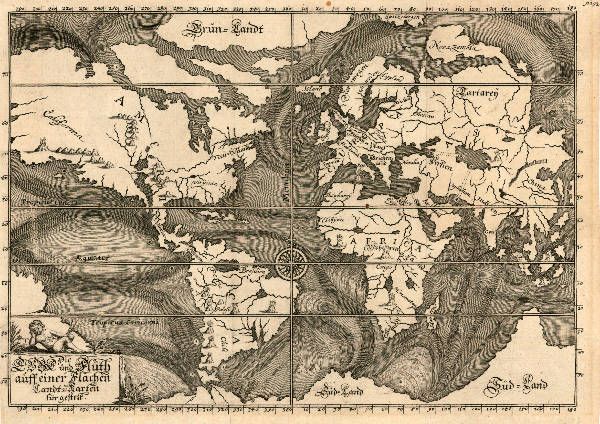
A 1685 Ocean Current Map
Satellite captures massive storm swirling off Antarctica

The satellite — known as EUMETSAT, which monitors weather and climate from space — was conducting an overflight when it caught the late summer storm with swirling clouds extending thousands of miles from its center.
According to Simon Proud, a
postdoctoral associate at MIT's atmospheric, oceanic and climate
sciences program, the cloud tail stretches nearly 3,500 miles.
Of course, big storms and harsh weather are not unusual for
Antarctica, one of the most treacherous and isolated places on Earth.Earlier this year, a Russian research vessel that was trapped in the ice off East Antarctica for 10 days led to a international effort to rescue the 52 people onboard.
NASA: Damn the Monoliths, Full Speed Ahead to Europa
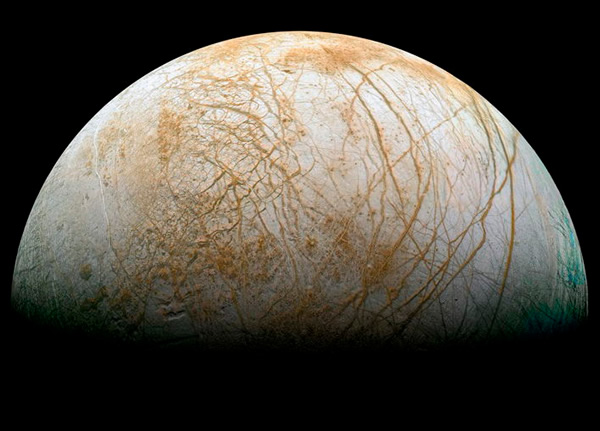
Jupiter moon Europa.
ALL THESE WORLDS ARE YOUR EXCEPT EUROPA ATTEMPT NO LANDING THERE.
That warning, as given in Arthur C. Clarke's 2010: Odyssey Two novel, was pretty explicit but apparently it is going to go unheeded by NASA.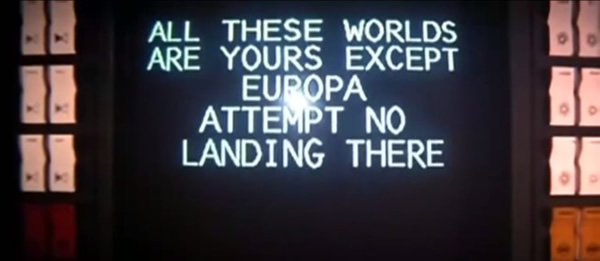
"Europa
is a very challenging mission operating in a really high radiation
environment, and there's lots to do to prepare for it," said NASA chief
financial officer Beth Robinson. "We're looking to launch sometime in
the mid-2020s."
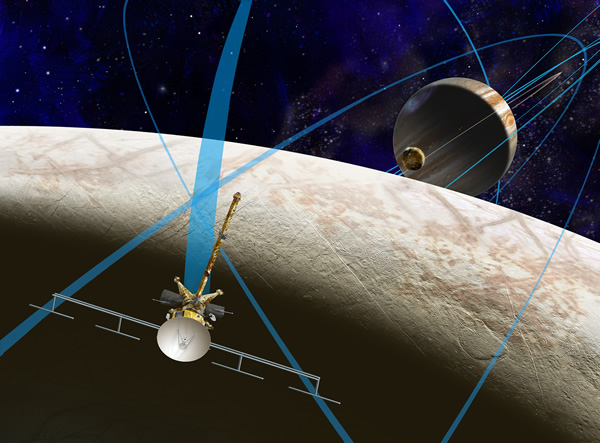
Artist's
concept of the Europa Clipper mission.
While the
space program is wide open, one candidate project is NASA's Europa Clipper,
a probe that would orbit Jupiter and make flyby trips to Europa to
study the moon's environment. An exciting potential is to have the probe
cruise through Europa's 125-mile-high water plumes, spotted by Hubble back in December 2013, to collect and analyze samples.
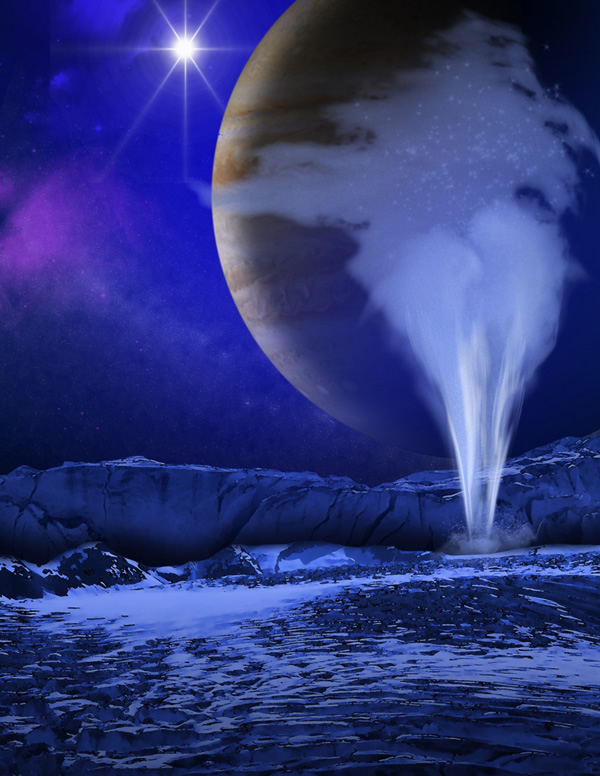
Artist's concept of Europa water vapor plume.
Strange Signal From Galactic Center Is Looking More And More Like Dark Matter

The more that scientists stare at it, the more a strange signal from the center of the Milky Way galaxy appears to be the result of dark matter annihilation. If confirmed, it would be the first direct evidence for dark matter ever seen.

Boneco: The Beekeeping Donkey

Manuel Juraci is a beekeeper in Itatira, Brazil. There are a lot of beekeepers in the small town, but Juraci is one of the most successful, and one of the reasons is that he has Boneco the donkey to help haul the honey. Boneco can accompany his master on his rounds safely in his custom-made beekeeping donkey suit! Read about Boneco, and a beekeeping dog as well, at Gizmodo.
Marine scientists identify lobsters' ancestors
Scientists have long believed that lobster-like crustaceans first
appeared on planet Earth about 360 million years ago. But FIU marine
scientist Heather Bracken-Grissom contends the ancestor of our favorite
mealtime decapod actually may have started roaming the planet at least
12 million years earlier.

"This is the most complete study of lobsters to date. One hundred and seventy-three species were analyzed, including commercially important species such as Maine lobster, Florida's spiny lobsters and the redswamp crayfish, which Louisiana is famous for," Bracken-Grissom said. "We also included some very rare species, recently discovered in the 1970s, who had never been included in an analysis before. It was interesting to include them because we got to see where they fell in the lobster tree of life."
The study, published in the Oxford Journal Systematic Biology, also examined the evolutionary relationships among lobsters, or how different species are related to each other. Bracken-Grissom's study found present crayfish distributions mirror the break up of the supercontinent Pangaea and Gondwana, the two southern supercontinents. The study also uncovered cryptic, or hidden diversity, with the discovery of several potential new species within lobsters.
"It's important to understand their evolutionary relationships, since that has implications for biodiversity estimates and increased evolutionary understanding," Bracken-Grissom said. "It also has implications for conservation efforts, fisheries management and aquaculture management."
Commercial fisheries and aquaculture rely on spiny, slipper and reef lobsters to bring in billions of dollars each year for human consumption and aquarium trade. Lobsters also contribute to the cultural livelihood of many communities that celebrate these delicacies through festivals, crayfish boils and other social activities.
Marine scientists identify lobsters' ancestors
Spiny Lobster
Using fossil records and DNA testing, a team of international scientists
led by Bracken-Grissom has determined the first lobster-like crustacean
appeared on planet Earth approximately 372-409 million years ago.
"This is the most complete study of lobsters to date. One hundred and seventy-three species were analyzed, including commercially important species such as Maine lobster, Florida's spiny lobsters and the redswamp crayfish, which Louisiana is famous for," Bracken-Grissom said. "We also included some very rare species, recently discovered in the 1970s, who had never been included in an analysis before. It was interesting to include them because we got to see where they fell in the lobster tree of life."
The study, published in the Oxford Journal Systematic Biology, also examined the evolutionary relationships among lobsters, or how different species are related to each other. Bracken-Grissom's study found present crayfish distributions mirror the break up of the supercontinent Pangaea and Gondwana, the two southern supercontinents. The study also uncovered cryptic, or hidden diversity, with the discovery of several potential new species within lobsters.
"It's important to understand their evolutionary relationships, since that has implications for biodiversity estimates and increased evolutionary understanding," Bracken-Grissom said. "It also has implications for conservation efforts, fisheries management and aquaculture management."
Commercial fisheries and aquaculture rely on spiny, slipper and reef lobsters to bring in billions of dollars each year for human consumption and aquarium trade. Lobsters also contribute to the cultural livelihood of many communities that celebrate these delicacies through festivals, crayfish boils and other social activities.

Friday, March 7, 2014
The Daily Drift

Carolina Naturally is read in 195 countries around the world daily.
Oh, yeah, Doodle ... !
Oh, yeah, Doodle ... !

Don't forget to visit our sister blog: It Is What It Is
Some of our readers today have been in:
The Americas
Santiago and Lo Prado, Chile
Alta Foresta, Rio De Janeiro and Salvador, Brazil
Surrey,
Vaughan, Ottawa, Brantford, Lansing, Templeton, Byward Market, Guelph,
Sioux Lookout, Vancouver, Calgary and Scarborough, Canada
Medellin and Bogota, Colombia
Pomona, Pima, Hackensack, Duluth, Wauconda, Ogden, Mascot, Dulles, Malvern, Shawnee and Orem, United States
The Bottom, Sint Eustatius and Saba
Lima, Peru
Buenos Aires, Argentina
Managua and Tipitapa, Nicaragua
Guaynabo and San Juan, Puerto Rico
Europe
Luxembourg, Luxembourg
Palmela, Costa De Caparica and Funchal, Portugal
Cavallino, Conversano, Venice, Rome and Milan, Italy
Rouen, Paris and Lyon, France
Ostrava, Czech Republic
Dublin and Limerick, Ireland
Veliko Turnovo and Ruse, Bulgaria
Bochum, Nuremberg and Koeln, Germany
Torshavn, Faroe Islands
Nicosia and Limassol, Cyprus
Tartu and Tallinn, Estonia
Pool, Woking, Manchester and London, England
Helsinki and Vantaa, Finland
Vladivostok and Chelyabinsk, Russia
Sarajevo, Bosnia and Herzegovina
Luqa, Malta
Ankara, Turkey
Warsaw, Poland
Belgrade, Serbia
Bratislava, Slovakia
Reykjavik, Iceland
Madrid, Spain
Copenhagen, Denmark
Amsterdam, Netherlands
Sibiu, Romania
Asia
Tangerang, Surabaya, Bualu, Jakarta and Makassar, Indonesia
Doha, Qatar
Sungai Besar, Puchong, Shah Alam and Parit Raja, Malaysia
Jeddah, Riyadh and Mecca, Saudi Arabia
Thiruvananthapuram, Bhubaneshwar, New Delhi, Mumbai, Shillong, Patna, Ahmedabad, Yanamalakuduru and Coimbatore, India
Kuwait, Kuwait
Thanh Pho Ho Chi Minh, Vietnam
Karachi, Lahore, Islamabad and Sibi, Pakistan
Colombo and Kandy, Sri Lanka
Seoul, Korea
Quarte Bornes and La Dagotiere, Mauritius
Sanaa, Yemen
Singapore, Singapore
Rangoon, Burma
Chengdu, China
Tehran, Iran
Africa
Ceres, Johannesburg, Potchefstroom and Cape Town, South Africa
Tetouan, Morocco
Cairo, Egypt
Porto-Novo, Benin
Carthage, Tunisia
Pacific
Surrey Hills and Homebush, Australia
Davao City, Pasig, Mandaluyong City, Pasay and Manila, Philippines
Honiara, Solomon, Islands
Today in History
| 322 BC | The Greek philosopher Aristotle dies. | |
| 161 | On the death of Antoninus at Lorium, Marcus Aurelius becomes emperor. | |
| 1774 | The British close the port of Boston to all commerce. | |
| 1799 | In Palestine, Napoleon captures Jaffa and his men massacre more than 2,000 Albanian prisoners. | |
| 1809 | Aeronaut Jean Pierre Blanchard — the first person to make the an aerial voyage in the New World — died on March 7, 1809, at the age of 56. | |
| 1838 | Soprano Jenny Lind ("the Swedish Nightingale") makes her debut in Weber's opera Der Freischultz. | |
| 1847 | U.S. General Winfield Scott occupies Vera Cruz, Mexico. | |
| 1849 | The Austrian Reichstag is dissolved. | |
| 1862 | Confederate forces surprise the Union army at the Battle of Pea Ridge, in Arkansas, but the Union is victorious. | |
| 1876 | Alexander Graham Bell is granted a patent for the telephone. | |
| 1904 | The Japanese bomb the Russian town of Vladivostok. | |
| 1906 | Finland becomes the third country to give women the right to vote, decreeing universal suffrage for all citizens over 24, however, barring those persons who are supported by the state. | |
| 1912 | French aviator, Heri Seimet flies non-stop from London to Paris in three hours. | |
| 1918 | Finland signs an alliance treaty with Germany. | |
| 1925 | The Soviet Red Army occupies Outer Mongolia. | |
| 1927 | A Texas law that bans Negroes from voting is ruled unconstitutional by the Supreme Court. | |
| 1933 | The board game Monopoly is invented. | |
| 1933 | The film King Kong premieres in New York City. | |
| 1935 | Malcolm Campbell sets an auto speed record of 276.8 mph in Florida. | |
| 1936 | Hitler sends German troops into the Rhineland, violating the Locarno Pact. | |
| 1942 | Japanese troops land on New Guinea. | |
| 1951 | U.N. forces in Korea under General Matthew Ridgeway launch Operation Ripper, an offensive to straighten out the U.N. front lines against the Chinese. | |
| 1968 | The Battle of Saigon, begun on the day of the Tet Offensive, ends. | |
| 1971 | A thousand U.S. planes bomb Cambodia and Laos. | |
| 1979 | Voyager 1 reaches Jupiter. |


Subscribe to:
Posts (Atom)
