

Monday, September 1, 2014

Is Lack of Sleep deadly?

It's commonly thought that not sleeping for super-long times
is a good way to get yourself dead. Trace tells us where that line is,
and how long record-setting humans have stayed up in the past.
Hitchin' A Ride

Next time you plant the garlic that's sprouted in your
kitchen cupboard you could be contributing to the spread of exotic
viruses.
Brewery removes 'fart-smelling' beer from sale
 A Norwegian brewery has removed all stock of one of its beers after
drinkers complained of its foul-smelling aroma.
Mack brewers, based in Tromsø, produced the “Isbjørn” (“Polar beer”),
but a flaw in the manufacturing process created a drink with
stomach-churning properties.
It was found that contamination in the bottling system led to a bad odor in many of the beer cans.
A Norwegian brewery has removed all stock of one of its beers after
drinkers complained of its foul-smelling aroma.
Mack brewers, based in Tromsø, produced the “Isbjørn” (“Polar beer”),
but a flaw in the manufacturing process created a drink with
stomach-churning properties.
It was found that contamination in the bottling system led to a bad odor in many of the beer cans.
A build-up of lactic acid in cans led to an unpleasant smell of sulphur
and rotten eggs. The contamination was particularly rife when the
weather was at its warmest this summer.
In reaction to complaints, Mack, who have sold tens of thousands of cans
of the "fart-smelling" drink, has over the last few weeks tried to
withdraw all “Isbjørns” produced on July 21st and 22nd this year.
Roger Karlsen, Mack's director, said to Harstad Tidende: “These bacteria are not dangerous. They are normally used in acidic milk products, such as yoghurt, but can give an unpleasant smell and taste in beer. The smell can be like anything from lemon and vinegar to rotten fish. It is something caused by, among other things, decomposition of the proteins in the beer.”
Any customers who purchased 12-packs of the “Isbjørn” beer could have received cans of foul-smelling liquid. The brewery has attempted to retrieve all cans, but has not got them all back yet. The affected beer has an expiration date of October 22nd and 23rd. Customers who have bought the beer will get their money back from the brewery, Mack said.
Roger Karlsen, Mack's director, said to Harstad Tidende: “These bacteria are not dangerous. They are normally used in acidic milk products, such as yoghurt, but can give an unpleasant smell and taste in beer. The smell can be like anything from lemon and vinegar to rotten fish. It is something caused by, among other things, decomposition of the proteins in the beer.”
Any customers who purchased 12-packs of the “Isbjørn” beer could have received cans of foul-smelling liquid. The brewery has attempted to retrieve all cans, but has not got them all back yet. The affected beer has an expiration date of October 22nd and 23rd. Customers who have bought the beer will get their money back from the brewery, Mack said.
How Can Foods Have Zero Calories?

Had something with zero calories in it lately? Unless it was
water, you haven't. Tara explains why the math is so fuzzy between
packaging claims and reality.
Genomics Study Offers Clues to Arctic Cultures

'Hobbits of the Arctic'

The petite Dorset people went extinct before the Vikings arrived and never mixed with Inuit or Eskimo peoples.
Archaeological News

The artifact had been well used by Roman soldiers and looks as though it was quite comfortable.

Forty wine jars were found within the remains of a mud-brick-walled room in Israel.

A Phoenician trading ship dating to 700 B.C. is discovered
off the island of Malta. The wreck is one of the oldest ever found in
the Mediterranean
Volcanic News

Mount Tavurvur erupted to 60,000 feet Friday, forcing planes
to re-route from Australia and evacuations of local communities.

If the big volcano, which last erupted 640,000 years ago,
were to blow up again, it would spew enough ash to send particles as far
away as New York City.

Cauldrons forming near Iceland's Bardarbunga volcano suggest an eruption under the ice has already taken place.

Cardboard cutout dogs used in attempt to scare off geese
Park officials in Stevens Point, Wisconsin, have recently planted
cardboard cutouts of dogs in an attempt to fend off flocks of geese that
are making a mess in popular regions of the park.

 The geese congregate "in front of the band shell where we have concerts
and get in the grass,” Tom Schrader, director of Parks and Recreation at
Pfiffiner Park, said.
“People want to put their blankets down on the ground but can’t.”
There are anywhere from 25 to 120 geese in front of the band shell at
once and they usually relieve themselves every 20 minutes, Schrader
said.
The geese congregate "in front of the band shell where we have concerts
and get in the grass,” Tom Schrader, director of Parks and Recreation at
Pfiffiner Park, said.
“People want to put their blankets down on the ground but can’t.”
There are anywhere from 25 to 120 geese in front of the band shell at
once and they usually relieve themselves every 20 minutes, Schrader
said.
In an attempt to move the geese into the lake, park officials placed three cardboard dog cutouts at $40 each around the band shell. “The geese generally stay about 30 to 40 yards away from the cutouts because they resemble coyotes,” he said. This is one of many efforts the park has used in the past two years to deflect the wild animals,
Other attempts have included mounting handcrafted owls in trees,
purchasing plastic clappers and employing volunteers to shoo them into
the nearby lake.
“This year we didn’t have as many people so we tried different
alternatives and Googled ways to scare geese,” he said.
Two of the three cutouts have since been stolen. The park plans to make their own to replace them.
The geese congregate "in front of the band shell where we have concerts
and get in the grass,” Tom Schrader, director of Parks and Recreation at
Pfiffiner Park, said.
“People want to put their blankets down on the ground but can’t.”
There are anywhere from 25 to 120 geese in front of the band shell at
once and they usually relieve themselves every 20 minutes, Schrader
said. In an attempt to move the geese into the lake, park officials placed three cardboard dog cutouts at $40 each around the band shell. “The geese generally stay about 30 to 40 yards away from the cutouts because they resemble coyotes,” he said. This is one of many efforts the park has used in the past two years to deflect the wild animals,
School closed due to feral cat inside building

A teacher noticed the cat in her classroom at 7:30am, but it ran away. School officials then kept around 500 students outside of the building,
which typically starts at 8:45am. A decision to close the school was
made at 9:45am. School officials said they're working with police and
Animal Control to capture the animal.
Robin Catlett, with the Anne Arundel County Animal Control, said the situation is still up in the air. The cat has not been identified by Animal Control yet, so they’re unsure of how they will proceed if they find the cat, Catlett said. "It would really depend on all the facts," she said.
 Schools spokesman Bob Mosier said: "We have no idea the health status of the cat and certainly, we weren't going to put the nearly 500 students here in potential danger by
having them in a building where a frightened cat might start running
around, so we made a decision to close the school. Hopefully we'll trap
it."
Mosier added that it was too early to consider what happens if the cat
is not found.
"We’re hoping this ends far sooner rather than later," he said.
Schools spokesman Bob Mosier said: "We have no idea the health status of the cat and certainly, we weren't going to put the nearly 500 students here in potential danger by
having them in a building where a frightened cat might start running
around, so we made a decision to close the school. Hopefully we'll trap
it."
Mosier added that it was too early to consider what happens if the cat
is not found.
"We’re hoping this ends far sooner rather than later," he said.
Robin Catlett, with the Anne Arundel County Animal Control, said the situation is still up in the air. The cat has not been identified by Animal Control yet, so they’re unsure of how they will proceed if they find the cat, Catlett said. "It would really depend on all the facts," she said.
Schools spokesman Bob Mosier said: "We have no idea the health status of the cat and certainly, we weren't going to put the nearly 500 students here in potential danger by
having them in a building where a frightened cat might start running
around, so we made a decision to close the school. Hopefully we'll trap
it."
Mosier added that it was too early to consider what happens if the cat
is not found.
"We’re hoping this ends far sooner rather than later," he said.
Chihuahua Puppy Enjoys Massage
This Chihuahua puppy discovers the delight of a mechanical massager. Like many humans, once he feels the sensation, he lingers, in no mood to hurry about his doggie day.
Memorial for Old Douglas


Though the men tried to treat Old Douglas like a horse, the camel was known to break free of any tether, and was eventually allowed to graze freely. Despite not being tied up, he never wandered far from the men. The Infantry’s horses feared Old Douglas, and he is recorded to have spooked one horse into starting a stampede, which reportedly injured many, and possibly killed one or two horses.[5]Learn more about the American camels from the Texas Camel Corps, a group “established to educate the public about the historic use of camels in America in the 19th century.”
Old Douglas’s first active service was with Gen. Price in the Iuka campaign. He also participated in the 1862 Battle of Corinth.[3] He remained with the regiment until the Siege of Vicksburg, where he was killed by Union sharpshooters.[6] Enraged at his murder, the men swore to avenge him. Col. Bevier enlisted six of his best snipers, and successfully shot the culprit. Of Douglas’s murderer, Bevier reportedly said, “I refused to hear his name, and was rejoiced to learn that he had been severely wounded.[7]” According to legend, after Douglas was shot, his remains were carved up and eaten, with some of his bones made into souvenirs by Federal soldiers.[2]

Animal News

With its spiritual pose, the praying mantis is a wonder to
behold. But behind its vaguely extraterrestrial features lies a ruthless
predator.

A veritable barrel full of monkeys -- five new species --
has been found in the tropical forests of South America.

New Yorkers are being treated to some dramatic
nature-produced shows these days as humpback whales travel to Big Apple
waters to feed.

Spry pup holds speed records in two categories.

Five new shark species, along with two species of manta ray, gain new worldwide protection next month.

Unusual fish that walk and breathe air turn out quite differently when raised on land, rather than in water.

The specimen, approximately 560 million years old, contains
fibrous bundles that appear to be muscle tissue, an important
evolutionary adaptation.

A tenfold increase in protected coral species was announced
Aug. 27, with 20 new corals added to the threatened species list.

Sunday, August 31, 2014
The Daily Drift

Carolina Naturally is read in 200 countries around the world daily.
Genuine Pony Express Rider (we think) ... !

Today is - Pony Express Day
Don't forget to visit our sister blog: It Is What It Is
Some of our readers today have been in:
The Americas
Arvada, Andes, Atlanta, Auburn, Anacortes and Achorage, United States
Luquillo, Puerto Rico
Santiago, Chile
Quebec, Montreal, Etobicoke and Ottawa, Canada
Tijuana, Mexico
Sao Paulo, Teixeira and Rio De Janeiro, Brazil
Managua, Nicaragua
Villa Carlos Paz, Argentina
Santiago, Chile
Europe
Braga and Parede, Portugal
Reykjavik, Iceland
London, Milton Keynes, Manchester and Liverpool, England
Rome, Treviso, Naples, Battipaglia, Verona and Terlizzi, Italy
Warsaw and Krakow, Poland
Madrid and Basauri, Spain
Sarajevo, Bosnia-Herzegovina
Hluboka Nad Vltavou and Prague, Czech Republic
Dublin, Cork and Tallaght, Ireland
Saint Petersburg, Moscow, Novosibirsk and Ryazan, Russia
Eschborn and Nuremberg, Germany
Ulus, Turkey
Rouen, Cerny, Cenac and Paris, France
Amsterdam, Netherlands
Stockholm and Bastad, Sweden
Steinsel, Luxembourg
Belgrade, Serbia
Riga, Latvia
Asia
Kota Kinabalu, Kuala Lumpur, Petaling Jaya, Melaka, Kuching and Kajang, Malaysia
Vacoas, Mauritius
Tehran, Tabriz and Fasa, Iran
Kandy and Colombo, Sri Lanka
Bangalore, New Delhi, Kolkata, Patna and Jodhpur, India
Islamabad, Karachi and Rawalpindi, Pakistan
Hanoi, Vietnam
Bandar Seri Begawan, Brunei
Doha, Qatar
Phra Nakon Si Ayutthaya, Thailand
Hafar Al-Batin, Saudi Arabia
Singapore, Singapore
Africa
Durban, South Africa
Al Jizah, Egypt
Abuja, Nigeria
Algiers, Algeria
The Pacific
Homebush and Subiaco, Australia
Manila,Quiapo and Makati, Philippines
Today in History
| 1303 | The War of Vespers in Sicily ends with an agreement between Charles of Valois, who invaded the country, and Frederick, the ruler of Sicily. | |
| 1756 | The British at Fort William Henry, New York, surrender to Louis Montcalm of France. | |
| 1802 | Captain Merriwether Lewis leaves Pittsburgh to meet up with Captain William Clark and begin their trek to the Pacific Ocean. | |
| 1864 | At the Democratic convention in Chicago, General George B. McClellan is nominated for president. | |
| 1919 | The Communist Labor Party is founded in Chicago, with the motto, "Workers of the world unite!" | |
| 1928 | Kurt Weill's The Threepenny Opera opens in Berlin. | |
| 1940 | Joseph Avenol steps down as Secretary-General of the League of Nations. | |
| 1942 | The British army under General Bernard Law Montgomery defeats Field Marshal Erwin Rommel's Afrika Korps in the Battle of Alam Halfa in Egypt. | |
| 1944 | The British Eighth Army penetrates the German Gothic Line in Italy. | |
| 1949 | Six of the 16 surviving Union veterans of the Civil War attend the last-ever encampment of the Grand Army of the Republic, held in Indianapolis, Indiana. | |
| 1951 | The 1st Marine Division begins its attack on Bloody Ridge in Korea. The four-day battle results in 2,700 Marine casualties. | |
| 1961 | A concrete wall replaces the barbed wire fence that separates East and West Germany, it will be called the Berlin wall. | |
| 1965 | US Congress creates Department of Housing & Urban Development. | |
| 1968 | The Dasht-e Bayaz 7.3 earthquake in NE Iran completely destroys five villages and severely damages six others. | |
| 1970 | Lonnie McLucas convicted of torturing and murdering fellow Black Panther Party member Alex Rackley in the first of the New Haven Black Panther Trials. | |
| 1980 | Polish government forced to sign Gdansk Agreement allowing creation of the trade union Solidarity. | |
| 1985 | Police capture Richard Ramirez, dubbed the "Night Stalker" for a string of gruesome murders that stretched from Mission Viejo to San Francisco, Cal. | |
| 1986 | A Russian cargo ship collides with cruise ship Admiral Nakhimov, killing 398. | |
| 1987 | Longest mine strike in South Africa's history ends, after 11 people were killed, 500 injured and 400 arrested. | |
| 1990 | East and West Germany sign the Treaty of Unification (Einigungsvertrag) to join their legal and political systems. | |
| 1990 | Ken Griffey and Ken Griffey Jr. become first father and son to play on same team simultaneously in professional baseball (Seattle Mariners). | |
| 1994 | Last Russian troops leave Estonia and Latvia. | |
| 1994 | The Irish Republican Army (IRA) announces a "complete cessation of military operations," opening the way to a political settlement in Ireland for the first time in a quarter of a century. | |
| 1997 | Diana, Princess of Wales, dies in a Paris car crash along with her companion Dodi Fayed and driver Henri Paul while fleeing paparazzi. | |
| 1997 | New York Yankees retire Don Mattingly's #23 (first baseman, coach, manager). | |
| 2006 | Edvard Munch's famed painting The Scream recovered by Norwegian police. The artwork had been stolen on Aug. 22, 2004. |

Professor to Students: Don't Email Me!
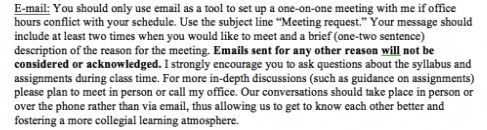
 Pictured above is a screenshot from a course syllabus produced by Dr. Spring-Serenity Duvall, a professor of media and gender studies
at Salem College in North Carolina. During the Spring semster of 2014,
she prohibited students from emailing her unless they were requesting an
appointment to speak with her face-to-face.
Pictured above is a screenshot from a course syllabus produced by Dr. Spring-Serenity Duvall, a professor of media and gender studies
at Salem College in North Carolina. During the Spring semster of 2014,
she prohibited students from emailing her unless they were requesting an
appointment to speak with her face-to-face.Dr. Duvall is no Luddite. She's simply tired of students asking her questions that she already answered in class or in the syllabus, or addressing her in an overly familiar manner. She explains what she changed:
In a fit of self-preservation, I decided: no more. This is where I make my stand! In my senior-level gender and media course, I instituted a no-email policy and (here’s the hard part) stuck to it religiously. I explained to my students that there were a few very solid reasons for this policy:Did it work? Yes!
1. They needed to read and know the syllabus and pay attention in class, rather than use email as a crutch to ask superficial questions. Taking these small yet seemingly impossible steps would make them more aware and engaged in the class.
2. Reading assignment instructions carefully and asking questions about the assignments in class or in office hours would force them to begin working on papers early, thus eliminating last-minute emails about instructions.
3. More of our conversations would take place in person – whether in my office or in class – rather than via email, thus allowing us to get to know each other better and fostering a more collegial atmosphere.
I am happy to report it was an unqualified success. It’s difficult to convey just how wonderful it was for students to stop by office hours more often, to ask questions about assignments in the class periods leading up to due dates, and to have students rise to the expectation that they know the syllabus. Their papers were better, they were more prepared for class time than I’ve ever experienced.
It is also difficult to tally the time I saved by not answering hundreds of brief, inconsequential emails throughout the semester. I can say that the difference in my inbox traffic was noticeable and welcome.

In an interview, Dr. Duvall explains that, like many professors, she suffers from "syllabus creep." That's "where the syllabus just gets longer and longer and you try to account for everything." The longer a syllabus gets, the less likely a student is to read the whole thing.
And course syllabi are getting a lot longer. Slate's Rebecca Shuman offers an explanation of why syllabi are now often 20 or more pages long:
First, the helicopter generation—raised on both suffocating parental pressure and the teach-to-the-test mandates of No Child Left Behind—started coming to college. Everyone needed A’s, and everyone needed to know exactly what needed to be done to get one. When that wasn’t abundantly clear, that made schools vulnerable to lawsuits.
Second, syllabi went from print to online, thus freeing the entire professoriate to capitulate to the aforementioned demands for everything from grading rubrics to the day-by-day breakdown of late assignment policies, without worrying about sacrificing trees or intimidating the class with a first-day handout they could barely lift, much less peruse in a mere 75 minutes.
Third, the skyrocketing percentage of hired-gun adjuncts—as opposed to tenure-track faculty, who have both a modicum of security and a minuscule say in university governance—meant that a substantial number of instructors were taking on courses a matter of weeks (sometimes days) before they began. Thus, they relied heavily on extensive syllabi already in existence.
Subscribe to:
Posts (Atom)
