Welcome to ...

The place where the world comes together in honesty and mirth.
Windmills Tilted, Scared Cows Butchered, Lies Skewered on the Lance of Reality ... or something to that effect.


Friday, January 17, 2014

Grandmother found $50,000 drug stash in her suitcase four years after cruise

A grandmother from Auckland in New Zealand opened her suitcase four years after her last overseas trip to discover $50,000 worth of amphetamine stashed in a side pocket. Gillian Rodgers, 74, dug out her old suitcase on Saturday for a trip and found a tightly-packed bag of white powder, about the size of a packet of cigarettes. "I was clearing it out and I saw this packet of white stuff and I thought, 'wow what's that?' I thought it was something to keep the suitcase dry. It was like a plastic packet, about three inches by two inches, and it was solid, like a cushion."

She had padlocked every pocket on her bag except the one in which the drugs were found, she said. Not knowing what the package was or where it came from, Ms Rodgers took it to the Albany police station to be examined. Police have praised Ms Rodgers and started an investigation. "I couldn't believe it when the policewoman rung me back and said it was [amphetamine]. She said it was $50,000 worth. I didn't for one minute expect it to be drugs even though we were joking about it that it might have been."
Ms Rodgers last used the suitcase four years ago when she made a month-long cruise around Australia with a friend before flying home to Auckland from Sydney. She suspects someone put the drugs into her suitcase pocket and that she was being used as mule to get the package into the country. "I'm baffled. Of course I didn't see anybody put it in there. The only time I was not in my possession of my luggage was when it was on the carousel and when I put it on the X-ray machine. I still can't believe it was drugs. I wonder if they were going to try to retrieve it. I'm sure they would have wanted it back. I wonder if they followed me."

It was only luck she wasn't caught with the drugs at Auckland Airport, she said.  "I could've been picked up at the airport. Or if I'd gone through somewhere like Bali or Thailand with that in my bag ... terrifying." The discovery has raised questions about the screening process at the airports on both sides of the Tasman. Customs spokeswoman Nicky Elliott said the airport protocols were sound. "There is no way to determine where and when the drugs were placed in the suitcase," she said. "This could have happened anytime since she last used the suitcase."

Ziggy

http://media.zenfs.com/en_us/News/ucomics.com/zi140117.gif

Born without fingerprints

Adermatoglyphia jpg 800x600 q85 crop Adermatoglyphia is a very rare genetic condition causing you to be born without fingerprints. In 2011, a small group of researchers pinpointed the genetic mutation behind it. One of them, dermatologist Peter Itin, was drawn to the mystery after he was contacted by a Swiss woman who found trouble at the US border when immigration agents couldn't take her prints… because she doesn't have any. "Adermatoglyphia: The Genetic Disorder Of People Born Without Fingerprints"

Tennis pro collapses after seeing Snoopy on the court

Canadian tennis pro Frank Dancevic collapsed on the court during the Australian Open yesterday when temperatures went above 105 degrees fahrenheit. "I was dizzy from the middle of the first set and then I saw Snoopy and I thought, 'Wow Snoopy, that's weird,'" Dancevic said. He was actually volleying with Woodstock. Dancevic called the conditions "inhumane." 

The Crumbling Ancient Texts That May Hold Life-Saving Cures

Seven hundred years ago, Timbuktu was a dream destination for scholars, traders, and religious men. At the southern edge of the Sahara desert in what is now Mali, travelers met in the bygone metropolis to exchange gold, salt, and ideas. Timbuktu is also know for its large number of historically important manuscripts that have been preserved for centuries in private households.

Bundled in camel skin, goat skin, and calf leather, the manuscripts remaining from Timbuktu's heyday come in an array of sizes. Subjects in the collections, spanning the 13th through 17th century, include the Koran, Sufism, philosophy, law, medicine, astronomy, and more. The books might also contain information about cures for maladies that persist today.

Why Do You Hate The Sound Of Your Own Voice?

'We hate it because it is so foreign,' said Dr. William Cullinan, dean of the College of Health Sciences at Marquette University in Wisconsin. You hear your voice differently than others hear it, because the vibrations that produce sound from your vocal chords travel to your ears through bone vibrations and other internal conduits as well as through the air.

When you hear a recording of your own voice, it isn't that the sound quality is poor - it sounds strange because you are hearing it as others do, as sound transmitted only through the air. It sounds higher in pitch.

Random Photos

Reviving the Tradition of Hand-Painted Signs

Once upon a time, every new business hired a professional artist to design their signs, decorate their windows, and even cover the sides of their buildings. The sign painter was not only an artist, but a designer, typographer, marketing director, editor, and contractor. The remnants of their work from decades ago are pleasing to the eye even today. What happened to sign painters? They were replaced by technology and the do-it-yourself culture. Print shops, then mass-produced sign companies, then home computers all made custom signs faster and cheaper -not necessarily better.
But artisanal sign painters aren't extinct, just rare. Collectors Weekly talked to filmmaker Faythe Levine, who, along with Sam Macon, produced a film and book about sign painters, their craft, and how it's experiencing a sort of modern revival.
Collectors Weekly: Is the revival of hand-painted signs part of this larger trend for artisan, hand-crafted culture?

Levine: Personally, I would say yes. I think that today more people want to know where their eggs come from. People are interested in their jeans being manufactured within the same region as where they buy them. I think hand-painted signs are part of this larger change, but I also think that there’s another audience that’s into design-related things. I think when people like designers and typographers have access to the history of hand paint, they just eat it up.
They talk about the history of hand-painted signs, the craftsmanship involved, and the different kinds of artisanal signage in the interview at Collectors Weekly. 

Hotels With Exciting Past Lives

In their previous lives, these hotels were banks, brothels, and more. Like the Liberty Hotel in Boston (photo above). Opened in 1851, the building was originally the Charles Street Jail, home to several famous inmates, including Malcolm X and Sacco and Vanzetti. The jail officially closed in 1990 and was reopened in 2007 as the trendy Liberty Hotel.

1913: The Schilovski Gyrocar


This car isn't moving. It has two only wheels. You can enter and exit easily without it falling over. It's the Schilovski Gyrocar--an incredible car design that was never mass-produced.
Count Peter P. Schilovski of Russia was fascinated with gyroscopes. He designed one that he believed would keep a car upright. He took his idea to the Wolseley Tool and Motorcar Company in the UK, where engineers there built it with a 188 cubic inch, 4-cylinder engine and transmission brakes.


It worked. In the spring of 1914, Schilovski and the British engineers took it out on public roads. People jumped on and off without disturbing the balance of the car at all. It seemed to have a bright future.
But something else happened in 1914. Schilovski returned to Russia to help in the war effort. The Wolseley engineers likewise turned their attention toward the war. They buried the gyroscopic car underground, excavating it in 1938.

They partially restored the car and placed it in a museum. Then, in 1948, they inexplicably broke it up for scrap metal.

The Gyrocar wasn't Schilovski's only use of the gyroscope. In the early 1920s, he also designed a gyroscopically-balanced monorail. His project laid 7 miles of track for this purpose before it was shut down.

Can you run a car on what comes out of your ass?

Jason Torchinsky of Jalopnik says yes. He takes a look at the two products produced by asses: flatus and feces, and determines the harvest-able energy in each. The good news is that butt fracking is a group building exercise: "It would take you months and months to fill an 8 gasoline gallon equivalent (GGE) tank like the one in the Honda Civic CNG. Oh, and remember, of that 100 ml fart, only 30% of that (at best) is methane — so to do this right, you'd want to pool a whole community of farts. It's really the only way."
Will Jason's article usher in a resurgence in gas bag cars?

Daily Comic Relief

http://media.zenfs.com/en_us/News/ucomics.com/dp140117.gif

"Able to lift more than 850 times their own weight"

"Extinct" shark found

80-Year-Old Vintage Snake Venom Can Still Kill


In 2002, Bryan Fry, the Venom Doctor, was going through the belongings of Straun Sutherland, the founder of the Australian Venom Research Unit (AVRU), who had recently died. He found a stockpile of snake venom that had been collected by "snake men" who captured snakes for research -as much as 80 years earlier! 
“It was like opening a time capsule,” he says. “It gave me goosebumps. These were very personal samples to us. To be working with the milkings from that exact snake… these weren’t just letters on the side of the tube. They had historical and emotional value.”

They also had something that Fry did not expect—toxicity. Even though some of them were 80 years old, they could still kill.

It’s not like the samples had been carefully prepared. They had been crudely dried, kept in glass tubes with rubber stoppers, and stored at room temperature rather than in a freezer.

Still, Fry’s team found that they contained the same cocktail of proteins and had the same toxic effects as venom that had been recently collected from modern snakes of the same species. Death adder venom from the 1960s could still stop neurons from communicating with muscles. Taipan and tiger snake venom from the 1950s could still clot blood. The only vial that contained ineffective venom was also the only one where the rubber seal had eroded. Otherwise, the toxins were in great shape.
The venom may be old, but it will be used as a valuable research tool. Some of the snakes the venom came from are extinct. And using existing venom supplies is much safer than collecting it from the wild. Read more about the snake men of Australia and the work they did at Not Exactly Rocket Science. 

Magnetic Termite Mounds

In Litchfield National Park near Batchelor, Northern Territory, Australia, you can find two unusual species of termites. Amitermes meridionalis and Amitermes laurensis colonies build their mounds in elongated wedge-shaped forms. Usually these mounds are aligned along a magnetic north-south axis.
Why? To find out, one researcher nudged a few with his off-road vehicle. This tilted the mound out of alignment. The interior temperature of mound rose significantly.
So by building their mounds on a north-south axis, the termites increased the amount of surface area directly exposed to the sunlight as the sun travels from east to west across the sky and thus increased the rate of heat loss. Aligning their construction in this fashion keeps their mounds cooler.

Primates: Now with only half the calories

New research shows that humans and other primates burn 50% fewer calories each day than other mammals.
The study, published January 13 in the Proceedings of the National Academy of Sciences, suggests that these remarkably slow metabolisms explain why humans and other primates grow up so slowly and live such long lives. The study also reports that primates in zoos expend as much energy as those in the wild, suggesting that physical activity may have less of an impact on daily energy expenditure than is often thought. Primates: Now with only half the calories
Male silverback Gorilla in SF zoo
Most mammals, like the family dog or pet hamster, live a fast-paced life, reaching adulthood in a matter of months, reproducing prodigiously (if we let them), and dying in their teens if not well before. By comparison, humans and our primate relatives (apes, monkeys, tarsiers, lorises, and lemurs) have long childhoods, reproduce infrequently, and live exceptionally long lives. Primates' slow pace of life has long puzzled biologists because the mechanisms underlying it were unknown. An international team of scientists working with primates in zoos, sanctuaries, and in the wild examined daily energy expenditure in 17 primate species, from gorillas to mouse lemurs, to test whether primates' slow pace of life results from a slow metabolism.

Using a safe and non-invasive technique known as "doubly labeled water," which tracks the body's production of carbon dioxide, the researchers measured the number of calories that primates burned over a 10 day period. Combining these measurements with similar data from other studies, the team compared daily energy expenditure among primates to that of other mammals.

 "The results were a real surprise," said Herman Pontzer, an anthropologist at Hunter College in New York and the lead author of the study. "Humans, chimpanzees, baboons, and other primates expend only half the calories we'd expect for a mammal. To put that in perspective, a human – even someone with a very physically active lifestyle – would need to run a marathon each day just to approach the average daily energy expenditure of a mammal their size."

This dramatic reduction in metabolic rate, previously unknown for primates, accounts for their slow pace of life. All organisms need energy to grow and reproduce, and energy expenditure can also contribute to aging. The slow rates of growth, reproduction, and aging among primates match their slow rate of energy expenditure, indicating that evolution has acted on metabolic rate to shape primates' distinctly slow lives.

"The environmental conditions favoring reduced energy expenditures may hold a key to understanding why primates, including humans, evolved this slower pace of life," said David Raichlen, an anthropologist at the University of Arizona and a coauthor of the study. Perhaps just as surprising, the team's measurements show that primates in captivity expend as many calories each day as their wild counterparts. These results speak to the health and well-being of primates in world-class zoos and sanctuaries, and they also suggest that physical activity may contribute less to total energy expenditure than is often thought.

"The completion of this non-invasive study of primate metabolism in zoos and sanctuaries demonstrates the depth of research potential for these settings. It also sheds light on the fact that zoo-housed primates are relatively active, with the same daily energy expenditures as wild primates," said coauthor Steve Ross, Director of the Lester E. Fisher Center for the Study and Conservation of Apes at Chicago's Lincoln Park Zoo. "Dynamic accredited zoo and sanctuary environments represent an alternative to traditional laboratory-based investigations and emphasize the importance of studying animals in more naturalistic conditions."

Results from this study hold intriguing implications for understanding health and longevity in humans. Linking the rate of growth, reproduction, and aging to daily energy expenditure may shed light on the processes by which our bodies develop and age. And unraveling the surprisingly complex relationship between physical activity and daily energy expenditure may improve our understanding of obesity and other metabolic diseases.

More detailed study of energy expenditure, activity, and aging among humans and apes is already underway. "Humans live longer than other apes, and tend to carry more body fat," said Pontzer. "Understanding how human metabolism compares to our closest relatives will help us understand how our bodies evolved, and how to keep them healthy."

Animal Pictures

natures-paintbox:

Musk Ox

Thursday, January 16, 2014

The Daily Drift

Captain Obvious says   ...

Carolina Naturally is read in 194 countries around the world daily.
 
Dragon  ... !
Today is - Appreciate A Dragon Day
 

Don't forget to visit our sister blog: It Is What It Is

Some of our readers today have been in:
The Americas
Saint John's, Ottawa, Byward Market, Templeton, Britannia, Pikangikum, Victoria, Sioux Lookout, Winnipeg, Toronto, Montreal, Thunder Bay, Mississauga, Canada
The Bottom, Sint Eustatius and Saba
San Juan, Puerto Rico
Kingston, Jamaica
Missoula, Picayune, Tavares, Wishon, Canby, Ruidoso, United States
Orizaba, Mexico
Europe
Klaipeda, Lithuania
Korsor, Denmark
Madrid, Alicante, Barcelona, Spain
Pistoia, Rome, Lecce, Italy
Moscow, Kaliningrad, Novosibirsk, Krasnodar, Russia
Zhovti Vody, Kiev, Ukraine
Lucenec, Slovakia
Rouen, Paris, Lille, cerny, France
London, Woking, England
Rothe Erde, Darmstadt, Kolen, Eschborn, Berlin, Germany
Dublin, Swords, Ireland
Covilha, Lisbon, Funchal, Portugal
Riga, Latvia
Sarajevo, Bosnia and Herzegovina
Wilcza, Olsztyn, Warsaw, Krakow, Gdansk, Wroclaw, Gliwice, Poland
Nis, Veternik, Novi Sad, Serbia
Groningen, Netherlands
Sofia, Bulgaria
Bergen, Norway
Ankara, Turkey
Zurich, Lausanne, Switzerland
Zagreb, Croatia
Amsterdam, Netherlands
Asia 
Colombo, Sri Lanka
Bhopal, Cochin, New Delhi, Kolkata, Jodhpur, Coimbatore, Bangalore, Bhubaneshwar, India
Tehran, Iran
Bangkok, Nakon Pathom, Thailand
Dhaka, Chittagong, Bangladesh
Kathmandu, Nepal
Karachi, Islamabad, Pakistan
Kuala Lumpur, Kota Kinabalu, Puchong, Ipoh, Sekudai, Johor Bahru, Malaysia
Riyadh, Al Bukayriyah, Abha, Saudi Arabia
Batam, Jakarta, Balaipungut, Indonesia
Doha, Qatar
Guangzhou, China
Taipei, Taiwan
Hanoi, Vietnam
Africa 
Johannesburg, South Africa
Rabat, Morocco
Accra, Nsawam, Ghana
Tripoli, Tobruk, Libya
Pacific
Makati, Manila, Philippines
Sunshine, Homebush, Australia

Today in History

1547 Ivan IV crowns himself the new Czar of Russia in Assumption Cathedral in Moscow.
1786 The Council of Virginia guarantees religious freedom.
1847 John C. Fremont, the famed "Pathfinder" of Western exploration, is appointed governor of California.
1865 General William T. Sherman begins a march through the Carolinas.
1900 The U.S. Senate recognizes the Anglo-German Treaty of 1899 by which the UK renounced its rights to the Samoan Islands.
1909 One of Ernest Shackleton's polar exploration teams reaches the Magnetic South Pole.
1914 Maxim Gorky is authorized to return to Russia after an eight year exile for political dissidence.
1920 The League of Nations holds its first meeting in Paris.
1920 Allies lift the blockade on trade with Russia.
1939 Franklin D. Roosevelt asks for an extension of the Social Security Act to include more women and children.
1940 Hitler cancels an attack in the West due to bad weather and the capture of German attack plans in Belgium.
1942 Japan's advance into Burma begins.
1944 Eisenhower assumes supreme command of the Allied Expeditionary Force in Europe.
1945 The U.S. First and Third armies link up at Houffalize, effectively ending the Battle of the Bulge.
1956 The Egyptian government makes Islam the state religion.
1965 Eighteen are arrested in Mississippi for the murder of three civil rights workers.
1975 The Irish Republican Army calls an end to a 25-day cease fire in Belfast.
1979 The Shah leaves Iran.
1991 The Persian Gulf War begins. The massive U.S.-led offensive against Iraq — Operation Desert Storm — ended on February 28, 1991, when President George Bush declared a cease-fire, and Iraq pledged to honor future coalition and U.N. peace terms.

Non Sequitur

http://media.zenfs.com/en_us/News/ucomics.com/nq140116.gif

The Hundred Acre Wood could use a therapist

Or, alternatively, society could stand to think a little bit more about whether, in our efforts to understand mental illness and get help for people who need it, we're leaning a bit too far towards medicalizing difference. That's the point a group of pediatric neurologists were trying to get across back in 2000, when they published a commentary in the Journal of the Canadian Medical Association concerning the possible DSM diagnoses of Winnie-the-Pooh and his animal friends.
We begin with Pooh. This unfortunate bear embodies the concept of comorbidity.

Most striking is his Attention Deficit Hyperactivity Disorder (ADHD), inattentive subtype. As clinicians, we had some debate about whether Pooh might also demonstrate significant impulsivity, as witnessed, for example, by his poorly thought out attempt to get honey by disguising himself as a rain cloud. We concluded, however, that this reflected more on his comorbid cognitive impairment, further aggravated by an obsessive fixation on honey. The latter, of course, has also contributed to his significant obesity. Pooh's perseveration on food and his repetitive counting behaviours raise the diagnostic possibility of Obsessive Compulsive Disorder (OCD). Given his coexisting ADHD and OCD, we question whether Pooh may over time present with Tourette's syndrome. Pooh is also clearly described as having Very Little Brain. We could not confidently diagnose microcephaly, however, as we do not know whether standards exist for the head circumference of the brown bear. The cause of Pooh's poor brain growth may be found in the stories themselves. Early on we see Pooh being dragged downstairs bump, bump, bump, on the back of his head. Could his later cognitive struggles be the result of a type of Shaken Bear Syndrome?
While the letters replying to this article seem to be behind a paywall, you can read the authors responses to several of the letters, including one where they explain that the goal was poke fun at the modern tendency to see pathology everywhere.
Contrast this with an article written about in 2010 that attempted to diagnose the mental problems of Darth Vader, Lord of the Sith, a project that had the stated goal of removing some of the stigma from mental illness. Looking solely at the authors' goals, I think the Pooh Bear paper succeeds where the Vader paper fails. After all, Vader pretty clearly has some problems, including a tendency towards genocide. It might be fun to give him an armchair diagnosis, but I don't see how that helps real people with mental illness seem less scary or their illnesses less taboo. Pooh Bear, on the other hand, for all his supposed problems, lives a pretty happy existence. As does Tigger and, arguably, most of the residents of the Hundred Acre Wood, with the exception of, probably, Rabbit (who really could use someone to talk to, I think) and Eeyore (but he likes it that way). Part of what distinguishes difference from mental illness is the question of whether traits and behaviors are getting in the way of your ability to live a healthy, happy life. It seems to me that Pooh has a pretty good lifestyle, Shaken Bear Syndrome notwithstanding.
Also, there are GIFs


Did you know ...

That Florida will soon surpass new york in population

About Chris Christine's other lingering controversy

About the real spending problem: corporate welfare

That your personal data is way too easy to get from your phone number

About repugican hate: The Louie Gohmert edition

by: Katie Singh

This week marked the 50th anniversary of LBJ's War on Poverty, which introduced major initiatives designed to help lift Americans out of poverty. President Obama marked the occasion by recommitting himself to fighting poverty, declaring that "our work is far from over."
-
Texas Congressman Louie Gohmert (r-Tyler), on the other hand, used the occasion to reaffirm how much he hates poor people, especially single mothers.
-
In a speech on the House floor Wednesday night, Gohmert explained that the War on Poverty inspired him to run for Congress. But it wasn't because he wanted to fight poverty, it was because he hated welfare. Gohmert said that as a state district judge, he realized that "the government will send you a check for every baby you have out of wedlock" and he decided he had to stop it.
-
If Gohmert were paying attention, he'd realize that 36% of children in his district live in single parent families, and social safety net programs have been proven to be highly effective at reducing poverty. But his commitment to crazy outweighs facts, and so he's dedicated his congressional career to stopping single mothers from receiving welfare.

NSA official: mass spying has foiled one (or fewer) plots in its whole history

During an NPR interview, the NSA's outgoing deputy director John C Inglis -- the top civilian official in the NSA hierarchy -- admitted that the NSA's mass surveillance program had foiled a total of one terrorist plot (an attempt to wire some money to al-Shabaab in Somalia) in its entire history. But he doesn't want to get rid of his agency's program of spying on everything every American does, because it's an "insurance policy" in case someone tries the kind of terrorist attack that it might foil.
While Inglis conceded in his NPR interview that at most one terrorist attack might have been foiled by NSA’s bulk collection of all American phone data – a case in San Diego that involved a money transfer from four men to al-Shabaab in Somalia – he described it as an “insurance policy” against future acts of terrorism.
“I'm not going to give that insurance policy up, because it's a necessary component to cover a seam that I can't otherwise cover,” Inglis said.

Patent mess goes to the Supreme Court

Two more high-profile patent cases are headed to the US Supreme Court, which has already agreed to hear a patent case this year. The patent system is in chaos, with ever-more-trivial patents being granted, and ever-broader theories of patent infringement being created by the Federal Circuit, the court that oversees the patent system.
A Supreme Court ruling that restored some sanity to patents would be very welcome indeed -- but if they went the other way, it would be dreadful. The only solution at that point would be for Congress -- whose campaigns depend on revenue from patent abusers -- to pass a new law (don't hold your breath).
When the case was appealed to the US Court of Appeals for the Federal Circuit, though, a sharply divided "en banc" panel made a surprising and broad ruling. In a 6-5 ruling, the top patent court found that Akamai didn't have to show that Limelight's customer actually infringed the patent directly; it merely had to show that Limelight "induced" its customer to infringe. Limelight would have to stand trial, again.
That led to Limelight appealing to the Supreme Court. It also raised alarm bells among other patent defendants. The issue of "joint infringement" comes up frequently in tech and Internet cases, where a user or customer performs some steps of the patent. (The recent TQP v. Newegg trial is an example; Newegg was accused of executing some steps of the patent, while its customers performed other steps.)
"The Federal Circuit has created a new basis for patent-infringement liability that conflicts with this Court’s precedents and the Patent Act," wrote Limelight lawyers in their petition.
"Imposing on a business the additional obligation to speculate correctly about potential future uses by a third-party buyer or user is unreasonable and unfair," wrote lawyers representing HTC and two other high-tech companies in an amicus brief supporting Limelight.

Educated black men remembered as ‘whiter’


Ancients Used Egg Shells as Lucky Charms

One of the eggshells found under the floor at Sardis was amazingly still intact when excavators lifted the lid on the container last summer.

Toxic Wine Might Have Killed Alexander the Great

A poisonous plant fermented into wine may have killed the Macedonian leader in 323 B.C.

11 Desserts That Changed the World

Believe it or not, there have been many international incidents, alliances, and cultural shifts that revolved around cakes, pies, and other assorted sweet treats. Consider the case of Eamon de Valera, a caper that became a fiction trope.
In 1916, Eamon de Valera found himself incarcerated because of his role in the 1916 Easter Rising, an uprising in which people of Ireland tried to assert their independence from British rule. De Valera managed to make a copy of the hail chaplain's master key by stealing it and making a wax impression using melted-down church candles. He sent the impression to his friends on the outside, who fashioned a metal key and sent it to him, embedded in a cake. Unfortunately, the key didn't function. They tried again, however, and de Valera's second attempt at escape was successful.
How did that cake change the world? Eamon de Valera went on to found the political party Fianna Fáil, and over a 50-year political career served as the leader of Ireland under several titles as the country gained its independence. The other stories on this list at mental_floss will make you say, "Oh yeah, I remember that!" Dessert turns out to be pretty important in the grand scheme of things. 

Ziggy

http://media.zenfs.com/en_us/News/ucomics.com/zi140116.gif

Man charged over 'ritualistic chess killing' in Dublin

An Italian national has been charged with murder in Dublin after the ritualistic style killing of a man in a murder sparked by a row over a chess match.
Tom O'Gorman, 39, was stabbed to death at his home in the Irish capital in the early hours of on Sunday morning. The Garda Siochana says there are aspects of the murder that are too gruesome to reveal.
It is understood that the victim had his throat cut and other parts of his body were attacked with a knife. The fatal stabbing happened just before 2am in the Castleknock district of west Dublin. 34-year-old Saverio Bellante from Palermo in Sicily was detained at the scene.
The gardai ruled out alcohol as a factor in the killing and said it may have been triggered after a chess piece was moved on a board inside the property. The victim worked as a researcher for the Iona Institute, a Dublin-based traditional Catholic campaign group that promotes marriage and religion.

Polish priest condemns sacrilegious toilet paper

A priest has publicly accused the manufacturers of a brand of toilet paper of sacrilege, claiming that the lamb printed on their product is ‘the Lamb of God’ and therefore an attack on the church.

Father Stanisław Szyszka gave a sermon in Zakopane, accusing the makers of the Lambi brand of loo roll of insulting Catholics. While many would see the lamb as a symbol of softness and comfort, the priest claimed the image was a deliberate anti-clerical attack.
Father Szyszka  told his congregation that the image on the toilet paper was just like the figures of lambs that Catholics have in their homes at Easter. He said: “It’s insulting to Catholics that the image so close to us and identified with the Lord Jesus is used for toilet paper.

“We Catholics cannot reconcile to the image of the Lamb of God on things like toilet paper.” A spokesperson for Metsä Tissue, the Finnish firm which produces Lambi, said the product had been sold in 30 countries for 20 years, and that nobody had previously seen anything untoward about the image.

Dispute over breaking wind led to assault with frying pans

An argument over flatulence stoked by drugs and alcohol led to an assault with frying pans in Duryea, Pennsylvania on Saturday night. Police responded to a report of domestic violence and found an elderly woman trying to break up a fight between two men in the kitchen of a house.

The two men, ages 23 and 30, whose names were not released, said they got into a fight after arguing over "passing gas and bowel movements," police said. A 23-year-old smacked the other man across the face with a hot frying pan, whacked him with another frying pan and threw a small television at him.
The younger man, who is originally from Texas, had been staying at the home of the 30-year-old man. During the fracas, the younger man suffered hand cuts while the older man had cuts to his ear and head. Both were taken to a hospital for treatment of their injuries. Each man was charged with simple assault and domestic violence offenses.

The older man also faces drug violations after police discovered drug paraphernalia allegedly belonging to him, and both men allegedly admitted to using drugs and drinking earlier in the night. The younger man said the older man was using the drugs heroin and MDMA, also known as "Molly," and pointed police to a baggie containing suspected drugs, police said.

Motorist furious after being given a ticket because her dog wasn't wearing a seatbelt

A motorist in Darwin, Australia is outraged after she was fined $184 because her dog who was sitting in the passenger seat of her car was not wearing a seatbelt. Police have since admitted it was not actually against the law. Millner resident Mel Bugg said she was pulled over at a breath-test station in the suburb. She was issued with an on-the-spot fine for having her maltese-poodle cross, Hendrix, not properly restrained in her car.

Ms Bugg said that when she was pulled over Hendrix jumped on to her lap from the front passenger seat as she unwound her window to talk to the officer. She said he asked her if there was a reason why she had her dog unrestrained in the vehicle. She replied she was not aware the law required dogs to be restrained inside cars. "He said there were TV commercials telling people it was law, but I told him that I don't watch (free to air) TV because I hate ads," Ms Bugg said.
"It didn't get me anywhere because he still hit me with the $144 fine plus a $40 victim levy. I was furious. Hendrix is my baby - he weighs probably 2kg and I take him everywhere with me. I've lived in the Territory for 17 years and I have never heard of this. None of my friends were even aware of this." But Northern Territory Police spokeswoman Rebbeca Forrest said it was once an offense under the Animal Welfare Act - but had since been repealed.

"I understand that the infringement team identified that this offense was repealed in February 2013 and as such, the infringement is invalid," she said. "The process to withdraw the infringement commenced earlier this week." Territory motorists are still prohibited from transporting an unrestrained dog on the back of a pick-up. Ms Bugg said she had since gone and purchased one-year-old Hendrix a seatbelt from a pet store. "I've gone and bought him one but it was so hard as he is tiny and none of them fit him properly," she said. "I've had to buy the smallest one they had."

Samoan youth fined £2,600, 30 boxes of tinned fish and two cows for ridiculing prime minister

The family of a youth who made a video ridiculing Samoa's prime minister, Tuilaepa Sa’ilele Malielegaoi, was ordered to pay a fine of 10,000 Samoan tālā (£2,600, US$4,300), 30 boxes of tinned fish and two cows.
The decision was made by the Sili Village Council on Thursday. Failure to provide the items that day would have resulted in the family being evicted from the village. “The family paid up the monetary fine and provided everything else that the Ali’i ma Faipule asked for,” a source said.

As the result, he said “the family was forgiven” and told to make sure the youth does not “misbehave again.” The source said all five church ministers in Sili received part of the money and food from the family’s punishment in line with traditional protocol.
The decision by Sili followed a traditional apology by the Ali’i ma Faipule - the high chiefs and orators - to Prime Minister Tuilaepa at his residence at Ululoloa last Saturday. Asked for a comment, Tuilaepa said he accepted the apology and had forgiven the youth, saying it showed Samoan culture was in a healthy state.

Random Photos

Scientists discover giant trench under Antarctic Ice


A massive ancient subglacial trough – deeper than the Grand Canyon – has been discovered […]

Fadiouth

A Unique Island Made Almost Entirely Of Clam Shells

Joal-Fadiouth is a small fishing village located at the far end of Petite Côte - a stretch of coast in Senegal. Joal is situated on the mainland and Fadiouth is an island just off the coast. A narrow, 400-meter wooden bridge links the two areas. Fadiouth is special - it is almost entirely covered with clam shells.

For centuries, the inhabitants of Fadiouth have been harvesting molluscs. They scoop out the meat and use the shells to construct almost everything, even the island itself. The millions of seashells accumulated over the years have been held strong by the roots of mangroves, reeds and giant baobabs.

Astronomical News

Tracking weather conditions on other planets is no easy task, but if we start playing close attention to dune formation, we could develop a means to at least know which way the wind is blowing.
For years, we've believed that around 2 billion planets in the galaxy are able to support alien life. But what if we were wrong? Anthony discusses how new knowledge of the 'Goldilocks Zone' could mean life on up to 60 billion planets.

Daily Comic Relief

http://media.zenfs.com/en_us/News/ucomics.com/dp140116.gif

Porcupines in box sparked bomb scare

A cardboard box abandoned near the house of a politician in Depok, West Java, Indonesia, sparked a bomb scare on Wednesday but police who rushed to the scene found the suspicious package contained only two porcupines.

An eyewitness, Samsuri, who said he was the first to notice the package lying in front of his house at 6:10am on Wednesday, alerted neighborhood security guards, who then summoned the police. The police dispatched the bomb squad from the nearby Kelapa Dua Mobile Brigade (Brimob) headquarters to the scene.
A notice attached to the box read, “Sorry to trouble you but could you please take the best care of what is inside this box because the owner already has too many of them. Thank you.” The writer gave his name as Alex Tutuarima. An X-ray examination showed the package contained no explosives.

Wary onlookers, with the recent killing of six terror suspects in nearby Tangerang still fresh in their minds, sighed in relief when a police officer announced the contents of the package. “When we opened it, we found two white porcupines,” said Sec. Insp. Paulus Silabok who led the bomb squad team. He said the police would seek the person who placed the box on the road.

Evolving Sound

Laci is joined by Catie Wayne from Animalist News to report on how evolution is happening in some species RIGHT NOW!
Most dog owners can sense the difference between Fido's yip of joy and howl of discontent.

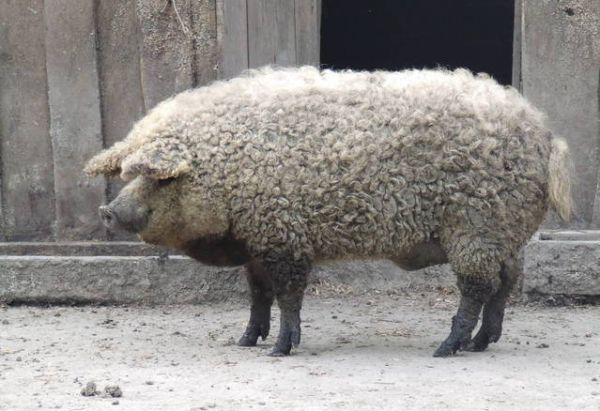
The Mangalitsa is a Sheep-Pig

The Mangalitsa is a rare breed of pig from Hungary. It’s the result of a Nineteenth Century experiment in the Austro-Hungarian Empire to breed a pig with very high fat content in order to produce large amounts of lard.
The breed faded in popularity and almost died out. The pigs take a full year to grow to 350 pounds—twice the time of more popular breeds. But in the 1990s, interest in the breed revived. There are now about 60,000 Mangalitsa pigs around the world, including some in the U.S.
The deep red meat consists of 50% fat, giving it a buttery flavor that is treasured by gourmands around the world. The lard is also prized by elite chefs who prefer to cook with it.